

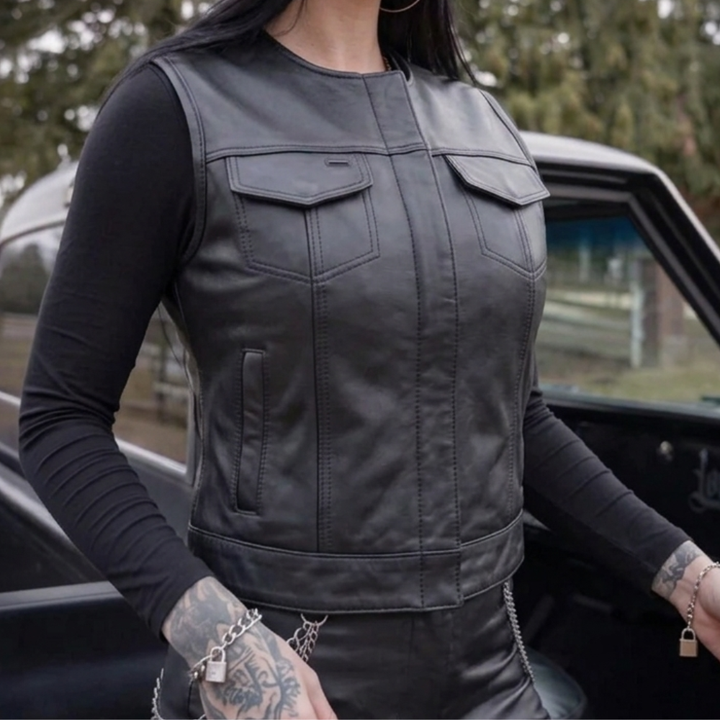


Outfitting a whole club is a different job from buying one vest. You are matching hide across a run, planning a size break for people who will not send you their measurements, deciding where the patches go before a single stitch is sewn, and doing it on a timeline that ends at a specific ride. This is the ordering guide we walk clubs through on the phone, written down.
How do you measure for a leather motorcycle vest?
One measurement does almost all the work, and most clubs get it wrong by measuring the wrong person in the wrong clothes.
- Wear what you ride in. Not a bare chest, not a dress shirt. If your members ride in a hoodie or a leather jacket eight months a year, they measure over that. This is the single biggest cause of vests that come back.
- Chest, at the fullest point. Run the tape under the armpits, straight across the shoulder blades at the back, level all the way around. Arms down at your sides, breathe normally, do not puff up.
- Keep the tape snug, not tight. You should be able to slip a finger under it and no more.
- Write down the number in inches. That number, not a t-shirt size, is what you send us.
- Add a back length if anyone is over six foot two. Measure from the bony bump at the base of the neck straight down to where they want the vest to end, usually at the belt line.
Send us the chest number and we will tell you the size. On our numeric-sized vests the size is the chest measurement, so a 44 inch chest takes a 44. On our letter-sized vests we map that number to the letter for you.
What vest size do I need for a 48 inch chest?
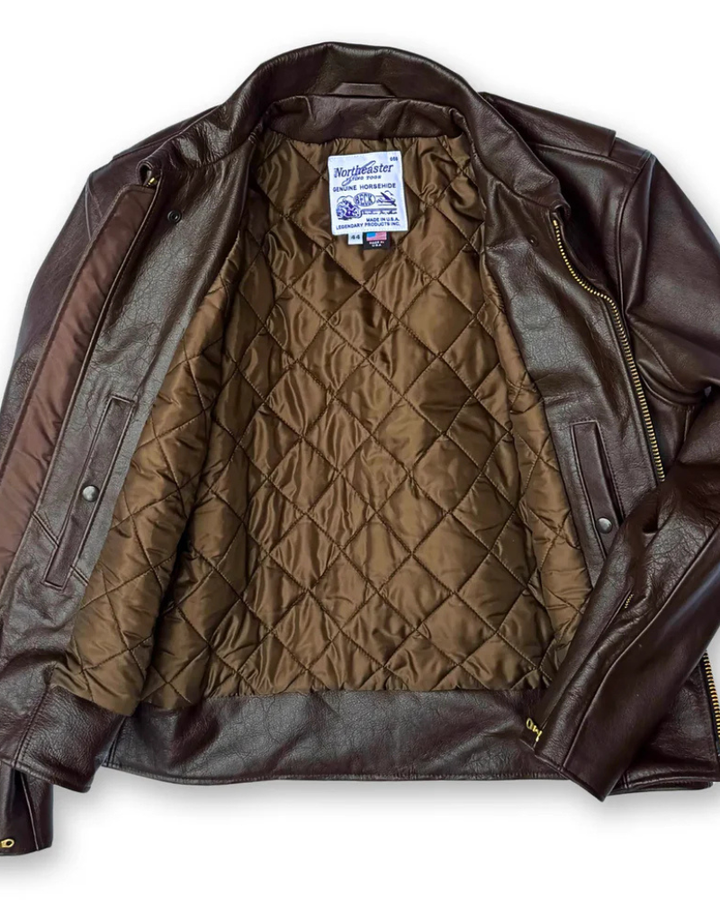
On a numeric-sized vest, size 48. That is the whole answer, and it is why we like numeric sizing for club orders. Our BECK 588 horsehide vest runs 36 through 56 in even sizes and a 48 inch chest takes the 48.
On a letter-sized vest, a 48 inch chest is generally a 2XL. Roughly, our letter sizing maps like this: S is 36 to 38, M is 40, L is 42 to 44, XL is 46, 2XL is 48 to 50, 3XL is 52, 4XL is 54, 5XL is 56.
The catch nobody mentions: if you measured over a bare t-shirt but you actually ride in a hoodie, 48 inches is not your number. Measure again over the hoodie. That is likely to move you from 2XL to 3XL, and 3XL is the vest you will actually wear.
Should a motorcycle vest fit tight or loose?
Snug, and closer to tight than to loose. A vest that is loose flaps at highway speed, which is genuinely irritating over a long day, and it lets a large back patch swing and pull at its own stitching. A vest that is too tight gaps at the snaps and stops you reaching the bars comfortably.
The target: the vest closes fully at every snap with a little effort, and when it is closed you can still get a flat hand between the leather and your chest. Leather relaxes roughly half an inch to an inch across the chest in the first month of wear, so a vest that is slightly firm on day one is correct on day thirty.
How tight should a leather motorcycle vest be across the chest?
Here are the three tests we give people over the phone.
- The snap line test. With the vest closed, the front placket should run in a straight vertical line. If the gaps between snaps pull open into little horizontal V shapes, it is one size too small.
- The flat hand test. You should be able to slide a flat hand, not a fist, between the closed vest and your chest.
- The reach test. Sit in a riding position and reach forward for imaginary bars. The vest should not pull across your shoulder blades or ride up at the back hem.
Should a motorcycle vest be sized over a jacket?
Only if you will genuinely wear it over the jacket most of the time, and that is a real decision, not an obvious one.
A leather jacket adds roughly 2 to 4 inches to your chest measurement, which is one to two vest sizes. Size for the jacket and the vest hangs like a tent in July. Size for a t-shirt and the vest will not close over the jacket in November.
Two ways out. Buy a vest with functional side lacing, which gives you two to four inches of adjustment in one garment and covers both cases. Or, if the club is going to wear cuts over jackets at every event, size the whole run over the jacket and say so on the sizing sheet so everyone measures the same way. What you must not do is let half the club measure one way and half the other.
Do leather motorcycle vests come in tall lengths?
Yes, and this is a question we get constantly because most sellers do not offer it. Our Legendary Men's Leather Club Vest is built in a Long option that adds 2 inches to the body length, currently offered in M, L, XL, 2XL and 3XL alongside the Regular lengths.
Who needs it: riders over about six foot two, riders with a long torso relative to their height, and anyone whose vest currently rides up above the belt when they reach for the bars. A regular length vest on a long torso also crowds a full back patch against the hem, which is a real problem for a three-piece set.
Are motorcycle vests available in big and tall sizes?
Yes. Our letter-sized vests run S through 5XL, which covers roughly a 36 to 56 inch chest, and the numeric-sized models such as the BECK 588 run 36 through 56. Combine that with the Long 2 inch body option on the club vest and you can cover big and tall in the same order as everyone else.
What is the best leather vest for wearing over a hoodie?
A side-laced vest, one size up from your t-shirt size, collarless.
All three parts matter. The lacing gives you the two to four inches you need for the hoodie without leaving the vest baggy when the hoodie comes off. The extra size covers the bulk. Collarless matters more than people expect, because a hood plus a vest collar bunches at the back of your neck and pushes the vest forward off your shoulders. The Legendary club vest with lacing is the model built for exactly this, and it is the one we point hoodie riders at.
Where to put patches on a motorcycle vest: a placement guide
Get this wrong and it is expensive, because patches are sewn once. Measure and pin everything before a needle goes near the leather.
The back: the three-piece set
A traditional club set is three pieces: a top rocker carrying the club name, a center patch carrying the logo, and a bottom rocker carrying the territory. Standard placement:
- Top rocker roughly 1 to 2 inches below the collar seam, centered on the spine.
- Center patch centered under it with about 1/2 to 1 inch of gap.
- Bottom rocker the same gap below that, and it must clear the bottom hem by at least an inch so it does not fold over the edge when you sit.
- A small MC cube, typically 3 by 3 inches, sits to the right of the center patch at its vertical midpoint.
Find the spine line first by folding the vest in half at the back and creasing lightly, then pin from that line outward. A set that is a half inch off center is visible from thirty feet.
The front
- Wearer's left chest: club name tab, rank or officer patch, or the 1 percent diamond where that applies.
- Wearer's right chest: name tag or road name.
- Keep front patches above the pocket line and off the shoulder seam. Leather flexes hardest right where the shoulder meets the chest, and a patch sewn across that line will pull its own stitching loose within a season.
- Memorial and support patches usually go lower on the front, or inside the vest.
Protocol you should know
If you are not in a club, do not wear a three-piece back set, an MC cube, a 1 percent diamond, or anything that reads as territory. That is not a legal rule, it is an etiquette that clubs take seriously, and independent riders avoid trouble by wearing a single center back patch instead of a full set. If you are unsure what is appropriate in your area, ask a local club before you sew, not after.
How to attach them
Sew, do not glue, and do not iron. Iron-on adhesive fails on leather and can scorch the finish. A leather shop will sew a full back set for roughly $30 to $60 depending on size and count. If you are doing it yourself, use a heavy-duty needle, bonded polyester thread, and go around each patch twice at 8 to 10 stitches per inch. Pin every patch and try the vest on before you sew anything.
Construction and Quality Standards
Construction quality decides whether the run lasts five rides or five years. Three things carry almost all of it.
Hide weight. A club vest wants 2.5 to 3.5 ounces per square foot, roughly 1.0 to 1.4 mm. Under that and a full back patch drags the shoulders out of shape. Over 4.5 ounces and it is stiff enough to fight you at the bars for the first two months.
Thread and stitch density. Bonded nylon or bonded polyester, at 6 to 8 stitches per inch on structural seams. Cotton thread is the single most common failure point on cheap vests, because it abrades against its own punch holes until it saws through. Armholes bound and double stitched, bar tacks at every pocket corner.
Reinforcement under hardware. Every snap and D-ring should sit on a second layer of leather. Push a thumb behind one and feel for it. A snap set through a single thickness eventually tears a crescent out of the panel, and that is not repairable without replacing the panel.
The back panel. For a club order this is non-negotiable: one piece, no center seam. A seam down the spine makes a three-piece set sit crooked no matter how carefully it is pinned.
Bulk Ordering Process and Minimums
We work with minimums starting at 10 vests and will handle smaller runs for a club that is just forming. Per-unit pricing improves meaningfully at 20 or more.
Send a size break, not a headcount. We want how many of each size, taken from chest measurements rather than guesses. Most clubs land somewhere around 20 percent S and M, 50 percent L and XL, 25 percent 2XL, and the balance 3XL and up, but your club is your club, and the sizing sheet beats the average every time.
Typical structure is a deposit to lock production and the balance before shipping. Sizing and design approval takes a week or two before anything is cut, and it is worth taking that time, because changes after cutting cost weeks.
Timeline for Large Group Orders
A full club run generally takes 8 to 12 weeks from confirmed order to shipping: sizing and design approval, pattern grading across the size range, hide selection and cutting, construction, patch application, then final inspection and boxing. Changes mid-production add two to three weeks. If you have a date, work backwards from it and add a month of slack.
If your date is tight, the fastest route is not a custom run at all. Buy standard catalog vests in the size break you need and have the patches sewn locally. Which brings us to the four we would actually pull off the shelf for a club.
Top Picks, Shop Direct
These are chosen on the two things that decide a club order rather than on price: a one-piece back panel that a three-piece set can sit square on, and a size range deep enough to outfit a whole club from a single model. Ratings and review counts are live from our own product pages.
| Product | Why it fits this question | From |
|---|---|---|
| Legendary Revolution Black Denim Vest | The prospect vest. Black denim, clean one-piece back, cheap enough to outfit new members or a support crew without a committee vote. Rated 4.95 out of 5 across 79 reviews, our most reviewed vest. Runs S through 5XL. | $65.00 |
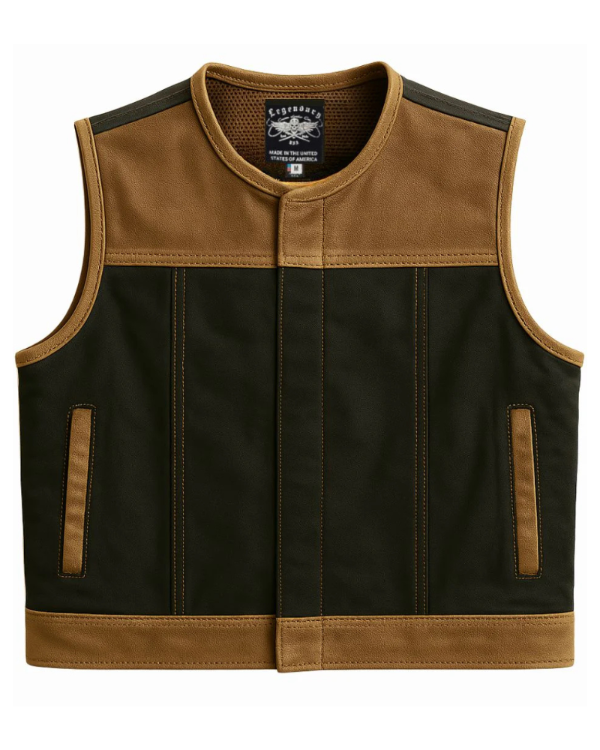
| Legendary Men's Leather Club Vest | The one to standardize a club on. Functional side lacing solves the hoodie and jacket layering problem, and it is the only vest here offered in a Long 2 inch body, so tall members get the same vest as everybody else. Rated 4.84 out of 5 across 38 reviews. Runs S to 5XL, plus M to 3XL in the Long body. | $179.99 |
| Legendary Gunslinger Leather Vest | Heavier hide and interior gun pockets, in a clean S to 5XL run, which is exactly what a bulk order needs. Rated 4.94 out of 5 across 51 reviews. | $220.00 |
| Legendary Outlaw Leather Vest | The officer vest. Numeric chest sizing from 38 to 56, so nobody has to guess a letter, on the heaviest hide of the four. Rated 4.98 out of 5 across 53 reviews. | $325.00 |
For most clubs the right answer is the club vest with lacing for the body of the membership and the Outlaw or Gunslinger for officers, ordered in one go so the black matches. Call us with your size break before you collect money from anyone. Prices shown are current at time of writing. Orders over $150 ship free.
Leather Selection and Color Matching
Full grain and top grain cowhide both work for a club vest. Corrected grain and splits do not, because the finish is a surface layer and a patched vest flexes at exactly the points where that layer cracks first.
On color, black hides road dirt and looks the same across a run. Brown and tan look better with age but show dye-lot variation much more obviously. For a multi-chapter order, order all of it at once, in black, and let us cut it from the same hide batches where we can. Two orders placed six months apart will not match, and there is nothing anyone can do about that after the fact.
Customization That Actually Means Something
Interior embroidery with a name, a chapter, or a founding year costs very little and is the detail members mention years later. Hardware is a real choice, not a cosmetic one: snaps handle wind better than a zipper, D-rings matter if your members run a wallet chain, and side lacing is worth it for the fit range alone. Collarless is the safer default for a club, because it layers over a hoodie or a jacket without bunching and gives a rocker patch a clean top edge.
What a Club Vest Is Not
It is not protective gear. An unarmored leather vest has no impact protectors, carries no CE certification, and leaves the arms and shoulders bare. If members want real protection under their colors, the Bohn Airtex Mesh Armored Riding Shirt at $229.99 carries CE Level 2 protectors at shoulders, elbows and back and wears under a vest without bulk. That is the honest arrangement, and it is what we tell clubs on the phone.
Browse the Made in USA motorcycle vest lineup to see what we build at retail, then call us with your size break.
Frequently Asked Questions
How do you measure for a leather motorcycle vest?
Measure your chest at the fullest point, over the clothing you actually ride in rather than a bare chest. Run the tape under the armpits and level across the shoulder blades, snug enough that you can slip one finger under it. Send that number in inches. On numeric-sized vests the size is the chest measurement, so a 44 inch chest takes a 44. On letter-sized vests, 48 to 50 inches is generally a 2XL. If anyone is over six foot two, also measure back length from the base of the neck to the belt line.
Should a motorcycle vest fit tight or loose?
Snug, closer to tight than loose. It should close at every snap with a little effort, and when closed you should be able to slide a flat hand between the leather and your chest. If the gaps between snaps pull open into horizontal V shapes it is a size too small. Leather relaxes about half an inch to an inch across the chest in the first month, so slightly firm on day one is correct on day thirty.
Do leather motorcycle vests come in tall or big and tall sizes?
Yes. Our letter-sized vests run S through 5XL, roughly a 36 to 56 inch chest, and numeric-sized models such as the BECK 588 run 36 through 56. The Legendary Men's Leather Club Vest is also offered in a Long body that adds 2 inches of length, currently in M through 3XL, which is what riders over six foot two need so the vest does not ride up above the belt.
Where do patches go on a motorcycle vest?
On the back, a three-piece club set runs top rocker about 1 to 2 inches below the collar seam, center patch below it with a half inch to an inch of gap, and bottom rocker below that, clearing the hem by at least an inch. An MC cube sits to the right of the center patch. On the front, rank or club tab goes on the wearer's left chest and a name tag on the right, both kept above the pocket line and off the shoulder seam. Sew patches rather than gluing or ironing them, and if you are not in a club, wear a single center back patch rather than a full three-piece set.