



Knuckle Protection in Motorcycle Gloves: What Carbon Fiber Defenders Actually Do
Quick Answer: Knuckles are one of the first body parts to hit pavement in a motorcycle crash. Carbon fiber knuckle defenders absorb and redistribute impact energy before it reaches bone and tendon. They add minimal bulk, maintain hand articulation, and are now available on premium deerskin gloves that offer both protection and comfort.
Why Knuckles Are a Primary Impact Zone in Motorcycle Crashes
In a forward crash, the natural instinct is to extend your hands to break the fall. That means the dorsal side of your hand — the top, where your knuckles sit — hits the road surface first. Studies from the Motorcycle Safety Foundation and HURT Report data consistently show that hand and wrist injuries account for a significant portion of rider trauma, and the knuckle area is particularly vulnerable because there is almost no subcutaneous fat protecting the joints from direct impact.
Unlike your palm, which at least has some muscle mass, the knuckle area is essentially skin over bone. Without a protective layer between that skin and asphalt, even a low-speed get-off can result in deep abrasions, fractured metacarpals, or joint damage that requires surgery and months of recovery.
This is not a hypothetical risk for touring riders or track day participants only. Urban riders navigating traffic at 25–40 mph face the same knuckle impact risk in a collision with a car door, a curb, or another vehicle. Speed is less of the determining factor than the angle and point of initial contact.
Carbon Fiber vs Plastic vs Hard Shell: Understanding the Difference
Not all knuckle protection is equal. The three most common materials used in motorcycle glove knuckle defenders are thermoplastic (hard shell), TPU (thermoplastic polyurethane), and carbon fiber. Each has a different performance profile.
Thermoplastic Hard Shell
Hard shell thermoplastic knuckle protectors are rigid, inexpensive to manufacture, and effective at impact deflection at higher velocities. The downside is stiffness. They sit proud on the hand, restrict finger flex, and can feel like wearing armor rather than a glove. On long rides, this rigidity becomes uncomfortable.
TPU (Thermoplastic Polyurethane)
TPU protectors are more flexible than hard shell and conform somewhat to the shape of the hand. They're common in mid-range gloves and offer a reasonable balance of impact resistance and articulation. They are not as stiff as hard shell but also not as lightweight as carbon fiber.
Carbon Fiber
Carbon fiber knuckle defenders are the premium option. Carbon fiber has an exceptional strength-to-weight ratio — it is stronger than steel at a fraction of the weight. In glove knuckle applications, carbon fiber panels are formed to follow the contour of the metacarpal ridge and are engineered to dissipate impact energy laterally rather than transmitting it directly into the joint. The result is a protector that is thin, lightweight, and highly effective at impact management without adding significant bulk to the back of the glove.
Carbon fiber also has excellent abrasion resistance, which matters in a slide scenario where the knuckle is dragging across road surface rather than taking a single blunt impact.
Leather-Covered vs Exposed Carbon Fiber: Aesthetics and Function
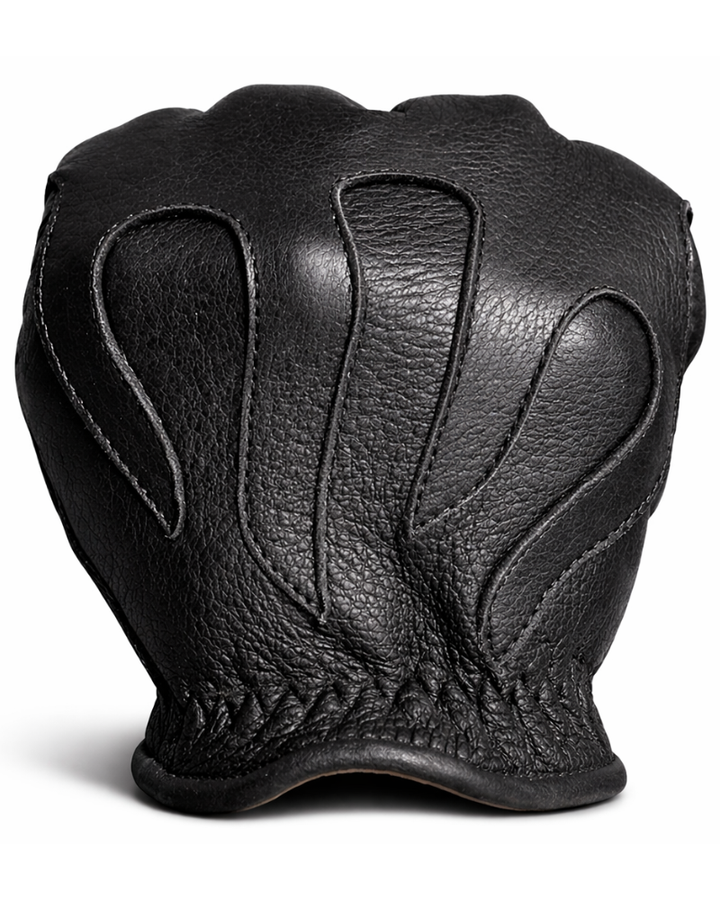
Some gloves expose the carbon fiber defender on the dorsal surface — the weave pattern is visible and the protector becomes a design element. Other gloves, including many premium deerskin motorcycle gloves, cover the carbon fiber panel with a matching leather layer so the glove has a clean, traditional look.
From a functional standpoint, both approaches work. Covered knuckle defenders integrate more seamlessly with the glove's overall construction and are less likely to catch on jacket sleeves or snag on gear. Exposed carbon fiber tends to be slightly more aerodynamic and can dissipate heat faster, which is marginal in practice but worth noting for summer riding.
For riders who want a glove that looks like a traditional leather motorcycle glove without the visual cues of overt armor, covered carbon fiber defenders are the better aesthetic choice while maintaining full protective function.
How Carbon Fiber Dissipates Impact Energy
Carbon fiber's protective mechanism is different from hard plastic. When a hard plastic protector takes impact, it transfers energy through the rigid shell to the underlying structure — which can mean your hand absorbs some of that load. Carbon fiber's layered fiber structure is designed to distribute impact energy across a larger surface area through a process called delamination at the fiber-resin interface.
In practical terms, this means a carbon fiber knuckle defender can absorb more energy before transmitting it through to your hand. The fiber layers crack or deform under extreme impact, absorbing energy that would otherwise reach your joint. This is why carbon fiber is used in motorsport helmets, body armor, and racing suits — not because it is indestructible, but because it manages energy delivery in a way that reduces injury severity.
After a significant impact, a carbon fiber defender should be inspected and may need replacement. A cracked or delaminated panel will not perform at full specification for a second impact.
Do Knuckle Protectors Restrict Hand Movement?
This is the most common objection riders raise, and it's a legitimate concern. A knuckle defender that locks out finger flex will make throttle control awkward, brake lever feel diminished, and clutch engagement imprecise. Poorly designed protectors do cause all of these problems.
Well-engineered carbon fiber knuckle defenders are profiled to follow the natural curvature of the metacarpal ridge without bridging across the finger joints themselves. The protection sits over the back of the hand and the proximal knuckle area rather than locking the fingers in place. When the glove fits correctly and the protector is properly positioned, finger articulation is almost entirely unaffected.
The key is fit. A protector that is sized for a different hand shape — even if the glove otherwise fits — will sit in the wrong position and restrict movement. This is one reason premium motorcycle glove brands build knuckle defenders that are integrated into the glove's pattern rather than added as an afterthought.
CE Ratings for Knuckle Protection: Level 1 vs Level 2
The CE EN 13594 standard governs protective gloves for motorcycle riders. Under this standard, knuckle protectors are tested for impact transmission — the force that passes through the protector to a sensor beneath it.
CE Level 1: Maximum transmitted force of 7 kN on average, with no single result exceeding 9 kN.
CE Level 2: Maximum transmitted force of 5 kN on average, with no single result exceeding 7 kN.
Level 2 offers meaningfully better protection for higher-impact scenarios. For highway riders, touring, or anyone riding at speeds where a fall would involve significant kinetic energy, Level 2 knuckle protection is the appropriate choice. Urban commuters and low-speed riders may find Level 1 adequate, but Level 2 has no downside beyond cost of manufacture.
When evaluating gloves, look for the CE mark and the specific level rating on the knuckle protector insert, not just a general CE logo on the product tag.
Knuckle Protection and Touchscreen Compatibility
Modern motorcycle gloves increasingly need to work with smartphone navigation. Touchscreen compatibility is built into fingertip panels — conductive material on the index finger and thumb tip that allows screen interaction without removing the glove. Knuckle protection on the dorsal surface does not interfere with touchscreen function at the fingertips.
The two features operate in entirely different zones of the glove and are fully compatible. If a glove advertises both carbon fiber knuckle protection and touchscreen capability, there is no technical tradeoff between the two.
The Legendary Uppercut Knuckle Defense Motorcycle Gloves combine carbon fiber knuckle defenders with premium American deerskin construction — a combination that delivers protection without sacrificing the softness and feel deerskin is known for.
Knuckle Protection in Urban vs Highway Riding
Urban riders actually face knuckle risk from a different threat vector than highway riders. In city riding, the most common impact scenarios involve car doors opening into a rider's path, intersection collisions, and low-speed tip-overs. These tend to involve sharp impact from a relatively low height — exactly the scenario where a knuckle protector prevents a deep laceration or fracture.
Highway riders face higher-speed slide scenarios where abrasion resistance matters as much as impact absorption. The combination of a carbon fiber defender (impact) over a leather-backed deerskin glove (abrasion) addresses both threat profiles simultaneously.
In both contexts, the case for knuckle protection is clear. The difference is the expected impact velocity — urban incidents tend to be lower speed but more frequent in occurrence, while highway incidents tend to be rarer but more severe when they happen.
How Thick Do Knuckle Protectors Make the Glove?
A carbon fiber knuckle panel typically adds 4–6mm to the dorsal profile of the glove at the metacarpal ridge. This is significantly less than a thermoplastic hard shell protector, which can add 10–15mm and create a visible bulge over the back of the hand.
When a carbon fiber defender is leather-covered and integrated into the glove's pattern, the visible profile difference from an unprotected glove is minimal. The glove may sit slightly tighter under a jacket sleeve cuff, but this is rarely a practical problem and can be managed by wearing the jacket sleeve over the glove cuff rather than under it.
Knuckle Protection Plus Perforated Back — Can You Have Both?
Yes. Perforated leather on the dorsal panel and a knuckle defender are not mutually exclusive. The perforations are located in the leather panels on either side of the knuckle defender — the interstitial zones between the fingers and the areas above and below the metacarpal ridge. The carbon fiber panel itself does not need to be perforated because it is not a primary ventilation surface.
The result is a glove that provides summer airflow through the perforated zones while maintaining full knuckle protection at the impact point. This is the right configuration for riders in warm climates who do not want to choose between temperature management and hand protection.
Deerskin Plus Carbon Fiber Knuckle — Why This Combination Works
Deerskin is the preferred leather for premium motorcycle gloves because of its natural softness, fiber density, and moisture management. It conforms to the hand quickly, provides excellent throttle feel, and remains supple even after repeated wet/dry cycles. But deerskin's looser fiber structure — the reason it's so soft — means it is not the highest abrasion resistance leather available.
Carbon fiber knuckle protection compensates for this in the highest-impact zone. The deerskin handles comfort, palm feel, and abrasion across the majority of the glove surface area. The carbon fiber defender handles impact energy at the knuckle — the area where leather alone, regardless of type, is insufficient protection.
This is a deliberate engineering choice, not a compromise. Using a heavier abrasion-resistant leather across the entire glove to improve knuckle protection would sacrifice the comfort that makes deerskin worth using in the first place. Targeted carbon fiber protection at the knuckle lets the deerskin do what it does best everywhere else.
For riders who also want cut and abrasion protection at the palm, the Legendary Aramid Lined Deerskin Motorcycle Gloves add Kevlar/aramid fiber lining beneath the deerskin palm — creating a multi-layer protection system that addresses impact, abrasion, and cut resistance across the full glove.
Crash Statistics and Hand Injuries: The Case for Knuckle Protection
Multiple independent studies on motorcycle crash injuries have established that hand and wrist injuries are among the most common non-fatal injuries in motorcycle accidents. The MAIDS study (Motorcycle Accidents In Depth Study) conducted across five European countries found that the upper extremities were injured in approximately 30% of crashes analyzed. The HURT Report, the most comprehensive U.S. motorcycle crash study, identified hand and wrist injuries as frequent outcomes even in crashes where the rider survived with no major lower-body injuries.
The implication is clear: gloves are not optional equipment for any level of rider, and gloves with knuckle protection provide meaningfully better outcomes than gloves without. The investment in a quality armored glove is a fraction of the cost of one emergency room visit for a fractured metacarpal.
Frequently Asked Questions: Knuckle Protection in Motorcycle Gloves
What exactly is a carbon fiber knuckle defender?
A carbon fiber knuckle defender is a formed protective panel made from carbon fiber composite material that is integrated into the dorsal (top) side of a motorcycle glove over the metacarpal area. It is designed to absorb and distribute impact energy during a crash before it reaches the underlying bone structure. Carbon fiber is used because it has a high strength-to-weight ratio — stronger than hard plastic with significantly less mass.
Are carbon fiber knuckle protectors CE certified?
CE certification for knuckle protectors follows the EN 13594 standard. A CE Level 1 rating means the protector transmits no more than 7 kN average force on impact testing. A CE Level 2 rating means no more than 5 kN average. Look for the CE mark and the level designation on the glove's documentation or inner label — not all gloves that advertise "carbon fiber" include a CE-rated protector insert.
Do knuckle protectors make gloves uncomfortable to wear?
When properly designed and fitted, no. A knuckle defender that is correctly profiled to the metacarpal ridge does not restrict finger articulation. Problems arise with protectors that are oversized, poorly positioned, or integrated into a glove that doesn't fit the rider's hand. Well-made gloves with integrated carbon fiber defenders feel almost indistinguishable from unarmored gloves during normal riding.
Can I feel the throttle and brakes normally with knuckle protection?
Yes. Knuckle defenders sit on the top of the hand. Throttle, brake, and clutch feel is governed by fingertip and palm sensitivity, which are unaffected by dorsal protection. Riders sometimes expect armored gloves to feel numb and are surprised by how little impact a properly placed knuckle defender has on control feel.
How do I know if my knuckle protector was damaged in a crash?
Inspect the panel visually after any impact. Carbon fiber damage can manifest as surface cracking, delamination (layers separating), visible white stress marks, or structural deformation. If you can flex the panel and feel or hear cracking, it is compromised. A damaged protector should be replaced — do not assume it will protect at full specification for a second impact.
Are knuckle protectors removable for washing?
This varies by glove. Some designs allow the carbon fiber panel to be removed via a slot or pocket in the dorsal lining, making both the glove and the protector easier to clean separately. Others have the protector permanently integrated. Check the manufacturer's care instructions before attempting to remove any internal components.
What's the difference between Level 1 and Level 2 knuckle protection for real-world riders?
CE Level 2 absorbs more impact energy before it reaches your hand — the threshold is 5 kN vs 7 kN average. In practical terms, at highway speeds or in higher-impact crash scenarios, Level 2 protection provides a meaningful margin. For riders who spend most of their time in urban traffic at lower speeds, Level 1 still provides significant protection over no protector at all. When choosing between otherwise equal gloves, Level 2 is the better choice if cost is not a barrier.
Do I need knuckle protection for short commutes?
Yes. Hand injuries occur in low-speed crashes as readily as in high-speed ones — sometimes more so because low-speed falls often involve more direct vertical impact without the sliding that distributes energy over a larger surface. A 20 mph collision with a car bumper at a city intersection can fracture knuckles just as effectively as a highway slide.
Can perforated motorcycle gloves also have knuckle protection?
Yes. Perforations are placed in the leather panels around the knuckle defender — between the fingers, above the metacarpal area, and in zones that don't overlap the carbon fiber panel. The result is a glove with full summer ventilation and full knuckle protection simultaneously. Riders in hot climates do not need to sacrifice protection for airflow.
Does deerskin hold up well around knuckle protectors?
Deerskin is an excellent material around knuckle protectors because its natural flexibility accommodates the slight stiffness differential between the leather and the carbon fiber panel. Unlike stiffer cowhide, deerskin doesn't develop hard creases or stress fractures at the transition zone between protected and unprotected areas. The leather remains supple throughout its service life even with a rigid insert beneath it.
What should I look for when buying armored motorcycle gloves?
Check for: CE rating (Level 1 or Level 2) on the knuckle protector specifically, leather quality and thickness, palm reinforcement, wrist closure security, and whether the armored panels are removable or permanently integrated. Also verify fit — protectors positioned incorrectly due to poor fit provide less effective coverage even if the components themselves are high quality.
Are armored gloves only for racing or sport riding?
No. Armored gloves benefit every category of rider. Touring riders on long highway stretches, urban commuters in traffic, cruiser riders, and adventure riders all share the same hand anatomy and the same vulnerability in a crash. The type of knuckle protection that's appropriate may vary — a cruiser rider may prefer the clean look of leather-covered carbon fiber over exposed hard armor — but the underlying protective function is equally relevant across riding styles.
How much do carbon fiber knuckle gloves cost compared to standard gloves?
Carbon fiber knuckle defenders add manufacturing cost. Expect to pay a premium of $30–$80 over a comparable unarmored glove from the same brand. When the base glove is already premium deerskin with quality stitching and American construction, the total cost reflects both the material quality and the protection engineering. This is not a category where buying the cheapest option is advisable — hand injuries are expensive, painful, and disruptive to daily life in ways that exceed the cost differential by orders of magnitude.