



Perforated vs Non-Perforated Motorcycle Gloves: When to Wear Each
At some point in your riding life, you'll find yourself standing in front of two pairs of quality leather gloves — one with perforation, one without — wondering which one to buy. Or maybe you have one and you're wondering whether you should have the other. This is a common point of confusion because both styles are correct answers, just to different questions.
Legendary USA addresses both sides of this conversation with their lineup. The Spitfire is their perforated deerskin glove designed for summer riding. The ILL DOZER is solid deerskin for three-season use. Understanding when each style is the right choice will help you build a glove inventory that covers your actual riding conditions rather than leaving gaps.
Quick Answer: Perforated motorcycle gloves are the right choice when ambient temperature is above roughly 75°F and you're riding at moderate to highway speeds where airflow through the perforations provides meaningful cooling. Non-perforated gloves are correct below that temperature or in rain, where perforations reduce warmth and allow water infiltration. Most serious riders own both.
How Perforation Actually Works in Riding Gloves
Perforation in leather gloves isn't just decorative. It functions as a ventilation system that draws air through the leather as the glove moves through airflow at speed. At highway speeds on a warm day, perforated leather allows significant air circulation around the hand, reducing the heat that builds up inside a sealed leather glove.
The mechanism is simple: holes in the leather allow air passage that solid leather doesn't allow. But the effectiveness is highly speed and temperature dependent. Riding slowly in traffic, perforation provides minimal benefit because there's insufficient airflow to drive meaningful air exchange through the holes. The ventilation benefit scales with speed — at 45 mph it's moderate, at 65-70 mph it's significant.
Perforation also has downsides that need to be weighed against the ventilation benefit. Every hole in the leather is a point of reduced abrasion resistance. The leather is thinner where it's perforated, which means a slide over the perforated area contacts more road surface area and has less material to resist that contact. For hot-weather riders who prioritize comfort over maximum protection, this trade-off is acceptable. For riders prioritizing protection above all else, solid leather is the safer choice.
When Perforated Gloves Are the Right Choice
Summer heat above 75°F: This is the core use case. When ambient temperature is high enough that your hands are sweating inside solid leather gloves, perforation solves the problem by allowing evaporative cooling and airflow. The Spitfire from Legendary USA is designed specifically for this scenario — deerskin's natural breathability plus active ventilation from the perforation pattern.
Consistent highway riding: At sustained speeds where airflow is constant, perforations deliver their full ventilation benefit. Summer touring at highway speeds is where perforated gloves shine most clearly.
Dry, hot climates: Places where summer riding means consistent high temperatures and low humidity, and where rain is rare, are the ideal environment for perforated gloves. You get maximum cooling benefit with minimal exposure to rain that would compromise the warmth advantage of solid leather.
When Non-Perforated Gloves Are Correct
Temperatures below about 65°F: At these temperatures, the ventilation from perforated gloves works against you — it allows cold air through the leather onto your hands. Even moderate highway speeds create substantial windchill that perforated leather amplifies rather than blocks. Solid leather maintains a pocket of warm air against the hand that perforated leather cannot.
Rain and wet conditions: Perforations are water entry points. In rain, a perforated glove soaks through faster and stays wet longer than solid leather. For riders who get caught in rain regularly or who ride in climates where rain is unpredictable, solid leather is the pragmatic choice.
Year-round versatility: If you're going to own one pair of gloves and ride through multiple seasons, solid leather is the right choice. It handles the widest range of conditions without the weaknesses that perforated leather shows in cold or wet weather.
The Deerskin Advantage in Both Formats
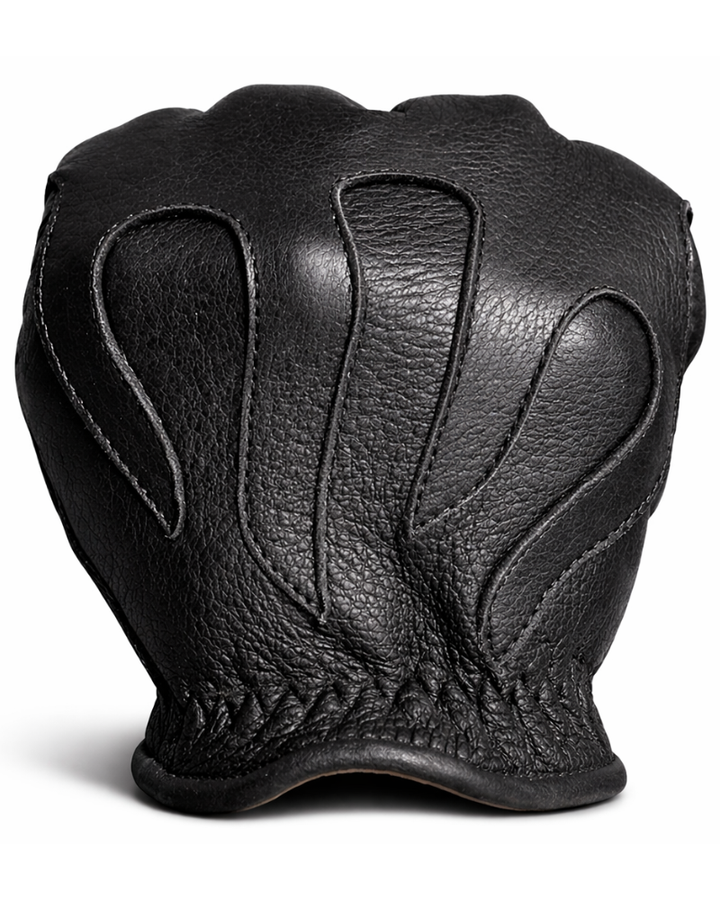
One thing that makes Legendary USA's approach to this choice interesting is that both the Spitfire and the ILL DOZER use the same genuine American deerskin foundation. Deerskin is inherently more breathable than cowhide — even without perforation, it allows more air exchange than solid cowhide. This means the ILL DOZER is more comfortable in warm weather than a comparable solid cowhide glove, reducing the temperature threshold at which you feel like you need perforated leather.
Conversely, the Spitfire's deerskin base means that even with perforation, it has better protection properties than a perforated cowhide or synthetic alternative. The deerskin underneath the perforations is still high-quality leather; the holes reduce it but don't eliminate its protective properties.
Building Your Glove Wardrobe
The most practical approach for most riders is to own both a perforated and a non-perforated pair of quality deerskin gloves. Spitfire for summer and the ILL DOZER for the rest of the year covers the vast majority of riding conditions without compromise in either direction. You're not making your solid gloves work in summer heat and you're not asking your perforated gloves to perform in fall rain.
This doesn't need to be expensive relative to the value you get. Two pairs of quality deerskin gloves that each last 5-10 years is a better investment than cycling through cheap synthetic options every season trying to approximate the performance.
Frequently Asked Questions
Are perforated motorcycle gloves less protective than solid leather?
Technically yes — the perforations reduce the continuous leather surface available for abrasion resistance. In practice, a perforated quality deerskin glove like the Spitfire still provides substantially better protection than cowhide or synthetic alternatives. The protection trade-off is the accepted cost of ventilation in warm weather riding.
At what temperature should I switch from solid to perforated motorcycle gloves?
Most riders find the switch point between 70-80°F depending on their personal temperature tolerance and riding speed. Deerskin solid gloves like the ILL DOZER are more breathable than cowhide, so the threshold where you need perforated leather is somewhat higher with deerskin than with other materials.
Can I wear perforated motorcycle gloves in rain?
You can, but the perforations allow water infiltration that makes the gloves wet faster and reduces warmth. For occasional rain, it's manageable. For sustained riding in rain, solid leather is far more practical and keeps your hands drier and warmer.
What is the Spitfire from Legendary USA?
The Spitfire is Legendary USA's perforated deerskin glove, designed specifically for summer motorcycle riding. It uses the same genuine American deerskin as the ILL DOZER but includes a perforation pattern for active ventilation at speed in hot weather.
Should I own both perforated and non-perforated motorcycle gloves?
If you ride through multiple seasons, yes. A perforated glove like the Spitfire for summer and a solid glove like the ILL DOZER for spring through fall covers the full range without asking either pair to work outside its optimal conditions.