



Ventilated Motorcycle Gloves: The Complete Guide to Staying Cool on Hot Rides
Quick Answer: Ventilated motorcycle gloves use perforated leather panels to allow airflow across your hands while riding. Perforated deerskin and cowhide gloves can measurably reduce hand temperature on hot days, and the best designs place perforation on the back of the hand where airflow hits first. They are the right choice for riders in temperatures above 70°F who don't want to sacrifice leather protection for a mesh alternative.
Why Hand Temperature Matters More Than Riders Think
Your hands are in constant motion on a motorcycle — gripping, squeezing the clutch, working the throttle. In summer heat, hands sweat. Sweat reduces grip. Reduced grip at highway speed is a safety issue, not just a comfort issue. Ventilated gloves address this at the material level, before the heat gets trapped.
A full-leather glove with no perforation acts like an oven mitt in direct sun. In 90°F heat at 65 mph, hand temperatures inside sealed leather gloves can reach 110°F or higher. Perforated panels break that heat cycle by allowing moving air to pass directly over the skin.
How Perforation Works in Motorcycle Gloves
Perforation is exactly what it sounds like: small holes punched or laser-cut through the leather. At speed, forward motion drives air through those holes and across the surface of your hand. The faster you ride, the more airflow you get — which is why perforated gloves feel dramatically better at highway speeds than in slow traffic.
The holes themselves don't cool your hand. Moving air does. Perforation is the mechanism that lets that air reach your skin instead of being blocked by a solid leather wall.
Back-of-Hand Perforation vs. Palm Perforation
This distinction matters more than most buyers realize. Back-of-hand perforation is where airflow enters first when you're riding in the natural grip position. Your hands face forward, knuckles up. Air hits the back of your hand constantly. Perforation here delivers continuous cooling.
Palm perforation sounds appealing but has a tradeoff. The palm is in constant contact with the grip and throttle. Any holes in the palm reduce the amount of material contacting the bar, which can slightly affect grip feel and tactile feedback. For riders who prioritize pure grip performance, minimal or no palm perforation is often the better choice.
The best ventilated gloves concentrate perforation on the back of the hand, fingers, and knuckle area — where airflow is maximized — while keeping the palm solid or lightly perforated only in non-contact zones.
White Deerskin vs. Black Deerskin in Summer Heat
Color affects heat absorption at the surface level. White or natural deerskin reflects more sunlight than black leather. In direct sun, a black leather glove absorbs significantly more radiant heat than a white or tan deerskin glove. This isn't marketing — it's basic physics.
For summer riding in direct sun, natural or white deerskin with perforation gives you a double advantage: lower surface absorption and interior airflow. Black leather with perforation still outperforms black leather without it, but natural-color deerskin with perforation is the cooler option by a meaningful margin on hot days.
How Much Does a Perforated Glove Actually Cool Your Hands?
This depends on speed. At 30 mph or slower, the airflow benefit is modest. In stop-and-go traffic, perforated gloves are better than sealed ones but not dramatically so. The real cooling effect kicks in at highway speeds — 55 mph and above.
Independent rider tests have shown hand temperature reductions of 15–25°F between sealed leather gloves and perforated leather gloves at highway speed in summer conditions. That difference converts directly into longer ride comfort, reduced fatigue, and better throttle feel.
Ventilated Leather Gloves vs. Mesh Gloves: The Protection Tradeoff
Mesh gloves offer maximum airflow — often more than perforated leather — but leather and mesh are not equivalent in abrasion resistance. Full leather, even with perforation, outperforms mesh in slide protection. In a low-speed fall where hands contact pavement, leather slows the abrasion significantly. Mesh tears faster.
The perforation holes in leather gloves are small — typically 3–5mm in diameter — and surrounded by intact leather. The structural integrity of the glove remains high. Mesh, by contrast, is fundamentally a woven open structure with far less material between the rider's skin and the road.
For riders who prioritize protection alongside cooling, perforated leather is the right answer. Mesh is an option for very short, low-speed, city-only rides where the comfort-to-risk tradeoff is acceptable.
Does Perforation Weaken Leather?
Done properly, no. The perforation process in quality gloves punches clean holes through the leather without tearing or degrading the surrounding material. The key is hole spacing — holes too close together reduce the structural leather between them significantly. Quality manufacturers maintain sufficient material between each perforation to preserve tensile strength.
What does weaken leather over time is moisture and UV — both of which affect perforated and non-perforated gloves equally. Proper conditioning extends the life of any leather glove regardless of perforation pattern.
Best Perforation Patterns for Riding
Two primary approaches exist: targeted perforation and full-coverage perforation.
Targeted perforation places holes in specific high-heat zones: the back of the hand, the proximal finger sections, and the knuckle area. The palm, fingertips, and wrist cuff remain solid. This pattern maximizes cooling where it matters most while maintaining structural integrity and grip feel everywhere else.
Full-coverage perforation punches holes across the entire glove surface including the palm and fingertips. Airflow is maximized, but tactile feedback through the grip is reduced. Some riders find full-coverage perforated gloves slightly slippery in wet conditions when the grip channels partially fill with water.
For most riders, targeted back-of-hand perforation is the better daily-use choice.
Ventilated Gloves in the Rain: What Actually Happens
Rain and perforated gloves have a complicated relationship. Small perforation holes generally don't flood with water at riding speed — surface tension and airflow keep them relatively dry. However, in heavy rain, water does penetrate perforated panels faster than solid leather.
The practical result: your hands will get wet sooner in rain with perforated gloves than with sealed leather. This matters for cold-rain situations where wet hands lose warmth rapidly. For warm summer rain, the tradeoff is minor. For cold rain, switch to unlined sealed leather or waterproof gloves.
Perforated gloves are a clear three-season choice, not an all-weather one.
Touchscreen Compatibility and Ventilation
Yes, you can have both. Touchscreen-compatible motorcycle gloves use conductive material on the fingertip — typically the index finger and thumb — that allows smartphone and GPS screen interaction without removing the glove. This is entirely compatible with perforation on the back of the hand and fingers.
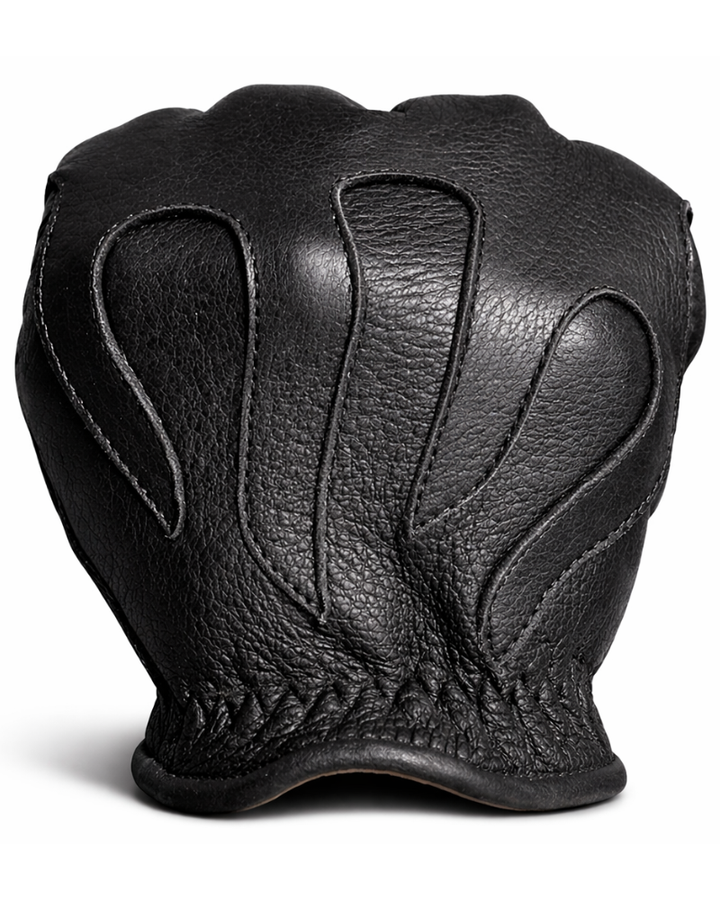
The conductive material sits on the fingertip pad, which is a small zone. Perforation on the dorsal (back) surface of the fingers doesn't interfere with fingertip conductivity. The Legendary Deerskin Ventilated Short Wrist Motorcycle Gloves combine perforated deerskin construction with the soft, supple grip of American whitetail deerskin, making them a strong choice for summer riders who need both cooling and device access.
When NOT to Use Ventilated Gloves
Perforated gloves are optimized for warm conditions. They're the wrong tool in three specific situations:
- Highway riding in cold weather: At 65 mph in 50°F temperatures, the same airflow that cools your hands in summer will chill them dangerously fast in fall or winter. Wind chill drops perceived temperature significantly below ambient.
- Cold rain: Wet hands plus wind chill equals rapid heat loss. Perforated gloves offer no meaningful water resistance.
- Early morning cold starts: Even on a hot day, if the morning departure temperature is below 60°F, sealed gloves for the first hour are a smarter choice than perforated.
For multi-season riders, the practical answer is two pairs: perforated deerskin for summer, insulated or sealed leather for fall and winter.
Perforated Driving Gloves vs. Perforated Riding Gloves
The difference is in the cuff and wrist construction. Driving gloves are designed for car use: shorter cuffs, often open-back designs, lighter construction. They offer minimal road rash protection.
Riding gloves designed for motorcycles have reinforced palms, knuckle protection or padding, and more substantial wrist closures. Perforation in a motorcycle riding glove appears in the back-of-hand and finger panels while the structural protective elements remain intact.
The Legendary Deerskin Ventilated Driving Gloves split the difference — soft deerskin construction with an open-back design and touchscreen fingertip — suited for lighter cruising and touring where airflow and feel matter most.
Hand Sweat, Grip, and Why Ventilation Improves Throttle Control
Sweat on the inside of a glove creates a slippery film between the leather and the skin. In a non-perforated glove, that moisture has nowhere to go. It pools and reduces the friction between your hand and the grip.
Perforated panels allow vapor to escape. Moisture doesn't accumulate at the same rate. The result is drier hands, more consistent grip friction, and better throttle control feel throughout a long ride. This isn't a minor benefit — riders who've switched from sealed to perforated gloves frequently cite improved confidence on the throttle as the most immediately noticeable difference.
Frequently Asked Questions: Ventilated Motorcycle Gloves
Do perforated motorcycle gloves actually make a difference in heat?
Yes, measurably. At highway speeds (55 mph and above), perforated leather gloves reduce hand temperature by 15–25°F compared to sealed leather gloves in equivalent conditions. The benefit is smaller in slow traffic where less airflow is generated.
Are ventilated motorcycle gloves less safe than regular leather gloves?
When perforation is done correctly with proper hole spacing, the abrasion resistance of the glove remains high. Small holes surrounded by intact leather do not significantly reduce protection compared to unperforated leather of the same hide weight and quality. They are far more protective than mesh alternatives.
What temperature range is best for perforated motorcycle gloves?
Perforated leather gloves are ideal between 70°F and 100°F+. Below 65°F, especially at highway speeds, the airflow becomes a cooling liability rather than an asset. Most riders treat 68–70°F as the crossover point where ventilated gloves make more sense than sealed ones.
Can I wear ventilated gloves in light rain?
In warm, light summer rain at lower speeds, yes — your hands will get wet but won't be dangerously cold. In cold rain or heavy downpour, perforated gloves are the wrong choice. Switch to waterproof or sealed leather gloves for cold-rain riding.
What is deerskin and why is it used in ventilated gloves?
Deerskin is leather tanned from whitetail or mule deer hide. It is naturally softer and more supple than cowhide or pigskin at equivalent thickness, which means it requires less break-in time and conforms to the hand quickly. In a ventilated glove, softer leather also flexes more freely around the perforation holes without stress cracking.
Do perforated gloves work better at higher speeds?
Yes. Perforation relies on moving air. The faster you ride, the more air is forced through the holes and across your hands. At 30 mph the benefit is noticeable. At 70 mph it's significant. At idle or walking pace, there's essentially no airflow benefit over sealed leather.
Will perforation cause the leather to crack or fail faster?
Not with quality leather and proper conditioning. Perforations are stress points only if the leather is allowed to dry out and become brittle. Regular conditioning of perforated leather gloves — two to three times per season — maintains suppleness around the holes and prevents cracking.
How do I clean perforated motorcycle gloves?
Use a damp cloth to wipe down the outside. Avoid soaking perforated leather in water — the holes allow water to penetrate the interior quickly. Let them air dry at room temperature (never in direct sun or near a heat source) and apply leather conditioner once fully dry.
Are fingerless gloves more ventilated than perforated full-finger gloves?
In terms of raw airflow, yes — open fingers allow more air movement than even heavily perforated full-finger gloves. But fingerless gloves sacrifice finger protection entirely. For riders who want cooling without giving up finger coverage, perforated full-finger gloves are the better protective choice.
Do ventilated gloves help with hand fatigue on long rides?
Yes. Heat-related hand fatigue is a real phenomenon. Overheated hands lose grip strength faster and fatigue more quickly on long rides. Ventilated gloves that keep hands cooler contribute to better endurance and reduced cramping on rides longer than two hours in summer heat.
Can I use perforated gloves for track days?
Perforated leather gloves can be appropriate for track use, but dedicated track gloves typically add hard knuckle armor, palm sliders, and wrist reinforcement that street ventilated gloves don't always include. For track use, verify that the specific glove meets the protection standards required at your track.
What's the difference between laser-cut perforation and punch perforation?
Laser-cut perforation uses a focused beam to vaporize leather material, creating extremely clean, consistent holes with sealed edges. Punch perforation uses a mechanical die to press holes through the leather. Both methods produce effective ventilation. Laser-cut holes tend to be more precise in size and spacing; punch perforation is the traditional method used in quality American-made gloves.
Should I size up when buying perforated gloves vs. regular leather gloves?
Not specifically because of the perforation. Size the glove the same way you would any leather glove — snug enough that the palm material doesn't bunch, with fingers reaching the full tip of each finger stall. Perforated leather doesn't affect sizing the way insulation does (where sizing up is often required).