



American Whitetail Deerskin Motorcycle Gloves: Why This Leather Outperforms Everything Else
Quick Answer: American Whitetail deerskin is the best leather for motorcycle gloves because it achieves the same abrasion resistance as cowhide at roughly half the weight and thickness, stays pliable when wet instead of stiffening, and molds to your exact hand shape over time. Domestic Whitetail hide processed by experienced tanneries produces a leather that no imported alternative — cowhide, pigskin, or goatskin — can replicate for long-ride comfort and grip.
What Makes American Whitetail Deerskin Different
Leather is not a commodity. The species of animal, the region where it was raised, the tannery process, and the grade of hide all determine what you're actually wearing on your hands when you ride. Understanding what separates American Whitetail deerskin from the alternatives explains why riders who have worn it once rarely go back to cowhide gloves.
Deerskin vs Cowhide: The Core Comparison
Cowhide is the default leather for motorcycle gloves because it's available in enormous volume, easy to source globally, and well understood by manufacturers. It's a serviceable material. It is not, however, the best material for hand protection in a riding context.
Weight and thickness: Comparable abrasion-resistant cowhide for motorcycle gloves typically runs 1.2mm to 1.4mm in thickness. American Whitetail deerskin achieves equivalent abrasion resistance at 0.7mm to 0.9mm. The reason is fiber structure: deerskin has a denser, more interlocked fiber arrangement than cowhide. More fiber per millimeter means more resistance to tearing and abrasion without needing additional thickness. The result is a glove that is noticeably lighter and thinner with no protective trade-off.
Wet performance: Cowhide stiffens when wet. The tanning process and the fiber structure of cattle hide both contribute to this — moisture swells and then re-tightens the fibers as the leather dries. Riders who have been caught in rain wearing cowhide gloves know the experience: the gloves stiffen on your hands, reduce grip feel, and require reconditioning and reshaping after drying. Deerskin does not behave this way. Its fiber structure remains flexible when wet and returns to its conditioned state as it dries. This is a property of the hide, not the tanning method — Whitetail deerskin simply handles moisture better.
Break-in period: Cowhide gloves typically require a break-in period of weeks or months before they feel natural on the hand. Deerskin has virtually no break-in period. It is supple from the first use. This is not a sign of lower quality — it's a property of the leather's cellular structure, which is inherently more open and flexible than cattle hide.
Deerskin vs Pigskin: Not in the Same Class
Pigskin gloves appear frequently in budget motorcycle gear. Pigskin is abundant, inexpensive, and has decent abrasion resistance. What it lacks is the drape and grip feel that deerskin provides. Pigskin has a visible pore pattern (three follicle holes in clusters) that creates a slightly rough texture — fine for work gloves, less refined for riding. It also stiffens in cold and wet conditions, similar to cowhide.
Deerskin outclasses pigskin in every dimension that matters for motorcycle riding: flexibility, grip feel, moisture response, and longevity of softness.
Deerskin vs Goatskin: Strength vs Softness Trade-Offs
Goatskin is the other premium leather used in high-end motorcycle gloves, and it deserves a direct comparison. Goatskin is stronger than deerskin at equivalent thickness — its fiber structure produces higher tensile strength and tear resistance. For racing applications where maximum abrasion protection is the only priority, goatskin has an argument.
For road riding and touring, the comparison tilts toward deerskin. Goatskin is stiffer, especially in the first months of use. It does not mold to the hand the way deerskin does. And it lacks deerskin's natural grip quality. The softness differential is significant — a deerskin glove worn all day produces dramatically less hand fatigue than a goatskin glove of equivalent weight.
The practical trade-off: if you are racing or doing track days where abrasion protection is the dominant requirement, goatskin has merit. If you are riding roads — daily commuting, weekend touring, long-distance travel — deerskin is the better choice for comfort and control.
Natural Grip Properties of Deerskin
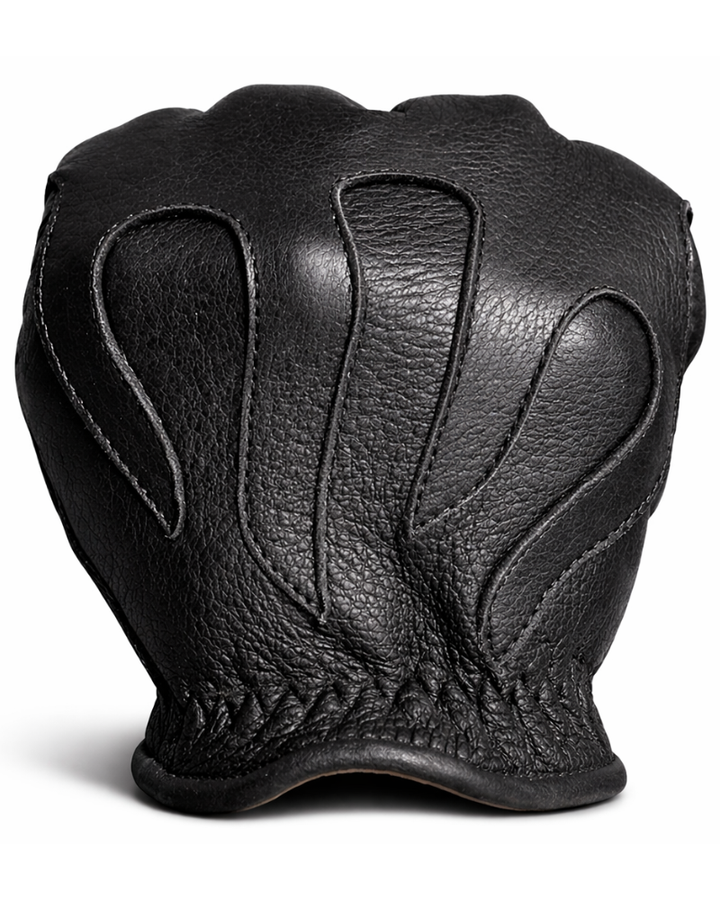
Deerskin has a naturally suede-like inner surface and a smooth but slightly textured outer surface. This combination provides grip on the throttle and brake lever that synthetic materials and many processed leathers cannot replicate. The surface texture creates micro-friction between glove and grip without being abrasive — it feels like a slight resistance that holds your hand in position, reduces vibration translation, and eliminates the "sliding" sensation some riders notice with very smooth cowhide gloves.
This grip property is most noticeable on long rides. After several hours in the saddle, the subtle grip quality of deerskin keeps your hand position controlled without requiring active gripping effort — which reduces hand fatigue significantly.
How Deerskin Molds to Your Hand Over Time
Deerskin's open fiber structure allows it to conform to the specific contours of your hand gradually over time. After the first few rides, a well-fitted deerskin glove will have shaped itself to your knuckle positions, finger widths, and palm curve. This is sometimes called a "custom fit" effect — the glove becomes more yours over time rather than remaining a generic shape.
This is distinct from stretch, which is a different phenomenon. Deerskin does stretch — see the section on fit below — but the molding effect is about the leather draping around your specific hand geometry. A cowhide glove of the same size will feel the same year after year. A deerskin glove of the same size will feel increasingly personal.
Does Deerskin Stretch? How Fit Changes Over Time
Deerskin does stretch with use, particularly across the width of the palm and at the finger joints. This is a property to account for when sizing. A deerskin glove that fits snugly in the store will relax to a more comfortable fit over several rides. A deerskin glove that feels loose in the store will become looser with wear.
The general sizing guideline: fit deerskin gloves snugly but not tight. You should be able to make a full fist without seam pressure at the knuckles, but the leather should be in contact with your skin across the palm and fingers. If there's loose material bunching at the palm in the store, the glove will be sloppy after break-in.
For riders who ride in multiple seasons: deerskin gloves worn year-round tend to hold their shape better than those worn seasonally. Regular use and conditioning keeps the leather at a stable moisture level, which prevents the repeated wetting-and-drying cycles that can cause permanent stretching over time.
Domestic vs Imported Deerskin: Quality Differences
Not all deerskin is equal. American Whitetail deer (Odocoileus virginianus) produce a specific hide quality tied to the animal's diet, climate adaptation, and the density of its winter coat. Whitetail hides tanned by domestic specialists with generations of experience in the material — like the Churchill family, who have been processing American Whitetail deerskin for 127 years — produce a consistent, premium-grade leather that is difficult to source outside the domestic supply chain.
Imported "deerskin" may come from different deer species with different hide characteristics, or may be blended with other materials without full disclosure. The tannery process matters enormously: deerskin tanned with chrome processes performs differently from brain-tanned or vegetable-tanned deerskin. Domestic specialists optimize their process for the specific properties that make Whitetail deerskin ideal for glove construction.
The practical implication: an imported glove labeled "deerskin" may not be using the same material at all. When buying deerskin motorcycle gloves, sourcing from manufacturers with explicit domestic tannery relationships is the only way to be certain of what you're getting.
127 Years of Churchill Family Deerskin Production
The Churchill family has been processing American Whitetail deerskin continuously since the late 1800s. This is not a marketing claim — it represents four generations of material knowledge applied to a single hide type. Churchill's expertise is in the tanning process that produces deerskin with the specific softness, tensile strength, and moisture response properties that premium glove manufacturers depend on.
The Churchill Deerskin Classic Motorcycle Gloves are made from this heritage material, carrying that direct lineage from raw Whitetail hide to finished riding glove. When a manufacturer uses Churchill leather, the quality of the base material is established by 127 years of refinement, not by batch-to-batch import quality variation.
Deerskin Care and Conditioning
Deerskin requires less conditioning than cowhide — its natural oils are more stable and less prone to drying out. That said, regular care extends the life and performance of any leather glove.
Cleaning: Wipe with a damp cloth for surface dirt. For deeper cleaning, use a mild soap (castile or saddle soap) applied lightly with a damp cloth. Do not submerge or machine wash.
Conditioning: Apply a pH-neutral leather conditioner (Leather Honey, Leather CPR, or similar) every few months or after the gloves get thoroughly wet. Apply sparingly — deerskin absorbs conditioner quickly and over-conditioning creates a greasy surface. Work the conditioner in, let it absorb for 20 minutes, then buff off any excess.
Drying: Allow wet gloves to dry naturally at room temperature. Never use direct heat (hair dryer, radiator, direct sunlight) — rapid drying causes deerskin to stiffen and can cause permanent fiber damage.
Storage: Store gloves in a cool, dry location away from direct sunlight. UV exposure degrades leather over time. A glove bag or cloth storage keeps dust off without trapping moisture.
Deerskin vs Cowhide for Long Rides: The Comfort Comparison
This is where the material difference becomes most tangible. On a 30-minute commute, most riders won't notice significant differences between deerskin and cowhide gloves of similar construction quality. On a 300-mile day, the difference is pronounced.
Cowhide's stiffness requires constant, low-level grip effort to maintain hand position — the glove does not fully conform to your grip, so your muscles compensate. Over hours, this creates fatigue in the hand and forearm. Deerskin's conformity to the hand means your grip position is supported by the glove's shape rather than muscular effort. Riders consistently report less hand fatigue, fewer grip adjustments, and less wrist strain at the end of long days in deerskin gloves vs cowhide of equivalent quality.
The Legendary ILL DOZER Deerskin Motorcycle Gloves combine this natural deerskin conformity with outseam construction (seams moved to the exterior of the glove) — which eliminates interior seam pressure at the finger joints and further reduces the fatigue variables on long rides.
American-Made Deerskin Gloves: Why Sourcing Matters
American-made motorcycle gloves made from domestic Whitetail deerskin represent a supply chain where every element is traceable and quality-controlled. The deer is North American Whitetail. The tannery is domestic with documented processes. The glove manufacturer cuts and assembles in the United States with skilled labor. The result is a product where the quality of every component is known.
Import alternatives break this chain at every link. The hide source is often opaque. The tannery process may vary batch to batch. The assembly quality is difficult to verify. The result is inconsistency: gloves that may perform well or poorly depending on which batch they came from.
For a safety-critical piece of gear worn every day, sourcing transparency matters. Buying American-made deerskin gloves from a manufacturer with long-standing domestic supply chain relationships is the only way to ensure consistent, known-quality protection on every ride.
Frequently Asked Questions About Deerskin Motorcycle Gloves
Is American Whitetail deerskin actually stronger than cowhide?
At equivalent thickness, deerskin does not exceed cowhide in raw tensile strength — cowhide has higher tensile strength per millimeter. What deerskin achieves is equivalent practical abrasion resistance at lower thickness and weight, because its fiber density compensates for what it lacks in raw tensile numbers. For gloves, this means equivalent protection with better feel and less fatigue.
Why doesn't deerskin stiffen when it gets wet like cowhide does?
Deerskin's fiber structure is looser and more open at the cellular level than cowhide. When water enters the leather, it distributes through these open fibers without the same swelling and re-tightening effect that occurs in cowhide's denser, more tightly cross-linked fiber structure. The result is leather that dries back to its conditioned state rather than to a stiff, shrunken shape.
How long does deerskin break in compared to cowhide?
Deerskin has no meaningful break-in period — it is supple from the first ride. Cowhide gloves of equivalent quality typically require four to eight weeks of regular use before they feel natural on the hand. This is one of the most immediately noticeable differences for riders switching from cowhide to deerskin for the first time.
Will deerskin gloves stretch too much over time?
Deerskin does stretch slightly with use, particularly across the palm. If sized correctly at purchase (snug but not tight), this stretch will result in a comfortable fit that still provides hand coverage and control. If sized too large at purchase, the gloves will become sloppy. Size deerskin snug, not loose.
Can I use regular leather conditioner on deerskin gloves?
Use a pH-neutral conditioner specifically formulated for smooth leather. Avoid heavy wax-based products (they can clog the fiber structure) and petroleum-based products (mink oil in large quantities can over-soften the leather). Leather CPR, Leather Honey, and similar products work well on deerskin. Apply sparingly — a little goes a long way.
What is the difference between brain-tanned and chrome-tanned deerskin for motorcycle gloves?
Brain tanning (traditional Native American method) produces extremely soft, washable deerskin but with lower durability and inconsistent results at manufacturing scale. Chrome tanning produces more consistent, durable deerskin suitable for production gloves while maintaining the softness properties of the hide. Most premium motorcycle deerskin gloves use chrome-tanned hides. Combination tanning methods are also used by some tanneries to optimize specific properties.
Is Churchill deerskin available in gloves sold anywhere besides Legendary USA?
Churchill leather is used by select manufacturers who source from their domestic supply chain. Legendary USA's relationship with Churchill leather means the gloves sold through Legendary USA carry the same hide quality and tannery standards that Churchill has maintained for 127 years. Not all gloves labeled "deerskin" are made from Churchill-processed leather.
How does deerskin perform in very hot weather?
Deerskin breathes better than cowhide at equivalent thickness due to its more open fiber structure. In summer heat, an unlined deerskin glove allows more air circulation against the skin than a comparable cowhide glove. Perforated deerskin takes this further by adding direct airflow through the leather. Hot-weather deerskin riding gloves are among the most comfortable summer riding gear available.
What is the typical lifespan of a quality deerskin motorcycle glove?
With proper care, a quality deerskin riding glove should last five to ten years of regular use. The leather itself is durable and responds well to conditioning. The most common failure points are stitching at stress zones (palm heel, knuckle crease, thumb gusset) — quality gloves use reinforced stitching at these points. Compared to three to five years for most cowhide gloves and one to three years for budget imports, deerskin offers excellent long-term value.
Do deerskin gloves offer enough protection for highway riding?
Yes. American Whitetail deerskin at proper thickness grades provides meaningful abrasion resistance in a low-to-mid-speed crash scenario, which covers the majority of real-world motorcycle accidents. For high-speed track use, CE-rated armor and higher abrasion resistance materials may be appropriate. For road riding at highway speeds, quality deerskin provides comparable protection to cowhide at equivalent thickness — and superior protection to thin synthetic materials regardless of marketing claims.
Why are deerskin gloves more expensive than cowhide gloves?
American Whitetail deerskin is a less abundant raw material than cattle hide, processed by fewer specialist tanneries. The supply chain is shorter but more specialized. Domestic labor for cutting and assembly adds cost relative to offshore production. The combination of premium hide, specialist tannery, and domestic manufacturing results in higher unit costs than mass-produced imported cowhide gloves. The offset is longevity, performance, and the absence of replacement cycles.
Can I machine wash deerskin motorcycle gloves?
No. Machine washing damages the fiber structure, causes uneven shrinkage, and can destroy the finish and fit of the glove permanently. Hand clean with a damp cloth and mild soap for surface dirt. For deep cleaning, professional leather cleaning is the appropriate option. After any significant wetting, condition the leather once fully dry to restore its natural suppleness.
What is the best deerskin motorcycle glove for a first-time buyer?
A rider buying their first deerskin glove should start with an unlined short-wrist model in the correct size — fit is the most important variable. The Churchill Deerskin Classic is a proven choice for riders who want a traditional, straightforward deerskin glove. Riders who also want perforated summer airflow should look at a perforated model. Both give you the deerskin experience without additional feature complexity to evaluate on a first purchase.