



A&E Industrial Thread in Motorcycle Gloves: Why the Thread Matters as Much as the Leather
Quick Answer: The thread holding a motorcycle glove together is as structurally critical as the leather panels it joins. A&E (American & Efird) industrial-grade thread offers significantly higher tensile strength, UV resistance, and abrasion resistance compared to standard sewing thread. When a glove fails at the seam rather than the leather, substandard thread is almost always the cause.
Every conversation about motorcycle glove quality starts and ends with the leather. Thread gets almost no attention — yet thread failure is the leading cause of glove retirement in gloves where the leather itself still has years of useful life remaining. Understanding what separates industrial-grade thread from standard glove thread is the difference between owning gloves that last two seasons and gloves that last a decade.
What A&E Thread Is
American & Efird (A&E) is one of the largest industrial thread manufacturers in the world, with production facilities across multiple continents. The company supplies thread to the automotive, military, aerospace, and safety gear industries — sectors where thread failure has consequences far beyond a ruined garment.
A&E thread is not a single product but a category of industrial specification threads. The characteristic that unites them is that they’re engineered to performance specifications rather than simply manufactured to a cost point. Each thread line in the A&E catalog has published tensile strength ratings, UV resistance ratings, chemical resistance data, and temperature tolerance ranges.
This specificity is what separates industrial thread from standard sewing thread. Standard sewing thread is characterized by weight and fiber content. A&E thread is characterized by performance data. When a glove manufacturer selects A&E thread, they’re selecting thread to meet specific strength and durability requirements — not simply buying the least expensive available thread that will pass through a needle.
How Thread Tensile Strength Affects Glove Durability
Thread tensile strength is measured in the amount of force required to break a single strand of thread. This number matters for motorcycle gloves in a specific way: it determines not the maximum force the seam can withstand, but rather the force threshold below which repeated stress cycling does not progressively degrade the seam.
In engineering terms, this is the difference between ultimate tensile strength and fatigue strength. A thread might not break under a single 10-pound pull, but if the fatigue threshold is only 2 pounds, repeated 3-pound grip forces will eventually cause progressive thread degradation even though no individual grip exceeds the breaking strength.
A&E industrial thread has higher fatigue thresholds relative to its tensile strength than standard sewing thread. This means that the same grip force applied thousands of times across a riding season causes significantly less cumulative thread degradation in A&E thread than in standard thread. The glove seams remain structurally intact long after cheaper thread would have begun to degrade.
Standard Glove Thread vs. Industrial-Grade Thread: The Difference in Production
Standard glove thread is typically produced to commercial apparel specifications. The manufacturing process optimizes for:
- Consistent appearance and color
- Ability to run at high speed through industrial sewing machines
- Low cost per spool
- Adequate strength for normal garment stress
Industrial-grade thread is produced to performance specifications. The manufacturing process optimizes for:
- Consistent tensile strength across the entire spool
- Minimum UV resistance ratings
- Chemical resistance to specific compounds
- Performance at temperature extremes
- Consistent diameter (which affects stitch uniformity and seam strength)
The production difference is visible in the thread itself. Industrial thread has tighter twist consistency, more uniform diameter, and a denser fiber structure. Under magnification, standard thread shows irregular twist and visible fiber variation. Industrial thread is visibly more uniform.
In production, industrial thread runs more consistently through sewing machines and produces more uniform stitch tension than standard thread. This consistency in manufacturing produces consistency in the finished glove’s seam quality — fewer weak spots from tension variation.
UV Resistance in Motorcycle Glove Thread: Why It Matters
UV degradation is a slow failure mode that most riders don’t detect until a seam fails unexpectedly. Standard polyester and nylon threads used in budget gloves are susceptible to UV degradation. Prolonged sun exposure causes the polymer chains in the thread to break down, reducing tensile strength without any visible indication of damage.
A glove worn through two full riding seasons in the sun can have thread that’s lost 30–40% of its original tensile strength from UV exposure alone — even if the leather looks fine and the stitching appears intact from the outside. The first significant grip load after that degradation can cause a seam to pop that would have held easily when the gloves were new.
A&E industrial thread lines include UV-stabilized variants engineered for outdoor and sunlight-exposed applications. The UV stabilizers are incorporated into the polymer structure during manufacturing, not applied as a surface coating. This means they don’t wash off or abrade away over time — the UV resistance is intrinsic to the thread material.
For motorcycle gloves specifically, UV resistance in the thread is as important as UV resistance in the leather finish. A glove with quality leather and poor thread can fail from UV thread degradation while the leather still has years of life remaining.
Abrasion Resistance of Thread vs. Leather: Which Fails First?
In properly constructed gloves with industrial thread, the leather should abrade before the thread fails. This is the correct failure sequence — because leather abrasion is gradual and visible, while thread failure is sudden and complete.
In gloves with standard thread, the thread at exposed seam points can abrade faster than the leather. The most common site for this is outseam construction, where the stitch line is on the outside of the glove and contacts the tank, grip surface, and other abrasive points.
A&E thread used in outseam applications is selected for abrasion resistance appropriate to that exposure level. The thread must resist surface abrasion from contact while maintaining structural integrity — properties that industrial thread can be specified to achieve, but that commercial sewing thread is not rated for.
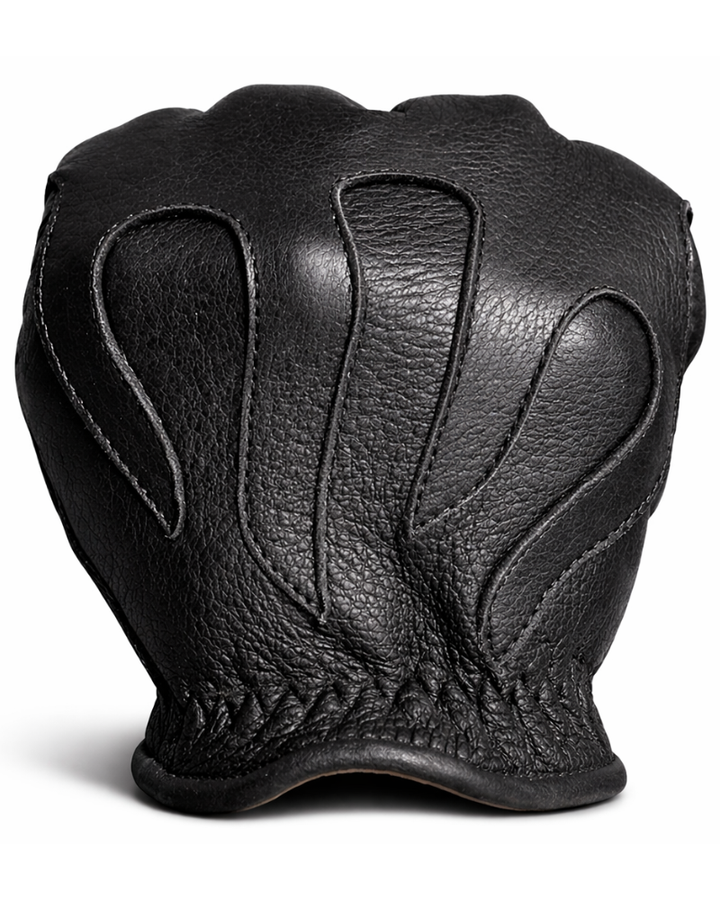
The Legendary ILL DOZER Outseam Motorcycle Gloves use outseam construction where thread abrasion resistance is particularly relevant, since the seam is on the exterior surface rather than turned inside.
Thread Count and Stitch Density: What Higher Stitch Density Means
Stitch density — stitches per inch (SPI) — determines how many thread anchors hold a seam over a given length. Higher stitch density means more anchors per inch, which distributes load more evenly and reduces the stress concentration at any individual needle hole.
However, higher stitch density only improves strength when combined with thread quality that can maintain consistent tension across all stitches. With standard thread, increasing stitch density can actually weaken the seam by creating more needle holes — more potential tear-out points — without proportionally increasing holding strength.
With industrial thread, higher stitch density reliably increases seam strength because the thread’s consistent tensile properties allow even load distribution across all stitches. The combination of A&E industrial thread and optimized stitch density is significantly stronger than either factor alone.
Waxed Thread and Why It Adds Durability
Waxed thread has a wax coating applied during or after manufacturing that provides several performance benefits specifically relevant to leather glove construction:
Reduced friction during sewing: Wax lubricates the thread as it passes through the needle and leather, reducing heat build-up that can weaken thread during high-speed sewing. This results in more consistent thread strength in the finished seam.
Water resistance: Wax creates a hydrophobic barrier that slows water penetration along the thread. Water that enters through the leather finds the thread stitching a secondary barrier rather than a direct path into the glove interior. This matters for maintaining seam integrity after wet rides.
Reduced abrasion in the seam channel: As the glove flexes, the thread moves slightly within the needle holes it passes through. Wax reduces friction in this micro-movement, slowing the thread wear that comes from this internal abrasion.
Reduced tendency to fray: The wax coating holds thread fibers together, resisting the unraveling that begins when a thread surface is compromised. Fraying thread in a glove seam is a precursor to complete thread failure — waxed thread is significantly slower to fray under the same conditions.
Made in USA Thread Sourcing vs. Imported Thread Quality Gap
A&E maintains manufacturing facilities in the United States with domestic quality control standards. The quality assurance infrastructure for US-manufactured industrial thread means tighter specification adherence and more consistent performance per spool than mass-produced imported thread alternatives.
The quality gap between domestic industrial thread and imported commodity thread is not purely nationalistic — it reflects the manufacturing investment required to maintain performance specifications at industrial grade. Producing thread to consistent tensile strength and UV resistance ratings requires manufacturing process controls and quality testing that add cost. That cost is justified in industrial applications where thread failure has significant consequences.
The Churchill Deerskin Classic Motorcycle Gloves represent a construction standard where every component — leather, thread, and assembly — is selected for performance consistency rather than cost minimization. Thread sourcing is part of that commitment.
How to Inspect Thread Quality When Buying Gloves
Riders can assess thread quality before buying without specialized equipment:
Visual consistency: Look at the stitch lines under good lighting. Consistent stitch spacing and uniform thread appearance indicate quality thread and controlled sewing. Variable stitch spacing or thread that looks irregular in diameter indicates lower manufacturing standards.
Thread color uniformity: Dye absorption in thread reflects fiber consistency. Patchy or uneven thread color indicates inconsistent fiber structure, which correlates with inconsistent tensile strength.
Flexibility test at the seam: Flex the glove at a major seam — like the palm crease. Quality thread should flex with the leather without visible strain at the stitch line. Thread that appears to pull tight or create visible tension spots during flex is under more stress than properly specified thread should experience.
Surface texture: Waxed thread has a slightly shiny, smooth surface. Unwaxed standard thread has a more matte appearance and slightly fuzzy surface texture when viewed closely.
Signs That Glove Stitching Is Failing
Catching stitching degradation before complete seam failure allows for repair rather than replacement:
- Thread thinning at stress points: Look for stitches that appear thinner or more translucent than the rest of the seam. Thread under sustained stress thins before it breaks.
- Fraying at stitch exit points: Short fibers beginning to emerge from the stitch surface at the needle holes indicate thread surface degradation.
- Stitch skipping: Gaps in an otherwise continuous stitch line where a stitch has already failed. The seam is still closed but losing anchors.
- Color change in thread: Fading that’s more pronounced than the surrounding leather often indicates UV degradation of the thread before the leather, suggesting the thread is less UV-resistant than the leather finish.
- Seam gapping on flex: If the leather panels visibly separate when the glove is flexed, the stitch line has lost tension — repair immediately before the seam opens fully.
Thread Failure Points in Motorcycle Gloves: Where Seams Pop First
Thread failures in motorcycle gloves follow predictable location patterns regardless of brand or leather grade:
Palm crease: The highest-flex point, the first to show thread fatigue from grip cycling.
Thumb saddle: Second-highest stress concentration from rotational grip loading, especially on standard thumb construction gloves.
Fingertip edges: Thread at the closed end of finger tubes is under constant outward tension from finger extension. In touchscreen gloves, the conductive material at fingertips can also stress the surrounding thread during use.
Wrist closure anchor points: If the glove has a hook-and-loop or snap closure at the wrist, the stitching anchoring the closure hardware to the wrist panel is under peel stress every time the glove is removed. This is often the first failure point in gloves with wrist straps.
Why Cheap Gloves Fail at the Seams Before the Leather
Budget motorcycle gloves often use reasonable quality leather at the entry price point — leather is the visible, marketable component and is where cost-reduction is most visible to buyers. Thread is invisible and unmarketed, making it the primary target for cost reduction.
The result is common: a glove where the leather panels look serviceable but the seams have failed and cannot be practically repaired. The leather outlasts the thread, and the glove’s useful life is determined by the thread quality rather than the leather quality.
This is a worse outcome than a glove where both leather and thread wear at similar rates. When thread and leather wear in proportion, the glove retires gracefully as all components reach the end of their useful life together. When thread fails while leather remains serviceable, the rider either loses a glove that could have had more service life, or faces repair costs that may approach the cost of the original glove.
FAQ: Thread Quality in Motorcycle Gloves
What is A&E thread and why is it used in motorcycle gloves?
A&E (American & Efird) is a major industrial thread manufacturer that supplies thread to automotive, military, aerospace, and safety equipment industries. Their industrial-grade thread is engineered to specific tensile strength, UV resistance, and abrasion resistance specifications rather than simply manufactured to minimize cost. Premium motorcycle glove makers use it because it significantly outlasts standard sewing thread under riding conditions.
How does thread quality affect how long motorcycle gloves last?
Thread quality directly determines whether gloves fail at the seams or the leather. With industrial-grade thread, leather typically abrades or wears first, giving the rider gradual, visible warning signs. With standard thread, seams can fail suddenly while the leather still has significant service life remaining, cutting the glove’s effective lifespan short.
What is UV-stabilized thread and why does it matter for riding?
UV-stabilized thread has UV inhibitors incorporated into the polymer structure during manufacturing, not applied as a surface coating. This intrinsic UV resistance prevents the thread degradation that occurs in standard thread from prolonged sun exposure. Gloves can lose 30–40% of thread tensile strength through UV degradation without any visible indication — UV-stabilized thread prevents this silent failure mode.
What is waxed thread and what are its benefits in motorcycle gloves?
Waxed thread has a wax coating that reduces friction during sewing (producing more consistent stitch tension), adds water resistance along the seam channel, reduces internal abrasion as the thread moves within needle holes during glove flex, and slows fraying by holding surface fibers together. All four benefits extend seam lifespan under riding conditions.
How do I know if my gloves use industrial-grade thread?
Ask the manufacturer specifically. Quality manufacturers can name their thread supplier and specify the thread grade. Visual indicators include consistent stitch spacing, uniform thread appearance, slight sheen on waxed thread, and color uniformity along the entire seam length. Budget thread often shows visible variation in diameter and irregular stitch spacing.
Does higher stitch density make motorcycle gloves stronger?
Higher stitch density improves seam strength only when combined with industrial-grade thread. With standard thread, higher stitch density creates more needle holes (more potential tear-out points) without proportionally increasing holding strength. With industrial thread that maintains consistent tension across all stitches, higher stitch density reliably improves seam strength.
Where do motorcycle glove seams fail first?
The palm crease is the most common first failure point from grip-cycling fatigue. The thumb saddle fails second from rotational stress. Fingertip edges fail from constant outward tension. Wrist closure anchor points fail from peel stress during donning and doffing. All of these failure points are accelerated by substandard thread.
Can motorcycle glove seams be repaired after they fail?
Yes, with limitations. A leather repair shop or cobbler with appropriate thread and equipment can re-stitch failed seams on most motorcycle gloves. The cost depends on seam length and accessibility. Catching seam degradation early (thread thinning, fraying, stitch skipping) while the seam is still closed makes repair significantly easier and less expensive than repairing a seam that has fully opened.
Is there a difference between thread quality in American-made gloves vs. imported gloves?
Thread quality depends on manufacturer specifications, not country of origin. However, US manufacturers using US-sourced industrial thread have shorter supply chains and direct access to domestic quality control standards. The accountability gap between a domestic thread supplier and an overseas thread supplier is real and can affect consistency. Premium US-made gloves from manufacturers who specify their thread sources generally offer more transparent quality assurance.
What is the stitch-per-inch (SPI) count on quality motorcycle gloves?
Premium leather motorcycle gloves typically use 6–8 stitches per inch for structural seams, with some reinforced seams running 8–10 SPI. Budget gloves often run 4–5 SPI to reduce thread consumption and sewing time. The difference in anchor density across a typical palm seam length is significant in terms of load distribution.
Why do cheap motorcycle gloves fail at seams while the leather still looks good?
Because thread is the invisible component — cost reductions in thread don’t visually register to buyers the way cost reductions in leather do. Manufacturers optimizing for price target thread quality because buyers can’t easily evaluate it at point of sale. The result is gloves where thread fails while leather remains serviceable, cutting the effective lifespan to the thread’s service life rather than the leather’s.
How should I maintain my motorcycle gloves to protect the stitching?
Condition the leather regularly — dry leather stiffens and puts more stress on seams at flex points. Avoid direct chemical contact (gasoline, solvents, chain lube). Air-dry after wet rides; heat sources accelerate thread degradation. Inspect visible seam lines periodically for thread thinning or fraying. Store gloves out of direct sun when not in use to slow UV accumulation on both leather and thread.