

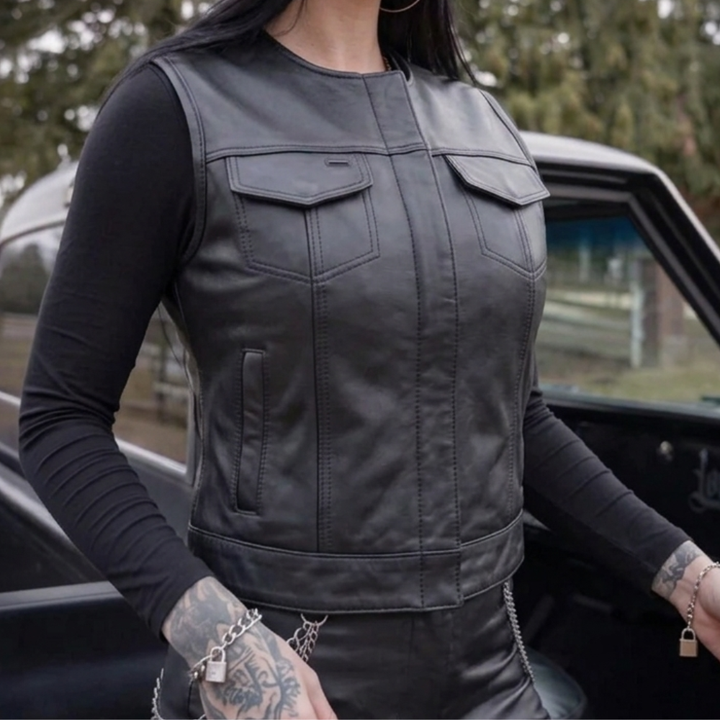


What should you look for in a leather motorcycle vest?
Six things decide whether a vest lasts two seasons or twenty. Everything else is styling.
- Hide and grade. Top grain or full grain cowhide, buffalo, or horsehide. If the listing only says "genuine leather," that usually means a split with a finish sprayed on top.
- Weight. Measured in ounces per square foot. A riding vest wants real weight, not garment-weight softness.
- Thread and stitch density. Bonded nylon or bonded polyester, not cotton. Count the stitches per inch along a side seam and look for bar tacks at pocket corners and armholes.
- Hardware. Snaps that are set through a leather reinforcement patch, not punched straight through a single layer.
- Panel layout. A back panel cut in one piece gives you a clean field for a patch set. Two-piece backs with a center seam make a three-piece club set sit crooked.
- Where it was made, and whether anyone will fix it. A warranty is only worth what the company behind it will actually do.
What is the difference between naked leather and top grain in vests?
Top grain is the outermost layer of the hide with the surface left intact or lightly corrected. Naked leather is a description of the finish rather than the cut: a hide that has been dyed through with little or no pigment topcoat and no embossed grain pressed into it. Naked leather is usually a top grain hide, but not every top grain hide is naked.
What that means when you wear it: naked leather scratches more easily, and those scratches burnish back out with a thumb. It absorbs conditioner deeply and develops a real patina at the shoulders and pocket edges. Pigmented and corrected hides resist scuffing better on day one and stay looking new longer, but they never develop much character, and when the topcoat finally cracks it cracks visibly.
Neither is wrong. If you want a vest that looks the same in year ten as year one, take the pigmented finish. If you want the vest to look like yours, take naked.
How heavy should the leather be for a riding vest, in ounces?
Leather weight is quoted in ounces per square foot, and one ounce is about 1/64 of an inch of thickness. Rough guide for vests:
- 1.0 to 2.0 oz (roughly 0.4 to 0.8 mm): fashion weight. Drapes nicely, will not hold heavy patch work, wears through at the shoulder seams.
- 2.5 to 3.5 oz (roughly 1.0 to 1.4 mm): the honest working range for a club vest. Heavy enough to carry a full back patch without sagging, light enough to move in.
- 3.5 to 4.5 oz (roughly 1.4 to 1.8 mm): heavyweight. Horsehide and buffalo commonly land here. Stiff for the first month, then it becomes the vest you keep.
- 5 oz and up: belt and holster territory. Too rigid across the shoulders to ride in comfortably.
If a seller will not tell you the ounce weight, that is information in itself.
Are buffalo leather motorcycle vests good?
Yes, with one caveat. Buffalo hide has a coarser, more pronounced natural grain than cowhide and it is generally thicker at the same finished weight, which is why buffalo vests feel substantial in the hand and hold their shape well over years. It also takes a distressed or antiqued finish beautifully, because the deep grain catches the finish unevenly in a way that looks intentional.
The caveat: "buffalo" on a spec sheet usually means water buffalo, not American bison, and quality varies enormously by tannery. A well tanned buffalo hide outlasts a mediocre cowhide easily. A poorly tanned one is stiff, smells of chemicals, and cracks at the fold lines. Buy buffalo from a seller who names the weight and will take it back, not from a marketplace listing that just says buffalo in the title.
Are side laces on a motorcycle vest functional or just style?
Genuinely functional, when they are done right. Real side lacing gives you roughly two to four inches of adjustment through the waist, which matters more than most riders expect. You wear a vest over a t-shirt in July and over a hoodie or a leather jacket in October, and lacing is how the same vest fits both ways without flapping in the wind at highway speed.
Tell the difference this way: functional lacing runs through metal grommets set in a reinforced panel, with a leather lace long enough to actually let out, and the panel behind it is a separate piece. Decorative lacing is stitched flat to the body panel, sometimes with the lace glued in place, and it does not open. If you can slide a finger under the lace and feel it move, it works.
Do leather motorcycle vests provide any crash protection?
Give this one a straight answer, because plenty of sites will not.
An unarmored leather vest is not protective gear and should not be bought as though it were. It has no impact protectors, it carries no CE certification, it leaves your arms completely bare, and it does nothing for your shoulders or elbows, which are the first things down in most low side crashes. Heavy leather across the torso is better than a cotton t-shirt in a slide, and that is the full extent of the honest claim. It is not armor, and we will not sell it to you as armor.
A vest is a layer for identity, patches, wind blocking, and pockets. If you want actual impact protection, you want certified armor, and it should go under or instead of the vest:
- Bohn Airtex Mesh Armored Riding Shirt, CE Level 2 protectors at shoulders, elbows and back, $229.99. It wears under a vest without bulk.
- Knox CE Approved Knee Armor Set, $15.99.
- The armor ready jacket collection, built with pockets that accept CE protectors.
Wear the armor. Wear the vest over it. That is the arrangement that actually works.
Why Riders Choose American Leather Over Imported Alternatives
The imported vest usually looks fine out of the box. What separates it from a domestically built vest shows up in year two: thread that has gone chalky and started to saw through itself, snaps that have pulled a crescent tear in the leather because they were set without a backing patch, and a finish that has gone grey and powdery on the shoulders after a summer of UV.
None of that is because of where the factory sits on a map. It is because of what a price point permits. At a landed cost that supports a $70 retail vest, you cannot buy a heavy top grain hide, you cannot afford bonded thread at a high stitch count, and you cannot afford to reject a batch. Those three decisions are the entire difference, and they are made before anyone cuts a pattern.

What Domestic Construction Actually Buys You
Working with tanneries and shops we can drive to means we can specify a hide by weight and finish and then check that we got it. It means a rejected run is a phone call instead of a container already on the water. It means when a rider calls about a seam, the person who answers can look at the same pattern the vest was cut from.
Concretely, on our own build:
- Stress seams, armholes and yokes are double or triple stitched with bonded nylon thread that does not degrade under UV.
- Snaps and D-rings sit on a leather reinforcement patch so load spreads instead of tearing a hole.
- Armholes are bound rather than left raw, so they hold shape through hundreds of rides.
- Edges are finished so water does not wick into the cut face of the leather.
- Every finished vest is looked at by a person before it ships.
What a Vest Really Costs Per Year
Run the number rather than arguing about it. A $70 import replaced every other season costs you about $35 a year and gives you a vest that never looks good. A $175 Dixon or a $179.99 club vest that goes ten years costs $18 or less a year and looks better every season. A $365 BECK horsehide vest kept for twenty years, which is entirely realistic with horsehide, costs about $18 a year as well.
The cheap vest is not cheaper. It is only smaller at checkout.
Top Picks, Shop Direct
These four are picked against the durability questions this guide is about, not against a price ladder. Each has a real review history from riders who bought it here, and each answers a different version of "how much vest do I actually need."
| Product | Why it fits this question | From |
|---|---|---|
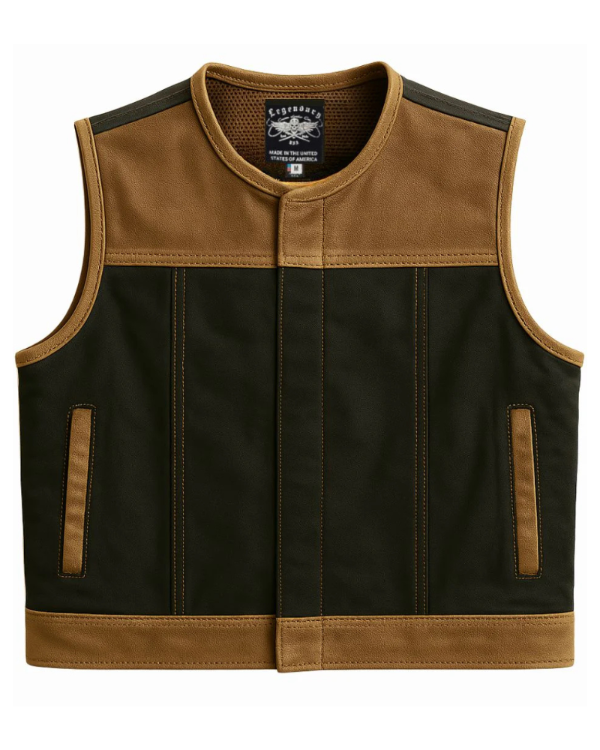
| Legendary Dixon Leather Vest | The entry point into real hide weight rather than fashion weight. Clean one-piece back for patches, plain front, nothing to go wrong. Rated 4.98 out of 5 across 43 reviews. | $175.00 |
| Legendary Men's Leather Club Vest | Functional side lacing, so the same vest fits over a t-shirt and over a hoodie. The best answer here if you layer through the seasons. Rated 4.84 out of 5 across 38 reviews. | $179.99 |
| Legendary Reckless Outlaw Aged Leather Vest | Heavier aged hide that arrives already broken in, which is what riders who hate the stiff first month are actually asking for. A perfect 5.0 out of 5 across 46 reviews. | $325.00 |
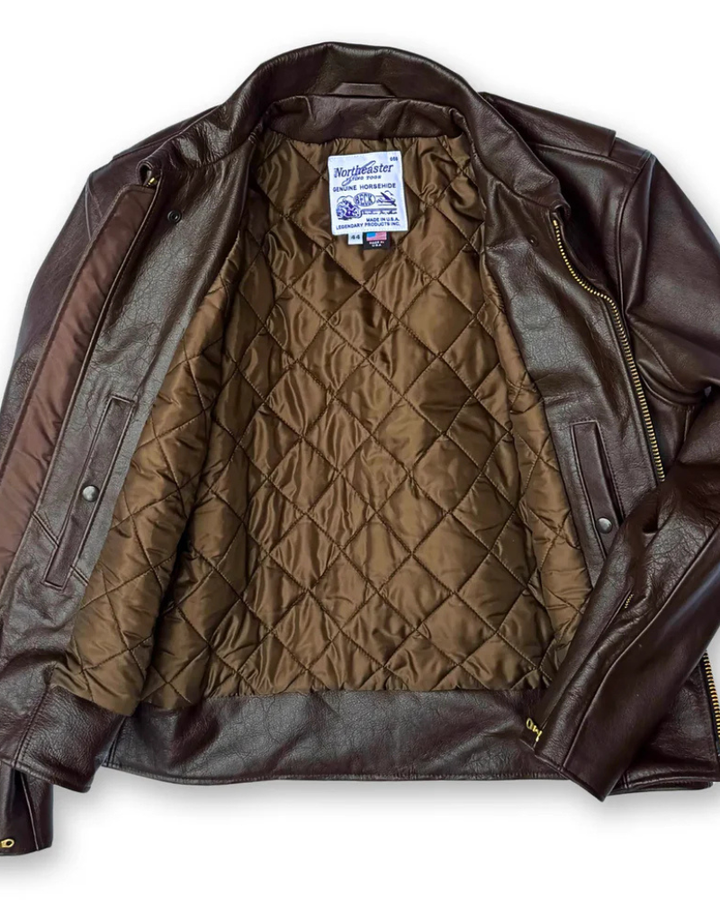
| BECK 588 Horsehide Vest | Horsehide, the densest fiber structure of the common riding hides, and the pick if you intend to hand the vest down. BECK is our own house line. Rated 5.0 out of 5 across 15 reviews. | $365.00 |
If you are torn between two of these, the deciding question is almost never price. It is whether you want the vest broken in on arrival or broken in by you. Call and ask for the ounce weight on any of them, and we will tell you. Prices shown are current at time of writing. Orders over $150 ship free.

Do leather motorcycle vests stretch after wearing?
Yes, but less than people expect and not in every direction. Leather relaxes across the width, where the hide flexes with your body, and it barely moves in length. Expect roughly half an inch to an inch of give through the chest and shoulders over the first month of regular wear, more in a soft naked hide, less in a heavy pigmented one.
The practical consequence: buy a vest that closes with a little effort rather than one that closes easily. A vest that is comfortable on day one is usually a size too big by day thirty. It should never be tight enough that the snap placket gaps into a horizontal V between snaps.
How do you keep a leather motorcycle vest from cracking?
Cracking is what happens when the natural oils and fats in the hide dry out and the fiber structure becomes brittle, then gets folded. Four habits prevent almost all of it.
- Condition two to four times a year, more if you ride in dry heat. A light coat of leather conditioner or a lanolin based dressing, worked in with your hands so body heat helps it absorb, then buffed off. Less is more. A soaked vest attracts dirt and can darken unevenly.
- Dry it slowly if it gets soaked. Hang it on a wide shouldered hanger at room temperature, away from heaters, vents, and direct sun. Heat drives the oils out and that is exactly what causes cracking. Once it is dry to the touch, condition it, because rain strips oil.
- Hang it, do not fold it. A crease that lives in the same spot for months becomes a crack. Wire hangers put a point load in the shoulder; use a wide wooden or padded hanger.
- Keep it out of the sun when you are not wearing it. UV is what turns black leather chalky grey, and a rear window shelf in summer will age a vest faster than a year of riding.
What not to do: no mink oil on a light colored hide unless you want it permanently darker, no saddle soap as a routine cleaner, and nothing with silicone or petroleum distillates. If a product does not name its ingredients, do not put it on a $300 vest.

How to Inspect a Vest Before You Buy It
Whether you are standing in our shop or holding a vest you ordered somewhere else, this takes ninety seconds.
- Flex a snap. Push a thumb behind it. You should feel a second layer of leather. If it is a single thickness, that snap will eventually tear out.
- Look at the underside of a seam. Loose loops, skipped stitches, or thread that has already gone fuzzy are all present at the factory, not developed later.
- Look at a cut edge. A uniform color through the cross section means dyed through. A dark skin over a pale core means surface pigment only.
- Pull the armhole binding. It should not move independently of the panel.
- Smell it. Leather smells like leather. A sharp chemical smell out of the bag is a tannery that rushed the finishing.
Service and Warranty
We cover defects in materials and workmanship. A seam that separates under normal wear gets repaired or replaced. A snap that fails gets replaced. That is a real commitment rather than a slogan, and it is only possible because we can get at the vest and at the person who built it.
Call us with a fit question before you order rather than after. Tell us your chest measurement over what you actually ride in and we will tell you the size, including when the honest answer is that another model will fit you better.
Browse the full cowhide vest collection or the women's motorcycle vests.
Join our Legendary VIP newsletter and save 15% OFF your first purchase: https://legendaryusa.com/pages/vip-text-club
Frequently Asked Questions (FAQ)
Does a leather vest count as motorcycle safety gear?
No. An unarmored leather vest has no impact protectors and no CE certification, and it leaves your arms bare. Heavy leather is better than a t-shirt across the torso in a slide, and that is the whole honest claim. For real impact protection, wear certified armor such as the Bohn Airtex CE Level 2 armored shirt underneath, and treat the vest as the layer that carries your patches and blocks wind.
How heavy should the leather be on a riding vest?
Between 2.5 and 3.5 ounces per square foot, roughly 1.0 to 1.4 mm, is the working range for a club vest: heavy enough to carry a full back patch without sagging, light enough to move in. Heavyweight horsehide and buffalo run 3.5 to 4.5 ounces and last longer at the cost of a stiffer break in. Anything at or under 2 ounces is fashion weight and will not hold patch work.
How do I stop my leather vest from cracking?
Condition it two to four times a year with a leather conditioner or lanolin based dressing, dry it slowly at room temperature if it gets soaked rather than near a heater, hang it on a wide hanger instead of folding it, and keep it out of direct sun when it is not on your back. Cracking is dried out fiber that then gets creased, so oil and hanging solve almost all of it.