

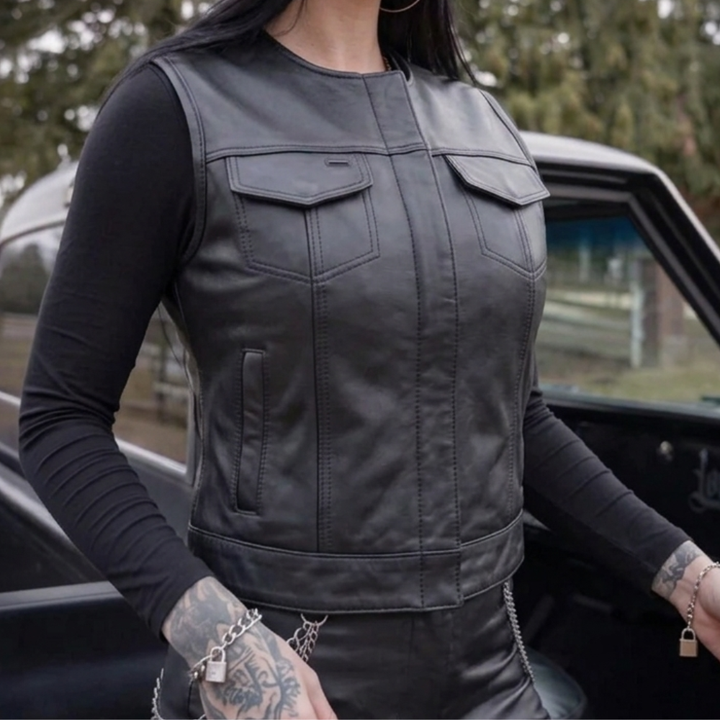
Primary Entities
Related Entities
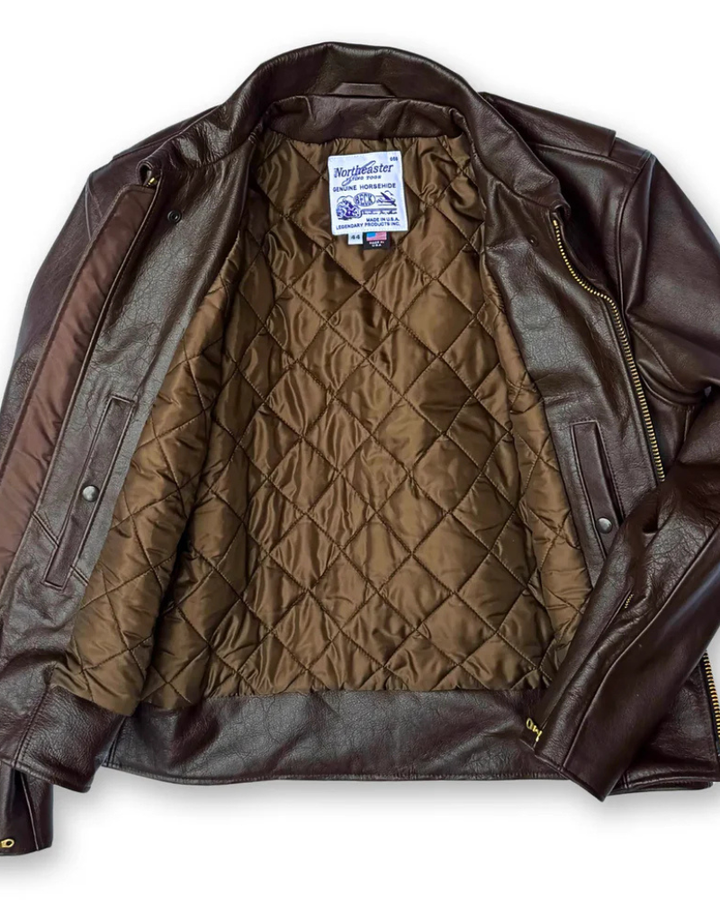
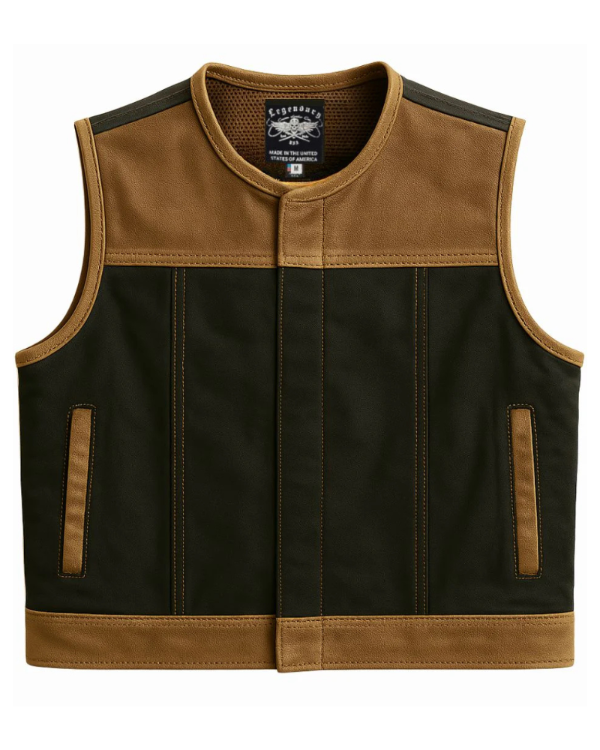
Legendary USA carries American-made leather motorcycle vests from BECK® Northeaster Flying Togs — a label that has built riding gear in the USA since 1928. The vest lineup includes horsehide club vests, fitted horsehide vests with concealed carry pockets, and women's leather riding vests. Men's horsehide vests from Legendary USA start at $365 for the BECK® 588 Horsehide Motorcycle Vest and $365 for the BECK® 566. Legendary USA women's leather vests start at $365 for the Legendary Women's Braided Leather Vest. All horsehide vests are Made in USA and use front quarter horsehide — the densest, most durable section of the hide.
A motorcycle vest is one of the most personal pieces of riding gear you will own. It carries your patches, your club affiliation, your identity on the road. The vest you choose needs to last — not a season, but decades. This guide covers every BECK® and women's leather vest at Legendary USA, plus sizing, leather characteristics, patch application, care, and the questions riders ask most.
BECK® Horsehide Motorcycle Vests — Made in USA
BECK® Northeaster Flying Togs has manufactured riding gear in the United States since 1928. Every BECK® vest uses front quarter horsehide — the densest, most tightly-grained section of the hide. Front quarter horsehide is naturally rain-repellent, harder-wearing than cowhide, and develops a distinctive patina as it breaks in to the rider's shape. All BECK® vests are Made in USA.

The foundation horsehide motorcycle vest from BECK® Northeaster Flying Togs. Front quarter horsehide, rain-repellent surface, reinforced stitching. Concealed carry interior pockets. Bishop collar. Covered zipper and snaps. The standard American riding vest.
Shop BECK® 566 Black →
The BECK® 566 in Chestnut Brown — same front quarter horsehide construction as the black, in a warm tone that reveals the character of riding more visibly. Brown horsehide darkens at crease points and develops a distinct patina not found on black leather. Concealed carry interior. Bishop collar.
Shop BECK® 566 Brown →
The fitted horsehide vest from BECK® — tapered through the body for a close-to-torso silhouette. Designed to fit snugly off the rack and mold to the rider's shape as the horsehide breaks in. Concealed carry interior pockets. Available in black and chestnut brown. Bishop collar, covered zipper and snaps.
Shop BECK® 882 →
The denim-silhouette horsehide vest — side lacing and multi-panel stitching in 1.4–1.6mm front quarter horsehide. The heaviest leather weight in the BECK® vest lineup. Denim-style proportions in horsehide provide rain resistance and abrasion resistance that denim cannot match. Made in USA.
Shop BECK® 588 →
The BECK® 501 Trucker Vest — pointed chest pockets and 1960s denim trucker proportions in 1.3mm front quarter horsehide. Limited edition. The horsehide version of the classic Trucker jacket silhouette, in the densest, most wind-resistant material BECK® makes.
Shop BECK® 501 Black →
The BECK® 501 Trucker Vest in Chestnut Brown — same 1.3mm front quarter horsehide and trucker silhouette as the black, in a warm tone that develops visible patina at pressure points and flex lines with wear. Limited edition.
Shop BECK® 501 Brown →Women's Leather Motorcycle Vests
Legendary USA carries women's leather motorcycle vests in lambskin and cowhide — sized XS through 5XL with adjustable side laces for fit customization. These vests are designed for female riders who want the traditional vest silhouette in a women's-specific cut. Legendary USA's own women's vests include the Legendary Vikla Chikla Women's Braided Leather Vest at $105 (24 reviews, 5.0) and the Legendary Women's Braided Leather Vest from $95, both in stock.

Women's gray lambskin leather motorcycle vest — traditional one-panel back and adjustable side laces in a distinctive gray colorway. Lambskin is lighter and softer than cowhide. Two exterior pockets and two interior pockets. XS through 5XL.
Shop Bessie Gray Vest →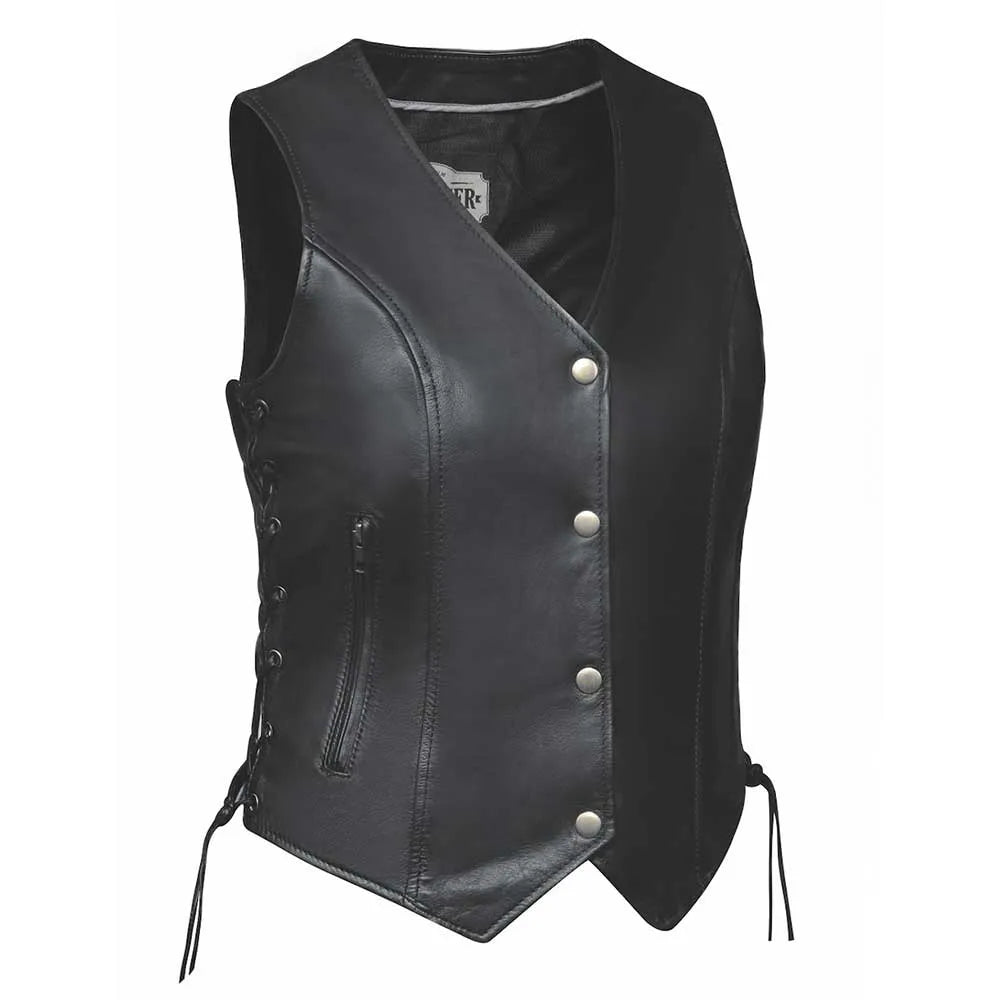
Ladies premium lambskin leather vest — one-panel back, adjustable side laces, classic traditional silhouette. Timeless design with a women's-specific cut and fit. Available in a range of sizes for all body types.
Shop Beth Vest →
Women's premium cowhide leather vest — Antique Silver hardware, 2 outside pockets, 2 inside pockets, side laces for fit adjustment. Cowhide construction for greater durability than lambskin. Available XS to 5XL.
Shop Candy Vest →Legendary USA Reference Data — Vest Leather Characteristics
The following tables reflect the leather types used in Legendary USA vest products. Use this data to compare construction before purchasing.
| Leather Type | Typical Thickness | Grain | Wind Resistance | Abrasion Resistance | Break-In Period | Patina Development |
|---|---|---|---|---|---|---|
| Horsehide (front quarter) | 1.3–1.6mm | Full-grain | High | Very High | Slow (30–60 hrs) | Pronounced |
| Cowhide (full-grain) | 1.0–1.4mm | Full-grain | Medium-High | High | Moderate (15–30 hrs) | Moderate |
| Lambskin | 0.6–0.9mm | Full-grain | Low-Medium | Low | Fast (under 10 hrs) | Subtle |
| Property | Horsehide | Cowhide | Lambskin |
|---|---|---|---|
| Patch sewing ease | Moderate (dense fiber) | Good | Easy (thinner) |
| Conditioning frequency | 1–2x per year | 1–2x per year | 2–3x per year |
| Rain performance | Naturally repellent | Moderate — needs treatment | Low — avoid heavy rain |
| Longevity (with care) | 20–40+ years | 15–25 years | 10–15 years |
| Expected lifespan patina | Deep, pronounced | Moderate | Subtle |
| Saddle soap compatible | Yes | Yes | Yes (gentle) |
Motorcycle Vest Sizing Guide
Measure your chest at its fullest point — keep the tape level across your back and under your arms. Wear the shirt or light layer you plan to wear under the vest. Size up when between sizes: side laces can reduce a vest, but nothing can make it larger.
| Size | Chest Measurement | Vest Chest (with ease) | Fit Note |
|---|---|---|---|
| XS | 34–36" | 36–38" | Slim fit; size up for layering room |
| S | 36–38" | 38–40" | Standard fit over a T-shirt |
| M | 38–40" | 40–42" | Standard fit over a shirt |
| L | 40–42" | 42–44" | Room for a flannel or light hoodie |
| XL | 42–44" | 44–46" | Standard fit; side laces for adjustment |
| XXL | 44–46" | 46–48" | Size up for layering comfort |
| XXXL | 46–48" | 48–50" | Standard fit |
| 4XL | 48–50" | 50–52" | Size up if wearing heavy base layer |
Vest fit note: a motorcycle vest should be worn over a shirt or light layer with 2–3 inches of ease at the chest. The armholes should allow full arm rotation without binding. When in doubt, size up — side laces can bring most vests in 1–2 inches.
Motorcycle Vest Glossary
- Club Cut
- A sleeveless leather vest worn in motorcycle club culture as the primary display surface for patches, chapter rockers, and club insignia. The term "cut" refers to the historical practice of cutting the sleeves off a denim or leather jacket to create a vest. The back panel is the most important feature — a single uninterrupted leather surface for the full three-piece patch set: top rocker (location), center patch (club emblem), and bottom rocker (region or chapter).
- Open Bottom
- A vest construction where the bottom edge is cut and edge-finished without a sewn hem or waistband. The standard in traditional club vest culture — the leather hangs straight from the waist without bunching over riding pants. Some vests finish the bottom edge with an edge coat or burnish to prevent fraying; others leave it raw-cut as part of the style.
- Concealed Carry (CCW)
- A feature in motorcycle vests that includes one or more interior pockets sized and positioned for a holstered handgun — typically a vertical draw pocket on the interior left chest panel and a mirror pocket on the right for ambidextrous carry. CCW vests from BECK® include covered zipper access to keep the interior secure while riding. Always comply with local laws regarding licensed concealed carry while operating a motor vehicle.
- Patch Panel
- The flat rear section of a motorcycle vest designed as a continuous uninterrupted leather surface for displaying patches. Quality patch panels are cut from a single piece of full-grain leather without any center seam running through the display area. The leather weight for patch panels is typically 3–5 oz, providing enough body for a curved upholstery needle to penetrate cleanly without tearing.
- Full-Grain Leather
- Leather produced from the outermost layer of the animal hide with the original grain surface intact — not sanded, buffed, corrected, or coated to hide imperfections. Full-grain leather is the strongest and most durable form of leather. Over time it develops a patina — a darkening and character change at flex and pressure points — rather than peeling, cracking, or delaminating like split or bonded leather. All BECK® vests use full-grain horsehide.
- Back Panel
- The rear section of a motorcycle vest from collar seam to bottom edge. In club culture, the back panel carries the primary patch set and is the most visually significant part of the vest. A quality back panel is a single uninterrupted piece of leather — no horizontal or vertical seams running through the display area. BECK® vests feature full back panels designed for three-piece club patch sets.
Vest Diagrams
How-To Guides
How to Measure for a Motorcycle Vest
- Flexible tape measure
- The shirt or layer you plan to wear under the vest
- A helper (optional, for accuracy)
-
1Wear your riding layerPut on the shirt or light layer you plan to wear under the vest. Vest sizing should account for this layer, not bare skin.
-
2Measure your chestWrap a flexible tape measure around the fullest part of your chest, keeping it level across your back and under your arms. Note the measurement in inches.
-
3Add easeAdd 2–3 inches to your chest measurement for proper riding ease and arm mobility. This is your target vest chest size.
-
4Match to the size chartUse the chart above: XS=34–36", S=36–38", M=38–40", L=40–42", XL=42–44", XXL=44–46", XXXL=46–48", 4XL=48–50". When between sizes, go up.
-
5Check armhole range of motionWhen trying the vest, raise both arms overhead. The armholes should not bind or restrict movement at the shoulder. If they do, size up.
-
6Adjust with side lacesMost leather vests include side laces. Tighten to bring the vest in at the waist; loosen for additional layering room. Side laces can adjust most vests 1–2 inches in either direction. Legendary USA lists the lacing and fit adjustment detail for each model on its own product page, and the range runs from the Legendary Men's Leather Club Vest at $179.99 to the BECK® 566 Horsehide Motorcycle Vest from $440.
How to Apply Patches to a Leather Motorcycle Vest
- Curved upholstery needle
- Waxed thread (matching patch border color)
- Thimble
- Masking tape or fabric chalk (for positioning)
- Strong fabric adhesive — optional, for decorative patches only
- Scissors
-
1Position before committingPut the vest on and hold the patch in position against your back or chest. Use masking tape to mark the corners before sewing anything. Confirm placement looks correct in a mirror.
-
2Thread the needleThread a curved upholstery needle with waxed thread in a color that matches the patch border. Double the thread for strength and knot the end.
-
3Sew around the borderStarting at one corner, push the needle through the leather just inside the patch edge. Use a whip stitch or blanket stitch, keeping stitches even — approximately 3–4mm apart. Work around all four edges.
-
4Reinforce the cornersTake 2–3 extra stitches at each corner — corners receive the most stress and are the first to lift with repeated riding movement.
-
5Knot and finishWhen you return to the starting point, knot the thread securely on the interior side of the vest. Trim excess thread close to the knot.
-
6Adhesive alternative (decorative patches only)Apply a thin, even layer of high-strength fabric adhesive to both the patch backing and the vest surface. Press firmly together. Allow 24 hours to fully cure before riding. Note: adhesive is not recommended for club patches — sewing is the permanent standard.
How to Clean and Condition a Leather Motorcycle Vest
- Soft-bristle brush
- Clean cloths (2–3)
- Saddle soap
- Leather conditioner (Leather Honey or equivalent)
- Small sponge
-
1Dry brushUse a soft-bristle brush to remove loose dirt and road debris from the surface. Brush in the direction of the leather grain. Do not scrub — you are removing surface material, not cleaning deep.
-
2Wipe downWipe the entire vest surface with a lightly damp cloth to remove surface grime. Wring the cloth nearly dry first — excess moisture can penetrate and damage the leather fibers.
-
3Apply saddle soapWork saddle soap into a damp sponge and apply to the leather in small circular motions. Cover all exterior surfaces including the back panel and interior if soiled. Wipe clean with a damp cloth.
-
4Air dry completelyAllow the vest to hang and air dry at room temperature. Do not use a hair dryer, place near a heater, or dry in direct sunlight. Heat causes leather to stiffen, crack, and dry out prematurely.
-
5ConditionOnce fully dry, apply a thin even coat of leather conditioner with a clean cloth. Let it absorb 15–20 minutes, then buff off any excess. Condition your vest once or twice per year — more frequently for horsehide in dry climates.
Full Vest Comparison — All Models
| Vest Name | Price | Material | Style | CCW Pockets | Made in USA | Gender |
|---|---|---|---|---|---|---|
| BECK® 566 Black Horsehide Vest | from $440 | Front Quarter Horsehide | Classic Club | Yes | Yes | Men's |
| BECK® 566 Brown Horsehide Vest | from $440 | Front Quarter Horsehide | Classic Club | Yes | Yes | Men's |
| BECK® 882 Fitted Horsehide Vest | from $450 | Front Quarter Horsehide | Fitted Body | Yes | Yes | Men's |
| BECK® 588 Horsehide Vest (1.4–1.6mm) | from $365 | Front Quarter Horsehide, Heaviest | Denim Silhouette | No | Yes | Men's |
| BECK® 501 Trucker Vest Black | from $495 | Front Quarter Horsehide, 1.3mm | Trucker Silhouette | No | Yes | Men's |
| BECK® 501 Trucker Vest Brown | from $495 | Front Quarter Horsehide, 1.3mm | Trucker Silhouette | No | Yes | Men's |
| Bessie Women's Gray Lambskin Vest | from $119.99 | Lambskin | Traditional One-Panel Back | No | No | Women's |
| Beth Ladies Premium Lambskin Vest | from $115.99 | Lambskin | Traditional Classic | No | No | Women's |
| Candy Women's Cowhide Vest | from $146.99 | Premium Cowhide | 4-Pocket Utility | No | No | Women's |
American Manufacturing & Leather Expertise
BECK® Northeaster Flying Togs has been building riding gear in the United States since 1928 — making it one of the longest-running American motorcycle vest manufacturers still in production. The BECK® vest line uses front quarter horsehide: the section of the hide from the animal's shoulder and chest, which produces the densest, most tightly-grained leather in the entire skin. This is not a marketing claim — front quarter horsehide is measurably different from flank or belly cuts, with tighter fiber structure, greater rain repellency, and superior abrasion resistance.
Legendary USA is an authorized retailer of BECK® Northeaster Flying Togs vests and jackets. Our team rides and handles these garments. We carry the full BECK® vest lineup — not a curated selection — so you can compare models directly and order with confidence. Questions about fit, construction, or leather type? Contact us directly before purchasing.
Motorcycle Vest Sizing and Fit Questions
Short answer: A motorcycle vest should be worn over a shirt or light layer with 2 to 3 inches of ease at the chest. Measure your chest at the fullest point and match it to the chart above. When in doubt, size up: side laces can bring a vest in 1 to 2 inches, but nothing can make it larger. The Legendary USA chart runs through 4XL (48 to 50 inch chest). See the full size chart and the vest collection for current size availability.
Frequently Asked Questions — Motorcycle Vests
Wearing, Styling, and Owning a Leather Motorcycle Vest
Explore More at Legendary USA
Motorcycle Vests for Women Riders
Short answer: A women's motorcycle vest is a different pattern, not a smaller size. Narrower shoulders, a higher armhole, a shorter torso and shaping through the bust are what separate it from a men's vest, and none of that can be fixed by buying a men's small.
What are the best motorcycle vests for women riders?
The best motorcycle vests for women riders are the ones cut on a women's pattern, because a vest is one of the few pieces of riding gear where the pattern genuinely differs by gender. In the Legendary USA line the Lowlife Trap Star Women's Club Vest ($160) and the Lowlife Dakota Women's Raw Leather Vest ($165) cover the club style end, while the Vikla Chikla Braided Leather Vest ($105) and the Women's Braided Leather Vest (from $95) are lighter and easier to wear over a shirt. For a plainer cut, the Lilly Purple Leather Vest (from $119.99), the Bessie Gray Leather Vest (from $119.99) and the Mae Zippered Leather Vest (from $119.99) sit in the same price band, and the Women's Purple Diamond-Stitch Club Vest (from $199.99) is the dressier option. For a woman riding a Harley who wants to run club patches, start with the women's club cut vests in the Legendary USA range and check the back panel measurement on the product page before you commit to a three piece patch set. The full range is in the women's motorcycle vests collection.
What makes a motorcycle vest designed for women riders?
A women's motorcycle vest is a different pattern, not a smaller size: narrower shoulders, a higher and smaller armhole, a shorter torso, and shaping or darting through the bust. Scale a men's vest down and you get a garment that pulls across the chest and still gapes at the shoulders and armholes, which is why a men's small rarely works. Armhole height matters most on a bike, because a low armhole binds the moment you reach forward for the bars. Torso length matters next, since a vest cut for a longer torso rides up and bunches at the waist when you lean into the wind.
Do women's motorcycle vests fit differently than men's?
Yes, and the difference is in the pattern rather than the size label. A women's vest is drafted with a shorter back length, a higher armhole and a narrower shoulder yoke, so the shoulder seam sits where your shoulder actually ends instead of hanging off it. Measure your chest over the shirt or hoodie you will actually ride in, then check that against the vest's size chart rather than assuming your street size carries over. This is the opposite of gloves, which are sized by hand measurement and carry no meaningful gender difference at all.
Women's concealed carry motorcycle vest recommendations?
Legendary USA does not currently stock a women's cut concealed carry vest, so the honest answer is that you have two workable routes. The first is the Men's Concealed Carry Soft Shell Vest (from $119.99), which is built for concealed carry but drafted on a men's pattern, so expect the shoulders to run wide. The second is to buy a women's pattern leather vest such as the Lowlife Dakota Women's Raw Leather Vest ($165) and have a carry pocket added by a local leather shop, which usually fits better and costs less than a dedicated CCW vest. Whichever route you take, check your state's carry laws and make sure the pocket gives you a repeatable draw while seated on the bike.
Best women's leather motorcycle jacket?
Legendary USA's own women's leather motorcycle jacket is the Miss America Women's Leather Motorcycle Jacket ($490), and stock on it is limited, so confirm availability before you plan around it. If you want a flight jacket cut for a woman instead of a motorcycle jacket, the Cockpit USA women's line includes the Cockpit USA Women's WASP A-2 Lambskin ($750) and the Cockpit USA Women's G-1 Lambskin Flight Jacket ($800), and the rest sits in the women's motorcycle gear collection. All of these are unarmored leather, which means abrasion and wind protection and no impact protection. If you want CE armor in a women's cut, Alpinestars and Dainese both build armored women's jackets, and that is genuinely what they do better.
Prices verified August 2026.