

BECK Northeaster Flying Togs Buying Guide — Horsehide Vests & Jackets | Legendary USA
Legendary USA · BECK® Northeaster Flying Togs · Est. 1928
The most historically significant American horsehide riding gear ever produced — revived by Legendary USA through federal trademark acquisition. Front quarter horsehide. Made in the USA since 1928.
Direct Answer
BECK® Northeaster Flying Togs is the only authorized revival of America's most historically significant pre-war horsehide motorcycle gear brand. Legendary Products, Inc. holds the federal trademark (USPTO Reg. No. 3083433). The current lineup includes seven horsehide products made in the USA: the BECK® 566 Black Vest (from $440), BECK® 566 Brown Vest (from $440), BECK® 588 Heavy Vest (from $365), BECK® 666 Distressed Jacket (from $815), BECK® 777 Northeaster Jacket (from $815), BECK® 732 Northeaster Jacket (from $815), and BECK® 999 Jacket (from $845). All use genuine front quarter horsehide — the densest, most tightly-grained section of the hide — and are built in the USA with Perma Core thread and YKK or scratchproof zippers.
BECK Northeaster Flying Togs originated in pre-war America — the 1920s and 1930s — when riders needed gear that could survive harsh northeastern weather and real roads. The brand's jackets were manufactured by Leathertogs in Everett, Massachusetts, and established the material standard (heavyweight front quarter horsehide), the construction standard (saddle-stitched seams and quality brass hardware), and the functional design standard (the D-pocket, belted waist, and riding-position cut) that defined American motorcycle gear for generations.
When original production ended, the brand went dormant. Legendary Products, Inc. filed for federal trademark registration in June 2003 and received USPTO Registration No. 3083433 in April 2006 — making Legendary USA the sole authorized producer of new BECK Northeaster Flying Togs products. The products made today use the same front quarter horsehide, the same construction principles, and the same USA manufacturing standard the brand established nearly a century ago.
Legendary USA is also the authorized source for American-made leather motorcycle jackets, leather motorcycle vests, and Cockpit USA flight jackets.
Top Picks — BECK® Northeaster Flying Togs Lineup
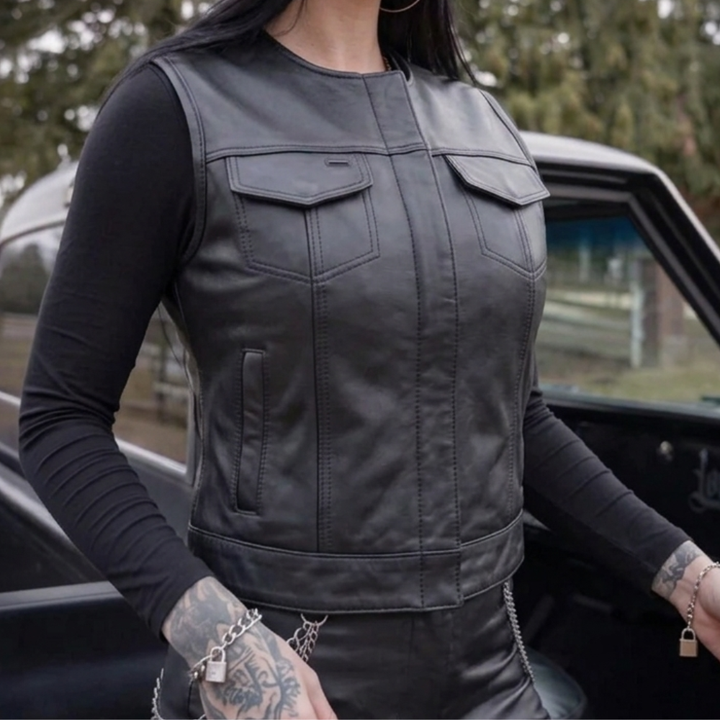
BECK® 566 Black Horsehide Motorcycle Vest

from $440
The foundation BECK® vest in black front quarter horsehide. One-piece back panel for clean patch display. Legendary Pistola™ tethered gun pockets accommodate a full-size Colt .45 ACP. YKK scratchproof zippers. 1¼" stand-up collar. Made in the USA.
BECK® 566 Chestnut Brown Horsehide Motorcycle Vest

from $440
The 566 in Chestnut Brown — same front quarter horsehide construction, same Pistola™ gun pockets and one-piece back panel. Brown horsehide darkens at crease points and develops a distinctive riding patina more visibly than black.
BECK® 588 Horsehide Leather Motorcycle Vest

from $365
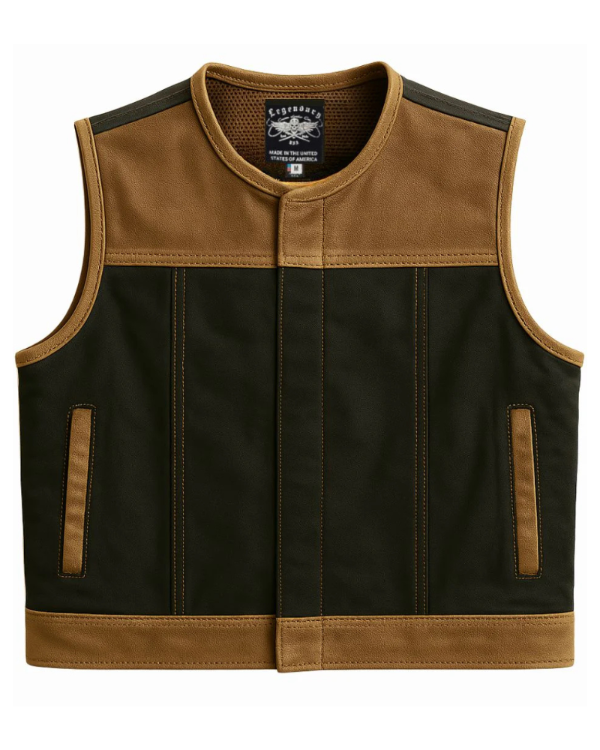
Denim-silhouette vest in 1.4–1.6mm front quarter horsehide — the heaviest leather weight in the BECK® lineup. Side lacing, multi-panel stitching, two zippered front pockets, and two internal 9" deep pistol pockets.
BECK® 666 Distressed Horsehide Café Racer Jacket

from $815
A stripped-down café racer cut in distressed front quarter horsehide that arrives pre-broken-in. Two zippered front pockets. Mandarin collar. Original BECK® D-pocket inspired design. No liner needed — the horsehide provides its own wind protection.
BECK® 777 Northeaster Flying Togs Horsehide Jacket

from $815
The most popular current BECK® horsehide jacket. Refined interior, antique brass hardware, and an angled chest pocket layout in 1.3mm front quarter horsehide. Made in the USA.
BECK® 732 Northeaster Flying Togs Horsehide Jacket

from $815
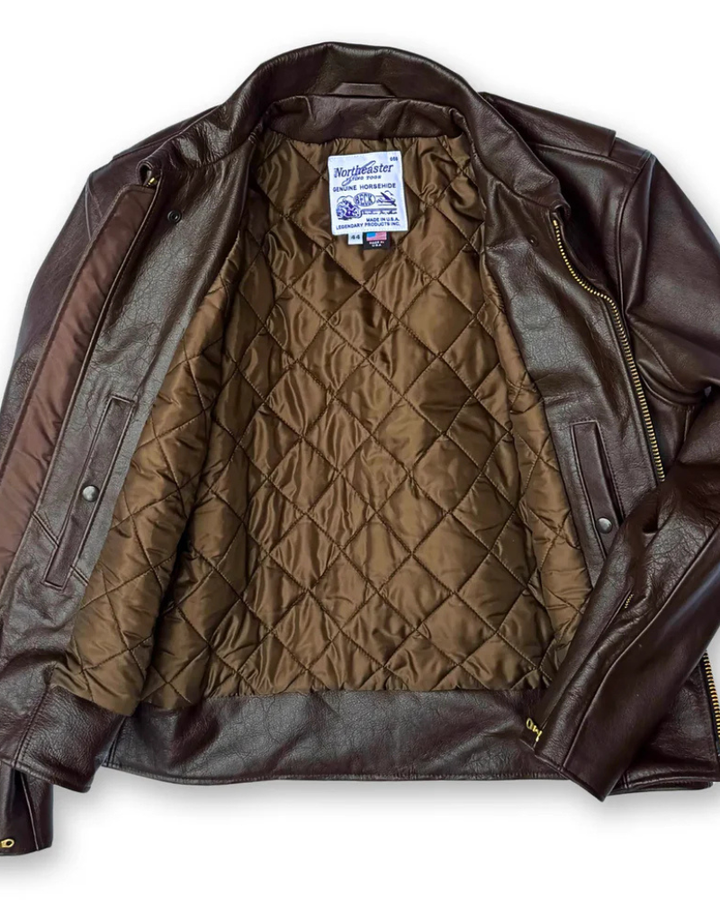
The traditional Northeaster build. Quilted cavity lining, nickel-plated hardware, and a racer snap collar in 1.3mm front quarter horsehide. Made in the USA.
BECK® 999 Genuine Horsehide Motorcycle Jacket

from $845
The top of the line BECK® jacket. Drum-dyed black horsehide in a half-belt silhouette designed with rider input, with an asymmetrical zippered chest pocket. Made in the USA.
BECK® Lineup at a Glance
| Model | Type | Leather | Price | Key Feature |
|---|---|---|---|---|
| BECK® 566 Black | Vest | Front Quarter Horsehide | from $440 | One-piece back, Pistola™ pockets |
| BECK® 566 Brown | Vest | Front Quarter Horsehide | from $440 | Chestnut patina, Pistola™ pockets |
| BECK® 588 | Vest | 1.4–1.6mm Horsehide | from $365 | Heaviest build, side lacing |
| BECK® 666 | Jacket | Distressed Horsehide | from $815 | Café racer, pre-broken-in |
| BECK® 777 | Jacket | 1.3mm Front Quarter Horsehide | from $815 | Antique brass hardware, refined interior |
| BECK® 732 | Jacket | 1.3mm Front Quarter Horsehide | from $815 | Quilted cavity lining, racer snap collar |
| BECK® 999 | Jacket | 1.3mm Front Quarter Horsehide | from $845 | Drum-dyed black, half-belt silhouette |
What Makes Front Quarter Horsehide Different
Front quarter horsehide is cut from the shoulder and neck area of the horse — the section that absorbs the most movement stress during the animal's lifetime. That stress produces leather that is denser, more tightly-grained, and more abrasion-resistant than rear quarter hide or belly leather. It is also naturally thicker, which means less splitting and cracking over years of riding exposure.
Horsehide in general outperforms cowhide of the same thickness in abrasion resistance — a relevant metric for motorcycle riding. The grain is tighter, the fiber structure is more uniform, and the natural oils in horsehide help it stay supple longer without aggressive conditioning. Front quarter horsehide amplifies these properties by sourcing from the densest part of the hide.
BECK® products use front quarter horsehide exclusively. This is stated in the product descriptions and has been the brand standard since original pre-war production by Leathertogs in Everett, Massachusetts.
| Property | Front Quarter Horsehide | Standard Cowhide | Synthetic |
|---|---|---|---|
| Grain tightness | Very tight | Medium | N/A (manufactured) |
| Abrasion resistance | Excellent | Good | Variable |
| Break-in time | 6–18 months | 2–6 months | None required |
| Patina development | Rich, distinctive | Moderate | None |
| Wind resistance | High (dense fiber) | Medium | Variable |
| Longevity | Decades with care | 5–15 years typical | 5–10 years typical |
The D-Pocket: BECK's Signature Design Element
The D-pocket is the half-circle chest pocket that appears on original BECK Northeaster Flying Togs jackets from the 1920s and 1930s. It was a functional innovation — the D-shape allowed a rider to reach the pocket while in a riding-forward position without opening a full flap or fumbling with a straight-entry pocket that shifts forward when you lean.
The D-pocket is one of the elements that made original BECK jackets recognizable and is referenced in the design heritage of the modern BECK® 666 café racer. It reflects the same riding-first design logic that informed the original brand.
The BECK® Trademark: Why It Matters
Legendary Products, Inc. holds USPTO Trademark Registration No. 3083433 for BECK Northeaster Flying Togs. The application was filed in June 2003 and the registration was granted in April 2006.
This means that any product sold as "BECK Northeaster Flying Togs" without authorization from Legendary Products, Inc. is a trademark violation. Legendary USA is the only authorized source for new BECK® products.
When you buy a BECK® product from Legendary USA, you are buying from the trademark holder — not from a third-party seller using the name without authorization. This distinction matters for product authenticity, quality control, and warranty coverage.
BECK Northeaster Flying Togs: History Since 1928
The BECK brand traces to 1928 — the period when American motorcycle culture was establishing its visual and material identity. Early riders needed gear that worked in actual weather conditions, not just fair-weather riding. The northeastern United States presented specific challenges: cold, rain, and rough roads that demanded durable, protective clothing rather than fashion gear.
Leathertogs of Everett, Massachusetts manufactured the original BECK jackets. They used front quarter horsehide because it was the most durable option available — military flight crews used it for similar reasons. The construction standards were saddle-stitching, solid brass hardware, and a riding-position cut that anticipated a forward lean rather than an upright standing posture.
The brand's original jackets are now collector pieces. Museum collections and private collector archives contain surviving BECK jackets from the 1930s and 1940s — evidence that the original construction standards were sound. Leather that survives intact for 80–90 years under any conditions is not ordinary leather.
Legendary Products, Inc. researched the brand's trademark history, filed for registration in 2003, and received USPTO Registration No. 3083433 in 2006. The current BECK® products honor that lineage with the same material standard (front quarter horsehide), the same made-in-USA manufacturing, and a Lifetime Guarantee that the original brand implicitly offered through the durability of its products.
BECK® Vests and Concealed Carry
Both the BECK® 566 and BECK® 588 vests include internal gun pockets designed for concealed carry. The 566 uses Legendary's proprietary Pistola™ tethered gun pocket system, which accommodates a full-size Colt .45 ACP and keeps the firearm from falling through the pocket during a fall or active movement. The tether retains the firearm without requiring a separate holster for most full-size pistols.
The BECK® 588 includes two internal 9" deep pistol pockets — sized for full-frame service pistols without the tether system.
BECK® Sizing Guide: Horsehide Fit Principles
Horsehide fits differently from cowhide and synthetic materials. Understanding these principles will help you select the correct size.
Horsehide does not stretch like cowhide #
Standard cowhide stretches 1–2 sizes over the first year of wear. Front quarter horsehide has a much tighter fiber structure and stretches minimally — the fit you get at purchase is close to the fit you will have in two years. Do not buy small expecting the leather to stretch into size.
Size to your riding position #
BECK® vests and jackets are cut for a forward riding position, not standing posture. When you measure chest circumference for sizing, measure at the fullest point and add 2" for riding comfort. A vest that fits perfectly standing may feel tight in a forward riding tuck.
The break-in period #
Front quarter horsehide has a break-in period of 6–18 months of regular wear, depending on climate and frequency of use. During this period, the leather softens at flex points (armholes, chest, shoulders) while retaining structure in the body. This is normal and expected — not a defect.
Sizing chart reference #
Legendary USA provides a sizing chart on each product page. For BECK® vests, measure chest circumference and refer to the chart. For the BECK® 666 jacket, also measure sleeve length from shoulder seam to wrist. When in doubt between sizes, take the larger size — horsehide does not expand significantly after purchase.
How to Care for Horsehide Leather
- Wipe the surface with a clean, dry cloth to remove surface dust and loose debris before applying any product.
- If the vest or jacket was exposed to rain, allow it to dry naturally at room temperature — never use heat (radiator, hair dryer, direct sunlight) as heat causes horsehide to crack at the grain.
- Apply a thin, even layer of conditioner with a soft cloth, working it into the grain in circular motions. Horsehide absorbs conditioner slowly — do not over-apply in one session.
- Allow the conditioner to absorb for 30–60 minutes, then buff with a clean cloth to remove excess. The leather should feel supple but not greasy.
- For storage between riding seasons, hang on a broad-shoulder hanger (wire hangers deform the shoulder seams over time). Avoid airtight storage — horsehide needs to breathe.
- Do not machine wash. Do not dry clean. Do not use products containing silicone, as silicone coats the grain and prevents future conditioning from penetrating.
Frequently Asked Questions — BECK® Northeaster Flying Togs
Is BECK® Northeaster Flying Togs made in the USA?
Yes. All current BECK® products sold by Legendary USA are made in the United States. This includes the 732, 777, and 999 jackets, the 666 café racer jacket, and the 566 and 588 vests. Legendary USA holds the federal trademark and produces the gear domestically.
What is front quarter horsehide?
Front quarter horsehide is cut from the shoulder and neck region of the horse — the area that absorbs the most movement stress during the animal's life. This produces leather that is denser, more tightly-grained, and more abrasion-resistant than rear quarter hide or belly leather. It is the same material standard used in original pre-war BECK jackets made by Leathertogs in Everett, Massachusetts.
Who owns the BECK® trademark?
Legendary Products, Inc. holds USPTO Trademark Registration No. 3083433 for BECK Northeaster Flying Togs. The application was filed in June 2003 and the registration was granted in April 2006. Legendary USA is the sole authorized producer of new BECK® products.
How does horsehide sizing differ from cowhide?
Horsehide stretches significantly less than cowhide. Standard cowhide gear often stretches 1–2 sizes over the first year. Front quarter horsehide has a tighter fiber structure and does not expand meaningfully after purchase. Size to your current measurements — do not buy small expecting the leather to break in larger.
Do the BECK® vests work for concealed carry?
Yes. The BECK® 566 uses the Legendary Pistola™ tethered gun pocket system, which accommodates a full-size Colt .45 ACP and retains the firearm with a tether during impact. The BECK® 588 includes two internal 9" deep pistol pockets sized for full-frame service pistols. Always carry in compliance with applicable state and local laws.
What is the price range for BECK® products?
The current BECK® lineup ranges from $365 (BECK® 588 Vest) to $845 (BECK® 999 Jacket). The 566 vests start at $440 each, and the 666, 732, and 777 jackets start at $815 each. All products come with Legendary USA's Lifetime Guarantee.
How long does horsehide take to break in?
Front quarter horsehide typically requires 6–18 months of regular wear to fully break in, depending on climate, riding frequency, and body heat. The leather softens at flex points — armholes, chest, shoulders — while retaining structural integrity in the body panels. This is the expected behavior of quality horsehide, not a defect.
Where can I find the original BECK® jackets from the 1930s and 1940s?
Original pre-war BECK jackets are collector pieces. They appear occasionally in estate sales, vintage motorcycle gear auctions, and private collections. Museum collections and private archives contain surviving examples from the 1940s. New BECK® products are available exclusively through Legendary USA at legendaryusa.com/collections/beck-northeaster-flying-togs.
Are BECK® Flying Togs jackets still available today?
Yes. BECK® Northeaster Flying Togs is in current production, made in the USA, and Legendary USA carries the current lineup: the 732 and 777 jackets from $815, the 999 from $845, the 666 café racer from $815, and the 566 and 588 horsehide vests.
Which BECK® jacket should I buy?
The 777 is the most popular current pick, with a refined interior and antique brass hardware. The 732 is the traditional build. The 999, from $845, is the top of the line in drum-dyed black with a half-belt. Riders after the café racer look choose the 666.
What is the difference between the BECK® 732, 777, and 999?
All three use the same 1.3mm front quarter horsehide, made in the USA. The 732 is the traditional Northeaster: quilted cavity lining, nickel-plated hardware, racer snap collar. The 777 refines the interior and moves to antique brass hardware with an angled chest pocket layout. The 999 is drum-dyed black with a half-belt silhouette, an asymmetrical zippered chest pocket, and details chosen with rider input. For a deeper comparison, read BECK vs. Other Horsehide Jackets.
What weight is BECK® horsehide?
1.3mm front quarter horsehide across the current Northeaster line, cut from the densest, most tightly grained section of the hide.
Horsehide vs. Cowhide for Motorcycle Gear: The Full Comparison
Riders comparing horsehide and cowhide motorcycle gear often focus on price — horsehide costs more. The price difference reflects material cost and availability, not marketing. Horsehide hides are smaller than cowhide, more expensive to source, and more difficult to work with in cutting and stitching. A vest that would require one cowhide may require two horsehide panels to avoid grain inconsistencies.
The relevant performance differences for motorcycle riding: horsehide is denser and more abrasion-resistant at equivalent thickness. A 1.2mm horsehide panel will outperform a 1.2mm cowhide panel in a slide test. Front quarter horsehide amplifies this advantage because it is sourced from the most stressed section of the hide — the area with the tightest grain and most uniform fiber structure.
Cowhide is not inferior leather — it is appropriate for most riding conditions and produces excellent gear. The distinction matters most to riders who: (a) intend to keep a piece for decades, (b) ride in conditions that put sustained stress on the leather, or (c) want material performance that cowhide cannot match at any price.
Is horsehide more protective than cowhide in a crash?
At equivalent thickness, yes. Horsehide's tighter grain structure provides more abrasion resistance in a slide. However, no leather vest or unarmored jacket provides full impact protection — the leather's role is abrasion resistance during a slide, not impact absorption. For CE-rated impact protection, look for gear with certified armor at the shoulders, elbows, and back.
Will horsehide shrink or stretch?
Horsehide shrinks if exposed to sustained heat or soaked and dried rapidly. It does not stretch significantly under normal wear — the fiber structure is too tight. This is different from cowhide, which commonly stretches 1–2 sizes over the first year. Buy horsehide gear in your correct current size.
How does horsehide age compared to cowhide?
Horsehide typically ages with more character — the patina at flex points is more pronounced and develops faster than equivalent cowhide. The color deepens at wear points while the body retains its original tone, creating a distinctive two-tone aging pattern. Brown horsehide (like the BECK® 566 Chestnut Brown) shows this aging pattern most visibly.
Why Made in USA Matters for Leather Motorcycle Gear
Domestic manufacturing for leather motorcycle gear means traceable material sourcing, consistent quality control, and direct accountability from brand to customer. When Legendary USA says a BECK® product is made in the USA, that means the cutting, stitching, and finishing happen in American workshops under Legendary's quality standards — not imported with a label change at customs.
The BECK® brand's original manufacturing by Leathertogs in Everett, Massachusetts was domestic. The current Legendary USA BECK® products continue that standard. The Lifetime Guarantee that accompanies every BECK® product is only possible because Legendary controls the manufacturing process and can stand behind the construction.
Are BECK® products fully made in the USA or just assembled here?
BECK® products sold by Legendary USA are manufactured in the USA. For specific material sourcing questions, contact Legendary USA directly at legendaryusa.com — the brand can provide detail on specific components and material origins for any current product.
Does Legendary USA offer a warranty on BECK® products?
Yes. Legendary USA backs BECK® products with a Lifetime Guarantee covering manufacturing defects in materials and workmanship. Contact Legendary USA customer service for specific warranty claim procedures.
The BECK® 666: A Café Racer Jacket Built for Real Riding
The café racer jacket format — minimalist cut, mandarin or band collar, no bulk — originated in the British café racer culture of the 1950s and 1960s but shares DNA with pre-war American riding jackets like the original BECK designs. The format prioritizes riding position over standing comfort: a shorter back hem that does not bunch when leaned forward, a closer cut through the torso that minimizes wind catch, and minimal hardware that does not create pressure points in a riding tuck.
The BECK® 666 applies this format in distressed front quarter horsehide. "Distressed" means the leather is processed to arrive with a broken-in surface character — not artificially aged with chemicals, but physically worked to soften the surface grain before construction. The result is a jacket that arrives ready to wear rather than requiring months of break-in before it feels comfortable.
Is the BECK® 666 a true café racer or a fashion jacket?
The BECK® 666 is built as a functional riding jacket in front quarter horsehide — the same material standard as the original BECK jackets. It is not a fashion interpretation of café racer styling. The cut, the material weight, and the construction are appropriate for actual motorcycle riding, not just street wear.
Does the BECK® 666 have armor?
The BECK® 666 does not include CE-rated armor inserts. It is a horsehide leather jacket providing abrasion resistance via material density. Riders who require CE-rated impact protection at shoulders, elbows, or back should add compatible armor inserts or select a jacket with integrated armor pockets. For specific fitment questions, contact Legendary USA.
How does the BECK® 666 fit compared to the vests?
The BECK® 666 jacket is cut with a closer torso fit than the 566 vests. Use the sizing chart on the product page and measure chest circumference at the fullest point. The distressed horsehide has slightly more initial flexibility than undistressed front quarter hide but still follows horsehide sizing principles — buy your correct current size, not a size smaller.
BECK® as Collector and Investment Gear
Original pre-war BECK Northeaster Flying Togs jackets are already collector items. Surviving examples in good condition from the 1930s and 1940s appear in museum collections and private archives. The combination of documented history, recognized brand name, American manufacturing provenance, and front quarter horsehide construction makes them significant objects in the history of American motorcycle culture.
Modern BECK® products from Legendary USA represent the continuation of that lineage under trademark ownership — the only new BECK® gear that can be legally sold as such. Whether modern pieces will appreciate as collectibles depends on factors that cannot be predicted, but the material quality (front quarter horsehide, made in USA, Lifetime Guarantee) and documented provenance (federal trademark) position them as durable, documented pieces of American gear history.
Are vintage BECK® jackets valuable?
Original pre-war BECK Northeaster Flying Togs jackets in good condition are valued by collectors of vintage American motorcycle gear. Pricing depends on condition, specific model, provenance documentation, and market conditions at time of sale. They are not common — original BECK jackets from the 1940s still surviving intact in collector archives.