



Cold Weather Motorcycle Gloves: The Complete Guide to Riding in the Cold
Quick Answer: Cold weather motorcycle gloves rely on insulation to trap body heat against your hand while wind chill at speed strips it away. 3M Thinsulate is the most widely used synthetic insulation in motorcycle gloves, rated by gram weight — 40g for mild cold, 100g for moderate cold, 200g for serious winter riding. Deerskin leather stays soft and pliable in cold temperatures where stiffer cowhide can impede grip — a critical advantage when throttle feel and clutch control matter most.
The Cold Weather Problem for Motorcycle Riders
Wind chill is the enemy of cold-weather riding. At 60 mph in 40°F ambient temperature, the effective wind chill on exposed skin is approximately 25°F — below freezing. Even at 50°F ambient, highway riding creates wind chill conditions that can numb unprotected hands in under 20 minutes.
Cold hands are dangerous hands. As hand temperature drops, fine motor control degrades. Brake lever feel diminishes. Clutch engagement becomes imprecise. In cold enough conditions, numb fingers can miss a gear shift entirely. The solution isn't toughing it out — it's matching insulation to conditions.
What Is 3M Thinsulate and How Does It Work?
3M Thinsulate is a synthetic microfiber insulation developed by 3M. The name comes from its combination of thin profile and insulating performance. It consists of extremely fine fibers — roughly 10 times finer than polyester fiber — that trap air in the spaces between them. Trapped air is the actual insulator. Body heat warms that air; the Thinsulate fibers prevent it from escaping.
The reason Thinsulate is popular in motorcycle gloves specifically is its thickness-to-warmth ratio. A glove needs to remain thin enough that the rider can feel the handlebar, throttle, and levers. Bulky insulation compromises that feel. Thinsulate delivers meaningful warmth in a layer thin enough to preserve tactile feedback — critical for motorcycle use.
3M Thinsulate Gram Weights Explained
Thinsulate is rated by gram weight per square meter (g/m²). This number tells you how much insulation material is present. More grams means more fibers, more trapped air, more warmth — and more bulk.
40g Thinsulate
Light insulation. Suitable for temperatures between 45–60°F at moderate speeds. Adds minimal bulk and preserves excellent feel. Good for fall shoulder-season riding or early morning departures that will warm up quickly.
100g Thinsulate
Moderate insulation. Suitable for temperatures between 30–45°F at highway speeds with wind chill factored in. A good all-around cold-weather glove for riders in temperate climates who ride through late fall and early spring. Noticeably thicker than 40g but still manageable for throttle feel.
200g Thinsulate
Serious cold-weather insulation. Designed for temperatures at or below freezing — 20–35°F range — at riding speeds. At this level, bulk is unavoidable. These gloves are warmer but sacrifice some of the fine tactile feedback of thinner options. Best for winter commuters, snowbelt riders, and anyone pushing riding season into true cold.
Above 200g
Some extreme cold weather gloves use 400g or higher Thinsulate weights. These approach mitten-territory in terms of bulk and are primarily used by winter touring riders or those riding in sub-zero conditions.
Gloves vs. Mittens for Cold-Weather Riders
Mittens are thermodynamically superior to gloves for one reason: fingers share body heat with each other in a mitten. In a glove, each finger is isolated in its own leather stall, losing heat independently. Mittens consolidate the fingers' combined warmth into one space.
The tradeoff for motorcyclists is obvious: fine motor control. Individual finger movement is what allows precise throttle roll-on, controlled braking, and smooth clutch engagement. In very cold conditions where mittens would be warmer, a compromise exists: motorcycle mittens with a single-finger trigger slot that isolates the index finger for brake lever access while keeping the other three fingers together for warmth.
The Legendary Deerskin Insulated Motorcycle Mittens are built around this principle — deerskin outer shell for suppleness in the cold, insulation for warmth, and a design that acknowledges the realities of motorcycle control.
Why Deerskin Stays Pliable in Cold When Cowhide Stiffens
Leather stiffens in cold temperatures because the fibers in the hide contract and the natural oils in the leather become less mobile. Cowhide — a denser, tighter-grained leather — stiffens noticeably at temperatures below 40°F. A cowhide glove that fits perfectly at room temperature can feel noticeably restrictive after an hour of 35°F highway riding.
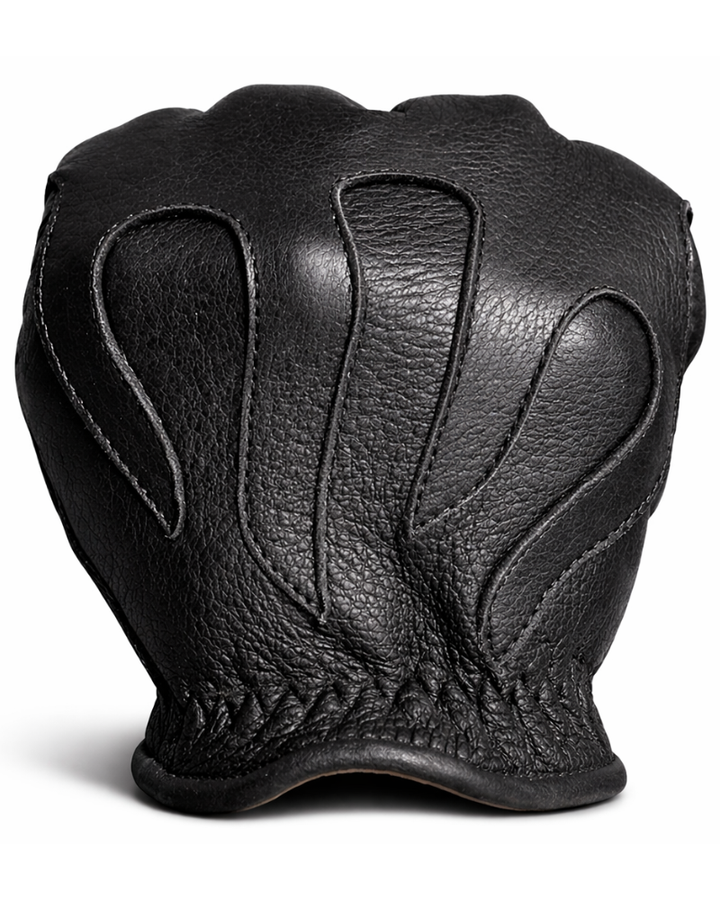
Deerskin has a different fiber structure. Whitetail deerskin is naturally softer and more loosely grained than cowhide. The fibers are not as tightly packed, which means they retain more flexibility at lower temperatures. A well-conditioned deerskin glove remains pliable and comfortable in cold where a cowhide glove of equivalent thickness would have stiffened.
For cold-weather motorcycle use, deerskin's cold-weather suppleness is a genuine functional advantage, not just a comfort preference.
Throttle Feel in Cold Weather Gloves
Insulation adds bulk between your hand and the handgrip. More bulk means less direct feel. This is the core tradeoff in cold-weather glove design: warmth versus feedback.
100g Thinsulate in a properly constructed glove is generally the upper limit where most riders maintain acceptable throttle feel. Beyond 200g, some riders find it helpful to increase the diameter of their handlebar grip slightly — adding a thin grip cover or switching to a slightly larger aftermarket grip — to compensate for the insulation thickness.
Deerskin's natural softness helps here too. Because deerskin transmits feel better than stiffer leather, a 100g deerskin insulated glove will typically deliver better throttle feedback than a 100g cowhide insulated glove of similar construction.
Sizing Up for Insulated Gloves
This is one of the most common buying mistakes with cold-weather motorcycle gloves. Insulation takes up interior volume. A glove that fits perfectly with no lining will often be too tight with 100g or 200g Thinsulate inside it.
The practical rule: if you normally wear a large in an unlined leather glove, try a large-tall or extra-large in a heavily insulated version. The goal is a fit where you can close your fist fully around a grip without the glove pulling tight across the knuckles — but not so loose that the palm material bunches and reduces feel.
If you're ordering online, err toward sizing up by half a size when selecting insulated gloves versus your normal unlined leather size.
Glove Liners vs. Insulated Gloves: When to Use Each
Glove liners are thin inner gloves — typically merino wool, silk, or synthetic fleece — worn under a primary leather glove to add warmth. They are a versatile option for riders who want to extend an existing glove into cooler temperatures without buying a dedicated cold-weather pair.
The advantage: one pair of quality leather gloves works across a wider temperature range by adding or removing the liner. The disadvantage: glove liners add bulk without the structural integration of purpose-built insulated gloves, and the liner can bunch or shift inside the outer glove over time.
Purpose-built insulated gloves with Thinsulate sewn directly into the construction are the better choice for consistent cold-weather riding. The insulation stays positioned correctly and the overall glove is engineered for the thickness. The Legendary Deerskin Fleece Lined Motorcycle Gloves integrate a soft fleece lining directly into the deerskin glove shell — no separate liner to manage, no bunching.
What Temperature Is Too Cold for Unlined Motorcycle Gloves?
There's no single threshold — it depends on ride duration and speed. The practical guidelines:
- Above 60°F: Unlined leather gloves are comfortable for most riders at all speeds.
- 50–60°F: Unlined gloves are acceptable for shorter rides or lower speeds. Highway riding at 60+ mph will feel cold within 30–45 minutes.
- 40–50°F: Unlined leather is uncomfortable on any ride longer than 20–30 minutes at highway speed. Light insulation or a liner is warranted.
- Below 40°F: Purpose-built insulated gloves are necessary. Unlined leather at 40°F and below, combined with wind chill from riding, will result in cold-related discomfort and eventual loss of fine motor control.
Wind Chill Factor and Glove Warmth
Understanding wind chill is essential for selecting the right insulation weight. The following illustrates why ambient temperature alone is insufficient for glove selection:
- 45°F ambient at 60 mph: effective wind chill approximately 32°F (at or below freezing)
- 35°F ambient at 60 mph: effective wind chill approximately 19°F (well below freezing)
- 25°F ambient at 60 mph: effective wind chill approximately 8°F (dangerously cold for unprotected hands)
The rule of thumb: when selecting glove insulation weight, calculate from wind chill, not ambient temperature. If the forecast shows 45°F and you'll be on the highway, plan for 32°F conditions at your hands.
Waterproofing in Cold Weather Gloves
Cold rain is more dangerous than dry cold. Water dramatically accelerates heat loss from the hands. A wet glove at 40°F will lose warmth far faster than a dry glove at 30°F.
For cold-weather riding in wet climates, look for gloves with waterproof membrane liners (Gore-Tex, HiPora, or equivalent). These membranes block water penetration while allowing some vapor transmission. The tradeoff is slightly more bulk and, in some designs, reduced feel.
A practical alternative for riders who already have quality insulated leather gloves: waterproof over-gloves (gauntlet-style covers) worn over the primary insulated glove. These protect the insulation from saturation while the primary glove provides warmth and grip feel.
Signs Your Motorcycle Gloves Aren't Warm Enough
These are the progression signals that your current gloves are being outrun by the conditions:
- Fingertip numbness after 15–20 minutes: Mild but a clear signal that you're at or past the warmth limit of your current gloves.
- Grip strength reduction: If you notice you're squeezing harder than normal to feel confident on the bar, cold is affecting your hand muscles.
- Difficulty operating fine controls: Missing a gear shift, slow brake response. This is a safety signal.
- Pain during warmup: After stopping and going indoors, painful tingling during rewarming indicates hands got colder than they should have.
At any of these stages, the correct response is to stop and warm your hands — not to continue riding with compromised hand control.
Handlebar Warmers vs. Warm Gloves: How They Work Together
Handlebar warmers (grip heaters) heat the grip surface, which conducts heat into the palm of the glove. Insulated gloves retain that conducted heat longer and prevent wind chill from stripping it away through the back of the hand.
These systems are complementary, not alternatives. Grip heaters without insulated gloves lose the generated heat quickly through the back of the hand in a headwind. Insulated gloves without grip heaters are warm but passive — they retain body heat but don't add to it.
The combination of heated grips plus 100g insulated deerskin gloves is a highly effective system for riding in 20–40°F conditions that would otherwise require much heavier insulation.
Frequently Asked Questions: Cold Weather Motorcycle Gloves
What gram weight Thinsulate do I need for winter riding?
For temperatures between 35–50°F at highway speeds, 100g Thinsulate is the standard recommendation. For temperatures below 35°F or for riders who tend to run cold, 200g is more appropriate. 40g is a light shoulder-season option for mild cold, not serious winter use.
Why do cold-weather motorcycle gloves feel stiff when I first put them on?
Leather and insulation both stiffen in cold temperatures before body heat warms them from the inside. This is normal. Flex your fingers repeatedly after putting on cold-weather gloves to accelerate the warming process. Deerskin gloves warm up and soften faster than cowhide in the same conditions.
Can I use heated gloves instead of insulated gloves?
Heated gloves use electric elements to generate heat and are extremely effective. They require either a battery pack or a connection to the motorcycle's 12V system. The tradeoff vs. passive insulated gloves: cost, wiring complexity, and battery management. For occasional cold-weather riding, a quality insulated glove is simpler. For serious winter commuting, heated gloves or heated grip systems are worth the investment.
Are fleece-lined gloves as warm as Thinsulate-lined gloves?
Fleece provides meaningful warmth and has an advantage in moisture management — it wicks perspiration away from the hand. Thinsulate at equivalent gram weights is typically warmer per millimeter of thickness. Many quality insulated motorcycle gloves combine both: a Thinsulate insulating layer and a fleece inner for comfort and moisture management.
How do I prevent my gloves from getting damp inside from sweat in cold weather?
Breathable insulation (Thinsulate allows some vapor transmission) and fleece liners both help. Avoid putting cold-weather gloves on over wet hands. After a ride, turn gloves inside out when possible to let the interior dry completely. Moisture inside the glove reduces warmth significantly and accelerates leather degradation.
Do I need waterproof cold-weather gloves or just insulated ones?
If you ride in dry cold, insulated without waterproofing is fine. If you ride in cold rain or wet snow, waterproofing is essential because wet insulation loses nearly all of its effectiveness. Assess your typical riding conditions and choose accordingly.
How long does deerskin last compared to cowhide in cold-weather use?
Deerskin and cowhide both require conditioning to maintain suppleness in cold, dry conditions. Deerskin is naturally more supple but is somewhat less abrasion-resistant than thick cowhide. With proper care and conditioning, both types of leather last many seasons. Deerskin gloves are more likely to show wear at high-friction points like the grip area; cowhide gloves may crack if not conditioned regularly through cold-weather cycling.
Can I wash insulated motorcycle gloves?
Do not machine-wash leather insulated gloves. Surface dirt: damp cloth only. If the interior liner gets funky, spray with a leather-safe antimicrobial spray and let air dry completely. Full submersion or machine washing will degrade the leather and can cause the Thinsulate to shift or mat inside the glove.
What's the best way to warm up cold gloves before putting them on?
Store gloves at room temperature, not in an unheated garage or saddlebag the night before a cold ride. Before a cold morning departure, keep gloves inside the house or in an inner jacket pocket until you're ready to ride. Carrying them inside your jacket on the way out to the bike is a simple habit that makes a real difference in first-minute comfort.
Are short-cuff insulated gloves as warm as gauntlet-style cold-weather gloves?
No. Gauntlet-style gloves extend past the jacket cuff and seal out wind at the wrist. Short-cuff insulated gloves leave a gap between the glove cuff and jacket sleeve that allows cold air to funnel directly to the wrist — where blood vessels are close to the surface. For serious cold-weather riding, a gauntlet-style cuff or a glove designed to tuck under a long jacket sleeve is significantly warmer.
How do I know if my insulated gloves are performing correctly?
Your hands should remain warm and fully functional for the entire ride in the temperature range the glove is rated for. If you're experiencing numbness, grip degradation, or stiffness within 30 minutes in the glove's rated temperature range, either the gloves are worn out and the insulation has compressed, or you've exceeded the glove's rated condition.
What should I do with insulated motorcycle gloves at the end of the season?
Clean the exterior with a leather cleaner, apply leather conditioner, and allow to dry fully before storage. Store in a breathable bag — not plastic — at room temperature. If the gloves have been exposed to salt (road salt in winter riding), wipe down thoroughly before storage as salt accelerates leather degradation.