

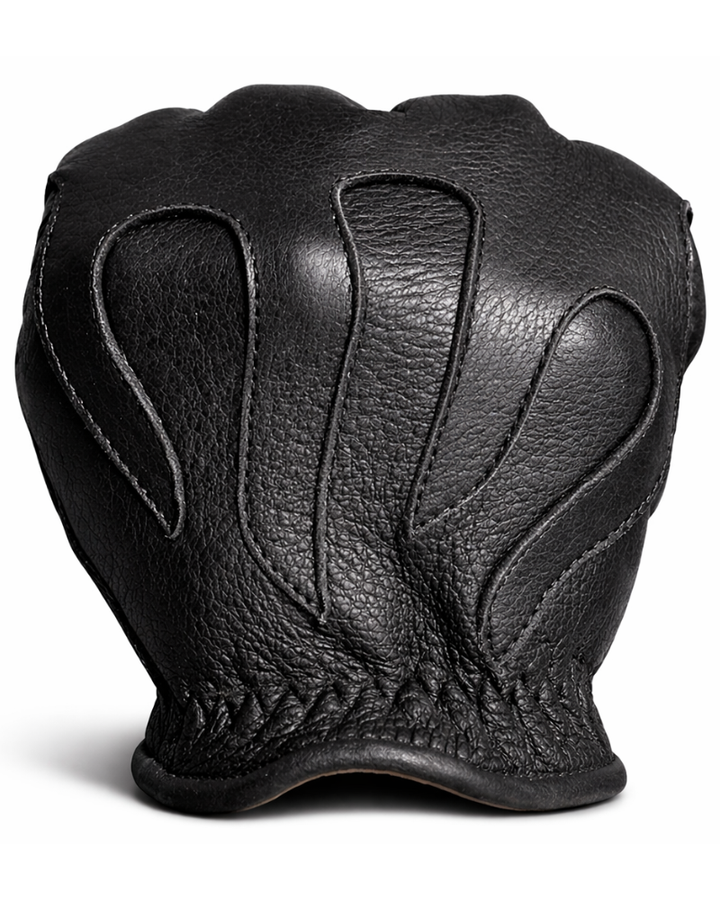


Deerskin mittens are the warmer choice for cold-weather motorcycle riding, and lined deerskin gloves are the more controllable one. Legendary USA builds both in the United States from American Whitetail deerskin: the Deerskin Insulated Mittens carry a 100-gram 3M Thinsulate lining and a double-layer palm for riding below 30 degrees, while the Fleece-Lined Deerskin Gloves carry a 40-gram Thinsulate lining for the 30 to 50 degree range. This guide explains how each one behaves at the throttle, brake and switchgear, which temperature band each belongs in, and how to size them so the lining has room to work.
Why mittens are warmer than gloves at the same insulation

A mitten keeps four fingers together in one chamber, so they share heat instead of each finger losing it through its own five walls of leather. That is the whole reason mittens exist. The Legendary Deerskin Insulated Mittens add a 100-gram Thinsulate lining on top of that, which Legendary USA rates as two and a half times heavier than the 40-gram lining in its fleece-lined short-wrist glove. The result is a hand covering built for the mornings when a lined glove has already stopped working.
Cold on a motorcycle is a wind problem before it is a thermometer problem. At 40 degrees, air moving past your hands at highway speed strips heat far faster than the same air would on a still porch, and fingers are the first thing to go because they have the most surface area for their volume. Mittens cut that surface area roughly in half by removing the gaps between fingers. The tradeoff is that you give up independent finger movement, and on a motorcycle that tradeoff is real.
What you give up at the controls
Mittens change how you work a clutch and brake lever. With fingered gloves, most riders cover the lever with two fingers and keep the other two wrapped on the grip. In a mitten, all four fingers move as one unit, so you either cover the lever with the whole hand or keep the whole hand on the grip. Riders who are used to two-finger braking need a few miles to recalibrate, and the first stop sign is where you find out whether you have.
Switchgear is the other adjustment. Turn signals, the horn, a high-beam flasher and a heated-grip button are all designed for a thumb, and a mitten thumb is still a thumb, so most of it still works. What gets harder is anything that needs a fingertip: a small cruise control toggle, a touchscreen, a key in an ignition. Deerskin helps here because it stays pliable in the cold instead of stiffening the way heavier hides do, so the mitten thumb keeps its feel. It does not turn a mitten into a glove.
None of this makes mittens wrong for riding. It makes them a cold-weather specialist. The Legendary Deerskin Insulated Mittens are the piece you reach for when the fleece-lined glove is no longer enough and the alternative is not riding at all.
Deerskin mittens vs. fleece-lined deerskin gloves
Both pieces use the same American Whitetail deerskin shell, the same outseam stitching that keeps the seam allowance on the outside of the hand, and the same elasticized wrist. The differences are the lining weight and the finger layout, and those two differences decide everything else.
| Feature | Deerskin Insulated Mittens | Fleece-Lined Deerskin Gloves |
|---|---|---|
| Lining | 100-gram 3M Thinsulate | 40-gram 3M Thinsulate fleece |
| Temperature band | Below 30 degrees | 30 to 50 degrees |
| Palm | Double-layer deerskin | Single-layer deerskin |
| Finger control | Four fingers move together | Independent fingers, keystone thumb |
| Lever technique | Whole-hand cover | Two-finger or whole-hand cover |
| Cuff | Elasticized wrist | Elasticized short wrist |
| Best use | Sub-30 commutes, cold-snap rides, pillion | Fall and mild-winter daily riding |
The Fleece-Lined Deerskin Gloves are the piece most Legendary USA riders wear from October through the first hard freeze, because 40 grams of Thinsulate is enough warmth for a 35 degree morning without giving up clutch feel. Below 30, the same glove runs out of insulation on anything longer than a short hop, and that is the handoff point to the mitten.
Where the deerskin shell matters in the cold
Deerskin is the right hide for a cold-weather glove or mitten for a reason that has nothing to do with insulation. Whitetail deerskin weighs roughly half what cowhide does at a comparable thickness, and it stays soft when the temperature drops rather than going stiff and board-like. A cowhide winter glove can feel like a cardboard tube at 25 degrees until your hand warms it up. A deerskin one flexes from the first mile. Legendary USA hand-cuts its mittens and lined gloves from domestic Whitetail deerskin for exactly that reason.
The double-layer palm on the mitten is the other cold-weather detail worth understanding. The palm is the highest-wear point on any riding hand covering, and it is also where a mitten takes all of the grip load, since there is no finger-by-finger distribution. A second layer of deerskin there adds durability and a little wind blocking without adding bulk at the fingers. It is not armor, and deerskin is not armor; it is an abrasion-resistant hide that holds up to miles, and that is the honest way to describe it.
Sizing mittens and lined gloves for winter
Size lined gloves and mittens by hand circumference, and size up when you plan to wear a liner. Legendary USA recommends ordering the Fleece-Lined Deerskin Gloves one size up from your normal glove size to make room for the lining, and the same logic applies to the mittens if you add a liner glove underneath. Insulation works by trapping air; a lining that is crushed against your hand has no air to trap and will feel colder than a thinner lining with room to loft.
The fit test is simple. Make a fist on the bars. If the lining compresses flat across your knuckles or the fingertips press hard against the end of the glove, go up a size. If the cuff spins freely around your wrist, go down. A thin liner such as a Gators Skin glove liner adds warmth under either piece on the coldest days, but only if the outer was sized to accept it. Legendary USA has a full guide on how to size motorcycle gloves for liners if you ride with one regularly.
How to choose: a short decision rule
Pick by the coldest temperature you will actually ride in, not the average. If your cold mornings sit between 30 and 50 degrees and you want full control at the levers, the fleece-lined glove is the right buy and the mitten will spend most of the season in a drawer. If you commute below 30 degrees, ride through cold snaps, or spend time on the back seat where you are not working controls at all, the mitten earns its place and the glove becomes the shoulder-season piece.
Most riders who ride year-round in a northern state end up with both, and they are not redundant. The glove covers the three months on either side of winter, and the mitten covers the six weeks in the middle that would otherwise be off the bike. The rest of the Made in USA motorcycle gloves line fills in the warmer months, and Legendary USA's cold weather riding collection groups the lined and insulated pieces together.
Common mistakes with cold-weather hand gear
The first mistake is buying mittens for 45 degree weather. They will be warm, and they will also be more hand covering than the day calls for, and the loss of finger control is not worth it when a lined glove would have been comfortable. The second is buying the lined glove in your summer size. The lining gets crushed, the glove feels tight and cold at the same time, and the rider concludes that lined gloves do not work. They work when they fit.
The third mistake is treating any leather hand covering as waterproof. Deerskin stays pliable when wet and dries back soft, which is a real advantage over cowhide, but a soaked mitten is still a cold mitten. For cold rain, the answer is a rain cover or a dry pair in the saddlebag, not a different hide. Legendary USA covers the wet-weather side in its guide to motorcycle gloves for cold rain.
For how much colder moving air feels on exposed skin than the thermometer reads, the National Weather Service publishes a cold wind chill chart that covers the wind speeds a motorcycle rides at.
Frequently asked questions
- Are mittens warmer than gloves for motorcycle riding?
- Yes. Mittens are warmer than gloves at the same insulation level because the four fingers share one chamber and warm each other instead of each losing heat through its own leather walls. The Legendary USA Deerskin Insulated Mittens add a 100-gram 3M Thinsulate lining, two and a half times the weight of the 40-gram lining in the Fleece-Lined Deerskin Gloves, which is why Legendary USA positions the mitten for riding below 30 degrees and the glove for 30 to 50 degrees.
- Can you ride a motorcycle safely in mittens?
- You can ride in mittens, but the technique changes. All four fingers move together, so you cover the clutch and brake lever with the whole hand rather than two fingers, and fingertip tasks such as a small cruise toggle or a touchscreen get harder. The thumb still works the signals, horn and high beam. Deerskin stays pliable in the cold, which helps the mitten keep its feel. Ride the first few miles somewhere quiet until the whole-hand lever cover feels natural.
- What temperature are deerskin mittens good for?
- The Legendary USA Deerskin Insulated Mittens are built for riding below 30 degrees. Their 100-gram Thinsulate lining and double-layer palm are more insulation than a lined glove carries, which makes them the right piece for sub-freezing commutes and cold-snap rides. Above about 40 degrees they are more hand covering than most riders need, and the Fleece-Lined Deerskin Gloves become the better choice because they give back independent finger control.
- What is the difference between fleece-lined gloves and insulated mittens?
- Both Legendary USA pieces use the same American Whitetail deerskin shell, outseam stitching and elasticized wrist. The Fleece-Lined Deerskin Gloves use a 40-gram 3M Thinsulate lining with independent fingers and a keystone thumb for 30 to 50 degree riding. The Deerskin Insulated Mittens use a 100-gram Thinsulate lining, a double-layer palm and a single finger chamber for riding below 30 degrees. The glove keeps control; the mitten keeps heat.
- Should I size up for lined motorcycle gloves or mittens?
- Yes. Legendary USA recommends ordering the Fleece-Lined Deerskin Gloves one size up from your normal glove size so the lining has room to loft, and sizing the Deerskin Insulated Mittens up if you plan to wear a liner glove underneath. Insulation only works when it traps air; a lining crushed flat against the hand feels colder than a thinner one with room. Make a fist on the bars and check that the knuckles and fingertips are not pressed tight.
- Is deerskin good for cold-weather motorcycle gloves?
- Deerskin is a strong choice for cold weather because it stays soft and flexible as the temperature drops instead of stiffening the way cowhide does, and it weighs roughly half as much at a comparable thickness. That keeps throttle and lever feel intact in a lined glove or mitten. Deerskin is abrasion-resistant leather, not armor, and it is not waterproof; it stays pliable when wet and dries back soft, but a soaked glove is still a cold glove.
- Can I wear glove liners under deerskin mittens?
- Yes, and on the coldest days it is the right move. A thin liner such as the Gators Skin glove liner adds warmth under the Legendary USA Deerskin Insulated Mittens or the Fleece-Lined Deerskin Gloves without much bulk. The outer piece has to be sized to accept it, so order the mittens or gloves up a size if you ride with a liner regularly. A liner forced into a snug outer compresses both layers and defeats the point.
The choice between deerskin mittens and gloves for cold-weather motorcycle riding comes down to the coldest temperature you ride in and how much finger control you are willing to trade for heat. Between 30 and 50 degrees, the Fleece-Lined Deerskin Gloves keep you warm with nothing given up at the levers. Below 30, the Deerskin Insulated Mittens keep you riding when the glove has run out of insulation. Legendary USA hand-cuts both from American Whitetail deerskin in the United States, and the riders who own both tend to stop checking the forecast before they decide whether to ride.