



Fingerless Motorcycle Gloves: The Honest Guide for Riders Who Want Maximum Airflow
Quick Answer: Fingerless motorcycle gloves protect the palm, thumb base, and wrist — the parts of your hand most likely to contact the ground in a fall — while leaving the fingers exposed for maximum airflow and direct feel. They are the right choice for warm-weather short rides, city riding, and cruiser use where heat management and throttle feel outweigh the need for full-finger coverage. They are not the right choice for highway riding at sustained speed or in any conditions where finger protection matters.
What Fingerless Motorcycle Gloves Actually Protect
Fingerless gloves are frequently dismissed as fashion-only gear, which misunderstands what they're actually doing. When a rider falls and extends their hands to catch themselves, three areas hit the ground with the most force and friction:
- The palm: The broad, flat center surface that contacts pavement first in a forward fall.
- The thumb base: The thenar eminence — the muscular pad at the base of the thumb — which contacts ground in both forward and sideways falls.
- The wrist: The joint itself, which absorbs significant impact force and slides along pavement in the seconds after initial contact.
A well-constructed fingerless glove in quality leather covers all three of these zones. The palm panel, the reinforced thumb base, and the wrist closure — when built from real leather rather than fabric — provide meaningful slide protection for the highest-impact zones in a typical low-speed fall.
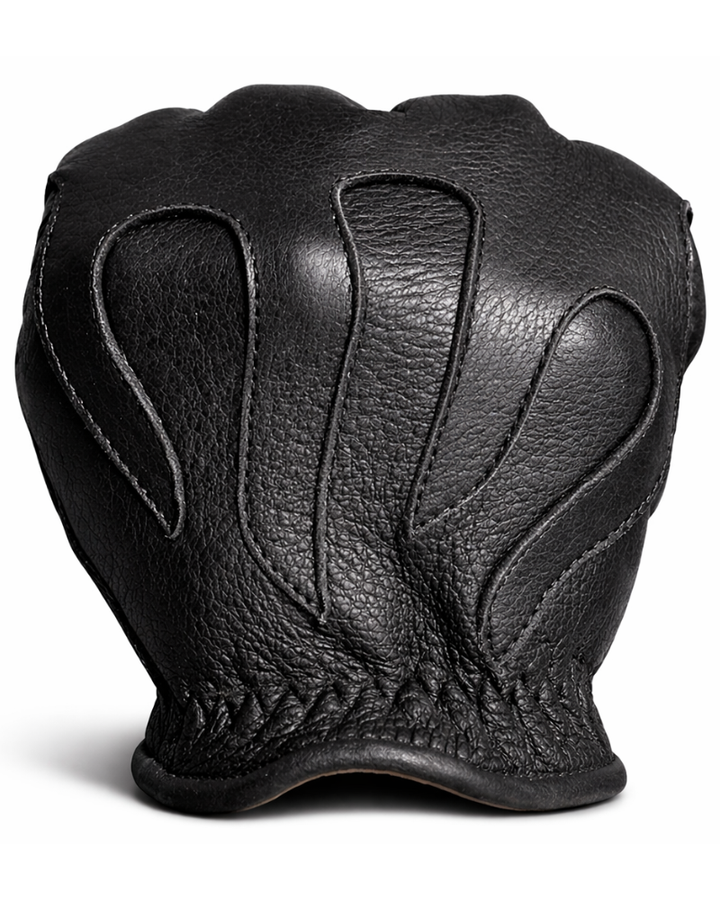
The Legendary Deerskin Fingerless Motorcycle Gloves are built with a full deerskin palm panel, providing the softness and abrasion resistance of American whitetail deerskin across the entire palm surface — where it counts most in a slide.
What Fingerless Gloves Don't Protect: The Honest Assessment
Fingerless gloves leave the fingers — from the second knuckle to the tip — entirely exposed. In any fall where the hands contact pavement, exposed fingers are vulnerable to abrasion and impact injury.
Riders need to make this tradeoff consciously. Fingerless gloves are a reasonable choice at low speeds where the severity of potential finger injuries is limited. They are a poor choice at highway speeds where sliding contact with pavement at 60 mph will cause serious finger injury to uncovered fingers.
This is not a reason to dismiss fingerless gloves entirely — it's a reason to match the glove to the ride. City riding, parking lots, short cruises at 35–45 mph: the fingerless tradeoff is often acceptable. Highway commuting, canyon runs, or long-distance touring: full-finger gloves are the appropriate choice.
When Fingerless Gloves Make Sense for Riders
There are specific riding contexts where fingerless gloves are the practical correct answer:
- Summer urban riding: Stop-and-go traffic at low speeds in 85°F+ heat. Fingerless gloves provide maximum airflow exactly when airflow is scarce (low speed) and when temperatures demand it.
- Short cruises: Rides under 30 minutes at speeds below 45 mph where full protective gear is contextually mismatched to the risk profile.
- Harley and cruiser culture: The fingerless glove is a long-established part of American riding tradition, and many cruiser riders prioritize the look and feel of the ride experience as much as the protection spec.
- Bike shows and events: Riding to a show or gathering where the aesthetic of the glove matters and highway exposure is minimal.
- Hot parking lot maneuvering: Moving a bike in a hot parking lot, trailering, or handling the bike at low speeds where the thermal benefit is real and crash speed is very low.
Fingerless vs. Full-Finger Perforated: The Airflow Comparison
For maximum airflow at any speed, fingerless wins over full-finger perforated. Open fingers allow 100% unimpeded air movement across the fingers. Even the most aggressively perforated full-finger glove still has leather between your skin and the airflow — reduced, but present.
However, the difference in airflow is most significant at low speeds and in stopped traffic. At 55 mph, both fingerless and heavily perforated full-finger gloves get significant airflow. At 5 mph in slow traffic, fingerless provides dramatically more cooling because there's no barrier to what little air is available.
The practical conclusion: if your primary riding is urban, low-speed, and hot, fingerless wins on airflow. If you're doing mixed riding that includes highway segments, perforated full-finger gloves like the Legendary Ventilated Short Wrist Motorcycle Gloves offer airflow and full-finger protection in a single glove.
Why Deerskin Palm in Fingerless Gloves Still Matters
Not all fingerless gloves are created equal. Many budget fingerless gloves use synthetic materials or low-grade split leather for the palm. These materials are dramatically less effective at abrasion resistance than full-grain leather.
Deerskin palm construction in a fingerless glove delivers the same material advantage as in a full-finger glove: natural softness that requires no break-in, grip texture that works without artificial roughing, and abrasion resistance that outperforms synthetic alternatives at the same thickness.
The softness of deerskin is a functional advantage in fingerless gloves specifically. Because the fingers are exposed, the rider is already operating with direct feel from the fingertips. The palm material should also feel natural and direct — stiff, rough, or synthetic palm materials create inconsistency in feel between the covered palm and the exposed fingers. Soft deerskin creates a more unified grip experience.
Elastic Removal Tabs Between Fingers: What They Do and Why They Matter
Quality fingerless motorcycle gloves include small elastic loops or tabs positioned between the finger cuffs on the dorsal side of the glove. These tabs serve a specific functional purpose: they allow the glove to be removed with one hand by hooking a finger through the tab and pulling.
Without these tabs, removing a fingerless glove with one hand while the other hand is occupied (holding the bar, holding a phone, holding a document) is surprisingly awkward. The tabs make single-handed removal practical — a convenience feature that gets used constantly in everyday riding situations.
Look for elastic or leather tabs between each finger pair when evaluating fingerless glove quality. Their presence signals attention to real-world usability rather than just construction appearance.
Velcro Wrist Adjustment in Fingerless Designs
The wrist closure on a fingerless glove is more important than it might appear. The cuff secures the glove in position during a fall — a loose closure allows the glove to move or shift off the hand during a slide, reducing its protective value precisely when it's needed most.
Velcro (hook-and-loop) wrist adjustments are the standard closure for fingerless motorcycle gloves. They allow the cuff to be tightened to exactly the rider's wrist diameter, accommodate minor swelling that can occur during long hot rides, and can be adjusted with one hand while the other remains on the bar.
Check the Velcro width and attachment quality when evaluating any fingerless glove. A narrow Velcro strip on a lightweight tab will wear out faster than a wider strap with reinforced attachment points. The closure should feel secure when cinched but not constrictive at a comfortable tightness.
Are Fingerless Motorcycle Gloves Legal for Riding?
In most jurisdictions in the United States, there is no legal requirement for specific glove type or protection level — gloves are not mandated at all in most states. Fingerless gloves are legal for street riding in nearly every U.S. state.
Track day policies are different. Most organized track events require full-finger gloves and, at higher-level events, gloves with specific CE protection ratings. If you ride on track, check the specific event's gear requirements before showing up with fingerless gloves.
In some European countries, riding gear standards and legal requirements are more specific. Riders in those markets should check local regulations. For U.S. street riding, legality is not a constraint on fingerless glove use.
Fingerless Gloves for Short Rides vs. Long Rides
Duration is a key variable in whether fingerless gloves are the right choice for a given ride.
Short rides (under 45 minutes): Fingerless gloves work well. Hand temperature stays manageable even on warm days, and the exposure window for any crash scenario is limited.
Long rides (2+ hours): Several considerations work against fingerless for extended use. Direct sun on exposed fingers causes burning and fatigue over hours. Finger grip muscles tire faster without glove support and padding. Vibration from the bars transmits more directly to exposed fingers, increasing hand fatigue. For rides over 90 minutes, full-finger gloves generally provide better endurance regardless of conditions.
Grip Feel in Fingerless vs. Full Gloves
Fingerless gloves deliver the most direct grip feel of any glove category because the fingertips are in unmediated contact with the throttle and brake lever. Throttle roll-on, brake lever pressure sensing, and clutch engagement feedback are all maximized when fingerless.
This tactile directness is a genuine advantage for riders who prioritize feedback over protection. It's also why fingerless gloves are popular among riders on smaller, lighter motorcycles where feel and feedback matter more than on heavier machines.
The tradeoff: that same direct feel means vibration transmits without dampening. On bikes with significant handlebar vibration (older V-twins, certain singles), the lack of padding across the fingers can lead to hand fatigue faster than full-finger gloves with palm padding.
Fingerless Gloves in the City vs. on the Highway
City riding and highway riding place different demands on gloves:
City: Lower speeds, more starts and stops, more hand movement (signal, phone, payment in toll situations), warmer ambient temperatures in traffic, frequent glove removal and replacement. Fingerless gloves excel in this environment. The protection tradeoff is most acceptable at city speeds.
Highway: Sustained high speed, higher wind load on hands, sustained throttle position with less variation, higher potential injury speed in any fall. Full-finger gloves are the appropriate choice for extended highway riding. Fingerless gloves at 75 mph for 2 hours put fingers at meaningful risk from both wind fatigue and crash severity.
Many urban riders own both: fingerless for commuting and city errands, perforated full-finger for day trips and highway runs. This is the practical dual-glove approach for warm-climate riders.
Summer Riding: Fingerless vs. Ventilated Full-Finger — How to Decide
This is the most common decision point for summer motorcycle glove buyers. Use this framework:
- Choose fingerless if: Your rides are primarily urban, mostly under 45 mph, 45 minutes or shorter, and you want maximum airflow and feel over finger protection.
- Choose ventilated full-finger if: Your rides include highway segments at 55+ mph, run longer than an hour, involve canyons or spirited riding, or you simply want full coverage at any speed.
- Consider both if: You do true mixed riding — a city commute during the week and longer highway rides on weekends. One pair doesn't optimally serve both use cases.
Temperature alone shouldn't make the decision. A 95°F day with a highway run calls for ventilated full-finger, not fingerless. A 75°F day with urban-only riding is a reasonable fingerless scenario despite the lower temperature.
Frequently Asked Questions: Fingerless Motorcycle Gloves
Do fingerless motorcycle gloves offer real protection or are they just fashion?
They offer real protection for the palm, thumb base, and wrist — the zones most likely to contact pavement in a fall. They don't protect the fingers. Whether that tradeoff is acceptable depends entirely on your riding conditions. For low-speed city riding, they're a legitimate protective choice. For highway riding, they're insufficient.
What makes deerskin better than cowhide for fingerless gloves?
Deerskin is naturally softer, thinner, and more supple than cowhide at equivalent quality levels. In a fingerless glove where the palm is the primary protective surface, deerskin provides smooth, natural grip feel that doesn't require break-in. It also conforms to the hand faster, reducing the adjustment period that cowhide gloves require before they feel natural.
Can fingerless motorcycle gloves be used for touchscreen devices?
Yes — open fingertips are inherently touchscreen-compatible. With no leather covering the fingertips, you can operate any capacitive touchscreen directly. This is one of the practical advantages fingerless gloves have over full-finger alternatives, even touchscreen-compatible ones where the conductive area is small and positioned precisely.
How do I know if a fingerless glove is good quality vs. cheap?
Key quality indicators: full-grain leather palm (not split leather or bonded leather), clean stitching at the finger cuffs that shows no fraying or loose threads, a Velcro wrist strap with reinforced attachment points, and elasticized removal tabs between the finger cuffs. Cheap fingerless gloves skip the removal tabs, use thin Velcro that peels off quickly, and often use synthetic palm material that doesn't wear or grip like real leather.
Will fingerless gloves give me blisters or calluses?
Well-fitted leather fingerless gloves on a properly gripped handlebar should not cause blisters. Issues arise from: gloves too loose that allow movement between leather and skin; grips with aggressive texture that abrades even through leather; or very long rides that exceed the endurance window for any glove type. Padding in the palm area of quality fingerless gloves significantly reduces blister and callus risk on longer rides.
Are fingerless gloves appropriate for women motorcycle riders?
Yes, with the same context as for male riders: match the glove to the ride, not the rider's gender. Women riders on cruisers doing city and short-distance riding have the same appropriate use profile for fingerless gloves as any other rider in the same conditions. Sizing is more relevant — women's hands are typically narrower with shorter fingers, and fingerless gloves should be sized to the palm measurement specifically.
What speed is too fast for fingerless motorcycle gloves?
There's no hard speed threshold, but most gear-conscious riders use 55 mph as a reasonable cutoff point where sustained highway speeds warrant full-finger coverage. Below 45 mph, the fingerless tradeoff is most defensible. Between 45 and 55 mph is a judgment zone that depends on ride duration and context.
How should I clean and care for deerskin fingerless gloves?
Wipe the palm surface with a damp cloth to remove surface dirt and grime after rides. Allow to dry at room temperature — never in direct sun or near heat. Apply a leather conditioner designed for soft leather (not a heavy wax conditioner intended for thick cowhide) two to three times per season. Store flat or hanging — don't crush the palm material under heavy gear.
Do fingerless gloves work for Harley-Davidson riders specifically?
Fingerless gloves have a long history in Harley and American cruiser culture and are well-suited to the riding profile: relatively low speeds, heritage aesthetics, warm-weather riding, and a riding experience that values feel and tradition. American deerskin fingerless gloves in particular align with the American-made ethos that many Harley riders value.
Can I use fingerless gloves in mild cold weather?
Not effectively. Exposed fingers lose heat rapidly in cold air even at low speeds. At 50°F and below, fingerless gloves provide inadequate thermal protection. Even for short cold-weather rides, a lined or insulated full-finger glove is the right call. Fingerless gloves are a warm-season tool.
What's the difference between half-finger and fingerless motorcycle gloves?
The terms are used interchangeably, but there's a subtle construction difference in some designs. "Fingerless" typically means the leather finger stalls end just below or at the second knuckle, exposing the upper two-thirds of the finger. "Half-finger" sometimes refers to designs where the stalls end at mid-finger, exposing less. For practical purposes, both terms describe the same category of open-finger glove.
Should the finger cuffs on fingerless gloves be reinforced?
Yes. The cut edge at the top of each finger cuff is a stress point where leather can fray or crack over time, especially with repeated flexing. Quality fingerless gloves stitch a reinforcing band or fold-over hem at the top of each finger cuff. This extends the life of the glove significantly and prevents the unfinished edge from catching on gear or controls.
Are fingerless gloves easier to put on and take off than full-finger gloves?
Generally yes, especially for riders with thicker fingers. Without the need to align each finger with a corresponding stall, fingerless gloves go on and come off in a single motion. The Velcro wrist closure is the only adjustment needed. This ease of doffing makes them practical for riders who frequently stop, remove their gloves, and replace them throughout a city riding day.