




Goatskin vs Deerskin Motorcycle Gloves: A Direct Material Comparison for Riders
Quick Answer: Goatskin and deerskin are both premier leather choices for motorcycle gloves, but they serve different rider needs. Goatskin has a tighter fiber structure, better cut resistance, and higher abrasion resistance — making it the stronger protective leather. Deerskin is softer from day one, breaks in faster, and manages moisture more naturally. If you prioritize durability and protection, goatskin. If you prioritize immediate comfort and feel, deerskin. Most premium riders own both.
The Fiber Structure of Goatskin vs Deerskin: The Key Physical Difference
The fundamental difference between any two leather types comes down to fiber structure — the microscopic arrangement of the collagen fibers that make up the hide. Every leather's performance characteristics — softness, durability, abrasion resistance, moisture behavior — trace back to this structure.
Goatskin has an exceptionally tight, densely interlocked fiber weave. The collagen fibers in goat hide are finer in diameter than bovine or porcine leather and are packed more closely together, creating a compact, resilient structure. This tight weave gives goatskin a naturally waxy surface texture, resistance to moisture penetration, and a surface hardness that translates to good abrasion resistance.
Deerskin has a looser, more open fiber structure with larger, more flexible fiber bundles. Deer collagen fibers are inherently more pliable than goat fibers, and the looser arrangement means the leather can flex and compress freely without cracking or resistance. This is why deerskin is so immediately soft — the fiber architecture allows deformation without stress, giving the material an almost fabric-like drape compared to stiffer leathers.
Neither structure is superior in all applications. The tight goatskin structure excels where abrasion resistance and cut resistance are prioritized. The open deerskin structure excels where comfort, feel, and flexibility are the primary goals.
Cut Resistance: Goatskin's Tighter Fiber Weave vs Deerskin's Looser Structure
Cut resistance in leather is a function of fiber density and interlocking. When a sharp object contacts leather, the fiber weave must resist the separating force — the tighter the weave, the more force is required to propagate a cut through the material.
Goatskin's dense fiber architecture provides superior cut resistance compared to deerskin of equivalent thickness. In blade resistance testing, goatskin consistently outperforms other light leathers including deerskin and lambskin. This is part of why goatskin is used in military and tactical gloves — the tight weave provides an inherent resistance to sharp-edge injuries.
Deerskin's looser structure means it has lower intrinsic cut resistance at the same thickness. This is why premium deerskin motorcycle gloves aimed at riders who want maximum protection often add an aramid (Kevlar) lining beneath the deerskin palm — the Kevlar provides the cut resistance the deerskin doesn't supply, while the deerskin handles comfort and feel.
For riders whose primary concern is hand protection in crash scenarios involving sharp edges — metal debris, road barriers, gravel — goatskin has the structural advantage without requiring an additional protective layer.
Softness and Feel: Which Is More Comfortable From Day One?
Deerskin wins on softness, and it is not a close comparison. Deerskin is the softest of all common motorcycle glove leathers — softer than goatskin, substantially softer than cowhide, and competitive with lambskin on initial feel while being far more durable.
From the first time you put on a new deerskin glove, the leather conforms to the hand's contours. There is minimal stiffness, almost no break-in rigidity, and an immediate sensation of leather that feels like a second skin rather than a stiff outer layer. This is the quality that has made deerskin the traditional choice for premium American motorcycle gloves for over a century.
New goatskin gloves have a firmer, more structured feel. They are not uncomfortable — goatskin is still a soft leather compared to cowhide — but the tighter fiber structure creates more initial resistance when flexing. A new goatskin glove requires meaningful break-in before reaching its full comfort potential.
After full break-in, the gap narrows. A fully broken-in goatskin glove is very comfortable and has conformed well to the rider's hand. But it never reaches the almost immediate softness that deerskin provides from the first ride.
Heat Retention: Goatskin Runs Hotter Than Deerskin — Why?
The same fiber density that gives goatskin its cut resistance also makes it a better insulator. Tightly packed fibers trap more air in their interstices and resist airflow through the material more effectively than a looser fiber structure. Goatskin's naturally waxy surface also reflects some radiated heat back toward the hand rather than allowing it to escape.
Deerskin's open fiber structure allows greater air circulation through the leather itself — even without perforations. The material breathes more effectively, which means hands stay cooler in warm weather and the moisture produced by sweating escapes more readily. This thermal permeability is a significant advantage in summer riding but a slight disadvantage in cold weather where insulation is the goal.
For summer riding in warm climates, deerskin is the better base leather on thermal grounds alone — and the advantage compounds when perforations are added, as deerskin takes perforation patterns that maintain the leather's integrity better than tighter-grained materials.
For riders looking for a glove that provides some additional warmth without a dedicated winter lining, goatskin retains heat well enough to extend the comfortable riding season into cooler fall temperatures that would make a deerskin glove feel cool.
Weight Comparison: Both Are Lighter Than Cowhide — But By How Much?
Both goatskin and deerskin are significantly lighter than cowhide, which is relevant for all-day riding comfort. Heavy gloves cause hand fatigue through sustained isometric effort holding up the glove weight in addition to gripping the bars.
Cowhide motorcycle gloves typically range from 150–220 grams per pair depending on thickness and construction. Goatskin gloves in the same pattern range from 90–130 grams. Deerskin gloves are comparable to goatskin — typically 85–125 grams — because deerskin is inherently thin while being strong.
The weight advantage of both premium leathers over cowhide is substantial — roughly 30–50% lighter for a pair of gloves. This matters over a full day of riding in the same way that lightweight footwear matters for a full day of walking: the cumulative energy savings from not lifting heavy gloves across thousands of throttle and control inputs add up to reduced fatigue.
Wet Weather Performance: Deerskin Stays Pliable, Goatskin Behavior
Deerskin has a well-documented and historically valued property: it remains pliable when wet. Unlike cowhide, which stiffens dramatically when soaked and then cracks if dried without conditioning, deerskin can be soaked, dried, and remain supple. This property was prized by Native American craftspeople who used deerskin precisely because the gloves or garments could get wet and still function.
In motorcycle glove applications, this means a deerskin glove caught in rain will continue to flex normally during the wet ride and will dry without requiring aggressive reconditioning to prevent stiffening. The glove may absorb some water — deerskin is not waterproof — and hands will get cold, but the leather itself is not damaged.
Goatskin has a more water-resistant surface due to its naturally tighter, waxier grain. Water beads on new goatskin rather than immediately soaking in. However, once a goatskin glove is fully saturated, it does stiffen more than deerskin during the wet state and requires more careful drying and conditioning to maintain suppleness. The flip side is that goatskin can ride through light rain without absorbing as much water, which keeps hands warmer and drier in a brief shower than a deerskin alternative would.
For riders in climates with frequent rain, goatskin's water resistance gives a slight edge in light rain scenarios. For riders who might get thoroughly soaked and need the glove to keep working without damage, deerskin's tolerance for full saturation is the more relevant property.
Break-In: Which Leather Breaks In Faster?
Deerskin breaks in faster, and the difference is significant. Because deerskin's fiber structure is already open and flexible, new deerskin gloves feel broken-in within 2–3 rides. The leather conforms to hand contours rapidly and softens to its final state quickly.
Goatskin requires longer break-in — typically 5–10 rides before the leather reaches its full flexibility. During break-in, a goatskin glove feels noticeably stiffer, particularly in the finger zones. Some riders use leather conditioner before the first ride to accelerate initial softening, which helps but does not eliminate the difference.
After full break-in, both leathers have conforming well to the rider's hand and provide good fit. But riders who put on a new pair of gloves and immediately head out on a 300-mile trip will have a more comfortable initial experience in deerskin than goatskin.
Patina Development: How Each Leather Ages
Both goatskin and deerskin develop character with use, but they age differently.
Deerskin aging: Deerskin lightens and softens over time. The napped surface of most deerskin gloves becomes slightly burnished at wear points — the thumb pad, the index finger base, the palm — creating a two-tone patina that shows where the glove works hardest. Well-cared-for deerskin gloves develop a warm, golden character that new gloves don't have.
Goatskin aging: Goatskin darkens and firms at wear points before softening again with continued conditioning. The grain surface develops a polished sheen in high-contact areas that contrasts with the matte grain elsewhere. Black or dark goatskin gloves develop subtle highlighting at the knuckle ridges and palm pads that looks purposeful rather than worn-out.
Both leathers are worth the investment in periodic conditioning to maintain suppleness and extend service life. Neglected deerskin dries out and cracks at flex points. Neglected goatskin develops surface cracking at the grain level. Both respond well to quality leather conditioner applied every 2–3 months under normal use.
Grip: Does Leather Type Affect Throttle Grip?
Yes, but differently depending on conditions. Grip is determined by the surface friction between glove palm and handlebar grip — which depends on leather surface texture, grip material, and the presence of moisture.
Deerskin's suede-like nap creates high friction against most grip materials — rubber, gel, compound grip covers — because the nap microscopically interlocks with the grip surface. This gives deerskin gloves excellent dry grip from the first ride. In wet conditions, the suede surface can become slightly slippery when soaked, though most deerskin gloves retain adequate grip for safe riding.
Goatskin's smooth grain surface has lower friction against most grip materials in dry conditions than deerskin's nap does. The tradeoff is that goatskin grip stays more consistent when wet — the smooth surface loses less grip in rain than a napped surface does. Riders who frequently ride in wet conditions may find goatskin's consistent wet grip preferable to deerskin's variable behavior.
Which Is Better for Warm Climates?
Deerskin. The open fiber structure breathes better, keeps hands cooler, and is available in perforated configurations that dramatically increase airflow. In climates where summer temperatures regularly exceed 85°F, the thermal comfort difference between deerskin and goatskin is noticeable across a multi-hour ride.
This is not to say goatskin is uncomfortable in warm weather — it is still far more breathable than cowhide. But given a choice between the two for warm climate riding, deerskin has the structural thermal advantage.
Which Is Better for Abrasion Resistance?
Goatskin. The tighter fiber structure resists abrasion more effectively than deerskin at equivalent thickness. In slide scenarios — where the hand drags across asphalt — goatskin holds together longer before wearing through. This is a real protection differential that matters in crash scenarios.
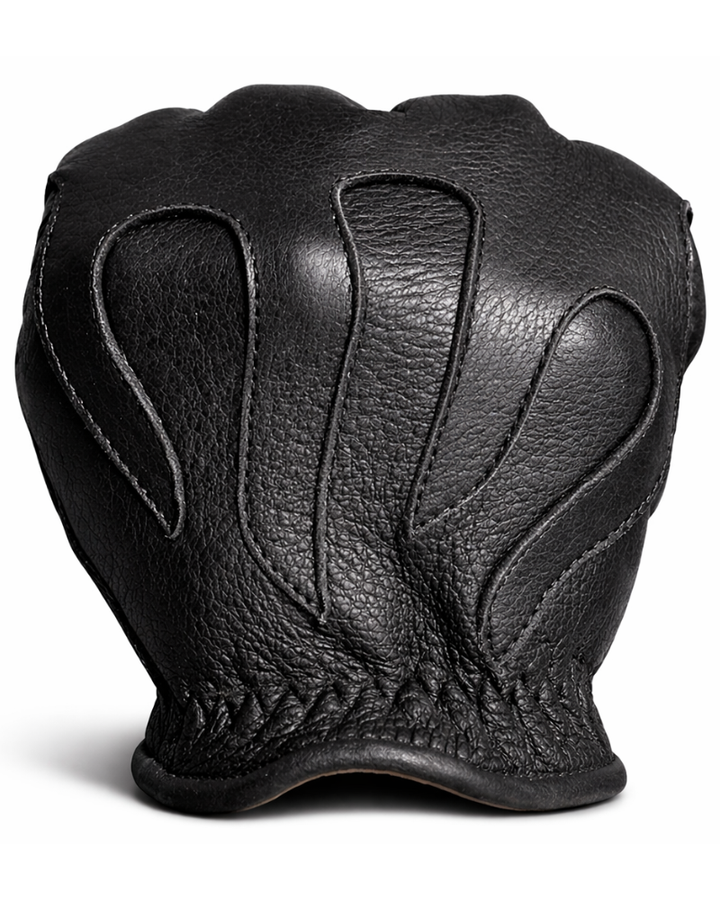
The Legendary Bad Billy Black Goatskin Motorcycle Gloves represent this material in a refined, American-made package. The goatskin construction delivers cut and abrasion performance at the hand's most vulnerable zones while remaining significantly lighter and more flexible than cowhide alternatives.
Riders who want deerskin's comfort with improved palm abrasion resistance have another option: deerskin gloves with aramid/Kevlar palm lining, which compensates for deerskin's lower inherent abrasion resistance with a structural backing layer. The Legendary Deerskin Short Wrist Touchscreen Gloves are built in this tradition — premium deerskin with full touchscreen capability for riders who prioritize comfort and modern connectivity.
Cowhide vs Both: Why Premium Riders Avoid Cowhide Gloves
Cowhide is the default leather in the majority of mass-market motorcycle gloves because it is inexpensive, readily available in consistent thickness, and durable enough for most use cases. But premium riders who have ridden in quality goatskin or deerskin gloves rarely return to cowhide willingly.
The reasons are straightforward:
Weight: Cowhide motorcycle gloves are 30–50% heavier than goatskin or deerskin alternatives. Over a full day of riding, this is a meaningful fatigue difference.
Stiffness: Cowhide is stiff, particularly new. The break-in period is measured in months rather than rides. A new cowhide glove feels like wearing a work gauntlet compared to deerskin or goatskin alternatives.
Breathability: Cowhide's dense, thick cross-section restricts airflow effectively. In summer riding, cowhide gloves make hands hot and sweaty in ways that lighter leathers do not.
Feel: Throttle feedback through cowhide is dulled by the material's thickness and stiffness. Fine control inputs are harder to feel, particularly in cold weather when cowhide stiffens further.
Cowhide does offer better abrasion resistance than both goatskin and deerskin at equivalent thickness, and it is the right choice for some applications — entry-level gloves where cost is the primary factor, or heavy-duty construction where maximum durability trumps comfort. For riders investing in quality motorcycle gloves, goatskin or deerskin are the appropriate choices.
Frequently Asked Questions: Goatskin vs Deerskin Motorcycle Gloves
Which leather is softer, goatskin or deerskin?
Deerskin is softer, and the difference is significant from the first time you put the gloves on. Deerskin's open fiber structure makes it immediately supple and conforming. Goatskin is also a soft leather — softer than cowhide — but has a firmer initial feel that requires a proper break-in period before reaching its full comfort level. If softness is your primary criterion, deerskin is the clear choice.
Which leather is more durable for motorcycle use?
Goatskin offers better abrasion resistance and cut resistance due to its tighter fiber weave. In crash scenarios involving road surface abrasion, goatskin holds up longer before wearing through. For long-term everyday durability under normal riding conditions (not crash scenarios), the two are more comparable — both outlast cowhide by weight when properly cared for.
Does goatskin motorcycle gloves run hot in summer?
Yes, relative to deerskin. Goatskin's tight fiber structure restricts airflow through the material, retaining more heat at the hand. In summer temperatures above 80°F, goatskin gloves will feel warmer than equivalent deerskin gloves. For warm-weather riding, look for goatskin gloves with perforations or deerskin as your warm-weather choice.
Can deerskin gloves get wet?
Yes, and deerskin handles wet conditions better than most leathers. It remains pliable when wet and dries without stiffening — a property historically prized in deerskin garments. Hands will get cold if the glove soaks through, but the leather itself is not damaged by water exposure. Condition after extended wet exposure to maintain suppleness.
Which leather has better grip on handlebars?
Deerskin provides better dry grip due to its napped (suede-like) surface, which creates high friction against rubber and gel handlebar grips. Goatskin's smooth grain surface provides lower but more consistent grip in wet conditions. For riders in dry climates, deerskin's dry grip advantage is meaningful. For riders who frequently encounter rain, goatskin's wet consistency may be preferable.
How long does goatskin take to break in?
Expect 5–10 rides for a new goatskin glove to soften and conform to your hand. During break-in, fingers feel somewhat restricted and the overall glove has a structured firmness. Applying leather conditioner before the first ride speeds initial softening. Full break-in produces a well-conformed glove with excellent fit retention.
Is deerskin leather durable enough for motorcycle riding?
Yes — with the caveat that deerskin's lower intrinsic abrasion resistance is worth understanding. For normal riding without crashes, deerskin motorcycle gloves last for years under regular use with proper care. In crash scenarios, deerskin will wear through on pavement faster than goatskin of the same thickness. Many premium deerskin gloves address this with aramid (Kevlar) lining in the palm area, which substantially improves slide performance without changing the comfort of the deerskin exterior.
What does deerskin look like after years of use?
Well-maintained deerskin develops a warm, burnished patina at the wear points — the thumb pad, finger bases, and palm center lighten and become slightly glossy compared to the surrounding napped leather. The overall color often warms and deepens. Riders who care for their deerskin gloves properly find they develop a character that new gloves don't have.
Is goatskin good for cold weather riding?
Goatskin provides modest warmth advantage over deerskin due to its tighter fiber structure and natural water resistance. It extends the comfortable riding season into cooler fall temperatures better than deerskin alone. For true cold-weather riding below 40°F, a lined glove in either leather is the appropriate choice — unlined goatskin or deerskin alone is insufficient at low temperatures regardless of the leather's inherent properties.
Why do premium motorcycle gloves use these leathers instead of cowhide?
Goatskin and deerskin are both lighter, softer, and more flexible than cowhide at the thicknesses appropriate for motorcycle gloves. The weight reduction (30–50%) reduces hand fatigue on long rides. The softness reduces break-in time and improves throttle feel. The flexibility allows better finger articulation for clutch and brake control. Cowhide is cheaper to source and adequate for basic protection, but neither leather compares to goatskin or deerskin in comfort and feel.
Can I use the same gloves for summer and fall riding?
Goatskin unlined gloves work better across a wider temperature range than deerskin because of the insulation difference — they're comfortable in warm weather (especially with perforations) but provide more warmth as temperatures drop. Deerskin is the better summer choice but may feel cool in fall temperatures. Riders who want one glove for both seasons often find goatskin the more versatile option, while riders who ride only in summer typically prefer deerskin.
What is the most important factor when choosing between goatskin and deerskin?
Intended use and climate. If you ride primarily in warm weather and prioritize maximum comfort and feel, choose deerskin. If you ride in varied conditions and want a single glove that provides better cut resistance and extends into cooler weather, choose goatskin. If budget allows, many experienced riders own both: deerskin for summer and warm-weather riding, goatskin for transitional seasons and conditions where protective properties are the priority.