



Motorcycle glove fit is not a comfort issue — it is a control issue. A glove that bunches at the palm or allows the fingertip seams to pull away from your fingers dulls throttle response and accelerates hand fatigue on longer rides. Getting fit right before you buy saves you from breaking in a glove that will never perform the way it should.
Why Fit Is the First Priority in Motorcycle Gloves

The glove sits between your hands and every control input on the bike. When leather bunches at the palm — because the glove is too large — the fold creates pressure hot spots that tire your grip within the first hour. When a glove is too small, the leather pulls across the knuckles and restricts your range of motion, making fine adjustments to throttle and brake feel mechanical and imprecise. Neither problem corrects itself over time; it just becomes the new normal until you put on a properly fitting pair.
Fit also determines how well the glove breaks in. Full-grain leather molds to the exact contours of your hand — but only if there is a hand there to mold around. A glove that is too large will break in to a generalized shape and never develop that custom fit.
How to Measure Your Hand Size
Use a soft measuring tape and take two measurements: hand circumference and hand length. For circumference, wrap the tape around the widest part of your palm, just below the knuckles, excluding the thumb. For length, measure from the base of your palm to the tip of your middle finger. If your measurements fall between sizes, size down — leather will give; it will not shrink.
Take the measurement on your dominant hand, which is typically slightly larger. Do this in the afternoon when your hands are at their natural working size, not first thing in the morning when they may be slightly puffy. Record both numbers and compare against the specific brand’s size chart, since sizing varies by cut and leather type.
What a Correctly Fitting Glove Feels Like
Put the glove on and close your hand into a riding grip. The fingertip seams should sit within roughly 1/4 inch of your actual fingertips — close enough that you feel the seam when you press against it, but not pressing against it at rest. There should be no excess leather gathering at the palm when your hand is open, and the knuckle area should feel secure without any pulling when you flex your fingers.
The leather will feel firm and slightly stiff at first, especially in the palm and across the knuckle line. That resistance is not a sign the glove is too small — it is simply unbroken leather. Run the grip check, the clutch reach, and a few throttle rotations. If you feel restriction pulling at the thumb gusset or pressure across the first knuckle joint, the glove is genuinely too small.
The one-finger test: you should not be able to slide a finger between the glove cuff and your wrist — that gap means excess material will shift under load.
The Break-In Factor: Deerskin vs. Horsehide
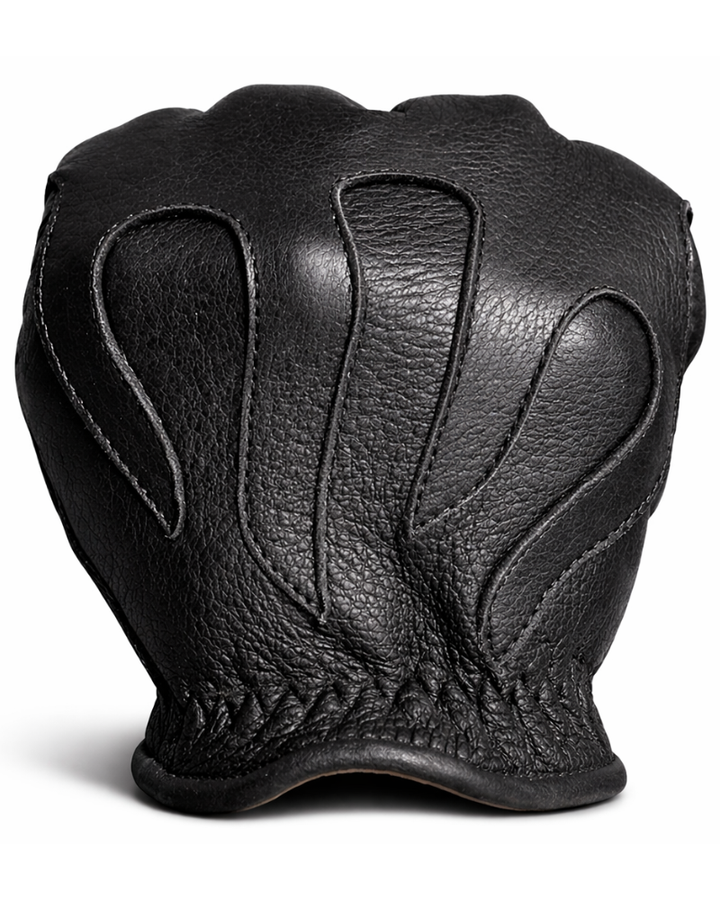
Leather type directly affects how quickly a glove reaches its fitted shape. Deerskin is the most supple full-grain leather available and breaks in faster than any other hide — often within the first two or three rides. The Legendary Deerskin Short Wrist Touchscreen Gloves conform quickly to the hand’s contours, making the break-in window short and the resulting fit highly precise. Horsehide is denser with a tighter fiber structure, so it takes longer to reach that same conformed state — several weeks of regular riding rather than a few sessions.
Both leathers will mold to your hand given time and wear; the difference is timeline, not end result. If you want a glove that feels custom-fitted early in the season, deerskin is the faster path. If you prefer a leather that holds its structure for years under heavy use and are willing to invest the break-in time, horsehide rewards that patience. The Legendary Deerskin Classic Touchscreen Gloves offer a longer cuff cut in deerskin for riders who want that fast conforming feel with additional wrist coverage.
Proper care during the break-in period matters. Conditioning the leather after the first few rides keeps the fibers pliable and prevents the stiffness from becoming permanent. Our guide to leather motorcycle glove care covers the conditioning schedule and products that work with full-grain hides without over-saturating the leather.
Gauntlet vs. Short Wrist: Does Cut Affect Sizing?
The gauntlet cuff extends up the forearm and typically closes with a snap or zipper. The short wrist cut ends at or just below the wrist bone and relies on a velcro or snap closure at the cuff. Neither cut changes how you measure your hand, but the closure style can affect how a borderline size feels in practice.
On short wrist gloves, the cuff sits closer to the palm, so the closure point is a useful secondary fit check: it should fasten without bunching the leather at the wrist. On gauntlet cuts, the cuff fit is less integrated with the palm fit — the cuff can be adjusted independently. If you are between sizes, the short wrist cut is less forgiving, since there is less material to adjust at the closure. The Legendary Spitfire White Deerskin Gloves are a short wrist cut, so following the measurement guidelines above closely before ordering will ensure the palm and finger fit land correctly from the first ride.
For riders shopping across styles and materials, our full men’s made-in-USA motorcycle gloves collection includes size guides specific to each glove on the product page.
Frequently Asked Questions
- My gloves felt tight at first but have loosened up. Is that normal?
-
Yes, and it is one of the clearest signs you sized correctly. Full-grain leather — deerskin especially — conforms to your hand’s exact shape over the first several rides. The leather fibers relax under warmth and friction, so a glove that felt snug out of the box will settle into a close, personalized fit. If the glove was painful from the start or restricted blood flow at the knuckle line, that is too small rather than a break-in scenario.
- Should motorcycle gloves fit loose so I can pull them on and off easily?
-
No. A loose glove causes friction bunching at the palm and finger joints, which accelerates fatigue and reduces throttle feel. Leather gloves that fit correctly will take a moment to pull on — that resistance is the leather conforming to your hand rather than sliding around it. If a glove goes on and off effortlessly from day one, it is almost certainly a size too large.
- Can I size up to fit thicker liners underneath?
-
This approach typically backfires. Sizing up for a liner leaves too much material in the palm when you ride without the liner, and the added bulk dulls throttle and brake feel. A better approach is to choose a glove designed for cold-weather use — one with built-in insulation — rather than layering under a warm-weather glove. If you need cold-season coverage, select a purpose-built winter glove at your true measured size.
- How do I know if my gloves are too small?
-
The clearest signs are: the fingertips press against the glove tip rather than sitting 1/4 inch from the seam, the leather pulls tight across the knuckles when you grip the bar, or the thumb gusset feels strained when you reach for the clutch. Numbness in the fingertips after short rides is another indicator — that points to restricted circulation at the knuckle or base of the palm. A correctly fitting glove should feel secure without any of those pressure points.
Motorcycle glove fit comes down to two measurements, one simple grip test, and an honest assessment of how the leather responds when your hand is in a riding position. Take the time to measure correctly, account for break-in when evaluating first feel, and match the cut to how you ride. A glove that fits from the start will outperform one you bought hoping it would work itself out.