





Outseam Motorcycle Glove Construction: Zero Interior Seam Pressure on Every Ride
Quick Answer: Outseam glove construction moves all stitching from the interior of the glove to the exterior, eliminating the ridge pressure that standard interior seams create against your skin during long rides. On a 30-mile commute you may not notice interior seams at all. On a 300-mile day, they become the primary cause of hand fatigue, blistering at the knuckle creases, and grip soreness. Outseam construction solves this entirely by making the seam a surface feature rather than a contact point.
What Outseam Construction Is
Every glove is assembled by stitching leather panels together. The stitching creates a seam — a ridge of thread and overlapping leather at the junction of two panels. In a standard glove, these seams face the interior of the glove, pressing directly against your skin. In an outseam glove, the panels are joined so that the seam ridge faces outward, away from the skin.
The difference seems minor in isolation. Its effect over time is not minor at all.
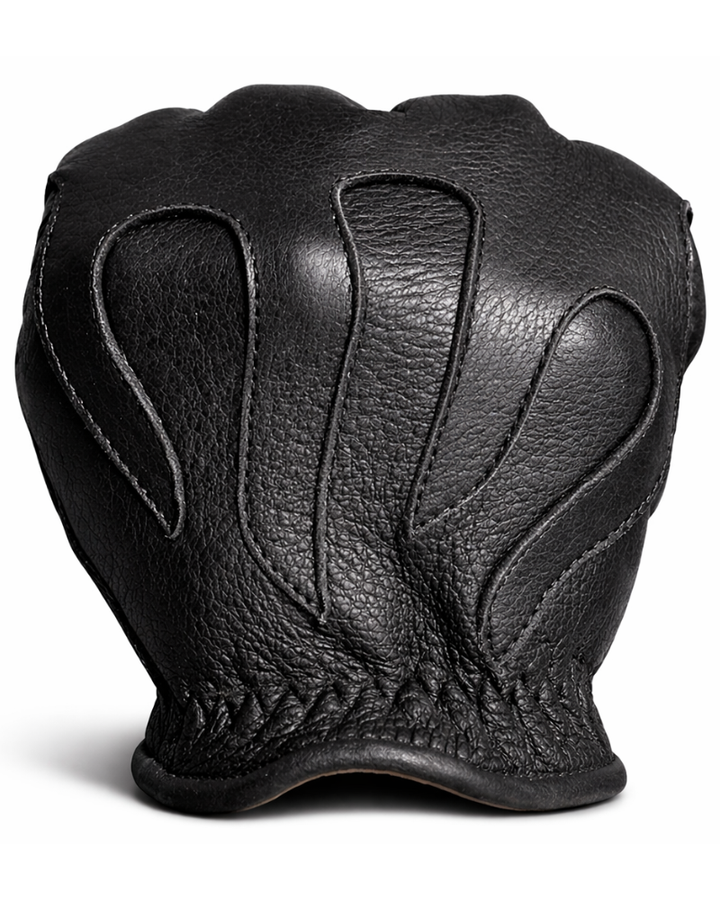
The visual difference between inseam and outseam is immediately apparent: pick up an outseam glove and the stitching is visible on the exterior surface of the leather. The inside is smooth. On a standard glove, the inside has raised seam ridges at every panel junction. The outside is smooth leather. This is the construction choice, and it has direct consequences for how the glove feels over hours of riding.
Why Standard Interior Seams Cause Pain on Long Rides
Interior glove seams sit in specific anatomical locations that happen to be high-pressure points during riding:
- Finger base creases: The seam joining each finger panel sits at the base of the finger — exactly where the finger bends during grip. Every squeeze of the throttle, every lever pull, every gear shift loads this crease under pressure.
- Knuckle area: Seams across or near the knuckles press into the skin when the hand is closed in grip position.
- Between-finger webs: Seams at the junction of adjacent finger panels press into the web of skin between fingers.
- Palm heel: Seams at the lower palm contact the grip surface constantly during riding.
At low mileage, these seams are barely perceptible. The skin can handle the mild, repeated pressure without complaint. Over hours and hundreds of miles, the cumulative loading creates:
- Hot spots where seam ridges repeatedly load the same skin area
- Blisters at high-friction contact points, especially where the seam moves against skin during grip flexion
- Calluses that form over time at chronic seam contact points
- Fatigue from the low-level but constant distraction of seam pressure that occupies background attention throughout a long ride
The physics are straightforward: pressure equals force divided by area. A seam ridge contacts the skin across a very small area — a thread-width ridge — concentrating the pressure of the grip force into a narrow line rather than distributing it across the full palm surface. The skin responds to this concentrated, repeated pressure the same way it responds to any friction source: inflammation, then callus or blister formation.
The Physics of Seam Pressure Under Throttle Grip
Throttle grip is not static. A rider's hand is continuously making micro-adjustments — rolling the throttle on and off, maintaining position against wind load, compensating for road surface variation. Each micro-adjustment involves a small amount of movement between the glove interior and the skin.
When the seam sits at a flex point (finger base, knuckle), this movement causes the seam ridge to roll slightly across the skin rather than staying in a fixed position. This rolling motion under pressure is the specific mechanical action that produces blisters: localized heat from friction, fluid accumulation, skin separation. Riders who blister at the base of the fingers on long rides are experiencing exactly this mechanism.
Moving the seam to the exterior eliminates the interior contact point entirely. The skin inside the glove contacts smooth, flat leather — no ridges, no friction points, no rolling seam pressure. The exterior seam becomes a visual and structural feature with no impact on the rider's experience.
Outseam vs Standard Inseam: The Visible Difference
Side by side:
Standard inseam glove interior: Raised thread ridges at every panel junction. Run your finger along the inside of the finger channels and you'll feel the seam ridges at the base, sides, and tip of each finger.
Outseam glove interior: Smooth, flat leather throughout. No ridges. The interior surface contacts your skin uniformly across the full contact area of each panel.
The exterior of an outseam glove has a distinctive appearance: the stitching is visible on the surface of the leather, often with exposed thread or a raised bead at panel junctions. Some riders find this aesthetically distinctive — it's a visible cue that the glove is constructed differently from standard. Others prefer a cleaner exterior look. The functional benefit is the same regardless of aesthetic preference.
How Outseam Construction Changes Fit and Feel
The interior space of an outseam glove is effectively larger at the seam locations than an inseam glove of the same nominal size. The seam material that would have occupied interior space is moved to the exterior. This produces a subtly more spacious interior at the finger joints and panel junctions — the places where standard gloves feel tightest when the hand is closed.
For riders who have found that standard leather gloves feel slightly constrictive when making a full fist, outseam construction often resolves this without requiring a size change. The relief is specifically at the panel junctions — the points of maximum seam pressure — which happen to be the same points that limit full hand closure in a tight glove.
The overall fit impression of a quality outseam glove is more conforming and less rigid than an equivalent inseam glove. With no seam ridges to create localized stiffness points, the glove flexes more uniformly across the hand and drapes more naturally in the grip position.
Who Benefits Most From Outseam Construction
The benefit scales directly with mileage and ride duration:
Touring and long-distance riders: If you're doing 6-10 hour days in the saddle, outseam construction is a meaningful comfort upgrade. The seam pressure that barely registers on a 30-mile commute accumulates into genuine discomfort over the course of a touring day.
Daily commuters with high annual mileage: Riders who commute year-round put in 15,000-30,000+ miles annually. Even on short daily rides, the cumulative seam contact over a riding season adds up. Commuters who notice calluses forming or recurring hotspots at the knuckle crease are experiencing standard seam effects.
Riders with sensitive skin or prior hand issues: Anyone prone to blistering, who has had hand surgery, or who has skin conditions that make friction a particular concern benefits disproportionately from the elimination of interior seam contact.
Riders who have never found a glove that fits comfortably for long stretches: If you've cycled through multiple gloves looking for the one that doesn't hurt on long rides, interior seam pressure is frequently the culprit — even when the nominal size is correct. Outseam construction eliminates the most common source of this complaint.
Two Years of Development Behind the ILL DOZER
The Legendary ILL DOZER Outseam Deerskin Motorcycle Gloves represent two years of design and prototype iteration specifically focused on long-ride comfort. The outseam construction was not a marketing feature added to an existing glove pattern — it required rebuilding the pattern from scratch to route all seams to the exterior without compromising the structural integrity of the glove or the fit in riding position.
This matters because outseam construction is more difficult to execute correctly than standard inseam. The panel engineering must account for the exterior seam bulk when calculating fit. The structural role of the seam — holding panels together under stress — is unchanged, but it now faces outward where it must also contribute to the glove's durability without interior seam reinforcement to back it up. Getting this right requires more pattern iterations than a standard glove, which explains why outseam motorcycle gloves are uncommon in the market relative to their benefit.
Does Outseam Construction Affect Durability?
This is a fair question. Interior seams derive structural support from the interior of the glove — they are sandwiched between the leather layers and partially protected from external abrasion. Exterior seams are exposed to the environment.
In crash conditions, exterior seams may abrade slightly faster than equivalent interior seams. In normal riding use, this exposure has no practical effect on durability. Thread quality matters more than seam placement — high-quality bonded nylon or polyester thread on an exterior seam will outlast cheap thread on an interior seam.
The more relevant durability comparison: interior seam stress from repeated flexion at contact points. The same mechanical loading that causes interior seams to irritate the skin also stresses the seam itself over thousands of flex cycles. Exterior seams at flex points experience less concentrated stress because the pressure is distributed differently. High-quality outseam construction using correct thread and seam allowances is not a durability compromise.
Outseam Gloves vs Padded or Gel-Palm Gloves for Vibration
Some gloves address long-ride hand fatigue with gel or foam padding in the palm. This is a different problem — vibration damping rather than seam pressure elimination. The two approaches are not competing; they address different sources of fatigue.
Vibration fatigue comes from the road surface transmitting vibration through the handlebars, grip, and glove to your hands. Gel padding absorbs some of this energy. Outseam construction does not address vibration — it addresses contact pressure from seam ridges.
For maximum long-ride comfort, the ideal combination is outseam construction (eliminates seam pressure) plus palm padding or vibration-damping material (reduces vibration fatigue). The ILL DOZER uses outseam construction alongside a LeathSorb™ palm panel that provides both grip and vibration reduction — addressing both fatigue sources in one glove.
LeathSorb™ Palm Paneling: How It Complements Outseam
LeathSorb™ is a proprietary palm material that combines leather-like durability with a degree of impact and vibration absorption. In the context of a long-ride glove, it adds a second layer of comfort engineering that complements the seam-elimination benefit of outseam construction.
The palm is the highest-pressure contact zone during riding. It receives constant load from the handlebar grip, experiences the most vibration transmission, and is the zone most likely to develop fatigue on extended rides. A LeathSorb™ palm panel distributes and absorbs some of this load, reducing the energy that reaches the palm tissue beneath.
Combined with outseam construction at the finger panels and finger-base seams, the ILL DOZER addresses long-ride comfort from two directions: eliminating interior seam contact pressure at the joints and fingers, and absorbing impact and vibration at the palm. This is why two years of development was required — integrating both features into a single pattern that fits correctly in riding position required significant engineering iteration.
Breaking In an Outseam Glove
Outseam deerskin gloves break in faster than standard inseam cowhide gloves because deerskin is inherently more pliable. The break-in process for an outseam glove is straightforward:
- Wear the gloves for the first ride in their natural state — do not apply conditioner before the first use.
- After the first few rides, the deerskin will have begun conforming to your grip position. You'll notice the glove feels more natural and moves with your hand rather than resisting it.
- After approximately 5-10 hours of riding, apply a pH-neutral leather conditioner. The leather will have opened slightly from use and will absorb the conditioner more evenly than it would have on first application.
- The outseam construction means the exterior seams will develop a slight patina with use — the thread and leather around the seam will visually integrate as the glove ages. This is normal and does not indicate wear.
Riders transitioning from padded inseam gloves to outseam deerskin sometimes notice that the smoothness of the interior feels "different" rather than "better" initially — the absence of the familiar seam pressure takes a brief adjustment. After one or two long rides, the comfort advantage of the outseam construction becomes apparent.
The Haymakers Alternative: Fat Welt Construction
For riders who want a similar seam-management benefit through a different method, the Legendary Haymakers Super Welted Motorcycle Gloves use a fat-welt seam construction. A welted seam encases the seam allowance in a strip of leather that sits on the exterior — similar in principle to outseam, but with the seam allowance wrapped rather than simply flipped outward. The result is a more pronounced exterior seam profile with a distinctive visual style, and the same interior-smoothness benefit for the hand.
Both outseam and fat-welt construction solve the interior seam pressure problem. They represent different aesthetic choices — outseam is cleaner and more minimal on the exterior, fat welt is more pronounced and traditional-looking. The functional benefit for long-ride comfort is comparable between the two methods.
Frequently Asked Questions About Outseam Motorcycle Gloves
What exactly is the difference between outseam and inseam construction in motorcycle gloves?
In inseam construction, panels are joined with the seam allowance folded to the interior of the glove — the stitching and seam ridge press against the rider's hand. In outseam construction, the panels are joined with the seam allowance folded to the exterior, leaving the interior surface smooth. The structural result is identical; the comfort difference is significant on long rides.
Will I notice the outseam ridges on the outside of the glove when I'm riding?
No. The exterior seam ridges on an outseam glove are small — typically 2-4mm raised from the leather surface — and sit on the back of the hand and sides of the fingers. They do not contact the handlebar, grip, or any control surface. They are not perceptible during riding. They are visible as a design feature of the glove exterior.
Do outseam gloves fit differently than standard inseam gloves?
Outseam gloves are typically cut to the same nominal sizes as equivalent inseam gloves, but the interior will feel slightly more spacious at the panel junctions because the seam allowance that normally takes up interior space has been moved outward. Riders who find standard gloves slightly tight when making a full fist often find outseam gloves more comfortable at the same stated size.
How long does it take to notice the comfort difference from outseam construction?
On rides under an hour, the difference may be barely perceptible — interior seam pressure doesn't accumulate significantly in short timeframes. On rides of 3-4+ hours, the difference becomes clear. Riders on multi-day tours consistently report the most dramatic comfort improvement compared to their previous inseam gloves.
Can I find outseam motorcycle gloves in a waterproof version?
Outseam construction is compatible with waterproof membrane gloves, but the combination is uncommon in the market because waterproofing typically adds liner bulk that outseam alone cannot compensate for. For wet-weather riding where comfort on long rides is a priority, the better approach is a well-fitted outseam glove with a waterproof overmitt for rain riding rather than a combined waterproof/outseam glove.
Does outseam construction make the gloves harder to put on and take off?
No. The entry and exit of the glove (wrist opening and cuff) are not affected by outseam construction at the finger panels. Putting on and taking off an outseam glove is identical in feel to a standard glove.
Why don't all motorcycle gloves use outseam construction if it's more comfortable?
Outseam construction is more difficult to pattern and assemble than standard inseam construction. The pattern must be engineered differently to account for exterior seam placement, and the assembly requires more precision because exterior seam alignment is visible on the finished product. Manufacturing cost is higher, and the design expertise required is greater. Most mass-market glove manufacturers do not invest in outseam construction because the volume economics don't support the additional development cost.
Will outseam gloves wear out faster at the exterior seams?
Under normal riding use, exterior seams on quality gloves do not wear out faster than interior seams. In crash conditions, exterior seams may abrade slightly faster because they are exposed to pavement contact. The practical durability of a well-made outseam glove using quality thread is equivalent to a comparable inseam glove for all normal use scenarios.
What is the ILL DOZER glove made of besides the outseam construction?
The ILL DOZER uses American Whitetail deerskin outer leather, perforated panels for airflow, outseam construction throughout the finger panels, and a LeathSorb™ palm panel. The short-wrist cut keeps it appropriate for three-season riding with jacket cuffs covering the wrist gap. It is designed as a premium long-ride glove that addresses the three primary sources of hand fatigue: seam pressure (outseam), vibration (LeathSorb™ palm), and heat (perforations).
Can outseam gloves be repaired if the exterior seams are damaged?
Yes, and exterior seam repair is in some ways easier to access than interior seam repair because the stitching is visible and reachable without disassembling the glove. A leather repair professional can restitch an exterior seam using appropriate thread. Restitching an interior seam requires turning the glove inside out, which is not always possible without damaging the glove structure.
I have calluses on my fingers from riding. Will outseam gloves help?
If the calluses are at the base of the fingers or at the finger-to-hand junction — classic seam pressure locations — yes, outseam construction will eliminate the seam contact that's causing them. If the calluses are at the fingertips or palm heel from grip pressure itself (not seam pressure), outseam construction won't directly address this, though the reduced overall discomfort of an outseam glove may reduce the grip force you're applying.
Is outseam construction available in winter motorcycle gloves?
Less commonly than in three-season gloves, because winter gloves require insulation liners that add interior bulk regardless of seam placement. The comfort benefit of outseam construction is most pronounced in lighter-weight gloves where the total interior panel stack is thin enough for seam ridges to be perceptible. In heavily insulated winter gloves, the insulation partially cushions interior seam ridges, reducing (but not eliminating) the comfort differential.
How does outseam construction affect touchscreen compatibility?
No effect. Touchscreen compatibility (conductive thread in the fingertips) is a feature of the fingertip panel leather and stitching, not of the seam construction method. Outseam and touchscreen capability are fully compatible design features that can be combined in a single glove. The seam construction method does not affect the conductive thread's contact with the screen.