


Most rider training conversations focus on the dramatic stuff: high-speed cornering, panic braking, swerve drills. Those skills matter. But the unglamorous skill that’s separating safe riders from accident-prone ones — the one that police motor units, MSF instructors, and 30-year veterans drill obsessively — is slow speed control. Tight U-turns, parking-lot maneuvering, balance under 15 mph. The stuff that goes wrong in driveways, parking decks, and gas station turnarounds, where the asphalt is unforgiving and the bike weighs more than you do.
Here’s why slow speed training matters, what to drill, and why the gloves on your hands make more difference than most riders realize.
What Slow Speed Motorcycle Training Actually Is

Slow speed training is the practice of controlling a motorcycle at speeds typically below 15 mph — the regime where engine torque, gravity, and rider input have to be balanced precisely or the bike falls over. Core drills include:
- Tight 360° circles inside a single parking space
- Full U-turns inside a 24-foot wide street
- Figure-eights between two cones
- Slow-cone weaves with cones spaced 12–15 feet apart
- Stop-start drills with one foot down, then both feet up
- The “clutch crawl” — rolling forward at idle in first gear
Most riders practice in an empty parking lot, ideally early Sunday morning, with cones or chalk marks. A good drill session is 30–60 minutes once a week.
Why Slow Speed Training Is Crucial
1. Improved Bike Control
At slow speeds, the gyroscopic stability of a moving wheel almost disappears. The bike wants to fall. The only thing keeping it upright is your input — clutch, throttle, rear brake, body position. Riders who drill slow speed develop a feel for the friction zone and counterbalance that translates directly into smoother riding at every speed.
2. Confidence in Tight Spaces
Most rider drops don’t happen on the highway. They happen in driveways, parking lots, and gas stations — places that demand slow, controlled maneuvering. Building real low-speed confidence is what stops you from putting your bike on its side in front of a Starbucks.
3. Critical for Urban Riding
City riders deal with stop-and-go traffic, tight intersections, parallel parking, and constant low-speed micro-adjustments. The rider who’s drilled their slow-speed skills handles all of it without breaking a sweat. The rider who hasn’t is fighting the bike every block.
4. Foundation for Advanced Skills
Counterbalance, clutch control, and rear-brake modulation are the building blocks of every advanced riding technique. Riders who master them at 5 mph have an easier time learning emergency braking, swerve drills, and high-speed cornering later.
5. Reduced Risk of Injury
Slow-speed practice in an empty lot lets you make mistakes without the consequences of road traffic. The muscle memory you build there transfers to real riding situations — the moment your bike is loaded up with luggage on a tight forest service road, or you have to U-turn on a narrow street with cars in your mirror.
Key Techniques to Drill
Clutch Control
The friction zone — the lever range where the clutch is partially engaged — is where slow-speed riding lives. Practice feathering the clutch to deliver smooth, controlled power without lurching forward or stalling. Once your hand learns the friction zone by feel, slow-speed riding becomes effortless.
Throttle and Rear Brake Coordination
Counterintuitively, the right way to slow-speed is to add a little gas while dragging the rear brake. The rear brake stabilizes the bike against the throttle, and the resulting balance keeps the bike from lurching or stalling. Almost every police motor cop in America does this.
Body Positioning and Counterbalance
For tight slow turns, lean the bike into the turn while keeping your body upright or even angled slightly outside. This counterbalance — bike leaned, body upright — is what allows police bikes to U-turn inside a single car length.
Head and Eye Placement
Look where you want to go. Not at the ground, not at the cones, not at the front fender — look through the turn to where you intend to exit. Your bike follows your eyes more than your hands.
Smooth Stops and Starts
Drill clean stops with one foot down, then both feet up, without rolling backward or wobbling. The clutch-and-rear-brake combination from above is the foundation here too.
Why Glove Quality Matters in Slow Speed Training
This is the part most training articles skip. Slow-speed work demands fingertip precision — you’re feathering the clutch lever a millimeter at a time, modulating throttle by single degrees, dragging the rear brake without locking it. Cheap, stiff, or thick gloves dull all of that. You can’t feel the friction zone if there’s a half-inch of polyester padding between your fingers and the lever.
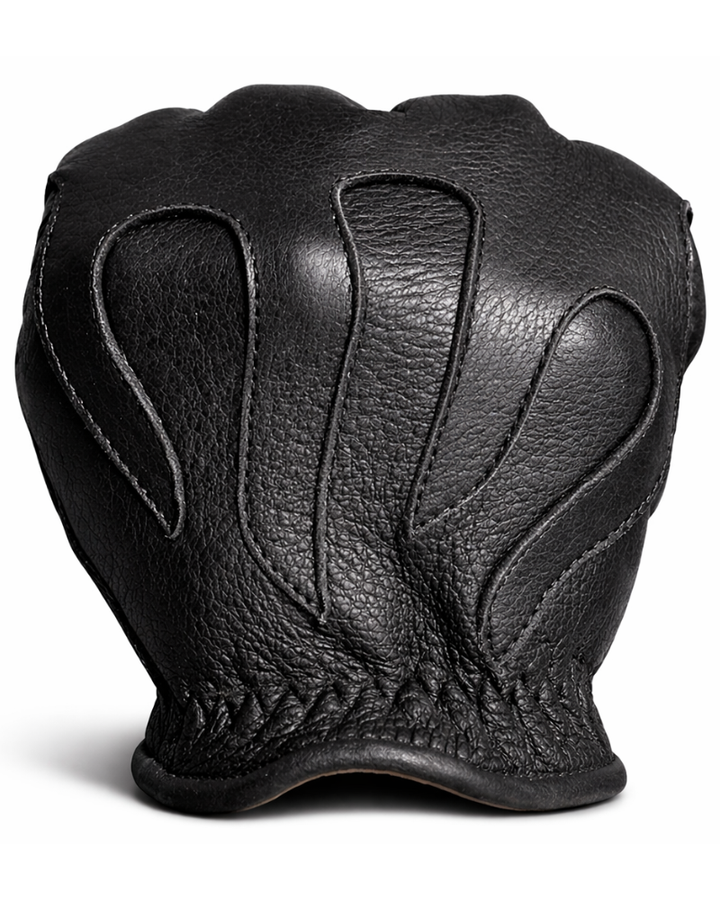
This is why American deerskin motorcycle gloves are the standard for police motor units, MSF instructors, and serious riders. Deerskin is thin enough to transmit feel directly to your hand, soft enough to break in to your grip, and strong enough to hold up to daily use.
Specifically:
- The short-wrist deerskin glove cuts are favored by highway patrol units across the country — the wrist runs clean under uniform sleeves, and the deerskin gives you direct lever feel
- The Legendary Haymakers add reinforced welt construction for riders who want extra abrasion margin without losing feel
- The Churchill heritage line brings 125+ years of glove-making lineage to the same deerskin tradition
Frequently Asked Questions
Why do I keep dropping my motorcycle in parking lots?
Because most riders never drill slow speed. The skills that matter at 70 mph aren’t the same as the skills that keep you upright at 3 mph. Spend an hour a week in an empty lot working on tight U-turns and figure-eights, and the parking-lot drops disappear within a few weeks.
What gloves do police motor officers wear?
Most U.S. motor officers wear hand-made American deerskin gloves — usually short-wrist cuts that fit cleanly under uniform sleeves. The deerskin gives them the lever and clutch feel they need for the precision slow-speed maneuvering that motor school drills.
Should I use the front brake at slow speeds?
Generally no — the front brake at very slow speeds can pitch the bike forward and upset balance. Use the rear brake to stabilize while dragging the clutch friction zone. Save the front brake for higher speeds.
How long does it take to get good at slow speed riding?
Most riders see meaningful improvement within 4–6 hours of focused parking-lot practice. Real fluency takes 20–30 hours, spread over several weeks. The progression is steep at first.
Are deerskin gloves stiff at first?
Less than most leathers. Deerskin breaks in faster than goatskin or cowhide and conforms to your hand within the first few rides. Order true to size and let them shape themselves.
What’s the best motorcycle for learning slow speed control?
Whatever you ride. Big touring bikes are actually easier to balance at slow speeds than small bikes once you learn the technique — more momentum, more stable. The skills transfer up and down the bike size range.
Train Slow, Ride Smart
Slow speed control is what separates riders who keep riding from riders who eventually quit because they keep dropping the bike. Drill it. And while you’re at it, give yourself the equipment that lets you actually feel what your bike is doing — browse our full Made in USA motorcycle gloves collection.
Article originally published July 2024. Updated May 2026 with expanded technique detail, glove guidance, and FAQ.