

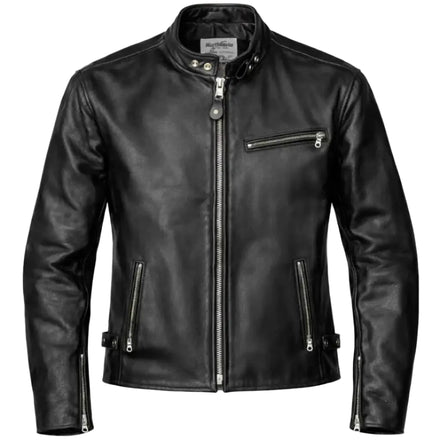


If you've searched for an original BECK jacket from the 1940s through 1960s, you already know: they don't come up often, and when they do, the prices reflect that scarcity. A clean example in horsehide with functioning hardware can bring $800 to $2,500 or more depending on model and condition. That's not just collector enthusiasm — it's a market accurately pricing something that can't be replicated at scale.
Here's why original BECK jackets hold and appreciate in value, and what that tells you about the modern BECK jackets produced under Legendary USA's revival.
The Horsehide Factor
The single biggest driver of BECK's value is the leather itself. Original BECK jackets were made from genuine horsehide — specifically front-quarter horsehide, the densest and most durable section of the hide. Horsehide production in the United States collapsed after the 1960s when horse slaughter for commercial use declined sharply. The American horsehide supply that powered brands like BECK, Buco, and Hercules essentially no longer exists at commercial scale.
This matters because horsehide behaves differently from cowhide in ways that aged leather collectors can see and feel. It develops a patina rather than just wearing out. The tight fiber structure resists cracking that degrades cowhide over decades. A 70-year-old BECK jacket in reasonable condition can still be worn — because horsehide doesn't rot, it refines.
When collectors examine a vintage BECK, they're not just buying history. They're buying a material that no longer exists in the same form, from a source that no longer exists in the same scale.
Pre-War and Early Post-War Construction
BECK's manufacturing peaked in quality and volume between the late 1930s and the late 1960s. Jackets from this era share specific construction details that command premiums: double-stitched seams, brass or steel hardware, full-grain leather throughout (no splits or corrected-grain finishing), and patterns developed directly from military jacket specifications.
The construction techniques of this era were labor-intensive. Workers spent more time per jacket than modern production economics allow. That time shows up in the jacket — in seam consistency, in how the zipper hangs, in how the collar lies flat after 50 years of wear. These details can't be faked, and they can't be efficiently reproduced at a price point that competes with modern mass production.
The Supply Problem
BECK closed its original operations decades ago. Every vintage BECK jacket in existence today is finite. They're not being made. The supply can only go down as jackets are damaged, lost, or destroyed. The demand comes from collectors who understand this, motorcyclists who want to actually ride in a piece of American history, and fashion buyers who have discovered that vintage American workwear carries genuine cultural weight.
This supply dynamic is why prices have trended upward rather than stabilizing. Each year there are more informed buyers competing for a pool of jackets that only shrinks.
The BECK 666 and Model Premiums
Not all vintage BECK jackets are equal. Certain models carry significant premiums. The BECK 666 — a D-pocket cafe racer design — is among the most coveted, partly because it was produced in smaller numbers and partly because the design influenced so much of what came after it. Original examples surface less frequently than the more common flying togs models.
The Northeaster Flying Togs design (models 732, 777) was the higher-volume seller and appears more frequently on the vintage market, which makes it slightly more accessible — but quality examples still command strong prices because buyers know what they're getting.
What the Revival Tells You
Legendary USA's revival of the BECK line — the BECK 732 Northeaster Flying Togs and the BECK 666 Distressed Horsehide Cafe Racer — uses genuine imported horsehide rather than a domestic supply that no longer exists at scale. The patterns are taken directly from the originals. The hardware specifications match. These are not tribute jackets — they are continuation jackets built to the same spec, produced in limited quantities.
If you can't justify the premium on a vintage original, or you want to actually ride in the jacket rather than keep it in a case, the revival BECK is the practical answer. You get the horsehide. You get the construction. You get a jacket that will develop the same patina that makes the originals worth what they're worth. Read our full BECK model comparison to find the right version for your riding style.
The vintage market establishes the floor. The revival sustains the living version of a tradition that would otherwise be fully in the past.