



Cold hands on a motorcycle are not just miserable — they compromise your ability to operate the controls. Throttle response gets sloppy, clutch engagement loses precision, and brake feel disappears exactly when you need it most. Choosing the right winter motorcycle gloves means finding the balance between insulation, dexterity, and a fit that stays functional across changing temperatures.
Top Picks, Shop Direct
| Product | What it is | From |
|---|---|---|
| Classic Deerskin Gauntlets | Legendary USA. Rated 4.88 from 112 customer reviews. | $140.00 |
| Fleece-Lined Deerskin Gloves | Legendary USA. Rated 4.9 from 104 customer reviews. | $115.00 |
| Aramid Touchscreen Deerskin Gloves | Legendary USA. Rated 4.93 from 102 customer reviews. | $120.00 |
| Deerskin Insulated Mittens | Legendary USA. Rated 4.83 from 80 customer reviews. | $115.00 |
Prices shown are current at time of writing. Orders over $150 ship free.
Why Cold Hands Are More Than Just Uncomfortable

Blood flow to the hands drops faster than almost any other part of the body when exposed to wind chill at highway speeds. At 60 mph in 40°F air, the effective wind chill on exposed skin can push into the low 20s within minutes. Your hands don’t just get cold — they stop working properly, and that happens gradually enough that you may not notice until your grip strength has already degraded.
The danger is not dramatic. It’s the small stuff: a slightly delayed brake pull, a clutch engagement that feels numb and imprecise, a throttle that you can’t modulate cleanly in traffic. Numbness sets in before pain, and by the time your hands ache, your fine motor control has been compromised for a while. Proper winter motorcycle gloves do not just keep you comfortable — they keep your hands functional through a full ride.
Wind chill on the hands is also cumulative. A 30-minute ride in 45°F weather may feel manageable at first. An hour in, especially if you hit a stretch of highway, and your hands are in a different condition entirely. Gloves that handle the first 20 minutes adequately may not handle the full ride.
Insulation Options: Fleece, Thinsulate, and Layering Liners
Fleece lining is the most common insulation choice for gloves designed to work down to around 40°F. It adds moderate warmth with minimal bulk, which means your throttle feel and grip remain close to what you’d have in an unlined glove. The Legendary Deerskin Fleece Lined Short Wrist Gloves use this approach — enough warmth for fall and early winter riding without the stiffness that heavier insulation introduces. Fleece is also forgiving on fit; it doesn’t compress and lose loft the way some synthetic fills do.
Thinsulate is a different animal. It’s designed for sub-freezing temperatures, and the trade-off is bulk. Gloves insulated with Thinsulate run larger than their unlined counterparts, which means you need to size up. If you order your standard size in a Thinsulate-insulated glove, you’ll end up with a fit that is too tight across the knuckles and restricts movement at the thumb. The added thickness also shifts your feel at the controls, so plan for a short break-in period to recalibrate your grip pressure.
Liner gloves are a third option, particularly useful for riders who need a single outer glove to work across a wide temperature range. A thin silk or merino liner worn under a well-fitted outer glove can add 10–15°F of effective warmth without committing to a permanently insulated shell. The limitation is that layering only works if the outer glove has enough room — a glove that fits precisely unlined will be uncomfortably tight with a liner inside.
Gauntlet vs. Short Wrist for Cold-Weather Riding
The gap between your jacket sleeve and your glove cuff is one of the most common sources of heat loss in winter riding. Short wrist gloves end at the wrist — when your jacket sleeve rides up even a few inches at speed, cold air drives straight into that opening. On a warm day, it’s irrelevant. On a cold day, it’s where the ride falls apart first.
Gauntlet-style gloves solve this problem directly. The extended cuff overlaps the jacket sleeve and reduces wind penetration at the wrist gap, keeping warm air trapped against your forearm and preventing the cold-air intrusion that undermines an otherwise adequate layering system. The Legendary USA Classic American Whitetail Deerskin Gauntlets are built specifically for this purpose — the extended cuff is not a styling choice, it’s a functional response to the wrist gap problem.
The trade-off with gauntlets is jacket compatibility. Some jacket sleeve closures don’t work well with a wide gauntlet cuff underneath. If you ride in a jacket with a tight wrist closure, check that the gauntlet fits under the sleeve before committing. Short wrist gloves remain the right call when jacket sleeve coverage is already adequate, or when you’re doing stop-and-go urban riding where getting gloves on and off quickly matters.
For most open-road winter riding in temperatures below 45°F, the gauntlet configuration is the more functional choice. Above 45°F, a well-fitting short wrist glove with a quality cuff closure does the job without the bulk of a full gauntlet.
Why Deerskin Is the Right Outer Shell for Winter
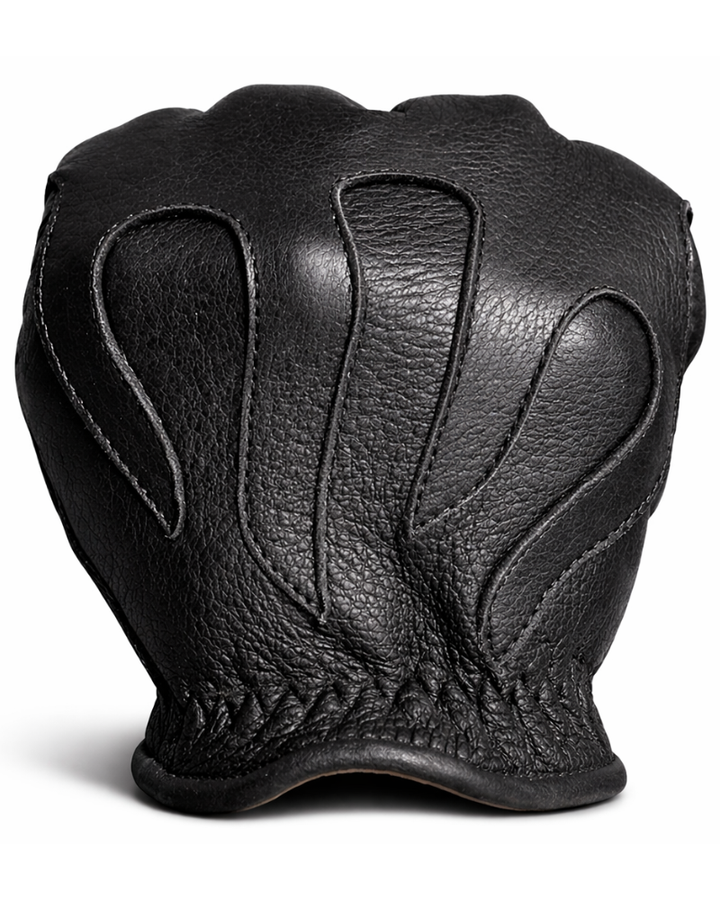
Deerskin is the most supple natural leather available for gloves. It doesn’t require the extended break-in period that stiffer leathers demand — deerskin conforms to your hand quickly and holds that shape. For winter riding, that pliability matters more than in warmer months because cold temperatures stiffen every material, including leather. A deerskin glove that starts supple will stay functional in the cold far longer than a stiffer cowhide that becomes board-like at 35°F.
Deerskin is also naturally warm. The fiber structure of deerskin leather retains body heat more effectively than most synthetic alternatives, which is why it has been used in cold-weather work gloves for generations. This warmth comes without the weight penalty of thicker hides, so a deerskin glove can provide meaningful thermal benefit without making the glove feel heavy or clumsy. Throttle feel — the precision with which you can sense resistance and micro-adjustments at the grip — stays intact in a way that heavier materials don’t preserve.
One note on moisture: deerskin is water-resistant, not waterproof. It will handle light rain and mist, and the natural oils in the hide help bead water, but sustained wet-weather riding will eventually saturate the leather. Regular conditioning extends the material’s life and helps maintain its water resistance. For guidance on keeping leather gloves in shape through winter riding, the leather motorcycle glove care guide covers conditioning schedules and wet-weather recovery in detail.
What to Avoid in a Winter Motorcycle Glove
Avoid gloves with insulation that can’t be verified. Many gloves are marketed as “warm” or “insulated” without specifying what the insulation is, how thick it is, or what temperature range it’s rated for. If the product description doesn’t name the insulation material and give you a working temperature range, assume the warmth claim is aspirational. A glove that works fine at 50°F is not a winter glove.
Avoid gloves that fit too tightly when insulated. Compression cuts blood flow, and reduced circulation in the hand accelerates heat loss — the opposite of what insulation is supposed to accomplish. A glove should be snug enough to stay in place and give you good feel at the controls, but you should be able to flex your fingers completely without the fingertips pulling tight. If the insulation is already maxing out the glove’s interior volume, there’s no room for your hand to move naturally.
Avoid thin synthetic shells when you’re expecting genuine cold. Synthetic leather and textile gloves can perform adequately in mild weather, but they do not retain heat or shed wind as effectively as quality natural leather. They also tend to degrade faster under the UV and mechanical stress of regular riding. For winter use specifically, the outer shell material directly affects how long the glove maintains its insulating properties over the course of a long ride.
Avoid any glove where the cuff closure doesn’t seal consistently. Velcro, snaps, and adjustable straps all work — but only if they stay closed under riding conditions. A cuff that loosens at highway speed defeats the purpose of the closure entirely.
Recommendations by Temperature Range
Above 50°F: An unlined or lightly lined deerskin glove handles this range without adding unnecessary bulk. The Legendary Deerskin Classic Touchscreen Gloves work well in this range — the deerskin shell provides enough thermal retention for cool mornings without overheating on the ride home. Touchscreen-compatible fingertips are genuinely useful at this temperature, where you’re still likely to check a phone or GPS during stops.
40–50°F: Fleece lining is the right call here. The Deerskin Fleece Lined Short Wrist Gloves are built for exactly this range — moderate insulation, minimal bulk, with the deerskin shell maintaining throttle feel through the cold. If your jacket sleeve doesn’t provide good wrist coverage, pair these with a gauntlet or add a thin liner and check fit before committing.
Below 40°F: Thinsulate insulation is appropriate at this temperature range, and you need to account for the added bulk by sizing up. The Legendary Haymakers Super Welted Short Wrist Deerskin Motorcycle Gloves are built for serious cold — the Thinsulate insulation is designed for sub-freezing conditions, and the deerskin outer shell stays pliable even when temperatures drop. Order one size up from your usual fit and verify your hand can move freely through the full range of motion before riding.
Extended cold-weather riding: If you’re riding regularly in cold conditions across a range of temperatures, having two gloves — a fleece-lined option for the 40–50°F range and a Thinsulate-insulated option for below freezing — gives you the right tool for each situation rather than one glove that compromises in both directions. The full lineup of men’s made-in-USA motorcycle gloves covers each of these ranges with American-made deerskin construction.
Cold-weather riding comes down to preparation, and gloves are one of the few pieces of gear that directly affects control of the motorcycle. Match your insulation to your actual riding temperature, verify the fit accounts for lining thickness, and choose a cuff style that works with your jacket. The right pair of winter motorcycle gloves will be the last thing you think about on a cold ride — which is exactly where they should be.