


Table of Contents
- 1. Professional Leather Conditioning
- 2. Custom Leather Patch and Repair
- 3. Hardware Replacement and Restoration
- 4. Leather Dyeing and Color Restoration
- 5. Lining Replacement and Interior Restoration
- 6. Legendary USA In-House Restoration
- 7. At-Home Preservation Between Services
- Common Leather Problems, Solved
- Top Picks, Shop Direct
- Frequently Asked Questions
A quality leather jacket does not wear out so much as wear in. But damage happens: tears, fading, stiff leather, broken zippers, worn linings. When your jacket needs real work, you need to know who can handle it and what is worth paying for.
We have seen riders bring us jackets butchered by careless repairs. Some fixes are genuinely DIY territory. Others need expertise you cannot replicate at a kitchen table.
1. Professional Leather Conditioning
Leather dries out. It happens to every jacket eventually, especially one stored badly or worn hard for years. A professional knows the difference between surface moisturising and genuine deep restoration.
What they do right:
- Test leather thickness and integrity before treating anything
- Match the conditioner to the hide, because cowhide, horsehide and deerskin do not want the same product
- Work the product in properly rather than leaving it sitting on the surface
- Recognise when leather is past conditioning and needs a different approach entirely
The wrong approach is dumping mink oil or a generic balm on the jacket. That is how you end up with leather that is stiff, over-darkened and no longer breathing. We use and recommend Obenauf's Heavy Duty LP at $15.99 for most full-grain American leather.
2. Custom Leather Patch and Repair
Tears, punctures and worn spots need patching. Most shops do it wrong, using fabric patches or adhesives that degrade the leather around the damage. Real leather repair means matching the weight, grain and finish, cutting the patch with the grain direction aligned, stitching so it flexes with the jacket, and conditioning the edges so it blends.

The worst move is taking a riding jacket to a general leather shop that mostly does couches and handbags. They do not know how a rider moves in a jacket, and their patches will not flex where yours needs to.
3. Hardware Replacement and Restoration
Zippers fail. Snaps corrode. D-rings crack. These are functional failures that quietly make a jacket less wearable until you stop reaching for it. A specialist knows how to replace a zipper without tearing the surrounding leather, which snap types match a given vintage, and how to clean tarnished hardware without stripping its character.
Zippers account for most of the work. A good restorer sources a replacement that matches the original weight and slider style rather than fitting whatever is on the shelf. Snaps and rivets are trickier, because a corroded snap has to come out without enlarging the hole and weakening the leather around it.
4. Leather Dyeing and Color Restoration
Fading happens. Sun, age and wear all change leather colour. Dyeing sounds simple and is not.
Professional dyers know which dyes bond without flaking, how to match an original colour, how to apply evenly across panels that have aged differently, and the difference between tinting faded leather and full-coverage dyeing. Preparation is most of the job: cleaning removes dirt and old finish, and light abrasion gives the dye something to grip.

Darkening is straightforward. Lightening is hard and sometimes impossible without stripping the leather, which is a decision you cannot walk back.
5. Lining Replacement and Interior Restoration
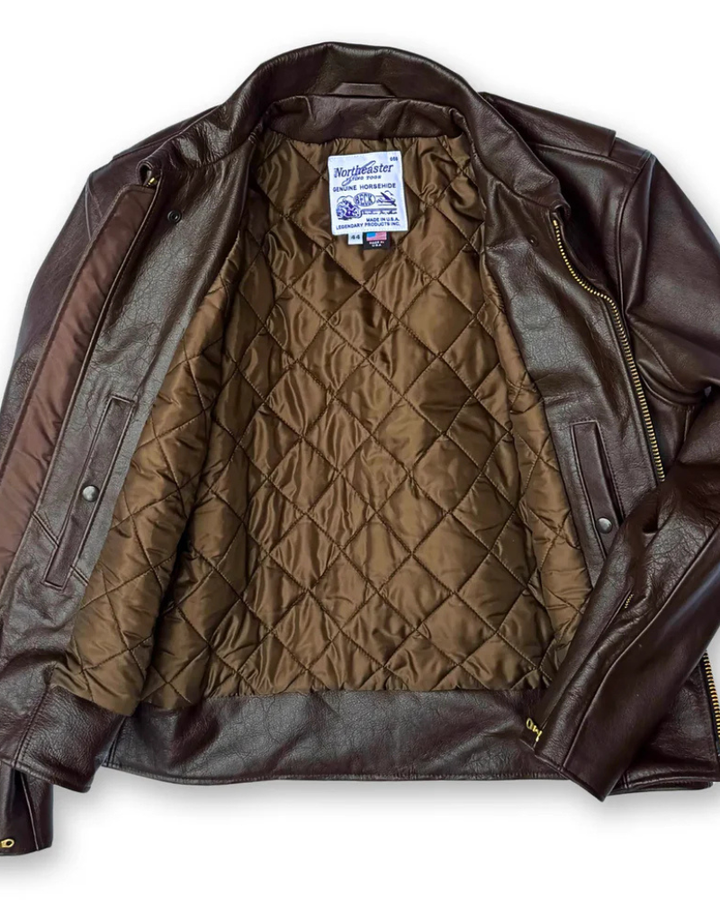
The lining takes damage nobody sees until it matters. A torn lining lets exposed hardware rub directly against the inside of the leather. Proper replacement means carefully removing the old lining, sourcing matching material, stitching the new one in, and reinforcing the high-stress areas at the armholes and pockets.
It is labour-intensive work and a full lining replacement can take 8 to 12 hours. The payoff is real: the jacket feels better, the leather interior is protected again, and you add years to its life.
6. Legendary USA In-House Restoration
We do not outsource restoration. We handle it in-house because we know what it takes to do it right, and over 25 years we have learned what separates a jacket that runs another decade from one that fails in a year.
When you send a jacket to us you are working with the people who design and manufacture the gear. We source patch leather from the same suppliers we use for new jackets, and hardware replacements come from the same inventory.

If you own one of our jackets, restoration work carries the same backing as a new piece. Contact us with photos and we will assess whether the jacket can come back to full function and what the timeline looks like. If it is past practical repair, we will tell you that too rather than take your money.
7. At-Home Preservation Between Services
Not everything needs a specialist. Storage matters most: cool, dry, out of direct sun, on a wide hanger, never folded. For cleaning, a damp cloth handles road grime and a leather soap made for garments handles the rest. No harsh chemicals, no machine wash, and air dry away from heat.
Condition annually, or every 18 months for lighter use. Apply sparingly and buff out the excess, because over-conditioning leaves leather soft and weak rather than supple and strong. For the full routine, see our leather jacket care guide.
Watch for early damage. Small tears become big ones, and a loose stitch becomes an open seam. Check the seams and stress points a couple of times a season.
Common Leather Problems, Solved
These four questions account for most of the calls we take about leather that has gone wrong.
How do you keep leather from cracking?
Cracking is dehydration. Leather is a fibre structure held flexible by oils, and once those oils are gone the fibres break rather than bend, which is why cracks appear at the flex points first: elbows, shoulders, the collar fold.
The prevention is simple and almost entirely about what you avoid:
- Condition once or twice a year with a proper leather conditioner, more often if you ride in sun or dry heat. This is the whole game.
- Never dry a wet jacket near heat. Not a radiator, not a hair dryer, not the back of a truck in summer. Heat drives the oils out fast and permanently. Air dry at room temperature, away from direct sun.
- Store it on a wide hanger, never folded. A fold becomes a permanent crease and a crease becomes a crack.
- Keep it out of long-term direct sunlight, which is the single most common cause of a jacket cracking on a hanger rather than on a bike.
- Do not store it in plastic. Leather needs to breathe, and a garment bag that seals traps moisture against the hide.
Once leather has genuinely cracked through, conditioning will improve the look but will not restore the structure. Prevention is the entire strategy here.
Can you repair a torn seam on a leather jacket?
Almost always, yes, and a torn seam is one of the more straightforward repairs there is. The important thing is to understand what you are looking at, because two different failures look similar.
If the thread failed and the leather is intact, this is a simple restitch. The old thread gets removed, the seam is re-sewn through the existing needle holes with bonded nylon, and the repair is invisible and as strong as the original. This is the most common failure on an older jacket, because thread ages faster than hide.
If the leather tore at the stitch line, the seam has perforated and pulled through. This needs a reinforcing panel or a patch behind the tear before it can be restitched, because sewing back through damaged leather just tears it further. It is real work and still very much worth doing.
What to do right now if a seam opens: stop wearing it. Every hour on the bike with an open seam lengthens the tear and turns a cheap restitch into a patch job. Do not use glue and do not use a home sewing machine, because a domestic machine cannot handle jacket-weight leather and the needle holes it leaves are a new tear line.
Send us photos and we will tell you which of the two you have.
What is the best way to waterproof leather?
First, set expectations. Well-conditioned full-grain leather is water resistant, not waterproof, and no treatment makes a leather jacket genuinely waterproof in the way a shell is. What treatment does is make water bead and roll off instead of soaking in, which is enough for most riding.
The approach that works:
- Clean it first. Any treatment applied over road grime seals the grime in. Use a proper leather cleaner such as Obenauf's Cleanit at $15.99, and let the jacket dry fully.
- Condition, then seal. Conditioner feeds the hide, a water repellent sits on top of it. Doing it in that order matters, because a sealant applied to dry leather locks the dryness in.
- Use a wax or beeswax-based treatment such as Obenauf's Water Shield at $15.99. Apply thin, work it in, buff off the excess.
- Expect it to darken the leather slightly and permanently. Test on the inside of the hem first if that matters to you.
- Reapply every few months in a wet season, or after any heavy soaking.
What to avoid: silicone sprays, which sit on the surface and stop leather breathing, and anything sold for boots without checking it is safe for garment leather. If you ride in genuinely heavy rain regularly, the right answer is a packable shell over the jacket rather than more wax on it.
Why did my leather shrink after getting wet?
Because it dried too fast, and this is one of the most common ways riders ruin good leather without realising what they did.
When leather gets soaked, water displaces the oils in the fibre structure. If it then dries quickly, especially near heat, the fibres contract and set hard in that contracted state. The result is a jacket that is a size smaller, stiff as board and shiny in patches. Heat is almost always the culprit: a radiator, a heater vent, a hot car, or direct sun.
What to do if it has already happened: condition it heavily and repeatedly. Work a good conditioner in, let it absorb for a day, and repeat several times over a week or two. While it is damp with conditioner, wear it, or stuff the sleeves and body so it is held at size while it relaxes. You will usually recover most of the size and most of the suppleness. Severe heat damage does not fully come back.
How to dry a soaked jacket properly: hang it on a wide hanger at room temperature, away from any heat source, and let it take as long as it takes, which can be a couple of days. Once it is dry to the touch but not bone dry, condition it. That last step is what most people skip and it is what prevents the stiffness.
Top Picks, Shop Direct
Restoration mostly comes down to three inexpensive products used in the right order and one honest decision about when a jacket is past saving. That is what this table is: the clean, feed and seal sequence we actually use in our own shop, plus the replacement we would point you at if the answer is that the jacket has had its life. Prices and ratings verified live before this update.
| Product | Why it fits this question | From |
|---|---|---|
| Obenauf's Heavy Duty LP Conditioner | The single most useful thing on this page. Beeswax and natural oil conditioner that prevents cracking and revives dried-out hide, and the product we use in-house on full-grain American leather. Available in 4 oz and 8 oz. Rated 4.67 out of 5 from 3 reviews. | $15.99 |
| Obenauf's Cleanit Natural Leather Cleaner | Step one of any restoration, because conditioning over road grime seals the grime in. Natural cleaner that lifts dirt without stripping the finish. No customer reviews yet. | $15.99 |
| Obenauf's Water Shield Extended Waterproofing | The sealing step, applied after conditioning rather than instead of it. Makes water bead and roll off, and it is the honest answer to the waterproofing question above. No customer reviews yet. | $15.99 |
| Legendary Black Hills Men's Leather Motorcycle Jacket | For when restoration genuinely is not worth it. Heavyweight American cowhide with sewn-in lining and serviceable hardware, meaning it is built to be repaired rather than replaced next time. Sized 36 to 56 plus a Custom Size. Rated 4.97 out of 5 from 63 reviews. | $675.00 |
The three care products together come to under $50 and will add years to a jacket worth ten times that. Prices shown are current at time of writing. Orders over $150 ship free.
Frequently Asked Questions
How do you keep a leather jacket from cracking?
Condition it once or twice a year, never dry it near heat, store it on a wide hanger rather than folded, keep it out of prolonged direct sun, and do not seal it in plastic. Cracking is dehydration, and once leather has cracked through, conditioning improves the look but does not restore the structure.
Can you repair a torn seam on a leather jacket?
Almost always. If the thread failed and the leather is intact it is a simple restitch through the existing holes with bonded nylon, and the result is as strong as the original. If the leather tore at the stitch line, it needs a reinforcing panel behind the tear before restitching. Stop wearing it as soon as a seam opens, and avoid glue and home sewing machines.
What is the best way to waterproof a leather jacket?
Clean it, condition it, then seal it with a wax or beeswax-based water repellent, in that order. Expect water resistance rather than true waterproofing, expect the leather to darken slightly, and reapply every few months in a wet season. Avoid silicone sprays, which stop leather breathing.
Why did my leather shrink after getting wet?
It dried too fast, usually near a heat source. Water displaces the oils in the fibre structure and rapid drying sets the fibres contracted and stiff. Recover it by conditioning heavily and repeatedly over a week or two while wearing it or stuffing it to hold the shape. Prevent it by air drying at room temperature away from heat, then conditioning before it is bone dry.
How much does professional leather jacket restoration cost?
Light conditioning runs $50 to $150. Patches and small repairs $75 to $300. Full lining replacement $200 to $500. Major dyeing or multi-issue restoration can run $400 to $800. For heritage pieces the maths still favours restoration over replacement.
Can a vintage leather jacket be fully restored?
Most can be brought back to full function with the right specialist. Massive structural tears, advanced rot and burned leather sometimes cannot be saved. Send photos for an honest assessment.
How often should I have my leather jacket professionally serviced?
Heavy daily-rider jackets every 2 to 3 years. Lighter-use jackets every 5 to 7 years. Storage-only pieces only when a problem shows up.
Do you restore leather jackets you did not make?
Yes, case by case. We are comfortable with heritage American brands including Schott, Vanson, BECK, Cockpit and Avirex. Send photos and we will quote.
For more on what we make: men's motorcycle jackets, leather touring jackets, and vintage and military aviation jackets.
Article originally published April 2026. Updated August 2026 with cracking, seam repair, waterproofing and shrinkage answers, verified live pricing, and a shop table.