

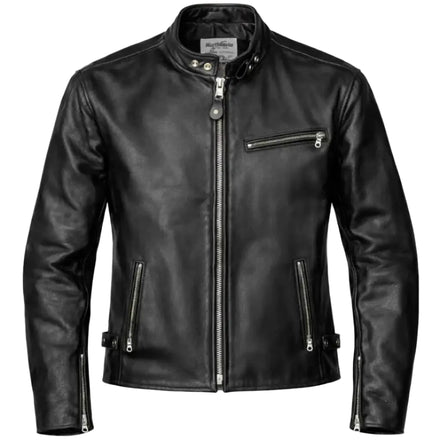


Yes. Cockpit USA jackets are made in the United States — and not in the performative, "designed in the USA" way that some brands use to imply domestic production without delivering it. Cockpit USA manufactures in America because it has to: the company holds or has held U.S. government contracts to produce flight jackets for American military branches, and those contracts require American manufacturing.
That government contract relationship is the clearest possible credential for a flight jacket maker. It means the product has passed procurement specifications written by people whose job is verifying that military equipment works. It means the materials, construction, and quality control have been subject to external scrutiny. For buyers trying to evaluate whether "made in America" is a marketing claim or a verifiable fact, this is where Cockpit USA stands apart from most of the market.
Where Cockpit USA Manufactures
Cockpit USA's manufacturing operations are located in the United States. The company traces its roots to Avirex, one of the major American flight jacket producers of the 20th century, and has maintained domestic production through changes in brand ownership and the broader flight jacket market's consolidation and offshoring.
American manufacturing at the level Cockpit USA operates requires skilled labor that has become genuinely rare. The stitching patterns for a horsehide A-2 or a sheepskin B-3 are not straightforward sewing operations — they require workers who understand how leather behaves under tension, how seam angles affect fit and longevity, and how to calibrate industrial machines for natural materials that vary in thickness and elasticity across a single hide. This knowledge base exists in very few American production facilities. Cockpit USA is one of them.
What American Manufacturing Means for the Jacket
American-made isn't a proxy for quality by itself — there are poorly made American products and well-made imported ones. But in the flight jacket category, domestic manufacturing correlates strongly with quality for a specific reason: the labor costs of American production can only be recovered if the jacket is priced to reflect them, and a jacket priced to reflect those costs has to deliver on quality to justify the price. Cockpit USA is not a $200 jacket brand.
The practical difference shows up in construction details. Seam alignment at the collar. Zipper pull action after three years of use. Leather finish that ages into patina rather than cracking and peeling. The knit cuffs and waistband that don't unravel after a season. These aren't features that can be verified in a product listing — they're the result of manufacturing standards that don't need to be explained because they're evident in the object.
The Government Contract Credential
Cockpit USA's history of military contracts is worth understanding in context. The U.S. military does not source flight jackets casually. Procurement specifications for military flight jackets cover leather thickness, seam strength, hardware performance under temperature extremes, and construction methods in detail. A contractor that can't meet those specifications doesn't keep the contract.
The jackets that survive these specifications are the same jackets Cockpit USA sells commercially. The commercial versions aren't a separate product — they're the same construction philosophy applied to civilian use, often using the same patterns and materials as the military versions. When you buy from the Cockpit USA collection, you're buying from a company whose manufacturing has been externally validated at the most demanding level available in the category. The BECK 732 in Chestnut Brown and the BECK 777 sit alongside Cockpit USA as the benchmark for what genuine American horsehide construction looks like in 2026.
Comparing Domestic vs. Imported Flight Jackets
The flight jacket market is full of imported products from manufacturers in Pakistan, India, and China who produce convincing-looking replicas at a fraction of the cost of American production. The visual difference between a well-photographed imported jacket and a Cockpit USA original can be difficult to detect in product images. The material and construction difference is immediate in person.
Imported flight jackets in the $150–$400 price range typically use corrected-grain cowhide (leather that has been sanded, embossed, and coated to look more consistent than the raw hide) or lower-grade genuine leather. The hardware is often chrome-plated zinc rather than brass. The lining is synthetic. The construction is machine-sewn with labor rates that don't support the slow work required for quality seaming.
The result is a jacket that looks correct in photos and wears out in three to five years. Compare that to a Cockpit USA jacket that — like other genuinely American-made flight jackets — is built to last 20 to 30 years of regular use and improves with age rather than degrading.
What This Means When You Buy
American manufacturing is one of several factors that determine whether a flight jacket is worth what you pay for it. Cockpit USA satisfies this factor definitively. Read our breakdown of whether Cockpit USA jackets are worth the investment for the complete picture of what you get for the price, and our explanation of the difference between an A-2 and G-1 jacket if you're deciding which model to buy.
The short version: if American manufacturing matters to you — either as a quality signal or as a values statement — Cockpit USA is one of the few flight jacket brands where that claim is verifiable, not aspirational. The same applies to the BECK Flying Togs line: the BECK 732, BECK 666, and BECK 501 are all built in genuine horsehide to American-made standards — reviving a Cincinnati brand with the same production integrity Cockpit USA represents in the flight jacket space.