

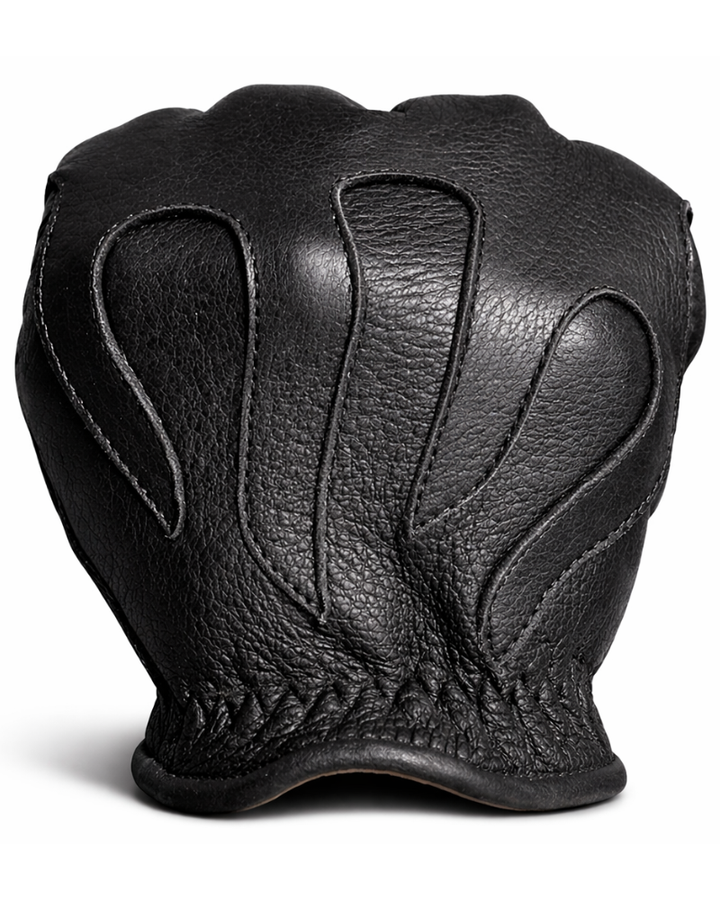


American whitetail deerskin has been the preferred leather for motorcycle gloves for over a century, not because it is the hardest leather, but because it is the right one for riding. It is soft from the first wear, breathes honestly in warm weather, and conforms to your hand in a way that no cowhide or synthetic can replicate. Legendary USA has been building deerskin motorcycle gloves in the United States for over two decades. This guide covers every model in the lineup, how they are constructed, what each one costs, which cut fits which riding style, and how to size and care for them.
Top Picks, Shop Direct
| Product | What it is | From |
|---|---|---|
| Fingerless Deerskin Gloves | Legendary USA. Rated 4.92 from 126 customer reviews. | $68 |
| Classic Deerskin Gauntlets | Legendary USA. Rated 4.88 from 112 customer reviews. | $140 |
| Gold Short Wrist Cuff Deerskin Gloves | Legendary USA. Rated 4.91 from 108 customer reviews. | $100 |
| Classic Short Wrist Touchscreen Deerskin Gloves | Legendary USA. Rated 4.9 from 106 customer reviews. | $105 |
Prices shown are current at time of writing. Orders over $150 ship free.
Why Deerskin for Motorcycle Gloves

Deerskin is not a marketing choice. The fiber structure of American whitetail deerskin is open-grained and naturally soft: it moves with your hand instead of fighting it. Most leather gloves require a break-in period of weeks or months before they stop restricting your grip. A deerskin glove from Legendary USA rides comfortable from the first day. That immediate feel matters on a handlebar where resistance between your hand and the control costs you precision. That immediacy is why the material stays popular with riders, and it is why Legendary USA builds its deerskin line, including the Double-Diamond Touchscreen Gloves at $140 with 87 customer reviews averaging 4.92, from American whitetail rather than cowhide.
Deerskin also breathes. The same open-grain structure that makes it soft allows airflow that cowhide at similar thickness does not. For summer riding, where heat management across your hands matters on a long day in the saddle, that is a real functional difference. In cold weather, deerskin does not stiffen the way cowhide does. A lined deerskin glove in January still moves naturally, whereas lined cowhide often becomes too rigid for fine throttle and lever work. That span from August to January is why Legendary USA builds a year-round glove line on one hide, with ventilated deerskin cuts for summer and fleece-lined and gauntlet cuts for winter, instead of switching leathers with the season.
Finally, deerskin ages correctly. It develops a patina as it takes on the patterns of your grip and your riding. After a season of use, a well-cared-for deerskin glove fits better than when you bought it. The full case for the material is in our guide to hand-made American deerskin gloves.
Construction: Outseam, Keystone Thumb, and Why They Matter
The way a glove is sewn matters as much as the leather it is sewn from. Two construction details separate a glove built for riding from one built to look like it.
Outseam construction moves the stitching to the outside of the glove. Standard inseam gloves have stitching running along the inside of the fingers and across the palm interior. Over a long ride, those seams create pressure points: subtle at mile twenty, noticeable at mile two hundred. Outseam eliminates that contact. Legendary USA uses outseam construction on models like the ILL Dozer, and the difference is immediately apparent on longer rides.
Keystone thumb construction angles the thumb attachment to match the natural position of the hand on a handlebar. A straight-sewn thumb pulls against the seam every time you grip, fatiguing the stitching over time and creating tension in the leather at the web of your thumb. The keystone geometry eliminates that pull. It is a traditional glove-making method that American workshops have used for generations, and one that mass-production factories skip because it takes more time and skill. That is the practical meaning of made in USA on a motorcycle glove: Legendary USA cuts and sews American whitetail deerskin here, with the keystone thumb and outseam work done in American workshops rather than specified out to an overseas factory. The Churchill Classic Deerskin Gloves at $110 are built that way.
See the full USA-made lineup at Men's Made in USA Motorcycle Gloves.
The Lineup at a Glance: Models and Current Prices
Every glove below is made in the USA. Orders over $150 ship free.
- ILL DOZER Perforated Outseam Deerskin Gloves, $135. The summer flagship: perforated deerskin with exterior seams and no interior pressure points.
- Classic American Whitetail Deerskin Gauntlets, $140. Full cuff coverage for cold weather and highway miles.
- Deerskin Aramid-Lined Touchscreen Gloves, $120. Added cut resistance plus phone-friendly fingertips.
- Classic Short Wrist Touchscreen Deerskin Gloves, $105. The everyday deerskin glove with touchscreen thumb and index finger.
- Fleece-Lined Deerskin Gloves, $115. The cold-morning and shoulder-season pair.
- Bad Billy Goatskin Gloves, $75. Tight-grain goatskin that toughens with daily use.
- Fingerless Deerskin Gloves, $68. Palm protection and maximum dexterity for summer.
Deerskin Motorcycle Gloves for Women
Legendary USA does not cut a separate women's pattern. The line is unisex, and the models that fit smaller hands are the ones that run XS: the ILL DOZER Outseam Gloves at $135, the ILLEST DOZER White Outseam Gloves at $135, and the Jail Break Black/White Gloves at $140. All three are full-grain American Whitetail deerskin, made in the USA, and share the outseam construction that puts the seam allowances on the outside of the glove, so there is no interior seam ridge pressing into a smaller hand.
The Double-Diamond Touchscreen Gloves at $140 are the pair most often bought by women riders. They run S through 2XL in several colorways, with the signature diamond-stitched back panel, and are stocked in the women's glove category as well as the men's.
| Model | Size range | Leather | Where it is made | Price |
|---|---|---|---|---|
| ILL DOZER Outseam | XS to 2XL | Perforated American Whitetail deerskin | USA | $135 |
| ILLEST DOZER White Outseam | XS to 2XL | White American Whitetail deerskin, LeathSorb palm paneling | USA | $140 |
| Jail Break Black/White | XS to 2XL | Black and white American Whitetail deerskin, outseam | USA | $140 |
| Double-Diamond Touchscreen | S to 2XL | American Whitetail deerskin, touchscreen thumb and index | USA | $140 |
Sizing note for smaller hands: measure across the widest part of the palm, not around the knuckles, and take your true size. Deerskin relaxes about half a size with wear, so a glove that is snug on the first ride is the right one. Going up a size to be comfortable on day one leaves a loose palm by week three, which is where grip and throttle feel are lost.
Summer Riding: ILL Dozer and Short-Wrist Ventilated Models
The Legendary ILL Dozer Perforated Short-Wrist Deerskin Motorcycle Gloves ($135) are the most technically refined summer glove in the lineup. The perforation pattern runs across the back of the hand and through the fingers, moving air across your knuckles and down the sides of your fingers on every pass at speed. The outseam construction means there are no interior seams to create pressure points across a long summer day. For riders who spend real time in the saddle in warm weather, the ILL Dozer is the glove to evaluate first. It is currently made to order rather than shipping from stock; the ILLEST DOZER White Outseam Gloves ($135) use the same outseam construction and ship from stock.
The Deerskin Aramid Lined Short-Wrist Touchscreen Gloves ($120) serve the rider who wants warm-weather usability and additional cut resistance. The aramid lining adds meaningful abrasion protection without significantly changing the feel of the leather on the exterior. Touchscreen-compatible thumb and index finger means you do not need to pull a glove off to use a phone or GPS. For daily commuting and touring in variable conditions, this model covers more ground than any other in the lineup.
Cold-Weather Riding: Fleece-Lined and Gauntlet Models
The Deerskin Fleece Lined Short-Wrist Gloves ($115) are built for cold mornings and shoulder-season riding. The fleece lining adds warmth without making the glove so thick that you lose feel on the controls, a common failure with cold-weather gloves that prioritize insulation over feedback. Order true to your palm measurement; the lining takes up some internal volume and compresses slightly after a few wears.
For genuinely cold conditions, the Classic American Whitetail Deerskin Gauntlets ($140) extend up the forearm and close the gap between glove and jacket sleeve. The gauntlet cut eliminates cold air channeling up your wrist, which is the primary source of discomfort when temperature drops into the thirties on the highway.
Fingerless Models and Goatskin
The Legendary Deerskin Fingerless Motorcycle Gloves ($68) are built for warm-weather riding where palm protection matters and maximum dexterity is the priority. Fingerless gloves cover the palm, provide grip consistency, and absorb road vibration without the heat load of a full-finger glove. The heritage and practical case for fingerless riding is covered in our fingerless motorcycle glove guide.
Legendary USA also runs a goatskin lineup under the Bad Billy name. The Bad Billy Goatskin Short-Wrist Gloves ($75) are built for the daily rider who wants a glove that toughens up over time. Goatskin has a tighter grain than deerskin, resists abrasion more effectively over years of use, and takes longer to break in, but rewards patience. Our goatskin motorcycle gloves guide covers the Bad Billy line in full.
How to Size Deerskin Motorcycle Gloves
Measure around the knuckles of your dominant hand, excluding the thumb. Small runs 7 to 7.5 inches, Medium 8 to 8.5, Large 9 to 9.5, XL 10 to 10.5, XXL 11 and up. Deerskin will conform to your hand over the first few rides. A snug, firm initial fit is correct. Our full motorcycle glove sizing guide covers fit testing, how lined models affect sizing, and what to expect during break-in.
How to Care for Deerskin Motorcycle Gloves
Let wet gloves dry naturally away from direct heat. Apply a light coat of leather conditioner every few months. Spot-clean with a damp cloth and mild soap. Never machine wash. Deerskin develops a patina and softens to your grip pattern over time. That is the material aging correctly. Legendary USA cuts every deerskin pair in the line from full-grain American whitetail, and this same routine covers all of them, from the fingerless models to the lined gauntlets. The complete routine, including conditioner choice, salt stain removal, softening, and off-season storage, is in our leather motorcycle glove care guide. For a full comparison of Legendary USA's construction versus imported alternatives, see the Made in USA vs. Pakistan motorcycle gloves comparison.
Frequently Asked Questions
- What makes deerskin better than cowhide for motorcycle gloves?
- Deerskin is softer from the first wear and conforms to your hand within a few rides. Its open fiber structure breathes better than cowhide in warm weather and does not stiffen in cold. For daily riding where comfort over long hours matters, deerskin outperforms cowhide at equivalent thickness.
- What is outseam construction in motorcycle gloves?
- Outseam construction moves the stitching to the exterior of the glove, eliminating seam pressure points on the inside of the hand. This reduces hand fatigue on long rides, particularly across the knuckles and between the fingers. Legendary USA uses outseam construction on the ILL Dozer.
- What is a keystone thumb on a motorcycle glove?
- A keystone thumb attaches the thumb at an angle matching the natural resting position of the hand on a handlebar. This eliminates the twisting tension a straight-sewn thumb puts on the seam during riding, making the glove more comfortable and the construction longer-lasting.
- How much do American-made deerskin motorcycle gloves cost?
- The made-in-USA lineup runs $78.50 for fingerless deerskin up to $145 at the top of the line, with full gauntlets at $140 and the most popular full-finger models at $105 to $120. The goatskin Bad Billy line is $69. Orders over $150 ship free.
- Are deerskin motorcycle gloves good for summer riding?
- Yes, especially perforated or ventilated cuts. Deerskin breathes naturally and does not trap heat the way dense cowhide does. The ILL Dozer and short-wrist ventilated models are the practical choices for hot-weather riding.
- What deerskin gloves are best for cold-weather riding?
- The Deerskin Fleece Lined Short-Wrist Gloves for shoulder-season cold. The Classic American Whitetail Deerskin Gauntlets for genuine winter riding: the extended cuff eliminates cold air channeling up the wrist. Size true to your palm measurement for both lined models.
- Do American-made deerskin motorcycle gloves last longer than imports?
- American-made gloves from Legendary USA are cut from full-grain deerskin with heavier thread and double-stitching at stress points. Mass-market imports typically use split leather that wears faster. A well-maintained pair of Legendary USA deerskin gloves routinely lasts five to ten years of regular riding.
- How do I size deerskin motorcycle gloves?
- Measure your dominant hand around the knuckles, excluding the thumb: Small (7 to 7.5 in), Medium (8 to 8.5 in), Large (9 to 9.5 in), XL (10 to 10.5 in), XXL (11+ in). For lined models, buy true to measurement: the lining compresses after a few wears.
- How do I care for deerskin motorcycle gloves?
- Dry naturally away from heat. Condition lightly every few months. Spot-clean with damp cloth and mild soap. Never machine wash. Deerskin softens and develops a patina with use. That is the material working correctly.
- What is the difference between deerskin and goatskin motorcycle gloves?
- Deerskin is softer from day one and breaks in faster. Goatskin has a tighter grain and stronger abrasion resistance but takes longer to break in. For immediate touring comfort, deerskin. For a daily-rider glove that builds durability over time, goatskin: the Bad Billy line.
Ready to Ride
Browse the full Made in USA motorcycle glove lineup, and check the glove size chart before you order so the fit is right the first time. Orders over $150 ship free, and if a size misses, exchanges are simple and domestic. If you are weighing protection standards before you buy, our CE ratings explainer gives the honest answer on where heritage leather gloves stand.