



When ambient temperature hits 85°F and you're sitting at a stoplight in traffic, standard leather gloves turn your hands into a heat problem. Perforated deerskin gloves solve this without switching to mesh — the deerskin leather stays intact across the grip zones while the perforations channel moving air across the back of the hand and fingers. The Legendary ILL DOZER is the specific glove built for this.
Top Picks, Shop Direct
| Product | What it is | From |
|---|---|---|
| Bad Billy Black Goatskin Gloves | Legendary USA. Rated 4.93 from 129 customer reviews. | $75.00 |
| Fingerless Deerskin Gloves | Legendary USA. Rated 4.92 from 126 customer reviews. | $67.50 |
| Bad Billy Tan Goatskin Gloves | Legendary USA. Rated 4.84 from 94 customer reviews. | $75.00 |
| Uppercut Knuckle Defense Gloves | Legendary USA. Rated 4.92 from 73 customer reviews. | $95.00 |
Prices shown are current at time of writing. Orders over $150 ship free.
Perforated Leather vs Mesh: What the Difference Actually Means

The distinction matters more than most buyers realize before they purchase their first summer gloves.
Mesh gloves sacrifice leather entirely in the ventilated zones. The mesh panels — typically across the back of the hand and along the fingers — are textile, not leather. In those areas, abrasion protection is reduced to whatever the textile backing provides, which is significantly less than full leather coverage. Some mesh gloves compensate with TPU inserts or reinforced palm panels, but the fundamental tradeoff remains: open the glove up for airflow and you reduce leather coverage in those same areas.
Perforated leather works differently. The leather is left intact. A punch press creates holes through the leather surface, so you get ventilation without removing the leather layer itself. In a slide or impact, the full leather thickness is still there — the holes don't disappear the material, they just open channels through it. Air moves through the perforations when the glove is in motion.
The real tradeoff is airflow volume. Mesh moves more air than perforated leather because the open area is larger. On a 105°F day, mesh will feel noticeably cooler at speed. On an 85–95°F day, perforated leather provides meaningful ventilation while keeping leather protection across the entire glove. For most riders in most summer conditions, perforated leather is the correct call. Mesh makes more sense when temperatures push above 100°F and airflow becomes the overriding priority over abrasion resistance in the ventilated zones.
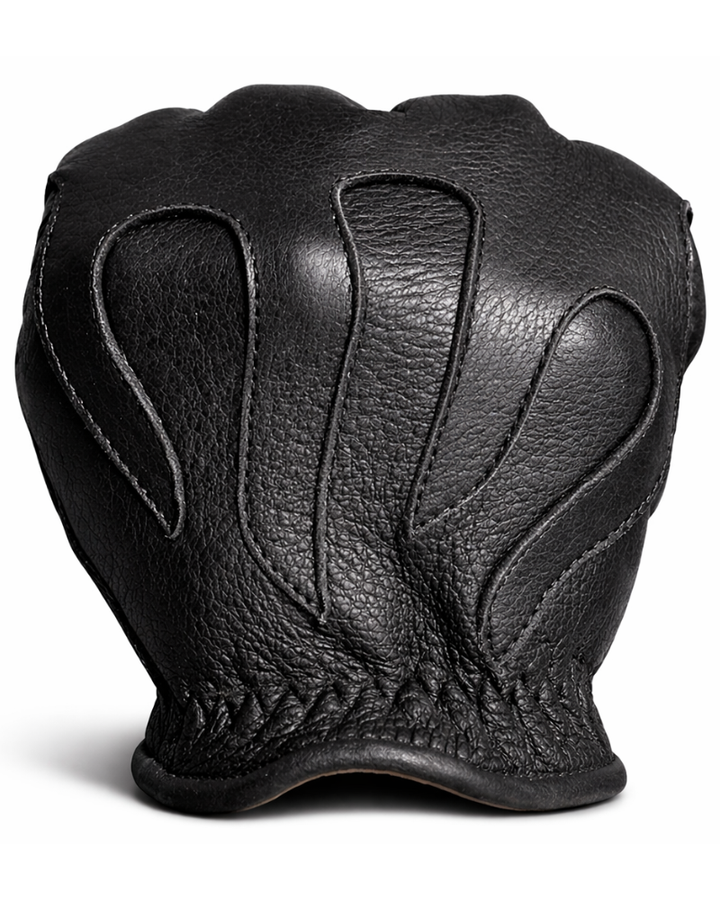
The Legendary ILL DOZER: Perforated Deerskin Built for Summer
The Legendary ILL DOZER Perforated Top Short Wrist Outseam Deerskin Motorcycle Gloves are priced at $144.99 and are built around a specific set of decisions that make them well-suited for warm-weather riding on cruisers, Harleys, and similar platforms.
The leather. American deerskin is the material here. Deerskin is meaningfully different from cowhide in the context of summer gloves: it's softer, lighter, and conforms to the hand faster. Cowhide is stiffer and more durable in heavy-use applications, but for riding gloves that need to flex repeatedly across throttle, brake, and clutch input, deerskin's natural softness works in its favor. Break-in time is shorter. The glove feels less rigid from the first ride. In summer heat, the lighter weight of deerskin also contributes to reduced heat retention compared to a heavier cowhide glove.
The perforation pattern. The perforations run across the top panel of the glove — the dorsal surface of the hand and the top side of the fingers. At highway speed, moving air channels through these openings and reduces heat accumulation on the back of the hand, which is the surface most exposed to sun and ambient heat while riding. The palm, thumb pad, and grip zones are solid leather. This is the correct placement: you want the ventilation where the hand heats up, and you want solid leather where the hand contacts controls.
The wrist fit. The short wrist design is intentional for cruiser and Harley riders. A shorter wrist cut sits cleanly under a jacket cuff without bunching up the leather. Gauntlet gloves that extend up the forearm create bulk under a jacket sleeve and can restrict wrist movement. The ILL DOZER's short wrist profile keeps the fit clean and the layering straightforward.
Outseam construction. The stitching runs on the outside of the glove rather than the interior. On a long ride, interior seams press into the fingers and palm and create pressure points, particularly on the inside of the index finger and the web between the thumb and index finger. Outseam construction moves those seams to the exterior where they have no contact with the skin. This is a construction detail that matters on rides over an hour and becomes more significant the longer the ride.
The ILL DOZER is available in black. For riders who prefer a white or lighter colorway, the Legendary ILLEST DOZER White Ventilated Short Wrist Outseam Deerskin Motorcycle Gloves share the same short wrist, outseam construction, and deerskin platform at $144.99. The white colorway is a practical choice in direct sun — lighter colors absorb less radiant heat than black leather, which can make a measurable difference on a long summer ride.
Where to Wear Perforated Gloves (and Where Not To)
Perforated gloves are a specific tool. Knowing when to reach for them and when to leave them in the drawer is part of using them correctly.
Use them for: summer commutes, highway cruising in warm weather, desert riding, track days when ambient temperature is above 75°F, and any ride where the forecast is clear and temperatures are consistently in the upper 70s or above. These are the conditions where the ventilation benefit is real and the protection tradeoff is minimal.
Skip them for: rain, cold weather below 60°F, and any ride where extended wet-weather exposure is likely. The perforations are open channels — rain moves through them faster than through solid leather, and once the leather is saturated, comfort drops significantly. Cold air channeling through perforations at speed in 55°F weather is also uncomfortable and can affect hand dexterity.
The shoulder season question: Spring and fall shoulder season depends on the specific day and your cold tolerance. On a sunny 68°F day, perforated gloves may be comfortable. On a 65°F overcast day with wind, you'll likely prefer something solid. Most riders who take shoulder-season riding seriously own at least two pairs — a perforated or ventilated pair for warm days and a solid or lined pair for cooler conditions. Single-glove riding through all conditions is a compromise in both directions.
Summer Riding Glove Features Worth Paying For
When evaluating summer gloves at different price points, a few specific features separate gloves that work well from gloves that work adequately.
Outseam construction is a direct comfort upgrade on long rides. Gloves with interior seams feel fine for short trips; the pressure points become apparent after 90 minutes. Outseam is worth looking for.
Deerskin vs cowhide for summer. Deerskin is lighter and breaks in faster. If you're buying a summer glove specifically for warm-weather riding, deerskin's natural softness and lower mass work in its favor. Cowhide is stiffer from the factory and takes longer to conform to the hand.
Short wrist vs gauntlet for summer. Short wrist runs cooler because there's less leather covering the forearm. Gauntlets add coverage but also add heat retention. For riding in a jacket with long sleeves, a short wrist glove under the cuff is often more comfortable than a gauntlet over it.
Palm padding. Vibration on a long highway cruise transfers through the throttle and grip into the palm. A glove with light palm padding reduces fatigue on rides over two hours. This is more relevant on naked bikes and cruisers than on bikes with significant wind protection.
Price and leather quality. Budget gloves in the $40–70 range frequently use stiffer, lower-grade leather that doesn't break in the same way as the leather in a $100–150 glove. The stiff leather doesn't conform to the hand, never feels fully natural, and can limit grip sensitivity. When you're paying for a well-made leather riding glove, the leather grade and tanning process are a significant part of what you're buying. Browse the full Legendary USA motorcycle gloves lineup to compare options across the range.
Frequently Asked Questions
Are perforated motorcycle gloves safe for riding?
Yes, when the leather is intact across the critical grip and palm zones. Perforated leather gloves maintain full leather coverage — the holes are punched through the leather, not replaced with mesh or fabric. In a slide or impact, you still have the full deerskin layer between your skin and the road surface. The ILL DOZER's perforation pattern is concentrated on the top of the hand and fingers, leaving the palm and grip areas as solid leather. Protection is not compromised.
How much cooler are perforated gloves compared to regular leather?
In motion, the difference is noticeable — moving air channels through the perforations and reduces heat buildup on the back of the hand and finger tops. At a stoplight or in slow-moving traffic, you lose most of that benefit because airflow drops. A rough estimate: perforated leather gloves can reduce glove interior temperature by 10–15°F at highway speeds compared to solid leather. At 30 mph and below, the gap narrows. They won't feel as cool as open-palm or fingerless gloves, but protection is maintained.
What is the ILL DOZER's perforation pattern?
The ILL DOZER's perforation pattern runs across the top (dorsal) surface of the glove — the back of the hand and the top side of the fingers. The palm, thumb pad, and grip zones are solid leather, which is the correct placement: you want airflow where the hand is exposed to sun and heat, and you want solid leather where your hand contacts the throttle, brake, and clutch. The perforations are uniform and sized to balance airflow with structural integrity.
Can I wear perforated gloves in light rain?
You can, but expect your hands to get wet faster than with solid leather. The perforations are open holes — rain gets through, and the leather will absorb moisture. Light rain on a short ride is manageable; the leather will dry and the gloves will be fine. Extended wet-weather riding in perforated gloves is uncomfortable and will saturate the leather. If rain is a consistent part of your riding, keep a pair of solid leather or waterproof gloves for those days and use the ILL DOZER for dry-weather riding.
Shop the ILL DOZER: Legendary ILL DOZER perforated motorcycle gloves — American deerskin, outseam construction, $135.00.
Full gloves lineup: Legendary USA motorcycle gloves collection
Also read: Best Motorcycle Gloves Buying Guide | USA-Made Motorcycle Gloves Guide