




Hands are the first thing riders put out in a fall — a reflex that is nearly impossible to suppress. A motorcycle glove’s job is to reduce what happens to skin and bone during that contact. Understanding what the glove actually does — and what it cannot do — helps you pick the right one.
What Happens to Unprotected Hands in a Slide
Road surfaces are essentially coarse sandpaper at a macro level. Asphalt aggregate creates high friction against soft tissue, and a slide of even a fraction of a second can remove skin to the dermis. The palm and the hypothenar eminence — the padded area below the pinky — are the first contact points in a reach-out fall. Knuckles and the dorsal hand surface follow depending on the angle of impact.
Road rash on hands is particularly problematic for recovery because hand skin is thin, the area is difficult to immobilize, and tendon and joint structures are close to the surface. The goal of a riding glove is to keep leather — not skin — in contact with the road surface long enough to slow the hand through the slide. The leather absorbs the abrasive energy; that is a direct reduction in what reaches the skin.
Gloves also provide a degree of impact protection at the knuckle and palm — foam, gel, or hard inserts at these areas distribute energy from point impacts rather than concentrating it at a small area of bone. This is meaningful in low-speed urban falls where the hand hits a curb or vehicle corner rather than sliding across open pavement.
No glove eliminates all hand injury risk. That is not a disclaimer — it is the accurate description of what leather and padding physically accomplish. The value is in reducing abrasion severity and road rash depth across the hand’s most exposed surfaces.
The Role of Leather Grade in Abrasion Resistance
Leather’s protective function against abrasion depends on fiber density, thickness, and surface grain integrity. Higher-quality hides with tighter, more uniform fiber structures resist surface abrasion longer — the fibers interlock and hold together under friction rather than separating quickly. This is why leather quality in a motorcycle glove is not purely about feel or longevity: it directly relates to how long the material stays between the road and the hand during a slide.
Deerskin has a naturally dense fiber structure and a tight grain that resists surface abrasion well for its weight and thickness. It is not the most abrasion-resistant leather available — cowhide and goatskin both offer harder surface resistance in material testing — but it is significantly more abrasion-resistant than synthetic materials of equivalent thickness, and it maintains its integrity better than cheap split leathers under road contact.
Leather thickness matters independently of leather type. A 1.0 mm full-grain cowhide shell outlasts a 0.7 mm deerskin shell in an extended slide. Most quality motorcycle gloves from purpose-built manufacturers use leather at 0.8 mm to 1.2 mm in palm and knuckle areas. Thin fashion-oriented gloves use thinner leather to reduce weight and cost — riders who prioritize protection should look at shell thickness as a specification, not just leather type.
Reinforcements at high-contact areas — double-layer leather at the palm heel and pinky side, reinforced stitching along seam lines — multiply the effective thickness where it matters most without adding bulk across the entire glove. These construction details are the difference between a glove designed with road contact in mind and one built primarily for aesthetics.
CE Ratings: What Level 1 and Level 2 Actually Mean
The European standard EN 13594 governs motorcycle glove performance ratings. It tests gloves in two categories: abrasion resistance (how long the material resists breakthrough against a grinding surface) and impact protection (how much energy the glove transmits to the hand during a point impact). A glove must pass both categories to receive a CE rating.
Level 1 is the baseline: the glove meets minimum thresholds for abrasion resistance and transmits impact energy below a set limit. This is appropriate for general road riding. Level 2 sets higher thresholds in both categories — longer abrasion resistance before breakthrough, lower impact energy transmission at the knuckle. Level 2 gloves are the standard at track days and are appropriate for riders who prioritize maximum tested protection.
CE ratings require third-party laboratory testing, not just manufacturer claims. A CE mark on a glove means it was submitted to testing and passed — it is not a self-certification. When shopping for CE-rated gloves, look for the EN 13594 standard number alongside the Level designation on the glove’s label or spec sheet. The presence of a CE mark alone, without the standard number, is less informative.
CE certification is not the only measure of a glove’s protective value. Uncertified gloves from quality leather manufacturers can provide meaningful abrasion resistance — the leather and construction determine real-world performance, not the rating alone. CE certification is a validated, tested benchmark, which is why it matters — but its absence does not automatically indicate an inferior glove.
Knuckle Protection: Necessary or Optional?
Hard or semi-rigid knuckle guards address impact energy — the force transferred to the knuckle joints when a hand hits a solid surface at an angle. In a highway-speed slide, abrasion across open pavement is the primary mechanism. In urban and low-speed falls, point impacts against curbs, vehicles, or road edges are more common. Knuckle protection addresses the second scenario more directly than the first.
Whether knuckle protection is necessary depends on riding type and environment. Urban commuters, riders in high-traffic areas, and anyone whose riding involves frequent stops and lower speeds benefit meaningfully from knuckle coverage because the fall scenarios they are most likely to encounter involve impact more than extended slide. Highway and touring riders face fewer of those impact scenarios at their normal speed profile.
The trade-off with hard knuckle inserts is a reduction in glove flexibility and, depending on construction quality, some reduction in feel at the controls. Well-designed guards are positioned to avoid interference with knuckle flexion during normal riding. Poorly positioned guards create a pressure point on every throttle roll. This is worth evaluating before purchase by flexing the hand while wearing the glove in the store or at return policy’s allowed inspection window.
A middle ground is a glove with a reinforced knuckle area using layered leather rather than a hard insert — this adds some impact distribution without the rigidity penalty. It is not equivalent to a hard guard in a direct impact, but for riders who prioritize feel over maximum impact coverage, it is a reasonable position.
Wrist Coverage: Gauntlet vs. Short Cuff Safety Comparison
The wrist and lower forearm are anatomically significant injury points in motorcycle falls. The bones and tendons of the wrist are close to the surface with minimal soft tissue padding. In a reach-out fall at speed, the wrist contacts the road and slides — and a short cuff glove leaves this area exposed to pavement contact.
Gauntlet gloves extend leather coverage over the wrist and lower forearm, reducing abrasion severity to that area during a slide. This is not a marginal difference — the wrist is a primary contact point, and extending the leather shell over it directly decreases road rash severity to vulnerable anatomy. Riders who ride at speeds where highway-speed slides are the relevant risk scenario gain meaningful protection from gauntlet length.
Short cuff gloves are not without value. For controlled environments, casual riding, and urban commuting where the speed profile keeps impact energy lower, short cuff gloves provide palm and knuckle coverage without the bulk and reduced maneuverability of a gauntlet. They are also more practical for frequent on/off use.
The honest comparison: if wrist protection is a priority — particularly for riders who do highway miles — gauntlet length provides anatomical coverage that a short cuff glove does not. Riders making a deliberate choice to ride with short cuff gloves should understand they are accepting reduced protection at the wrist specifically, and may choose to compensate with a tightly cinched jacket cuff that partially fills the gap.
The Legendary USA Protection Profile
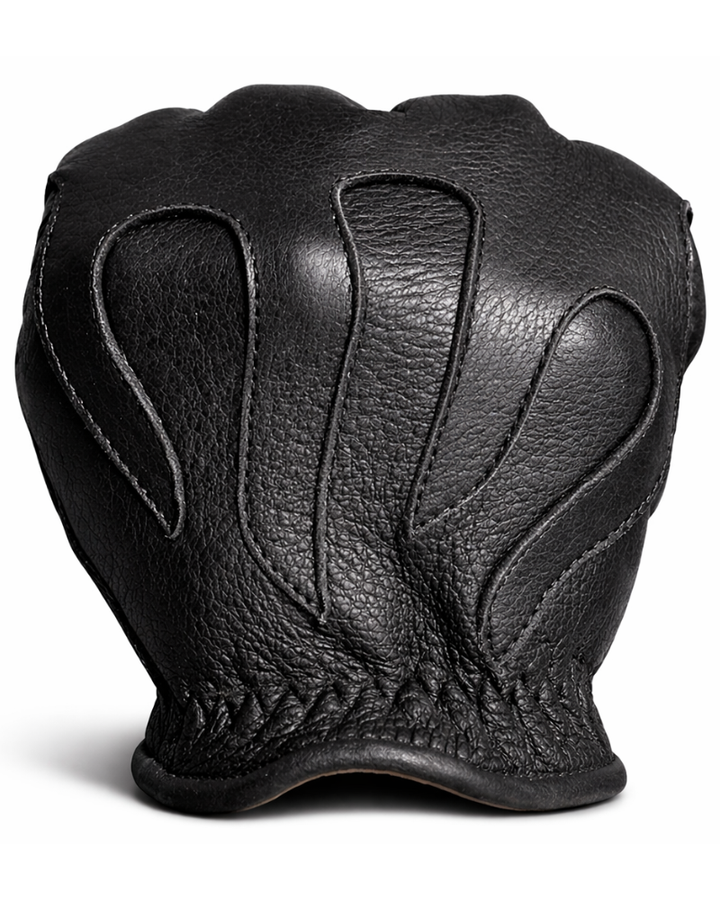
Legendary USA builds its motorcycle gloves from American deerskin with a focus on construction quality and leather selection. Two gloves in the lineup address protection directly through their material composition and reinforcement design.
Legendary Deerskin Aramid Lined Short Wrist Touchscreen Gloves — $120.00

The Aramid Lined glove adds a layer of Aramid fiber (the material family that includes Kevlar) between the deerskin shell and the interior. Aramid fibers are highly cut-resistant and add a layer of material between the road surface and the skin in scenarios where the leather shell is compromised. This is the most substantive protection-focused construction in the Legendary USA glove lineup — the deerskin handles abrasion, the Aramid lining provides a secondary cut-resistant barrier underneath.
The touchscreen-compatible fingertips allow phone and GPS use without removing the glove. At $124.99, this is the choice in the Legendary USA lineup for riders who are explicitly prioritizing protection as their primary selection criterion alongside day-to-day practicality.
Legendary Gold Deerskin Leather Short Wrist Motorcycle Gloves — $100.00

The Gold Deerskin glove represents the baseline construction across the lineup — quality American deerskin shell with consistent stitching and palm construction designed for road contact durability. This is the everyday riding glove in the lineup: the deerskin shell provides abrasion resistance to the skin during pavement contact, and the construction holds up to regular use. For riders whose primary riding is at speeds where leather shell quality is the relevant protection variable, this is a sound choice at a practical price.
See the complete Legendary USA motorcycle gloves collection and the best motorcycle gloves guide for comparison across the full lineup. For cold-weather riding specifically, see the winter motorcycle gloves guide.
Frequently Asked Questions
Do motorcycle gloves actually reduce hand injury in a fall?
Motorcycle gloves are designed to reduce abrasion to the skin during pavement contact and to provide a measure of impact absorption at the knuckles and palm. Leather gloves with substantial shell thickness reduce road rash severity during a slide by keeping the leather — not the skin — in contact with the pavement surface. They do not prevent all hand injury, and no glove eliminates injury risk in all scenarios. A glove’s practical function is to decrease the severity of road rash and reduce exposure of bare skin to road surfaces during the time a hand is in contact with the ground.
What is the difference between CE Level 1 and CE Level 2 motorcycle gloves?
CE ratings for motorcycle gloves are governed by European standard EN 13594. Level 1 gloves meet baseline requirements for abrasion resistance and impact protection — sufficient for general road use. Level 2 gloves pass more stringent testing thresholds for both abrasion and impact energy absorption, and are the appropriate choice for higher-risk riding environments such as track days or aggressive street riding. Both levels require testing of the palm, knuckles, and wrist area. A Level 2 glove is not dramatically safer than a Level 1 in everyday riding scenarios, but it represents a higher standard of protection across all tested categories.
Is deerskin or cowhide safer for motorcycle gloves?
Cowhide is generally more abrasion-resistant than deerskin in pure material tests — it has a denser, more uniform fiber structure and greater surface hardness. Deerskin offers superior softness and conformability, which makes it a preferred choice for everyday riding gloves where fit and feel are priorities. For maximum abrasion resistance per millimeter of material, cowhide or goatskin typically outperforms deerskin. However, glove thickness, stitching, and reinforcement at wear points matter as much as the base leather — a well-constructed deerskin glove with palm reinforcement will outperform a thin cowhide glove in practical use.
Are knuckle protectors worth it in motorcycle gloves?
Knuckle protectors — rigid or semi-rigid inserts over the knuckle area — address impact energy rather than abrasion. In urban and low-speed falls where the hand impacts a curb, vehicle, or road surface at an angle, a knuckle guard distributes that impact energy rather than concentrating it on the joint. For highway-speed slides, the primary mechanism of injury shifts toward abrasion rather than impact, where leather shell quality matters more. Riders in urban environments, commuters who encounter stop-and-go traffic, and anyone who rides technical routes where falls at lower speeds are more likely will benefit more from knuckle protection than pure highway riders.
Are short wrist gloves as safe as gauntlet gloves?
Short wrist gloves leave the lower forearm and wrist unprotected in a way that gauntlet gloves do not. The wrist is a significant injury point in motorcycle falls — instinctive reach-out reactions put the wrist in contact with the road, and the wrist and lower forearm have minimal natural padding. A gauntlet extends leather coverage over this area, reducing abrasion severity to the wrist during a slide. Short cuff gloves are appropriate for controlled environments and casual riding; riders who prioritize protection coverage for higher-speed or higher-risk riding typically benefit from gauntlet coverage over this anatomically vulnerable area.
Browse the full Legendary USA motorcycle gloves collection, or visit the best motorcycle gloves guide to compare models. Planning a winter ride? The winter motorcycle gloves guide covers insulation, gauntlet vs. short cuff, and layering options.