



Perforated leather is how American riders kept leather on their hands through summer instead of giving it up. Punching a pattern of small holes through the back of a glove lets air move across the hand at road speed while the palm stays solid where it wraps the grip. It is a plain solution to a plain problem, and it has outlasted a lot of cleverer ideas.
Every August the same argument gets settled again in gas station parking lots from Arizona to the Dakotas: bare hands or leather. Perforation is the answer American riders arrived at that let them stop choosing.
The Problem Summer Created
Leather does what riders need it to do. It resists wind, it takes abrasion better than fabric, it molds to the hand, and it lasts. It also traps heat, and a solid leather glove in full sun on a hundred-degree afternoon in Texas is a genuinely miserable piece of equipment.
A Technique Borrowed From Working Leather
Perforation was not invented for motorcycles. Punching ventilation holes into leather panels was already standard practice in driving gloves and work gloves. The technique moved onto the motorcycle because the problem was the same: a hand gripping something for hours in heat.
What motorcycles added was airflow. A rider at highway speed has moving air across the back of the hand that a factory worker never had, which turns perforation from a modest improvement into a real one.
Where the Holes Go, and Why

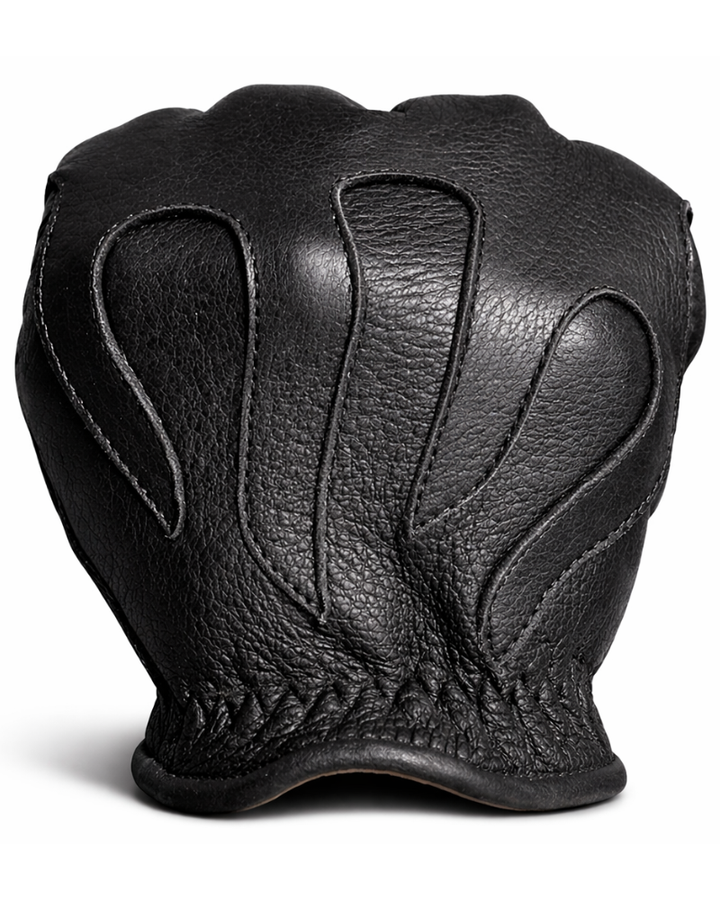
Good perforation is placed, not scattered. The back of the hand and the tops of the fingers get the pattern because that is the surface facing the wind. The palm stays solid because the palm is the wear surface, the grip surface, and the part of the glove that sees the most abrasion if things go wrong.
Construction matters alongside perforation. Outseam construction puts the finger seams on the outside of the glove instead of inside against your skin, which removes pressure points on a long day. Combine outseam construction with a perforated back panel and you get a summer glove that stays comfortable past the fourth hour. The ILL DOZER perforated deerskin glove is built on both ideas, in American whitetail deerskin.
Perforated vs Fingerless: Two American Answers
These are the two traditional American solutions to summer heat, and they are not the same solution. Fingerless gloves remove leather from the fingers entirely. Airflow is total, coverage is gone, and your fingers take full sun for the length of the ride. Perforated full-finger gloves keep coverage everywhere and move air through the leather instead of around it.
Neither is wrong. Fingerless has a place for short rides, town riding, and riders who want the feel of a bare fingertip on a switch. Perforated is the better call for a long day of highway miles. Plenty of riders own both, which is the sensible outcome. Our take on fingerless gloves as a fixture of American riding covers that side of it.
What Perforation Costs You
Holes work both directions. A perforated glove soaks through in rain, pushes cold air onto your knuckles in the fifties, and has less leather in the panel than a solid glove of the same hide. None of that is a flaw in the design. It is the design.
A perforated glove is summer equipment. Riders who treat it as a year-round glove end up disappointed in October and blame the glove. Riders who keep it as one pair in a rotation get years out of it and never think about their hands in August. That is the honest way to sell it and the honest way to buy it.
Twenty-Five Years of the Same Answer
Legendary USA opened in 2001 and has been selling American-made riding gloves ever since. In twenty-five years, the gear that riders come back for has not changed much. Perforated deerskin for heat. Solid unlined leather for the shoulder seasons. Something lined for the cold end. The Made in USA motorcycle gloves collection is organized around that reality rather than around whatever is new.
Perforated leather survived because it solved the problem without asking riders to give up leather. That is the whole tradition. It is not romantic, and it works.
Frequently Asked Questions
- What is perforated leather in motorcycle gloves?
- Perforated leather is hide punched with a pattern of small holes that let air pass through the panel. In motorcycle gloves the perforation usually sits on the back of the hand and the tops of the fingers, where airflow reaches at road speed. The palm is normally left solid because that is the surface that wraps the grip. The result is a glove that vents heat while keeping full leather where the hand does its work.
- Why did American riders start using perforated gloves?
- American riders adopted perforated gloves because summer riding across the South and West made solid leather unbearable without giving up leather entirely. Perforation was the compromise that kept hide on the hand through July and August. It borrowed from a technique already common in driving gloves and work gloves, where ventilation had long been punched into leather panels for the same reason.
- Is perforated leather weaker than solid leather?
- Perforation removes material, so a perforated panel has less leather in it than a solid panel of the same hide. In practice the difference in a well-made glove is modest, because perforation is placed on the back of the hand rather than the palm and the hole pattern is spaced to keep the panel intact. Perforated leather is still leather. It is not armor, and neither is solid leather.
- What is the difference between perforated and ventilated gloves?
- Perforated gloves are punched with holes through the leather itself. Ventilated gloves may use perforation, or they may use mesh panels, gussets, or open sections between leather panels to move air. Perforation keeps the glove all-leather. Other ventilation methods can move more air but introduce a second material. Both approaches solve the same summer problem in different ways.
- Do perforated gloves let rain through?
- Yes. Holes in leather let water in as readily as they let air out, and a perforated glove will soak through in a hard rain. That is the cost of the design and no perforated glove should be sold as weather protection. Riders who face wet summer afternoons usually keep a solid unlined pair alongside their perforated pair rather than expecting one glove to handle both.
- Are perforated deerskin gloves worth it?
- For hot-weather riding, yes. Deerskin is already the softest of the common American glove hides, and perforating it produces a glove that breathes well and breaks in within two to three weeks of regular riding. The limits are real: perforated deerskin is a summer glove, it soaks in rain, and it is not cold-weather gear. Judged as summer gear, it does the job better than solid leather.
Closing Thought
The perforated glove is not a heritage piece the way a horsehide jacket is. Nobody collects them. They get worn until the palm goes and then replaced, which is the highest compliment you can pay a working piece of gear.