
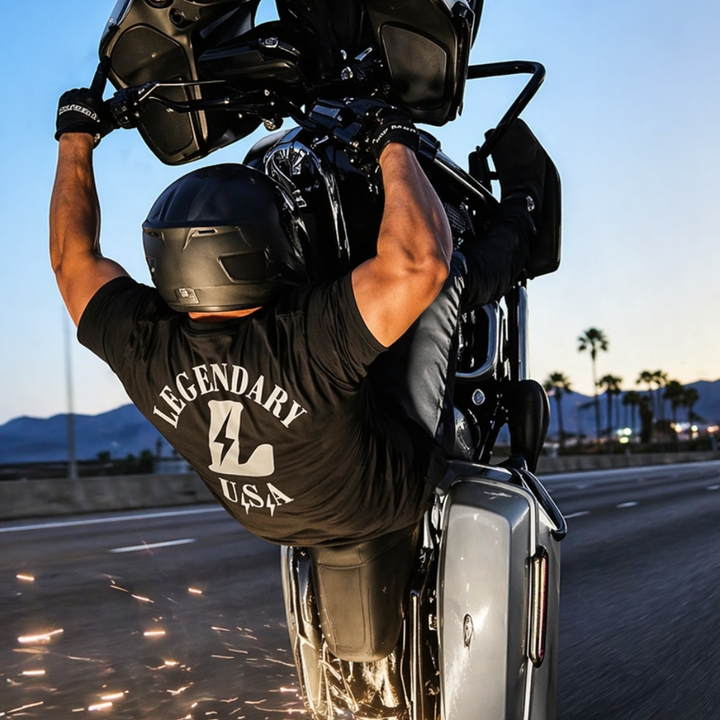
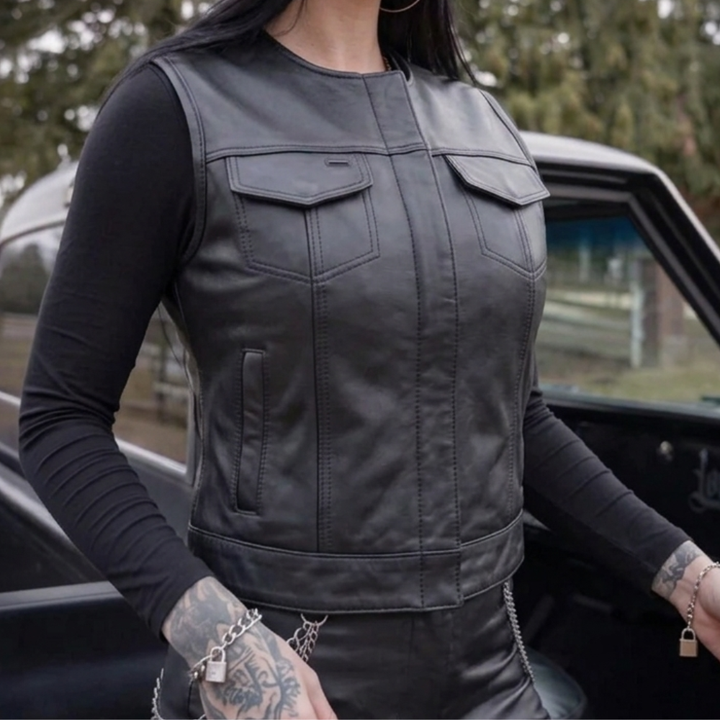


When you are riding in real conditions, your jacket is not just clothing. It is the layer between your skin and the road, and it has to hold together for years of weather, wind and wear. The difference between a jacket that is still good after 50,000 miles and one that falls apart after five seasons comes down to construction.
We have been making leather gear for over 25 years. Here is what separates heavy-duty USA-made leather jackets with reinforced seams from everything else.
1. Heavy Duty Construction and Reinforced Seams

Heavy-duty leather jackets are not built the same way as fashion jackets. The differences are thread, seam placement, and materials chosen for abrasion resistance and longevity rather than for cost.
A typical imported jacket uses single-needle stitching with cheap polyester thread. One line of thread holds fine right up until the seam is stressed. Reinforced seams use double or triple-needle stitching with bonded nylon thread that resists abrasion and UV breakdown.
What to look for:
- Double-needle stitching at stress points: shoulders, armholes, collar attachment
- Bonded nylon thread rather than polyester, which breaks down in sunlight within a few years
- Seam tape or binding on the inside, which stops leather edges separating along the stitch line
- Box-stitching or cross-stitching where the sleeve meets the body
- Proper seam allowance, a quarter inch minimum and more where stress concentrates
Seams matter because in a slide the hide is only as good as what holds it together. A seam that opens turns a jacket into two pieces of leather. That is the failure mode reinforced construction is built to prevent.
2. American-Made Jackets That Set the Standard
There is a reason riders stick with American-made gear. Domestic manufacturers have skin in the game. We source from tanneries we know, we inspect hides, and we hire people who have been cutting leather for decades rather than rotating factory workers every six months.
When you buy an American-made leather jacket from us, you get:
- Direct accountability, because your jacket was not made by an anonymous factory three countries away
- Quality control at every step rather than one final inspection before shipping
- Leather sourced from established US tanneries with traceable standards
- Patterns refined over 25 years of making the same jackets
Imported jackets are engineered to a price. We price fairly because we pay fairly for materials and labour. For the broader case, see our USA vs imports comparison.
3. Military Heritage Craftsmanship in Civilian Wear
Our flight jacket work and our motorcycle jacket work come out of the same shop and the same standards. That heritage shows up in specific, checkable places rather than in a slogan:
- Leather weight and thickness specified rather than whatever the hide happens to be
- Seam construction chosen for tear strength at the stress points
- Hardware selected for service life, and replaceable when it does wear out
- Patterns drafted around how leather actually behaves when it is stretched and abraded
- Hide and lining that stay flexible in cold weather instead of going board-stiff
Most fashion jackets use 2 to 3 oz leather. We use 4 to 5 oz hides on jackets meant to take a slide and stay closed. Thin leather looks better on a hanger. Thick leather performs.
One thing that heritage does not include: our leather jackets carry no CE-certified armor and no armor pockets, and we make no impact protection claim for them. They are abrasion cover. If you want certified impact protection, layer a CE-rated armored riding shirt or flannel underneath.
4. Premium Leather Quality and Durability
Source matters enormously. We buy from tanneries that use vegetable tanning, or chrome tanning with proper finishing. Vegetable tanning is slower and more expensive and produces leather that develops real character. Chrome tanning is faster and cheaper, and can be excellent or poor depending entirely on whether the tannery cuts corners.
The difference shows up in service life:
- Vegetable-tanned leather: 10 to 15 years with proper care
- Properly finished chrome-tanned leather: 7 to 10 years minimum
- Poor-quality chrome-tanned leather: 3 to 5 years before cracking starts
What is the difference between naked leather and top grain?
This question comes up constantly and the terms get used loosely, so here is the plain version.
Naked leather means the hide has been tanned and dyed but not coated with pigment or a surface finish. You are touching the actual grain. It feels soft and slightly waxy, it takes conditioner readily, and it scuffs and patinas fast, which is exactly what people who love it are buying. It also shows every mark, so the tannery has to start with a genuinely good hide.
Top grain describes where in the hide the leather came from, not how it was finished. It is the outer layer with the surface lightly sanded and usually a finish applied to even out the colour. It is more uniform and more stain resistant than naked leather, and slightly less breathable.
Full grain is top grain that has not been sanded at all, so the strongest fibres at the very surface are intact. For a riding jacket this is the one that matters most, because that surface layer is the densest part of the hide.
Practical guidance: for a riding jacket, prioritise full grain and hide weight. Naked finish is a preference about how the jacket will age and look, not a durability upgrade on its own. What you want to avoid entirely is split leather or genuine leather labelling, which usually means the lower layers of the hide with a coating sprayed on. That is the material that separates under stress.
5. Reinforced Seams That Actually Hold Up
How we reinforce seams for durability:
- Double-needle stitching with spacing tight enough to hold without perforating the leather into a tear line
- Bonded nylon thread that does not degrade under UV exposure
- Seam binding on the interior to protect the thread from abrasion
- Cross-stitching at high-stress points: collar, shoulder seams, sleeve attachment
- Generous seam allowance where stress concentrates
The result is a seam that can take a slide without splitting open. Most riders never stress-test a jacket until the day they need it, and by then the construction decisions have already been made. That is why we build the seams for the day rather than the average.
6. What Leather Motorcycle Jacket Will Last Twenty Years?
A twenty year jacket is not a brand, it is a specification. Five things decide it, and four of them are things you can check before you buy.
- Hide weight and grade. Full-grain or genuine horsehide at 4 to 5 oz. This is the single biggest factor. Thin corrected-grain leather will crack at the flex points inside five years no matter how well it is sewn.
- Bonded nylon thread, not polyester. Thread is the cheapest component in a jacket and the most common cause of failure. Polyester degrades in sunlight. In a twenty year jacket, the thread has to outlast the leather.
- Serviceable hardware. Zippers wear out. That is fine if the zipper can be replaced. It is fatal if the jacket is built so the zipper cannot come out without destroying the front panel.
- Repairable construction. Sewn-in linings, accessible seams, panels that can be replaced. Glued construction cannot be repaired.
- Care, which is on you. Condition it twice a year, keep it off wire hangers, never dry it near heat. That is most of the work.
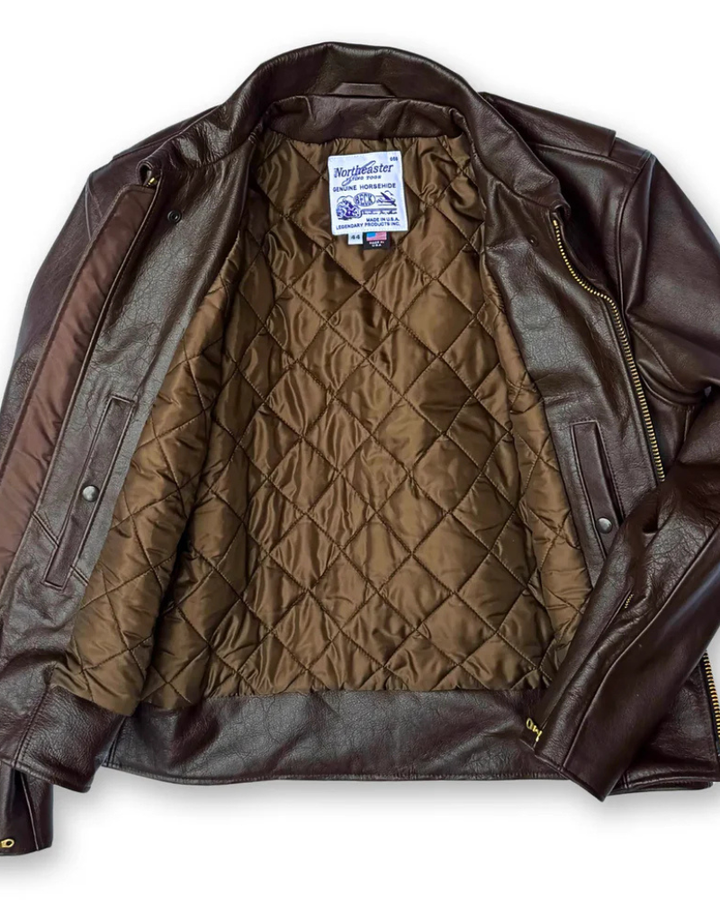
From our own line, the jackets we would bet on for twenty years are the horsehide ones: the BECK 999, the BECK 501 Trucker and the BECK 666. Horsehide has a denser, tighter fibre structure than cowhide, which is precisely why it was the standard riding leather before cowhide got cheaper. The Legendary Black Hills in heavyweight cowhide is the value answer to the same question.
One honest caveat: a twenty year jacket has to still fit you in year twenty. That is a real argument for buying the correct size now rather than sizing up, and for using the Custom option if your measurements sit between sizes.
7. USA Production vs Imported: Direct Comparison
USA-made heavy duty jackets:
- Leather sourced and inspected domestically
- Seams: double or triple-needle with bonded nylon thread
- Quality control: in-house, multiple checkpoints
- Accountability: you can contact the actual manufacturer
- Service life: 10 to 15 years and up with care
- Cost: roughly $500 to $1,200 per jacket. Our own heritage line runs $675 to $845.
Imported budget jackets:
- Leather selected on cost rather than performance
- Seams: single-needle with polyester thread
- Quality control: final inspection only, which misses internal defects
- Accountability: limited, because factories close and retailers move on
- Service life: 2 to 4 years before visible degradation
- Cost: roughly $89 to $250 per jacket
Cost per year: a $725 American-made jacket lasting 15 years is about $48 a year. A $150 imported jacket lasting 3 years is $50 a year, and that assumes you keep wearing it as the seams go. Once you count replacements, the expensive jacket is the cheap one.
Top Picks, Shop Direct
These four are the jackets in our line where the construction story in this guide is actually true. Horsehide leads because a tighter fibre structure is the honest answer to a question about seams and service life. Prices and ratings were verified live before this update.
| Product | Why it fits this question | From |
|---|---|---|
| BECK 999 Genuine Horsehide Motorcycle Jacket | The heaviest hide and the most heavily built jacket we make, and our first answer to a twenty year question. Offered 36 through 56 plus a Custom size. Rated 4.97 out of 5 from 37 reviews. | $845.00 |
| BECK 666 Distressed Horsehide Motorcycle Jacket | Our most reviewed BECK jacket, which is the closest thing to long-run field data we have on the construction. Distressed finish means scuffs blend in rather than stand out. Offered 36 through 56 plus a Custom size. Rated 4.96 out of 5 from 68 reviews. | $815.00 |
| BECK 501 Trucker Style Genuine Horsehide Jacket | The best value in horsehide, and the shortest body length in the range if a full-cut jacket swamps you. Offered 36 through 56 plus a Custom size. Rated 4.93 out of 5 from 41 reviews. | $725.00 |
| Legendary Black Hills Men's Leather Motorcycle Jacket | Heavyweight cowhide with the same reinforced seam construction at the lowest price here. Offered 36 through 56 plus a Custom size. Rated 4.97 out of 5 from 63 reviews. | $675.00 |
All four are unarmored heritage leather. If you want certified impact protection alongside the construction, add an armored flannel from $119.99 and wear it underneath. Prices shown are current at time of writing. Orders over $150 ship free.
Investment Value in Real American Leather
A quality heavy-duty leather jacket holds value because it holds up. A damaged imported jacket is refuse. A worn but well-maintained American-made jacket is still wearable, and often more desirable, because the leather has aged into something you cannot buy new.
Browse our leather touring motorcycle jackets, military and aviation bomber jackets, and men's American-made motorcycle jacket lineup.
Save 15% off your first purchase when you join our Legendary VIP newsletter.
Frequently Asked Questions
What makes reinforced seams different from standard motorcycle jacket construction?
Double-stitched seams with heavy-gauge bonded nylon thread, plus bar-tacking and cross-stitch reinforcement at stress points like shoulders and underarms. The benefit is tear strength and service life: the seam stays closed under load where single-needle polyester construction opens up.
What leather motorcycle jacket will last twenty years?
One built from full-grain or horsehide at 4 to 5 oz, sewn with bonded nylon thread, with serviceable hardware and repairable construction, and conditioned twice a year. From our line, the BECK 999, BECK 501 Trucker and BECK 666 in horsehide, or the Legendary Black Hills in heavyweight cowhide.
What is the difference between naked leather and top grain?
Naked leather is tanned and dyed with no pigment coating, so you touch the actual grain. It patinas fast and shows every mark. Top grain describes the outer layer of the hide, lightly sanded and usually finished for uniformity. Full grain is top grain that has not been sanded, which keeps the strongest surface fibres intact and is what you want in a riding jacket.
Why does Made in USA matter for a motorcycle jacket?
Direct control over every step from hide selection to final inspection, and a real company to contact when you need warranty or repair support years later.
How do you determine leather weight for each jacket style?
4 to 5 oz cowhide for heavyweight touring and cruiser jackets, and around 3 to 3.5 oz horsehide for heritage motorcycle cuts, where the tighter fibre structure does more with less thickness.
Can a damaged American-made jacket be repaired?
Yes. Reinforced seams and sewn-in construction make repair practical. Call us about work on jackets we made.
Do these jackets have CE armor?
No. Our leather jackets are unarmored abrasion cover with no armor pockets and no impact rating. Layer a CE-rated armored shirt or flannel underneath for certified impact protection.
Article originally published April 2026. Updated August 2026 with corrected protection claims, a twenty year durability section, a leather grades explainer, verified live pricing, and a shop table.