



Choosing motorcycle gloves for cold-weather commuting comes down to three decisions: how much lining the ride needs, how much cuff the jacket allows, and whether the glove still works a phone and a brake lever at 6:45 in the morning. A commute is short, repeated, and ridden at the coldest hour of the day, which makes it a different problem from a weekend ride in the same temperature. Legendary USA builds deerskin gloves for this exact pattern, and this guide works through the choice the way a daily rider should.
Start With the Commute, Not the Glove

A 25-minute commute at 34°F behaves differently from a two-hour ride at 34°F. The commuter's hands never fully warm up, but they never reach the deep chill of an hour of highway wind either. A commuter can often get away with less insulation than a touring rider, provided the glove blocks wind well and goes on warm.
Write down three numbers before shopping: the typical morning temperature, the share of the route at highway speed, and the number of stops. High-speed miles push toward a longer cuff, frequent stops toward a glove that comes off quickly, and a start temperature in the 30s toward a lining or a liner.
The evening ride home is usually ten to twenty degrees warmer than the morning ride in, so commuters often end up with a two-glove rotation or a glove-and-liner system that scales. Legendary USA's commuter glove guide covers the rotation approach.
Lined Glove or Unlined Glove Plus Liner
A lined glove is the simpler answer for a commuter who wants to grab one pair and go. Legendary USA's Fleece-Lined Deerskin Gloves pair a Whitetail deerskin outer with a 3M Thinsulate 40-gram fleece lining that Legendary USA rates for 30°F to 50°F. That range covers most fall and early-winter commutes in much of the country, and the short wrist keeps the glove quick on and off at the parking garage.
An unlined glove over a separate liner is the more flexible answer. Legendary USA carries Gators Skin Glove Liners, a windproof, moisture-wicking liner that slips inside a riding glove or wears alone. On a 30°F morning the liner goes in; on the 50°F ride home it comes out and rides in the jacket pocket. The deerskin shell does the same wind and abrasion work either way.
The tradeoff is dexterity against convenience. A bonded fleece lining mutes lever feel slightly and the glove is always the same warmth. A liner system keeps the shell thin and adjustable but adds a step at each end of the ride. Commuters who hate fiddling pick the lined glove; commuters who ride through wide temperature swings pick the liner system.
How Much Cuff a Commuter Actually Needs
Cuff length should match the jacket and the speed. A short elasticized wrist works when the jacket has a snug cuff and the route is mostly surface streets at 35 to 45 mph. The moment the commute includes a sustained interstate stretch, wind starts finding the gap at the wrist, and a longer cuff pays off.
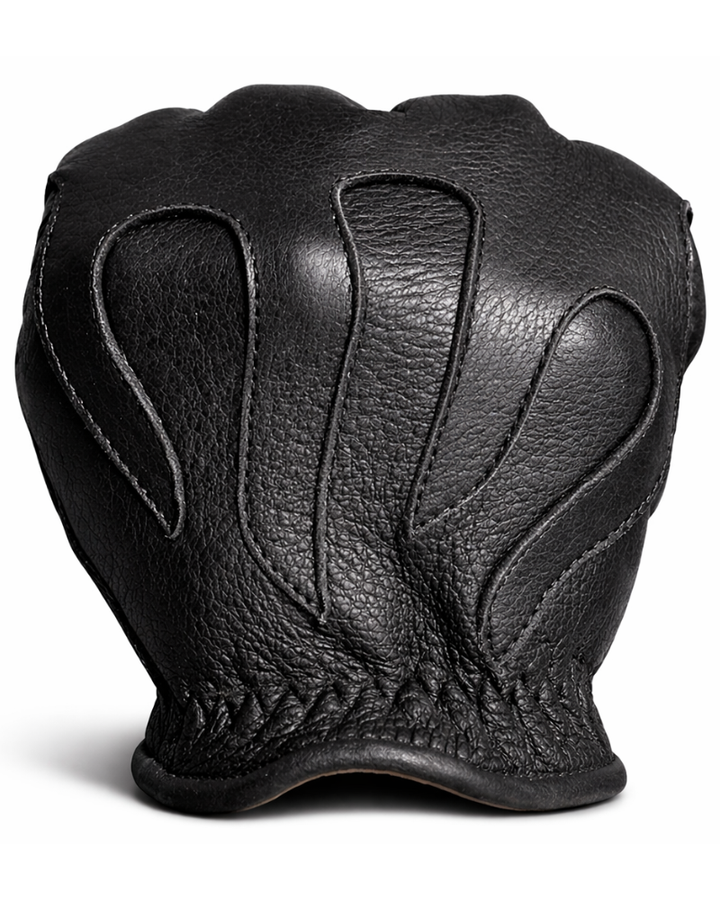
The middle option is often the right one for commuters. Legendary USA's Classic Longer Cuff Deerskin Gloves carry a 1.5-inch elasticized wrist cuff that sits higher than a short wrist and blocks more wind at the sleeve gap, without the bulk of a full gauntlet that slows down every stop. The touchscreen-capable thumb and index finger also matter more on a commute than on a Sunday ride, because the commuter checks a phone, taps a garage keypad, and pays for coffee without taking the glove off.
A full gauntlet is the right call for commutes that are mostly highway. For a stop-and-go urban route it is more glove than the ride needs.
Why Deerskin for a Cold Commute
Deerskin stays pliable in the cold, which is the quality a commuter notices first. A cowhide glove left in a 30°F garage overnight is stiff for the first ten minutes of the ride, and a commute is only 25 minutes long. Legendary USA's Whitetail deerskin gloves go on soft and stay soft, so the clutch hand works normally from the first light.
Deerskin also handles the damp of fog, frost, and wet pavement, staying pliable after getting wet without conditioning. It weighs roughly half of cowhide at equivalent protection, which keeps even the lined version from feeling like a work glove.
Deerskin is soft leather, not armor. Legendary USA's deerskin gloves carry no CE rating, and a rider who wants cut resistance beyond what deerskin alone offers should look at the aramid-lined version in the USA-made motorcycle gloves collection. For the commuter, the leather's job is wind, abrasion, grip, and staying flexible in the cold, and deerskin does all four.
Getting the Fit Right for Lined and Layered Gloves
Size up one size for any glove that will be lined or worn over a liner. A glove that fits bare-handed in the showroom will bind once a liner goes in, and a glove that binds restricts blood flow, which makes cold hands colder. Legendary USA advises sizing up one from the normal glove size for the Fleece-Lined Deerskin Gloves, and the same rule applies to an unlined glove that will carry a Gators Skin liner.
Deerskin stretches and molds to the hand over the first two to three weeks of regular riding, so a new glove should feel close but not tight. Measure the hand around the knuckles with the liner on, and buy to that number. A commuter puts the glove on and takes it off ten times a week, so the fit gets dialed in fast.
Keeping Commuter Gloves Working All Winter
Daily use in cold, wet conditions is hard on leather. Let the gloves dry at room temperature after a wet ride, never on a heater or vent, because fast heat pulls the oils out of deerskin. Condition deerskin only when it starts to feel dry, not on a schedule, and Legendary USA's guide to conditioning leather gear before winter covers the method.
The right cold-weather commuting glove is the one that matches the morning temperature, the jacket cuff, and the number of times it comes off between the driveway and the desk. For most commuters in the 30s and 40s, that is either the Fleece-Lined Deerskin Gloves for simplicity or the Classic Longer Cuff with a Gators Skin liner for range. Size for the layer, let the deerskin break in, and the same pair will handle the whole season.
For the wind chill math behind these temperature bands, the National Weather Service publishes a cold wind chill chart.
Frequently Asked Questions
- What are the best motorcycle gloves for a cold-weather commute?
- For most commuters riding in the 30s and 40s Fahrenheit, a deerskin glove with either a built-in fleece lining or a removable liner is the practical choice. Legendary USA's Fleece-Lined Deerskin Gloves are rated for 30°F to 50°F and are the simplest option. Riders whose morning and evening temperatures differ by 15 degrees or more do better with an unlined deerskin glove over Gators Skin liners.
- Do I need gauntlet gloves for commuting in the cold?
- Only if a large share of the commute is at highway speed or the jacket sleeves ride up. On surface streets at 35 to 45 mph, a short or longer-cuff glove with a snug jacket cuff blocks enough wind, and it comes on and off faster at stops. Legendary USA's Classic Longer Cuff Deerskin Gloves, with a 1.5-inch elasticized cuff, are the middle ground many commuters settle on.
- How do I keep my hands warm on a short cold motorcycle ride?
- Block the wind first, then add insulation. Make sure the glove cuff and jacket sleeve overlap so no air reaches the wrist, start with gloves that have been indoors rather than in a cold garage, and use a lining or liner once the temperature drops below about 40°F. Deerskin helps because it stays pliable in the cold, so the hand does not fight a stiff glove.
- Should I size up for fleece-lined motorcycle gloves?
- Yes, size up one from the normal glove size. Legendary USA gives that guidance for its Fleece-Lined Deerskin Gloves because the 3M Thinsulate lining takes up room inside the shell. A lined glove bought in the bare-hand size binds at the knuckles and restricts circulation, which makes fingers colder. The deerskin will still relax and mold to the hand over the first few weeks of riding.
- Are touchscreen gloves worth it for commuting?
- For a daily commuter, yes. A commute involves a phone for navigation, a garage keypad, a fuel pump, and a coffee counter, and each one otherwise means pulling a glove off in the cold. Legendary USA's Classic Longer Cuff Deerskin Gloves have a touchscreen-capable thumb and index finger built into the deerskin. On a weekend ride the feature matters less; on a commute it gets used every day.