



The History of Horsehide in American Motorcycling
Before cowhide dominated leather goods manufacturing, horsehide was the American standard. It was tougher, tighter-grained, and more weather-resistant than cowhide. Early motorcycle riders chose it for the same reason cavalry riders and industrial workers had chosen it for generations: it held up.
The Early Riders, Early 1900s
When motorcycle riding became a practical activity in the first decades of the twentieth century, riders needed protection from wind and road debris. There was no dedicated motorcycle apparel industry. Riders wore what working men wore in environments that demanded durable protection: horsehide jackets, horsehide gloves, horsehide boots.
Horsehide was widely available in early American manufacturing because horses were still central to transportation and agriculture. The hides were a byproduct of an industry that was everywhere. American tanneries processed horsehide into a leather that was harder and more resistant than cowhide precisely because the fiber structure of horse skin is denser.
Early motorcyclists who rode any distance quickly learned the relevant properties: horsehide didn't stiffen in cold the way cowhide did, it shed light rain better, and it held up to the abrasion of repeated road travel without losing integrity at the surface. These weren't theoretical advantages — they were functional ones that riders discovered through use.
The WWII Aviation Intersection
The US Army Air Corps adopted horsehide for their A-2 flight jacket specification when that garment was formalized in 1931. The reasoning was the same as early motorcycle riders had discovered — horsehide's tight grain structure handled variable weather conditions, held its shape under sustained use, and aged in a way that improved with wear rather than degrading.
WWII aviators who returned to civilian life often kept their flight jackets. Many of them became motorcyclists. The jackets that had survived Pacific missions and European theater combat rides naturally transitioned to American highways. The connection between aviation leather and motorcycle leather — already close in material terms — became part of the culture of American riding in the postwar period.
The Shift to Cowhide
In the 1950s and 1960s, the American leather goods industry began a gradual shift from horsehide to cowhide as the default material. Horses were no longer central to American working life — the automobile had replaced them — and horsehide supply contracted. Cowhide, sourced as a byproduct of the expanding American beef industry, became abundant and cost-effective.
Mass-market leather jacket manufacturers made the transition because it made economic sense. Cowhide was cheaper, more available, and softer out of the tannery — which appealed to buyers who didn't understand the difference between immediate softness and long-term performance. Premium horsehide, requiring more specialized sourcing and processing, became the territory of specialists.
Horsehide in the Premium Market
The brands that stayed with horsehide after the mainstream transition to cowhide did so because their customers demanded it. Military-specification reproduction brands like Cockpit USA needed horsehide for the A-2 because the government spec called for it. Motorcycle-specific brands like BECK stayed with horsehide because riders who'd owned and worn horsehide jackets understood the difference in long-term performance.
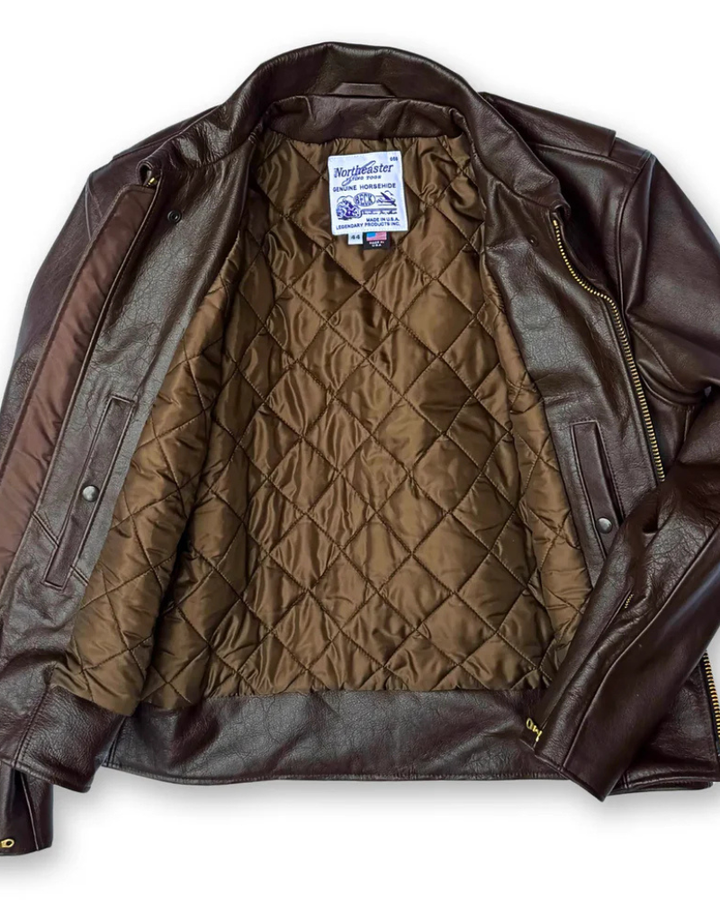
The BECK 732 Northeaster is a direct product of this heritage. It's a motorcycle jacket built from horsehide because that's the material that delivers the performance profile — abrasion resistance, weather resistance, aging character — that serious riders want. The brand's name, Northeaster Flying Togs, references the aviation-to-riding cultural current that horsehide has always carried.
Why Horsehide Persists
Horsehide today occupies the premium end of the leather motorcycle jacket market because it delivers what cowhide doesn't: a break-in arc that ends with a jacket shaped to your body, an aging process that produces a distinctive patina unique to each wearer, and a structural durability that keeps the jacket performing a decade or more into regular use.
The riders who choose horsehide now are making an informed material decision, not a nostalgic one. They understand the difference, they've often owned cowhide jackets and know what they're upgrading from, and they're willing to invest in the break-in period because the long-term result justifies it.
Legendary USA carries BECK horsehide jackets and the full military leather jacket collection for riders making that decision. The BECK Northeaster buying guide covers every model in detail.