



Insulated motorcycle gloves keep hands working on the controls when unlined leather stops being enough, which for most riders happens somewhere between 50°F and 40°F at highway speed. The right insulated glove depends on how cold it gets and how long you stay out in it: a fleece-lined deerskin short wrist covers fall and mild winter, a thin liner under an unlined gauntlet covers sustained highway miles, and a 100-gram insulated mitten covers the days below 30°F when fingered gloves give up. This guide walks through every insulated and lined glove Legendary USA builds, what each lining actually does, and how to pick one for the temperatures you ride in.
What Insulation Does Inside a Riding Glove

Insulation in a motorcycle glove slows the loss of heat from the hand to the cold air moving past it. The leather shell blocks wind. The lining traps a layer of warmed air against the skin. Without the shell, a lining soaks through with wind in seconds. Without the lining, the shell leaves hands cold once air temperature drops below what bare leather can hold off.
The tradeoff is feel. Every gram of insulation sits between your fingers and the throttle, clutch and brake. That is why Legendary USA builds its coldest-weather gloves with 3M Thinsulate rather than thick fleece: Thinsulate holds warmth at a fraction of the loft, so a 40-gram lined glove still closes around a grip without feeling like a ski glove. It is also why the gloves use American Whitetail deerskin for the shell. Deerskin weighs roughly half what cowhide does at equivalent thickness and stays pliable in cold instead of stiffening, so the insulated version of a deerskin glove still weighs less than a standard cowhide winter glove.
Fleece-Lined Deerskin: The Three-Season Insulated Glove
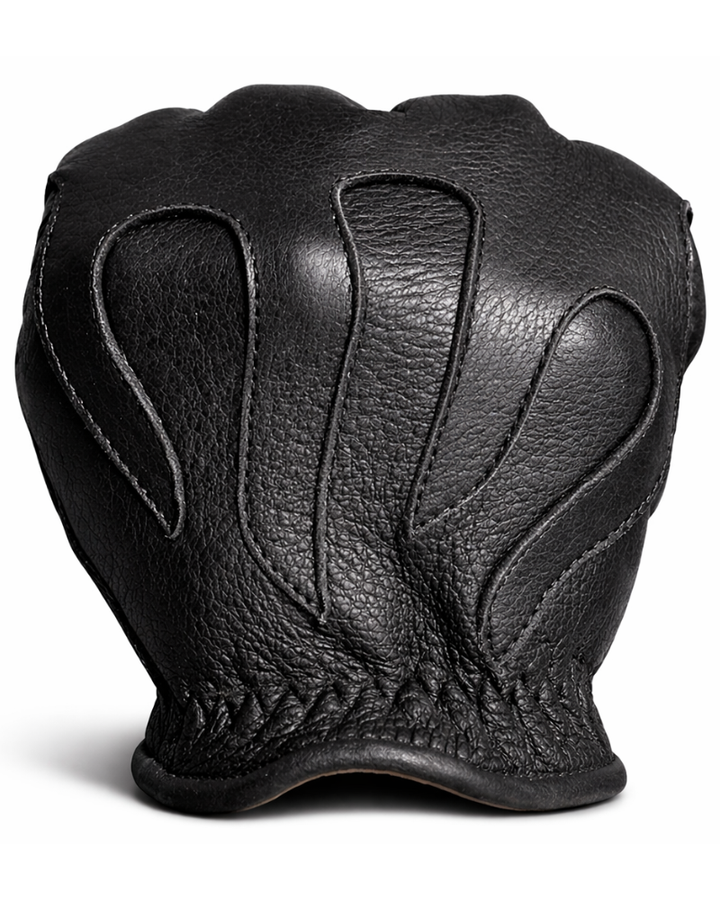
The Fleece-Lined Deerskin Gloves are the glove most riders mean when they ask for an insulated motorcycle glove. The shell is 100 percent American Whitetail deerskin. The lining is 3M Thinsulate 40-gram fleece. Legendary USA builds them for the 30°F to 50°F range, which covers October mornings, November commutes and the first and last rides of a northern winter.
The construction is the same short wrist, keystone thumb pattern as the unlined deerskin gloves, stitched with American and Efird industrial thread and hand-cut in the USA. The elasticized wrist cuff seals against the sleeve. The keystone thumb is cut as a separate piece set into the palm, so the thumb moves on the grip without pulling the palm leather tight.
Two things to know before ordering. The 40-gram lining takes up room, so size up one from your normal glove size. And a short wrist cuff stops at the wrist, which means wind can reach the gap between glove and sleeve at speed. For a commute or a two-hour ride that gap is manageable with a jacket cuff snapped over it. For a four-hour highway day at 38°F, see the gauntlet and liner option below.
Deerskin Insulated Mittens: The Below-30°F Option
The Deerskin Insulated Mittens are the heaviest insulated piece in the Legendary USA glove line. The lining is 100-gram 3M Thinsulate, two and a half times the weight of the 40-gram lining in the fleece-lined short wrist. The shell is the same American Whitetail deerskin, built with outseam stitching so no seam ridge sits inside against the hand, and a double-layer palm at the highest-wear point.
A mitten holds more heat than a fingered glove at the same insulation level because the fingers share warmth instead of being isolated in separate tubes of leather. That is the reason the mitten exists: below 30°F, a fingered glove at any practical insulation weight cannot keep fingertips warm for more than a short ride. The cost is dexterity. A mitten covers the brake and clutch levers fine, but working a turn signal switch or a phone mount takes practice. These are the gloves for a short, cold ride or for a rider who is going out anyway and wants hands that still work when they get there.
Order by hand circumference, and size up if you plan to wear liner gloves underneath.
Gauntlet Plus Liner: Insulation You Can Adjust
The Classic Deerskin Gauntlets are unlined, and that is the point. The gauntlet cuff covers the wrist and lower forearm, closing the sleeve gap that lets wind reach skin at highway speed. Wear the cuff over the jacket sleeve or tuck it under, depending on conditions. Because the gauntlet itself carries no insulation, you add exactly as much as the day needs by wearing a thin liner inside it.
The Gators Skin Glove Liners are the liner Legendary USA stocks for this: a thin, moisture-wicking, windproof synthetic that slips inside a leather glove without changing how the controls feel. Gauntlet plus liner is the combination touring riders settle on for shoulder-season highway days, because it covers 35°F in the morning and 55°F by noon with one pair of gloves and a liner stuffed in a pocket. A fleece-lined short wrist cannot do that; its insulation is sewn in.
The gauntlet is also the glove that stays in use longest across the year. Unlined deerskin breathes well enough for spring and fall, and the cuff is what you want in rain at any temperature. If you can only own one pair of gloves for cold weather, the gauntlet and liner combination is the one that covers the most days.
Aramid-Lined Deerskin: Lined, Not Insulated
The Aramid Touchscreen Deerskin Gloves get mentioned in insulated glove searches because they are lined, and the distinction matters. The aramid fiber liner sits between the deerskin shell and the hand and adds cut and abrasion resistance beyond what deerskin alone offers at the contact surface. It is a thin layer that does not add significant bulk, and it is not a thermal lining.
In practice the aramid layer does add a small amount of warmth over a bare unlined glove, simply because it is one more layer between skin and wind. Riders who want a short wrist glove for 50°F mornings that also works with a phone screen pick this one. Riders who want a 35°F glove should pick the fleece-lined short wrist or add a liner to the gauntlet.
Fleece-Lined vs. Gauntlet and Liner: Which to Buy
This is the comparison most riders are really making, so here it is in plain terms.
The fleece-lined short wrist is warmer the moment you put it on, needs no second piece, and is the better glove for commuting, errands and rides under two hours in the 30°F to 50°F range. Its limits are the short cuff at highway speed and the fact that you cannot remove the insulation when the afternoon warms up.
The gauntlet and liner combination is warmer at sustained highway speed because the cuff seals the sleeve gap, and it adjusts to the day because the liner comes out. Its limits are that unlined deerskin alone is a 50°F glove, so without the liner it is not a cold-weather glove at all, and the long cuff takes a second longer to put on and take off.
A rider who commutes year-round in a place with real winters usually ends up owning both and reaching for the fleece-lined glove on the short cold days and the gauntlet on the long ones.
Sizing Insulated Gloves
Insulation changes fit. The fleece-lined short wrist should be ordered one size up from your unlined deerskin size. The mittens are ordered by hand circumference and sized up if you will wear liners inside. The gauntlet is ordered at your normal size if you will wear it alone, or one size up if you plan to run the Gators Skin liner inside it every cold ride. An insulated glove that is too tight compresses the lining against the hand and loses most of its warmth, which is the single most common reason a rider says a lined glove did not work.
Legendary USA's full guide to sizing motorcycle gloves for thick liners covers measuring hand circumference and how much room each lining takes.
Common Mistakes With Insulated Gloves
The first mistake is buying insulation when the real problem is wind. A rider cold at the wrist in a 40-gram lined short wrist does not need a heavier lining, he needs a gauntlet cuff or a jacket sleeve that snaps over the glove. The second is wearing a cotton liner under a leather glove. Cotton holds sweat against the skin and the hand gets colder than it would with no liner at all. The third is storing lined gloves wet. Dry them at room temperature, never on a heater, and keep them away from a hot exhaust pipe at a gas stop.
Leather care for cold-weather gloves is covered in Legendary USA's guide to maintaining leather motorcycle gear through winter.
Which Legendary USA Insulated Glove to Buy
For a commuter or weekend rider in the 30°F to 50°F range: the Fleece-Lined Deerskin Gloves, sized up one. For a touring rider who runs highway miles across the shoulder season: the Classic Deerskin Gauntlets with the Gators Skin liners. For a rider who goes out below 30°F: the Deerskin Insulated Mittens. For a rider who wants a lined short wrist that works a phone screen on cool mornings: the Aramid Touchscreen Deerskin Gloves. All four are built from American Whitetail deerskin and hand-cut and stitched in the USA, and all four are in the USA-made motorcycle gloves collection.
None of these gloves carry armor or a CE rating. They are leather riding gloves built for warmth, feel and durability, and that is what they should be judged on.
For the wind chill numbers behind these temperature ranges, the National Weather Service publishes a cold wind chill chart.
Frequently Asked Questions
- What are the warmest motorcycle gloves Legendary USA makes?
- The Deerskin Insulated Mittens are the warmest piece in the line. They carry 100-gram 3M Thinsulate, two and a half times the insulation of the fleece-lined short wrist, and the mitten shape keeps fingers together so they share heat. They are built for riding below 30°F. For fingered gloves, the Fleece-Lined Deerskin Gloves with 40-gram Thinsulate are the warmest option and cover 30°F to 50°F.
- Are fleece-lined motorcycle gloves warm enough for winter riding?
- Fleece-lined deerskin gloves with 40-gram 3M Thinsulate are warm enough for 30°F to 50°F riding, which covers most fall and mild winter days. Below 30°F, or on long highway rides near 30°F, the short wrist cuff lets wind in at the sleeve gap and 40 grams of insulation is not enough. For those conditions, move to a gauntlet with a liner inside or to the 100-gram insulated mittens.
- Should I size up for insulated motorcycle gloves?
- Yes. Order the Fleece-Lined Deerskin Gloves one size up from your unlined deerskin size, because the 40-gram lining takes up room inside the glove. Order the insulated mittens by hand circumference and size up if you will wear liners inside. A lined glove that fits tight compresses the insulation against the hand and loses most of its warmth, so a snug fit is the wrong goal for a cold-weather glove.
- What is the difference between insulated and lined motorcycle gloves?
- An insulated glove carries a thermal lining, such as 3M Thinsulate, whose job is holding warmth. A lined glove can carry any lining at all. Legendary USA's Aramid Touchscreen Deerskin Gloves are lined with aramid fiber for cut and abrasion resistance, not for warmth, so they are a lined glove but not an insulated one. The Fleece-Lined Deerskin Gloves and Deerskin Insulated Mittens are both lined and insulated.
- Can I wear glove liners inside deerskin motorcycle gloves?
- Yes, and with unlined deerskin it is the most flexible way to add warmth. A thin synthetic liner such as the Gators Skin Glove Liners slips inside the Classic Deerskin Gauntlets without changing control feel, and it comes out when the afternoon warms up. Avoid cotton liners, which hold sweat against the skin and make hands colder. Size the outer glove up one if you will run a liner on every cold ride.
- Are gauntlet gloves warmer than short wrist gloves in cold weather?
- At highway speed, yes. The gauntlet cuff covers the wrist and lower forearm and closes the gap between glove and jacket sleeve where wind reaches skin. The Classic Deerskin Gauntlets are unlined, so they hold no more heat than a short wrist when standing still, but once moving the sealed cuff makes a bigger difference than a thin lining does. Add a liner inside the gauntlet for cold days.