



Motorcycle glove liners are thin inner gloves worn underneath your riding gloves to add warmth without forcing you into a bulkier outer glove. For fall riding, a liner is the cheapest way to stretch a pair of unlined deerskin gloves another 10 or 15 degrees down the thermometer. The tradeoff is fit. A liner takes up room inside the glove, so the glove has to have room to give.
What a Glove Liner Actually Does

A liner traps a layer of still air against your hand. Leather blocks wind well, which is most of the job at 55 miles an hour, but a single layer of unlined deerskin does not hold heat on its own. The liner supplies the insulation the leather does not, and the leather supplies the wind blocking the liner does not.
That division of labor is why the combination works. It also explains the limit. Once temperatures drop far enough that you need real bulk, a liner inside a thin glove stops keeping up, and you are better served by a glove built warm from the start.
The second thing a liner does is give you a second system. You can carry liners in a jacket pocket, pull them on for a 45 degree morning, and strip them out at the lunch stop when the afternoon hits 70. That is the exact swing September delivers across most of the country, and it is why liners earn their keep in fall more than in January.
Liners vs. Fleece-Lined Gloves vs. Gauntlets
These three answers solve overlapping problems, and picking wrong costs you either warmth or throttle feel. A liner adds insulation to a glove you already own. A fleece-lined glove builds the insulation in. A gauntlet attacks a different problem entirely, which is wind coming up your jacket sleeve.
Liners are the most flexible and the least warm. They cost the least, they pack flat, and they can be removed mid-ride. They also change the fit of your glove, which is the whole reason riders abandon them.
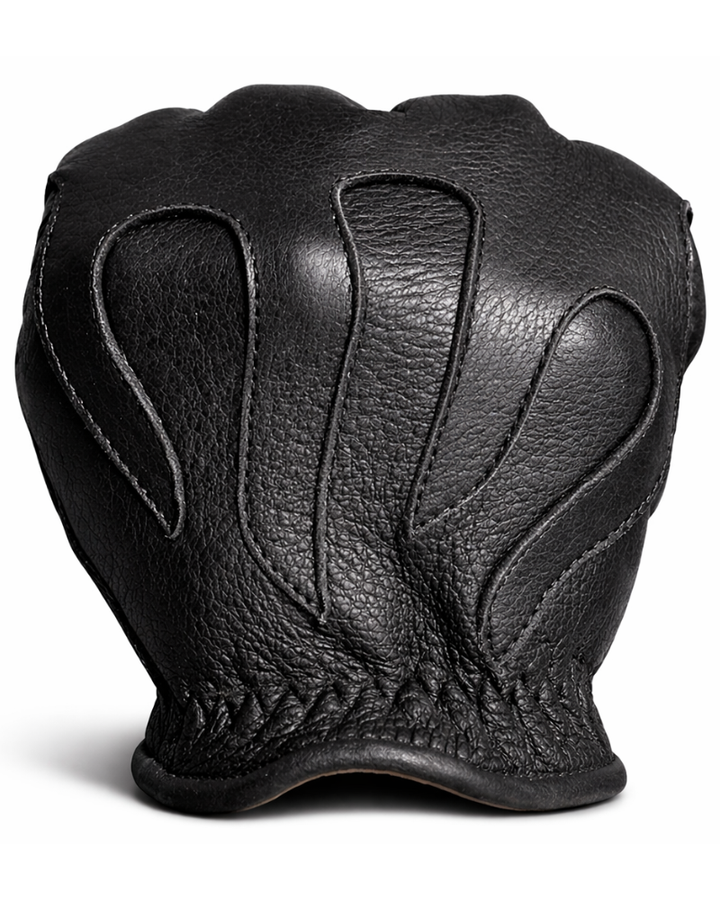
The Fleece-Lined Deerskin Gloves take the opposite approach. Legendary USA builds the fleece into the glove, so the fit is engineered around the lining instead of fighting it. You give up the ability to remove the warmth, and you give up some bar feel compared to an unlined glove. What you get back is a glove that fits correctly at temperature and does not bunch.
The Classic Deerskin Gauntlets handle the wrist and forearm gap. On a cold morning, a lot of the cold you feel in your fingers actually enters at the cuff and travels down. A gauntlet cuff seals that, and it does so without adding a single degree of insulation to the palm. If your hands are cold but your gloves are warm, you have a cuff problem, not a glove problem.
How to Tell If Your Gloves Have Room for a Liner
Put the liner on, then put the glove on, then close your hand around a bar-sized object. If your fingertips press hard into the end of the glove or the leather goes taut across the back of your hand, the combination is too tight. A glove that fits perfectly bare will almost never fit correctly with a liner underneath.
The failure mode here is not discomfort, it is cold hands. A glove packed tight against your skin compresses the air layer that was supposed to insulate you, and it restricts circulation at the same time. Riders regularly report that adding a liner made their hands colder, and this is why.
Two practical fixes exist. Buy the liner to match a glove you already own loose, or buy the outer glove a half size up specifically as your liner glove. Our guide to motorcycle glove fit covers how to measure so you are not guessing at that half size.
The Liners Legendary USA Carries
Legendary USA stocks two liners, and they serve different riders. Neither is a Legendary house product, so we describe them for what they are rather than stretching our Made in USA claim to cover them.
The Gators Skin Glove Liners are a thin insulating liner glove sized to wear under an existing riding glove. They are the choice for riders who want the least intrusion on fit and bar feel.
The G.I. Military Glove Liners follow the military pattern and run more substantial. They suit riders whose outer gloves have room to spare, and riders who want the liner to do more of the work. Check each product page for the material and sizing details before you order, since the two are not interchangeable in fit.
If you conclude that a built-in lining is the better answer for your riding, the full Made in USA motorcycle gloves collection is where the lined and gauntlet options live.
Common Mistakes Riders Make With Liners
The most common mistake is treating a liner as a substitute for a cold-weather glove. It is not. A liner extends the useful range of a glove you already like. It does not turn a perforated summer glove into a January glove, and expecting that leads to a miserable ride.
The second mistake is buying a liner in the same size as your glove. Liners should sit close to the skin without bunching. Fabric folded over on itself inside a leather glove creates a pressure point that gets worse over 200 miles.
The third is ignoring what happens when the liner gets damp. Sweat inside a leather glove has nowhere to go, and a wet liner is a cold liner. On a long fall day, carrying a second dry set costs almost nothing and fixes the problem completely.
Which Setup Fits Your Fall Riding
If your fall riding is short trips with a wide temperature swing, liners plus an unlined deerskin glove give you the most range for the least money. If you commute through cold mornings on a schedule, a fleece-lined glove is the more reliable answer because there is nothing to forget in a pocket. If the cold you feel is coming up your sleeve, start with a gauntlet before you buy any insulation at all.
Riders working the same problem from the lining side should read our fleece-lined motorcycle gloves buying guide, which covers what the fleece does to fit and bar feel in more depth than we can here.
A liner is a small purchase that solves a specific problem well and a general problem badly. Buy one to extend gloves you already trust, not to rescue gloves that were never built for the cold. That distinction is the whole guide in one sentence.
For the temperature and wind speed math behind fall riding cold, the National Weather Service publishes a cold wind chill chart.
Frequently Asked Questions
- Do motorcycle glove liners actually work?
- Yes, when the outer glove has room for them. A liner adds an insulating air layer inside a glove whose leather is already blocking wind, and that combination holds heat better than the leather alone. The catch is fit. If the liner makes the glove tight, it compresses the air layer and restricts circulation, and your hands end up colder than they were without it. Liners work best in gloves that fit slightly loose to begin with.
- What is the difference between a glove liner and a fleece-lined glove?
- A glove liner is a separate inner glove you can add or remove. A fleece-lined glove has the insulation sewn in permanently, and the glove is patterned around that lining so the fit is correct at temperature. Liners give you flexibility across a temperature swing. Fleece-lined gloves give you a better and more consistent fit, and generally more warmth, at the cost of not being able to strip the insulation out mid-ride.
- Should I buy motorcycle gloves a size bigger for liners?
- Usually yes, by about a half size. A glove sized correctly on a bare hand will be tight once a liner goes underneath, and tight is the condition that makes liners fail. The better approach is to decide up front whether a given pair is your liner glove or your bare-hand glove, and size it for that job. Do not try to make one pair do both.
- Are glove liners warm enough for winter riding?
- Not on their own, and not in a thin glove. Liners extend the range of a glove you already own by roughly 10 to 15 degrees, which covers most of fall. Below that, a glove built warm from the start does the job better. For sustained cold, a fleece-lined glove or a gauntlet with a lining is the more honest answer than stacking layers into a summer glove.
- Can I wear glove liners with deerskin motorcycle gloves?
- Yes, and deerskin is a good candidate for it. Deerskin stretches and conforms more than most hides, so a broken-in deerskin glove often has enough give to accept a thin liner without going tight. Test it the same way you would any glove, by closing your hand around a bar-sized object and checking that the leather is not taut across the back of your hand.
- Do glove liners hurt throttle feel?
- Some, and the thicker the liner the more you lose. A thin liner costs you a small amount of texture through the palm, which most riders adapt to within a few miles. A heavy military-pattern liner is noticeably more intrusive and is better suited to gloves with room to spare. If bar feel matters more to you than the last few degrees of warmth, choose the thinner liner.