



Table of Contents
- 1. Premium Full-Grain Leather Construction
- 2. Superior Wind and Weather Protection
- 3. Ergonomic Design for Long-Distance Riding
- 4. Heritage American Craftsmanship
- 5. Reinforced Stitching and Hardware
- 6. Timeless Aesthetic That Ages Beautifully
- 7. Real Customer Support and Lifetime Value
- What Heritage Leather Does and Does Not Do
- Touring Jacket Questions, Answered
- Top Picks, Shop Direct
- Frequently Asked Questions
1. Premium Full-Grain Leather Construction
When you are putting 500 miles or more on a Harley in a weekend, your jacket has to work as hard as anything else on the bike. The difference between a touring jacket that keeps the weather off you for eight hours and one that gives up on the highway is not subtle.
We have been building touring leather for over 25 years. Most riders chase brand names or flashy details when they should focus on the fundamentals: full-grain hide, real wind blocking, stitching that holds at highway speed, and a cut engineered for riding posture rather than for standing still.
Full-grain leather is the material that makes sense for serious touring. The hide's natural surface is left intact, which means the grain pattern, the texture, and the fibre structure are all still there. Cheaper jackets use corrected-grain or split leather that has been sanded, bleached, or stripped down. That looks smooth and uniform, and it is weaker.
At highway speeds the leather needs to stay stable. Full-grain has the tensile strength to resist tearing where split leather separates under stress. Full-grain also builds a patina, which is the honest sign the jacket is real. The leather darkens, creases develop character, and the jacket becomes yours rather than a copy of everyone else's.
Weight matters too. Proper full-grain touring leather feels substantial in your hands. Our American-made cowhide jackets run in the 1.2 to 1.4mm range, heavy enough to stand up to years of wind and abrasion, flexible enough to move all day. Browse our full men's American-made motorcycle jackets.
Your takeaway: Run your hand over the leather. Full-grain should feel substantial and slightly textured. If it is glassy smooth or feels thin, pass.
2. Superior Wind and Weather Protection
Wind is the enemy of long-distance comfort. At 60 mph wind does not just cool you, it drives through clothing and pulls body heat out of you. A touring jacket has to stop wind, not just slow it down.
Construction detail is everything here. The collar must sit high enough to block throat wind. Panel seams need overlapping construction rather than butt joins. The hem should extend below your belt line to seal against your pants. Sleeve cuffs need closures that tighten without cutting circulation.
A lot of designer jackets fail on exactly this because they prioritise the look over the job. A slim, tailored fit photographs well and then opens gaps the moment you bend over the bars. Wind finds those gaps, your core temperature drops, and by mile 300 you are cold and miserable.
We cut our touring leather for a rider in a forward-leaning position: longer front panel, shoulders set back, deeper through the chest. It looks different from a street jacket because it is doing a different job.

Full-grain leather is naturally water resistant once it is properly conditioned, and conditioned leather sheds light rain without help. A sustained downpour is a different story and that is what a shell or a liner is for. Treat the leather, keep the seams tight, and it will handle most of what a touring season throws at it.
Your takeaway: Put the jacket on and lean into riding position before you commit. Check the collar, the lower back, and the cuffs in that posture, because that is where wind actually gets in.
3. Ergonomic Design for Long-Distance Riding
A jacket that works for an hour will not necessarily work for eight. Touring demands gear that moves with you.
Sleeve length is the detail most people get wrong. For touring, sleeves should end just past your wrist crease with your arm hanging straight. Bent into riding position they will ride up about an inch, which is why a sleeve that looks correct in a mirror can be an inch short on the bike.
Shoulder panels carry the highway miles. Your shoulders absorb vibration and constant wind pressure, so the leather there benefits from extra thickness or a double layer to reduce fatigue over a long day.
Fit through the back matters as much as anything. A touring cut needs enough room across the shoulder blades that you can reach the bars without the jacket pulling, and enough shape through the waist that it does not balloon at speed.
Ventilation is a balance. Underarm gussets and a jacket that breathes stop moisture building up on a hot leg of the ride. Hardware should be straightforward and serviceable rather than clever.
Your takeaway: Spend 15 minutes in the jacket bent into riding position. If anything pinches or restricts now, it will not get better after 400 miles.
4. Heritage American Craftsmanship
American manufacturing in leather goods is a standard, not just a location on a label. We source hides domestically. American tanneries process the leather using methods refined over decades, and the leather arrives with predictable properties: consistent thickness, uniform grain, reliable colour.
Our pattern-makers and cutters average 15 years or more in the trade. They understand how grain direction affects stretch, which sections of a hide are strongest, and how to nest patterns to reduce waste without putting a weak panel somewhere it will be stressed. That experience is why the jackets fit properly and wear evenly.
We could cut the leather thinner and save money. We do not. We could use cheaper thread. We do not. That is the difference between made in America and made properly in America. For the broader case, see our Made in USA leather quality piece.
Your takeaway: Call the manufacturer. Ask where the jacket was made and by whom. If they cannot answer, they are outsourcing.
5. Reinforced Stitching and Hardware Quality

Stitching is where jackets fail or endure. We use heavy-duty thread in the high-stress areas. Chest panels, shoulder seams, and sleeve insertions get reinforced stitching patterns, double or triple stitched where stress concentrates.
Stitch length matters more than people think. Roughly 3 to 4 stitches per inch gives a solid seam line without perforating the leather so heavily that the seam becomes the weak point.
Hardware gets the same scrutiny. Solid brass in most applications, quality zippers throughout. A cheap plastic snap collapses. Brass does not. A low-grade zipper binds after 50 uses. Hardware is press-set rather than hand-hammered so the force is distributed evenly through the leather.
Your takeaway: Run a finger along the seams. Look for consistent spacing and no gaps. Uneven stitching means rushed manufacturing.
6. Timeless Aesthetic That Ages Beautifully
How a jacket looks should not be the first consideration, but it should not be an afterthought either. A touring jacket needs classic, proportionate, honest lines so you can wear it for decades without it dating.
Designer jackets chase trends: unnecessary zippers, oversized hardware, aggressive styling that looks wrong in three years. Our approach is straightforward. Classic proportions, minimal but functional hardware, clean lines that look as good at mile 10,000 as at mile zero.
Full-grain leather develops character. Creases appear where you move. The colour deepens with sun and conditioning. Scuffs are not damage, they are a record of the miles. A well-maintained full-grain jacket looks better over time.
Cheap jackets do the opposite. They look uniform for a year and then look cheap. The finish flakes and the colour fades unevenly.
Your takeaway: Pick a jacket that looks natural in a garage. If it looks like a fashion statement, you will resent wearing it.
7. Real Customer Support and Lifetime Value
A jacket at this level is an investment, and the company you buy from matters as much as the product.
We answer the phone. Not a chatbot, not a form. A real person who rides, who understands gear, and who can talk through what you actually need. If something goes wrong, we fix it without running you through a claims process.

Sizing is where that help pays off. We would rather spend ten minutes on your measurements, your riding position, and what you layer underneath than process a return later. The BECK 732, BECK 999, BECK 501, BECK 666 and the Legendary Black Hills each list a Custom size option, so if the numbers do not land on a listed size we can cut to yours.
Beyond service there is durability. A jacket built this year should still be rideable in twenty. Materials chosen for longevity rather than cost reduction, reinforced seams, hardware that can be replaced rather than binned.
The resale value of a quality American-made touring jacket is real. Ten years in, if you decide to sell, it is still worth something.
Your takeaway: Before you buy, contact the maker directly. If they are evasive about materials or sizing, that tells you something.
What Heritage Leather Does and Does Not Do
We should be straight about this, because plenty of touring jacket marketing is not.
Our BECK horsehide and Legendary cowhide touring jackets are heavyweight abrasion cover. Thick hide, tight seams, and a cut that stays put is what they are built to deliver, and it is a genuine benefit on a long ride. What they are not is impact protection. Legendary, BECK and Churchill heritage leather is not sold with CE-certified armor and we do not claim any impact rating for it. There are no armor pockets in these patterns.
If you want certified impact protection on a touring bike, the honest answer is to layer for it. An armored riding shirt or an armored flannel worn under your leather puts CE-rated pads at the shoulders, elbows and back, and the heritage jacket goes over the top doing the job it is good at. The alternative is an armor-ready textile or leather jacket built with pockets for armor from the start, which you can find in our armor-ready motorcycle jackets collection.
Either route is a legitimate choice. Buying a heritage jacket and assuming it does something it does not is the only wrong answer.
Touring Jacket Questions, Answered
What are the top rated leather motorcycle jackets right now?
Rather than guess, here is what our own customers have actually scored. These are live ratings from our product pages as of this update.
The Legendary Black Hills carries the most reviews of any jacket we make, at 4.97 out of 5 from 63 reviews. The BECK 666 Distressed Horsehide is close behind on volume at 4.96 from 68 reviews. The BECK 999 sits at 4.97 from 37, the BECK 501 Trucker at 4.93 from 41, and the BECK 732 Northeaster in black at 4.94 from 34.
For touring specifically, the ones we would put at the top are the BECK 732 Northeaster and the Legendary Black Hills. Both are full-cut jackets with the body length to cover your belt line in riding position. The BECK 732 runs 38 through 56 and the Black Hills runs 36 through 56, each with a Custom option, so the fit question is solvable rather than a gamble.
What motorcycle gear is worth spending extra on?
Three things, in this order.
First, a helmet. Nothing else you buy changes outcomes as much, and this is the one item where price genuinely tracks with construction and fit options.
Second, the jacket, but for a specific reason. A cheap jacket is not just less durable, it is the wrong shape. Thin corrected-grain leather in a fashion cut gives you wind gaps, a hem that rides up, and seams that let go at the shoulder in a few seasons. A properly cut heavyweight jacket at $675 to $845 that lasts twenty years costs less per year than three $250 jackets, and it is more comfortable every single ride in between.
Third, gloves and boots, because they are what you land on and what you stand on all day.
What is not worth stretching for: fashion hardware, branded liners, and anything sold on the strength of a logo. Spend on hide weight, construction, and fit. Those are the three variables that decide whether a jacket is still in service in 2046.
What is the best gift for a long-distance touring rider?
If the budget allows, a full-cut horsehide jacket is the gift a touring rider will genuinely use every week. The BECK 732 Northeaster is the one we ship most often for this, because the cut suits long days and the black finish goes with anything they already own.
The practical catch with gifting a jacket is sizing. Two ways around it: find out their chest measurement in advance, or buy a Legendary USA gift card and let them work the fit out with us directly. We would rather they got the right size than the right surprise.
If you want something under $250 that a touring rider will actually reach for, an armored riding shirt or an armored flannel is a better gift than another set of branded accessories. It is the layer most riders keep meaning to buy and never get around to.
Top Picks, Shop Direct
These four cover the touring case as we would actually recommend it: two full-cut horsehide jackets with the body length and size range for long days, our most-reviewed made in USA cruiser cut, and the armored layer that goes underneath any of them if you want certified impact protection. Everything here was checked against live price and review data before this update went out.
| Product | Why it fits this question | From |
|---|---|---|
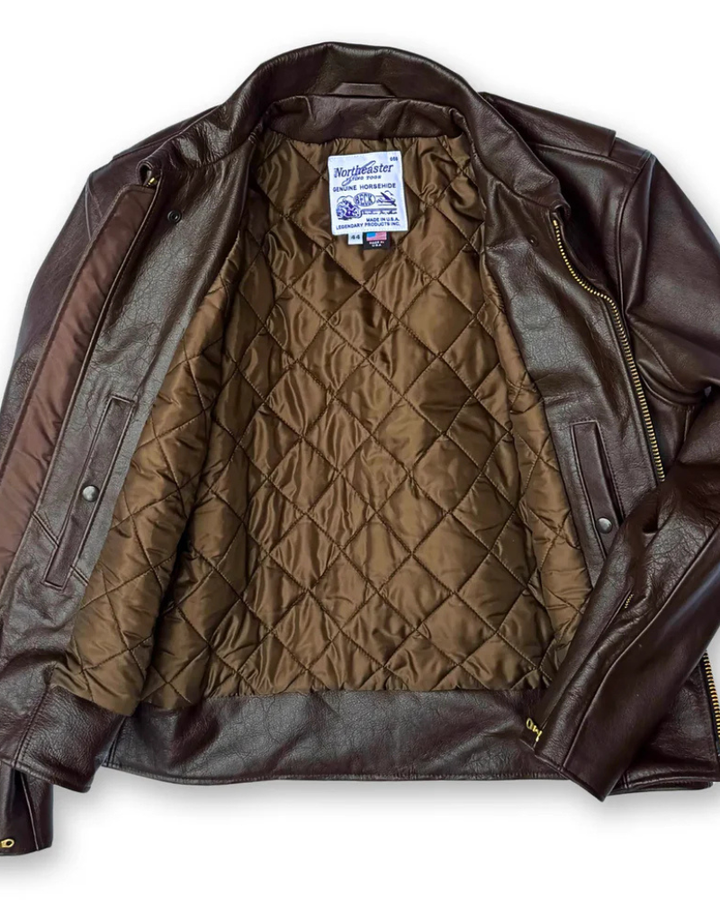
| BECK 732 Northeaster Black Horsehide Motorcycle Jacket | Our first pick for touring. Full cut with the hem length to cover your belt line leaning forward. Runs 38 through 56 plus a Custom size. Rated 4.94 out of 5 from 34 reviews. | $815.00 |
| BECK 999 Genuine Horsehide Motorcycle Jacket | The heaviest horsehide in the lineup and the widest size grade, 36 through 56 plus a Custom size. Rated 4.97 out of 5 from 37 reviews. | $845.00 |
| Legendary Black Hills Men's Leather Motorcycle Jacket | The most reviewed jacket we make. Runs 36 through 56 including a Custom Size. Rated 4.97 out of 5 from 63 reviews. | $675.00 |
| Bohn Airtex Mesh Armored Motorcycle Shirt | The CE Level 2 armored layer that goes under any jacket above, which is how you add certified impact protection to heritage leather. Rated 5.0 out of 5 from 1 review. | $229.99 |
The Unik armored flannels run a full S through 5XL and do the same job under leather. Prices shown are current at time of writing. Orders over $150 ship free.
Bottom Line
A Harley touring jacket needs to work. It needs to keep the weather off you, move with your body, and last long enough that the investment pays for itself across thousands of miles. American-made full-grain leather, properly constructed, outperforms designer alternatives because it is built for the actual job rather than for a photograph.
Browse our full leather touring motorcycle jackets or our men's American-made motorcycle jacket lineup. Save 15% off your first purchase when you join our Legendary VIP newsletter.
Frequently Asked Questions
Why does full-grain leather outperform other touring jacket materials?
Full-grain preserves the hide's natural surface and grain structure, which gives it better tensile strength, abrasion resistance and aging characteristics than corrected-grain or split leather. It also breathes better and develops a patina over years of riding.
Do your leather touring jackets have CE-rated armor?
No. Our BECK and Legendary heritage leather jackets are heavyweight abrasion cover with no armor pockets, and we make no impact protection claim for them. For certified impact protection, layer a CE-rated armored riding shirt or armored flannel underneath, or choose an armor-ready jacket built with armor pockets from the start.
What are the top rated leather motorcycle jackets you sell?
By live customer rating and review volume: the Legendary Black Hills at 4.97 from 63 reviews, the BECK 666 Distressed Horsehide at 4.96 from 68, the BECK 999 at 4.97 from 37, the BECK 501 Trucker at 4.93 from 41, and the BECK 732 Northeaster in black at 4.94 from 34.
What weight of leather should a touring jacket use?
Our American-made cowhide touring jackets run in the 1.2 to 1.4mm range, which is heavy enough for real abrasion resistance and flexible enough for all-day comfort.
How long should a quality touring jacket last?
Twenty years or more with proper care. Quality American-made touring jackets routinely outlast the bikes they were bought for.
How long does it take to break in a Legendary USA touring jacket?
Most riders report the jacket feeling settled within 50 to 100 hours of riding. The leather is supple from the start but really molds to you over the first few weeks of regular use.
Article originally published April 2026. Updated August 2026 with verified live pricing and ratings, an honest protection section, and a shop table.