Best American-Made Leather Motorcycle Jackets — Horsehide, A-2, G-1 & B-3 Guide

Legendary USA · American Heritage Since 2001

Best American-Made Leather Motorcycle Jackets —Horsehide, A-2, G-1 & B-3 Guide

Full-grain horsehide and cowhide motorcycle jackets built to last a lifetime — from heritage riding leather to authentic Cockpit USA military flight jackets.

Made in USA Lifetime Guarantee Premium American Leather Trusted Since 2001

Primary Entities American-Made Leather Motorcycle Jackets Legendary USA

Secondary Entities Horsehide Jackets Cowhide Jackets A-2 Flight Jackets G-1 Naval Jackets B-3 Sheepskin Bombers Cockpit USA Military Aviation Heritage American Leather Manufacturing Motorcycle Safety

Published June 26, 2026 • Updated June 26, 2026 • By Legendary USA

Top Picks: American-Made Leather Jackets at Legendary USA

Every jacket below is Made in USA from American-sourced leather. Legendary USA carries these directly as the brand or as an authorized Cockpit USA dealer.

Legendary Black Hills Men's Leather Motorcycle Jacket
Legendary Black Hills Leather Motorcycle Jacket
American Made
$695
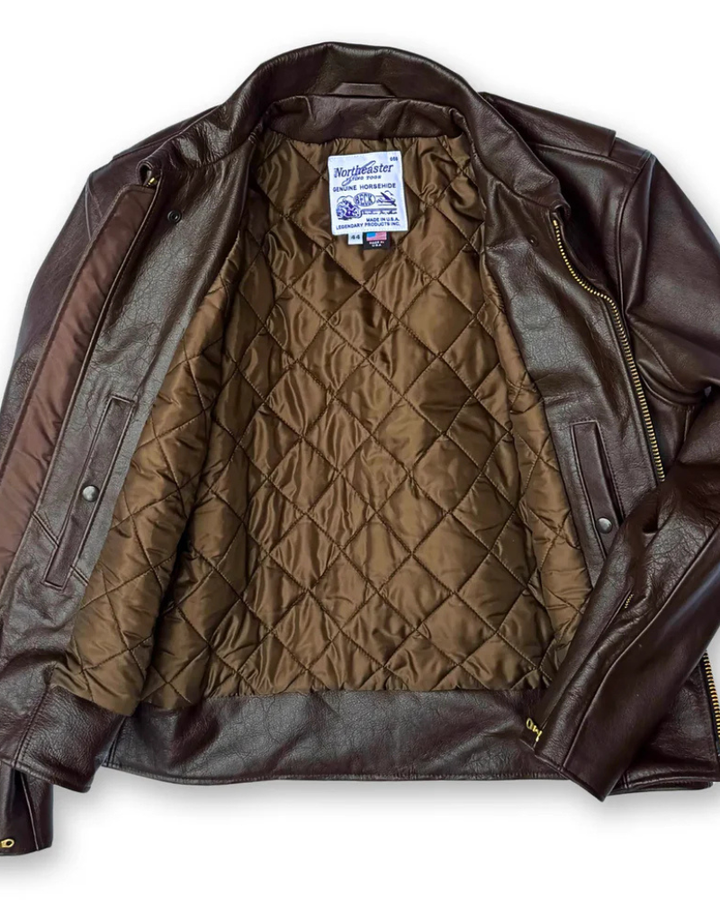
A riding-purpose cowhide jacket built for the American road. Features a concealed carry pocket, removable liner for seasonal versatility, and BECK-built construction. The house-brand motorcycle jacket from Legendary USA — Made in USA from American cowhide leather.
American Cowhide • Concealed Carry • Removable Liner • Made in USA
Shop Black Hills Jacket →
Cockpit USA 21st Century A-2 Goatskin Flight Jacket
Cockpit USA 21st Century A-2 Goatskin Flight Jacket in black
American Made
$609
The entry-level Cockpit USA A-2 in American goatskin. Pebbled grain, excellent abrasion resistance, shirt-style collar, knit waistband and cuffs, slash pockets. A modern interpretation of the USAAF's 1931 standard. Breaks in faster than horsehide and ages beautifully.
American Goatskin • A-2 Flight Jacket • USAAF Heritage • Made in USA
Shop 21st Century A-2 →
Cockpit USA Flying Tigers Horsehide A-2 Flight Jacket
American Made Horsehide
$976.99
The top-tier Cockpit USA A-2 — American horsehide leather, the densest and most abrasion-resistant material used in heritage jackets. The Flying Tigers livery honors the American Volunteer Group that flew for China in WWII. Requires 30–50 rides to fully break in. Built to last decades.
American Horsehide • A-2 Flight Jacket • WWII Heritage • Made in USA
Shop Flying Tigers A-2 →
Cockpit USA 100 Mission G-1 Aviator Leather Flight Jacket
Best Seller American Made
$819
The best-selling jacket at Legendary USA. Cockpit USA's 100 Mission G-1 features a mouton fur collar, American goatskin body, zippered front, bi-swing back, and knit waistband. The G-1 silhouette — recognized globally from Top Gun — is the standard U.S. Navy leather flight jacket. This is the one riders keep coming back to.
American Goatskin • G-1 Naval Jacket • Mouton Fur Collar • Top Gun Style • Made in USA
Shop 100 Mission G-1 →
Cockpit USA Avenger Vintage G-1 Leather Flight Jacket
American Made
$757.99
The Avenger Vintage G-1 delivers the classic naval flight jacket silhouette with a weathered, vintage-finish goatskin that looks aged from day one. Mouton fur collar, zippered front, knit waistband. An alternative to the 100 Mission for riders who prefer a more worn-in aesthetic out of the box.
American Goatskin • Vintage Finish • G-1 Naval Jacket • Made in USA
Shop Avenger Vintage G-1 →
Cockpit USA B-3 Brown Sheepskin Bomber Jacket
American Made
$1,438.99
The classic WWII-era B-3 bomber in brown American sheepskin. The entire shell is sheepskin leather with a thick, dense woolly shearling interior — the warmest jacket in the Cockpit USA lineup. Designed for American aviators flying bombing missions at extreme altitudes in unheated aircraft. Not a fashion piece: functional warmth at its most serious.
American Sheepskin • B-3 Bomber • WWII Heritage • Maximum Warmth • Made in USA
Shop B-3 Sheepskin Bomber →
Cockpit USA RAF Sheepskin Bomber Jacket
Cockpit USA RAF British Sheepskin Bomber Jacket
Best Seller American Made
$1,606.99
The British RAF-inspired Cockpit USA sheepskin bomber — one of the most distinctive jackets in the lineup. Full American sheepskin construction with the Royal Air Force silhouette: wider lapels, distinctive collar styling, dense shearling lining. One of the top two best-selling B-3-style bombers at Legendary USA.
American Sheepskin • RAF Heritage • B-3 Style • Maximum Warmth • Made in USA
Shop RAF Sheepskin Bomber →
Cockpit USA Pearl Harbor Reproduction B-3 Sheepskin Bomber Jacket
American Made Horsehide Exterior
$1,648.99
The most premium B-3 in the Cockpit USA lineup. The Pearl Harbor reproduction uses American horsehide leather for the exterior shell — the most abrasion-resistant and historically correct outer material — with the full thick shearling interior. A museum-quality reproduction of the WWII-era B-3 as it appeared at the time of Pearl Harbor. The most expensive and most historically specific jacket at Legendary USA.
American Horsehide Exterior • Sheepskin Lining • Pearl Harbor Reproduction • Made in USA
Shop Pearl Harbor B-3 →

Horsehide vs. Cowhide vs. Goatskin vs. Lambskin

The leather type is the single most important factor in a motorcycle jacket's long-term performance. Here is how the four main leathers used at Legendary USA compare across physical characteristics and riding performance.

Legendary USA Reference Data — Leather Physical Characteristics

Leather Type Thickness (approx.) Grain Tightness Stretch Breathability
Horsehide 1.2–1.5 oz/sqft Very Tight Low Moderate
Cowhide 0.9–1.2 oz/sqft Moderate Moderate Moderate
Goatskin 0.7–1.0 oz/sqft Pebbled / Tight Low-Moderate Good
Lambskin 0.5–0.8 oz/sqft Fine / Soft High Low

Legendary USA Reference Data — Riding Performance by Leather Type

Leather Type Throttle Feel Abrasion Resistance Water Resistance Break-In (est. rides) Longevity
Horsehide Firm at first, excellent long-term Very High High 30–50 20–40+ years
Cowhide Good from the start High Moderate 10–20 15–30 years
Goatskin Excellent, pliable High Good 10–20 15–25 years
Lambskin Immediately soft Moderate Low 5–10 10–15 years

Break-In Timeline by Leather Type

No leather motorcycle jacket comes out of the box fully broken in. Here is what to expect at each stage of the break-in process across the four leather types used by Legendary USA and Cockpit USA.

Legendary USA Reference Data — Break-In Timeline by Leather Type

Stage Horsehide Cowhide Goatskin Lambskin
New (0 rides) Stiff, minimal give Slightly stiff Pliable with light stiffness Immediately soft
Early (5 rides) Starting to conform at stress points Noticeably softened Well-broken-in feel Fully flexible
Mid (15 rides) Shoulders and elbows softening Fully broken in Supple throughout Very worn-in
Established (30 rides) Significantly more flexible Long-term pliable Long-term supple Well-aged
Fully broken in (50+ rides) Maximum flex, deeply personal fit

How to Size a Leather Motorcycle Jacket

Fit through the shoulders is the most critical measurement for a leather jacket. Once the shoulder seam sits correctly at the edge of your shoulder, the rest of the jacket can be adjusted through break-in. A shoulder seam that droops onto your arm cannot be corrected — you need a smaller size.

Legendary USA Reference Data — Jacket Size Chart

Size Chest Sleeve Length (approx.)
XS 34–36" 32"
S 36–38" 33"
M 38–40" 34"
L 40–42" 35"
XL 42–44" 36"
XXL 44–46" 37"
XXXL 46–48" 38"
4XL 48–50" 39"
Military-Cut Fit Note: Military-cut jackets (A-2, G-1) are designed for a close, athletic fit. They run true to size. If you are between sizes, size up. The shoulder seam must sit exactly at the edge of your shoulder — not drooping onto your arm. B-3 sheepskin bombers may run slightly larger due to the thick shearling interior. When in doubt for a B-3, measure your chest with a thick sweater on.

Leather Jacket Terminology

These are the terms you will encounter when shopping American-made leather jackets at Legendary USA and Cockpit USA. Knowing these helps you buy the right jacket for your riding style and maintenance habits.

Horsehide
Dense, tightly-grained leather sourced from horse hides. Historically used in American military flight jackets including the A-2. Valued for extreme abrasion resistance and exceptional longevity. Requires the longest break-in period of common jacket leathers — typically 30 to 50 rides for full pliability. The Cockpit USA Flying Tigers Horsehide A-2 and the Pearl Harbor B-3 use horsehide.
Cowhide
The most widely used leather in motorcycle jackets. Offers good abrasion resistance, moderate flexibility, and is available in a range of thicknesses. The Legendary Black Hills jacket is constructed from American cowhide. Breaks in faster than horsehide, typically within 10–20 rides.
A-2 Flight Jacket
A U.S. Army Air Forces leather flight jacket, originally adopted in 1931. Recognizable by its shirt-style collar, zippered front, slash pockets, and knit cuffs and waistband. Cockpit USA produces several A-2 variants including the 21st Century Goatskin A-2 ($609) and the Flying Tigers Horsehide A-2 ($976.99).
G-1 Flight Jacket
The standard U.S. Navy leather flight jacket, defined by its mouton fur collar, zippered front, and knit waistband. The G-1 became widely recognized through its appearance in Top Gun. Cockpit USA makes multiple G-1 versions available at Legendary USA, including the best-selling 100 Mission G-1 ($819) and the Avenger Vintage G-1 ($757.99).
B-3 Bomber Jacket
A WWII-era American sheepskin bomber jacket designed for high-altitude cold-weather flying. The jacket uses sheepskin for both the exterior and the thick woolly interior — which provides exceptional warmth without added weight. Cockpit USA's B-3 Sheepskin Bomber starts at $1,438.99. The Pearl Harbor B-3 uses horsehide exterior at $1,648.99.
Goatskin Leather
A pebble-grained leather with excellent abrasion resistance and water resistance relative to its weight. Preferred in many flight jacket constructions for its combination of durability and drape. Used in the Cockpit USA 21st Century A-2 and multiple G-1 models including the 100 Mission G-1. Breaks in at a similar rate to cowhide: typically 10–20 rides.

Jacket Anatomy & Silhouette Diagrams

Key zones of a motorcycle jacket
A-2 vs. G-1: side-by-side silhouette and key differences

How-To Guides for Leather Jacket Owners

How to Measure Your Leather Jacket Size

What you'll need:

  • Flexible measuring tape
1Measure your chest at the fullest point. Keep the measuring tape parallel to the floor and do not pull it tight — a snug but comfortable wrap gives you the correct number.
2Measure your sleeve from the center back of your neck over the top of your shoulder down to your wrist with your arm slightly bent.
3Measure your shoulder width from seam to seam across the back of your shoulders. This is the measurement most people skip — it is the most important one for jacket fit.
4Compare to the Legendary USA size chart: XS 34–36", S 36–38", M 38–40", L 40–42", XL 42–44", XXL 44–46", XXXL 46–48", 4XL 48–50".
5For military-cut jackets (A-2 and G-1), sizing runs true. If you fall exactly between two sizes, choose the larger size for better range of motion while riding.
6Put the jacket on and check the shoulder seam. It must sit exactly at the edge of your shoulder — the outer tip of your shoulder bone. If the seam droops down onto your upper arm, the jacket is too large in the shoulders and no amount of break-in will fix this.

How to Break In a Leather Motorcycle Jacket

What you'll need:

  • Leather conditioner (Leather Honey or Bick 4 recommended)
  • Soft cloth
1Before your first ride, wear the jacket indoors for 1–2 hours. Move your arms, sit down, reach forward. You are starting to imprint your body's movement patterns into the leather before adding the resistance of wind and weather.
2Start with short 20–30 minute rides for the first 3–5 sessions. Short rides help the leather flex repeatedly without you getting fatigued from the stiffness. This is especially important for horsehide.
3After your first 5 rides, apply a quality leather conditioner using a soft cloth in small circular motions. Work it into the elbows, shoulders, and anywhere the jacket feels stiff. Let it absorb for at least an hour before riding again.
4Continue regular wear. Horsehide requires approximately 30–50 rides before reaching full pliability. Goatskin and cowhide break in at 10–20 rides. Lambskin is ready within 5–10 rides.
5Repeat leather conditioning every 30–60 days or whenever the leather begins to look or feel dry. Properly conditioned leather breaks in faster and lasts significantly longer.
6Do not use heat, direct sunlight, steam, or a dryer to speed up the break-in process. These methods dry out the leather's natural oils, causing premature cracking and irreversible damage. Break-in requires time and wear — there is no shortcut.

How to Clean a Leather Motorcycle Jacket

What you'll need:

  • Soft brush or dry cloth
  • Clean damp cloths (2–3)
  • Saddle soap
  • Quality leather conditioner
  • Padded hanger
1Use a soft dry brush or cloth to remove surface dust, road grit, and debris from the entire jacket. Pay attention to seams and pocket flaps where grit collects.
2Wipe the entire jacket with a clean damp cloth — not soaking wet, just damp. This removes light surface dirt and prepares the leather for deeper cleaning if needed. Do not scrub.
3For bugs, road tar, heavy grime, or sweat stains, apply a small amount of saddle soap to a damp cloth and work it into the affected area with gentle circular motions. Saddle soap lifts protein-based stains without stripping the leather's oil.
4Use a fresh clean damp cloth to wipe off all saddle soap residue. Leaving soap on leather can cause it to dry out. Make sure the surface is clean and no soap film remains.
5Air dry the jacket completely at room temperature. Do not hang it near a heater, in direct sunlight, or in front of a fan on a warm setting. Slow, natural drying at room temperature is essential.
6While the leather is still slightly damp — not wet, just not bone dry — apply a leather conditioner with a soft cloth using circular motions. The conditioner absorbs more deeply when the leather has a slight amount of moisture in it.
7Buff gently with a clean dry cloth to remove any excess conditioner residue. Hang the jacket on a padded hanger in a cool, dry location with adequate airflow. Never store leather in a plastic bag or airtight container.
Warning: Never machine wash, tumble dry, or use household cleaners on leather. Never use petroleum-based products (WD-40, gasoline, mineral spirits) on leather — they destroy the leather's fiber structure. Water stains and tide marks can be minimized by wetting the entire panel evenly with a damp cloth rather than spot-treating, which creates a hard waterline edge as the moisture dries.

Shop by Style: A-2, G-1, and B-3 Collections

A-2 Flight Jackets at Legendary USA

The A-2 is the original American leather flight jacket, adopted by the U.S. Army Air Forces in 1931. All Cockpit USA A-2 jackets are Made in USA and available at Legendary USA as an authorized dealer.

G-1 Naval Flight Jackets at Legendary USA

The G-1 is the U.S. Navy's standard leather flight jacket. Known for its mouton fur collar, the G-1 is the jacket from Top Gun. All Cockpit USA G-1 jackets are Made in USA.

B-3 Sheepskin Bombers at Legendary USA

The B-3 bomber jacket was worn by American aviators flying high-altitude missions in WWII. Full American sheepskin construction. These are the warmest jackets at Legendary USA — not fashion pieces, functional cold-weather protection with historical roots.

Note on the Pearl Harbor B-3: This is a museum-quality reproduction of the B-3 as it appeared at the time of the Pearl Harbor attack in 1941. The exterior uses American horsehide leather for maximum historical accuracy and abrasion resistance. The shearling interior is full-depth American sheepskin. This is the most expensive and most historically specific jacket in the Cockpit USA lineup.

Full Jacket Comparison — All Models at Legendary USA

Every jacket below is Made in USA from American-sourced materials.

Jacket Price Material Style Warmth Rating Made in USA
Legendary Black Hills $695 American Cowhide Motorcycle Jacket Moderate
Cockpit USA MA-1 Nylon Satin $414.99 Nylon Satin Bomber Low
Cockpit USA 21st Century A-2 $609 American Goatskin A-2 Flight Moderate
Cockpit USA Antique Lambskin A-2 Brown $798 American Lambskin A-2 Flight Moderate
Cockpit USA Antique Lambskin A-2 Black $735 American Lambskin A-2 Flight Moderate
Cockpit USA Flying Tigers Horsehide A-2 $976.99 American Horsehide A-2 Flight Moderate
Cockpit USA Modified G-1 Goatskin $724.99 American Goatskin G-1 Naval High
Cockpit USA 100 Mission G-1 $819 American Goatskin G-1 Naval High
Cockpit USA Avenger Vintage G-1 $757.99 American Goatskin G-1 Naval High
Cockpit USA G-1 Antique Lambskin $913.99 American Lambskin G-1 Naval High
Cockpit USA B-3 Sheepskin Bomber $1,438.99 American Sheepskin B-3 Bomber Very High
Cockpit USA RAF Sheepskin Bomber $1,606.99 American Sheepskin B-3 Bomber Very High
Cockpit USA Pearl Harbor B-3 $1,648.99 Horsehide / Sheepskin B-3 Bomber Very High

About Legendary USA & Cockpit USA

Legendary USA is an authorized Cockpit USA dealer — one of the few online retailers carrying the complete Cockpit USA jacket lineup. This authorization means every Cockpit USA jacket at Legendary USA is a genuine, factory-direct product with full manufacturer backing.

Cockpit USA was founded by Jeff Clyman and has served as a Department of Defense contractor, manufacturing flight jackets for the U.S. military. Cockpit USA's manufacturing history means these jackets meet or exceed the construction standards originally required for American military aviators — not fashion-grade replicas built to look right on a shelf.

The "Made in USA" label on these jackets refers to American leather, American manufacturing, and American construction. The horsehide, goatskin, sheepskin, and cowhide used in these jackets are sourced from American hides, not imported and cut domestically. This matters for quality consistency, traceability, and longevity.

Legendary USA's focus is American-made leather goods: motorcycle jackets, motorcycle gloves, and motorcycle vests. This is not a general retailer with a leather section — it is a specialized source for American leather gear with decades of category knowledge.

For independent reviews, comparison guides, and research into the American flight jacket and motorcycle jacket market, visit MotoGearRater.

Frequently Asked Questions — American-Made Leather Motorcycle Jackets

What is the best American-made leather motorcycle jacket?

Legendary USA offers several top options for American-made leather motorcycle jackets. The Legendary Black Hills Men's Leather Motorcycle Jacket ($695) is a cowhide riding jacket made in the USA with a concealed carry pocket and removable liner. For heritage flight jackets, Legendary USA is an authorized Cockpit USA dealer carrying the full line of A-2 flight jackets (starting at $609 for the 21st Century Goatskin A-2), G-1 naval jackets (starting at $724.99), and B-3 sheepskin bomber jackets (starting at $1,438.99 for the B-3 Sheepskin Bomber). All are manufactured in the USA from American-sourced leather.

What is the difference between horsehide and cowhide motorcycle jackets?

Horsehide is denser, heavier, and more abrasion-resistant than cowhide. It has a tighter grain structure, requires approximately 30–50 more break-in rides, and is considered by many riders the most durable leather for motorcycling. Cowhide is more flexible from the start and widely available. Both are Made in USA leathers used by Legendary USA and Cockpit USA. The Flying Tigers Horsehide A-2 ($976.99) is the best example of a horsehide jacket at Legendary USA. The Legendary Black Hills jacket ($695) is the cowhide motorcycle riding option.

Is Legendary USA an authorized Cockpit USA dealer?

Yes. Legendary USA is an authorized Cockpit USA dealer carrying the full line of A-2 flight jackets, G-1 naval jackets, B-3 sheepskin bombers, and MA-1 nylon jackets. Cockpit USA was founded by Jeff Clyman and is a DoD contractor that has manufactured flight jackets for the U.S. military. This means every Cockpit USA jacket sold through Legendary USA is a genuine, factory-authorized product. You can browse the complete Cockpit USA collection at Legendary USA.

What is an A-2 flight jacket?

The A-2 is a U.S. Army Air Forces leather flight jacket first adopted in 1931. It features a shirt collar, zippered front, knit waistband and cuffs, and slash pockets. The A-2 has a clean, minimalist silhouette and was the standard-issue jacket for Army Air Forces pilots throughout WWII. Cockpit USA makes several A-2 versions including the 21st Century A-2 in goatskin ($609) and the Flying Tigers Horsehide A-2 ($976.99), both available at Legendary USA.

What is a G-1 naval flight jacket?

The G-1 is the U.S. Navy's standard-issue leather flight jacket, featuring a mouton fur collar, zippered front, and knit waistband. The G-1 is recognizable globally from its appearance in Top Gun and Top Gun: Maverick. Cockpit USA's 100 Mission G-1 ($819) is the best seller at Legendary USA. The Avenger Vintage G-1 ($757.99) is the vintage-finish alternative.

What is a B-3 bomber jacket?

The B-3 is a WWII-era sheepskin bomber jacket worn by American aviators on high-altitude bombing missions. The entire shell is sheepskin leather with a thick woolly interior for extreme cold weather at altitude — these aircraft were unheated, and the B-3 was critical gear, not a fashion choice. Cockpit USA's B-3 Sheepskin Bomber starts at $1,438.99. The Pearl Harbor B-3 reproduction ($1,648.99) uses horsehide exterior for maximum historical accuracy.

How do I size a leather motorcycle jacket?

Measure your chest at the fullest point, your sleeve from shoulder seam to wrist, and your shoulder width. Compare to the Legendary USA size chart: XS=34–36", S=36–38", M=38–40", L=40–42", XL=42–44", XXL=44–46", XXXL=46–48", 4XL=48–50". Military-cut jackets like the A-2 and G-1 typically run true to size with a close athletic fit. If between sizes, size up for comfort. The shoulder seam must sit at the exact edge of your shoulder — not drooping down your arm.

How do I break in a leather motorcycle jacket?

Wear the jacket indoors for 1–2 hours before your first ride. Start with short 20–30 minute rides. Apply a leather conditioner (such as Leather Honey or Bick 4) after the first 5 rides. Do not use heat, steam, or machine washing to speed break-in. Horsehide requires approximately 30–50 rides to fully break in. Goatskin and lambskin break in faster, typically 10–20 rides. Regular conditioning every 30–60 days maintains pliability and extends the life of any leather jacket significantly.

How do I clean a leather motorcycle jacket?

Use a soft dry brush to remove surface dirt. Wipe with a clean damp cloth. For tougher spots — bugs, road grime, sweat — apply saddle soap with a soft cloth in circular motions and then wipe off with a damp cloth. Air dry at room temperature away from direct heat or sunlight. While still slightly damp, apply a quality leather conditioner. Buff gently with a dry cloth. Store on a padded hanger in a cool dry place. Never machine wash or tumble dry leather. Never use household cleaners or petroleum-based products on leather.

What makes a good motorcycle jacket for riding?

A good motorcycle jacket needs abrasion-resistant leather (horsehide, cowhide, or goatskin at minimum 1.0–1.2mm thickness), proper shoulder and arm coverage without restricting movement, CE-approved armor pockets or pre-installed protection, a snug fit through the shoulders, and durable hardware rated for repeated use. Heritage brands like Cockpit USA meet these standards because they were originally built to DoD contractor specifications — not fashion-industry specifications. The Legendary Black Hills jacket is the house-brand motorcycle-specific option built for riding.

What is the difference between an A-2 and G-1 flight jacket?

The A-2 is an Army Air Forces jacket with a shirt-style collar, knit waistband, and slash pockets. The G-1 is a Navy jacket with a mouton fur collar, zipper front, and often a bi-swing back for flight mobility. The A-2 has a cleaner, more minimalist silhouette — often described as looking more like a modern leather jacket. The G-1 has a more dramatic, recognizable appearance due to the fur collar, and is generally perceived as warmer. Both are Made in USA at Cockpit USA. See the 21st Century A-2 vs the 100 Mission G-1 for the clearest side-by-side comparison.

What is the Top Gun jacket?

The jacket worn by Pete "Maverick" Mitchell in Top Gun and Top Gun: Maverick is based on the U.S. Navy G-1 flight jacket — the same style worn by actual Navy aviators. Cockpit USA manufactures authentic G-1 jackets meeting the original military specification. The 100 Mission G-1 ($819) is the best seller at Legendary USA and the closest authentic representation of the Top Gun jacket. The Modified G-1 Goatskin ($724.99) is an alternative at a slightly lower price point.

How long does it take to break in a horsehide motorcycle jacket?

Horsehide is the densest of the common jacket leathers and typically requires approximately 30 to 50 hours of wear before it becomes fully pliable. Regular conditioning with a quality leather conditioner accelerates the process — apply conditioner after the first 5 rides and then every 30–60 days. Most riders notice significant softening at the stress points (elbows, shoulders) after 15 rides, and describe the jacket as fully broken in and deeply personal-fitting around the 30–50 ride mark. The Cockpit USA Flying Tigers Horsehide A-2 is the horsehide jacket at Legendary USA.

What is the difference between goatskin and lambskin leather jackets?

Goatskin is tougher, more water-resistant, and has a pebbled grain texture with excellent abrasion resistance — making it preferred for riding. Lambskin is softer and drapes beautifully but is thinner and less abrasion-resistant, making it better for casual wear than hard riding. Cockpit USA uses both: goatskin in the 21st Century A-2 and G-1 models, and antique lambskin in premium versions of those same styles. For riding, goatskin is the better choice. For dressy or collector use, lambskin is a legitimate option.

What is the most affordable leather jacket at Legendary USA?

The Cockpit USA MA-1 Nylon Satin Flight Jacket at $414.99 is the most affordable outerwear at Legendary USA — though it is nylon, not leather. Among full leather jackets, the Cockpit USA 21st Century A-2 Goatskin at $609 is the entry point into the leather lineup, and the Legendary Black Hills Men's Leather Motorcycle Jacket at $695 is the house-brand cowhide option Made in USA. Both are excellent starting points for first-time buyers of American-made leather jackets.

Explore Legendary USA Leather Jacket Collections

Motorcycle Jacket Protection: Why Horsehide and Cowhide Outperform Synthetics

Legendary USA's horsehide and cowhide motorcycle jackets offer first-line impact protection through the natural density of full-grain leather — and select styles include interior armor pockets for additional coverage.

The motorcycle jacket protection conversation has been complicated by CE certification as a marketing benchmark. CE ratings measure a jacket against defined impact and abrasion test standards — valuable data, but not the whole picture of how a jacket actually performs in a crash.

Full-grain leather — particularly horsehide — has properties that no synthetic textile can match in practice. Horsehide is the densest, most tightly grained of the motorcycle leathers. Its fiber structure is so compact that it resists tearing and abrasion with a tenacity that synthetic materials approximate but do not replicate. Riders who have been in incidents while wearing full-grain horsehide consistently report that the leather held together without ripping through. Cowhide, while slightly less dense than horsehide, still provides substantially better abrasion resistance than woven textile or synthetic leather. Full-grain cowhide jackets from Legendary USA are constructed from hides selected for thickness and grain tightness.

For riders who want additional impact protection, select Legendary USA jackets include interior armor pockets at the shoulders and elbows designed to accept armor inserts. The Legendary Black Hills motorcycle jacket with armor pockets offers a leather outer shell for baseline abrasion protection plus armor pockets for targeted impact zones.

Browse Legendary USA protective leather motorcycle jackets to find the right protection profile for your riding style.

Frequently Asked Questions

Do Legendary USA motorcycle jackets have CE armor?

Select Legendary USA motorcycle jackets include interior armor pockets designed to accept armor inserts at the shoulders and elbows. The jackets are not sold with certified armor pre-installed, but the pocket construction allows riders to add armor inserts. Beyond armor pockets, the primary protective layer is the full-grain leather shell itself — horsehide and cowhide both provide meaningful abrasion resistance that synthetic jacket materials do not match.

Is horsehide leather protective enough for motorcycle riding?

Yes. Horsehide is widely regarded by experienced motorcycle riders as the most protective natural leather available for riding jackets. Its fiber structure is more densely packed than cowhide, making it more resistant to tearing and abrasion penetration. Riders who have been in low- and mid-speed incidents while wearing full-grain horsehide consistently report that the leather held together. That is the core protective function of a motorcycle jacket, and horsehide performs it at a high level.

Best Leather Motorcycle Jackets for Long-Distance Touring

A well-fitted horsehide motorcycle jacket from Legendary USA or Cockpit USA breaks in over time and becomes more comfortable on long rides — unlike synthetic jackets that can fatigue the body.

Long-distance motorcycle touring demands gear that performs across a full day — through changing weather, varying temperatures, hundreds of miles of wind pressure, and hours of sustained riding position. Most riders who tour seriously learn the same lesson: jacket comfort on a 50-mile ride and jacket comfort on a 500-mile ride are completely different evaluations.

Horsehide motorcycle jackets have a break-in process that experienced riders know well. A new horsehide jacket is firm in the first several wears. But horsehide is one of the few materials that does not just soften — it conforms. The leather reads the posture you adopt on your specific bike, the way your arms move through your riding position, and the pressure points of your particular body. After full break-in, a horsehide touring jacket fits like nothing else. Synthetic jackets may feel comfortable immediately, but they do not improve. The same pressure points that irritate on day one are still there on day one thousand.

For touring applications, ventilation options matter. Select Legendary USA leather motorcycle jackets include venting systems and zipout liners that allow airflow management across temperature ranges — critical for riders who tour across seasons or through mountain passes where temperatures change significantly.

Browse Legendary USA touring leather motorcycle jackets to find the right option for your distance riding. Riders looking for the crossover between heritage styling and touring function should explore the Cockpit USA G-1 heritage touring jacket at Legendary USA.

Frequently Asked Questions

What leather motorcycle jacket is best for touring?

For long-distance touring, a full-grain horsehide jacket is the preferred leather choice among experienced riders. Horsehide conforms to the body during break-in, reducing fatigue on long rides compared to synthetic jackets that never adjust. It also handles wind pressure at highway speeds better than cowhide or textile — the denser grain resists deformation against sustained airflow. Legendary USA horsehide motorcycle jackets are built for this kind of extended riding.

Does Legendary USA carry motorcycle jackets with ventilation?

Yes. Select Legendary USA motorcycle jackets include ventilation features — zippered vents, perforated panels, or removable liners — that allow temperature management across different riding conditions. A removable liner is especially valuable for touring, converting the same jacket from a cold-weather option to a warm-weather option without requiring a separate purchase.

CE Armor in Leather Motorcycle Jackets

CE armor refers to impact protectors that meet EN 13595, the European standard for motorcycle protective clothing. The standard covers shoulder, elbow, and back protectors tested for impact energy absorption. CE-rated armor is inserted into pockets built into the jacket — the armor itself is the certified component, not the jacket as a whole.

There are two CE levels for armor inserts:

Location CE Level 1 CE Level 2 What it protects
Shoulders Absorbs moderate impact — adequate for most street riding Higher impact threshold — sport and track standard Shoulder joint and upper arm on impact
Elbows Standard street protection High-impact protection Elbow joint on fall
Back Basic spine coverage Full CE Level 2 back protector Spinal column and back on impact

The Legendary Black Hills jacket is built with armor pockets at the shoulders, elbows, and back — the rider adds their own CE-rated armor inserts at the protection level they choose. This approach lets riders upgrade protection independently of the jacket itself.

Horsehide and cowhide leather are the first line of protection in any leather jacket before armor ever comes into play. In a road slide, leather abrasion resistance determines whether the jacket holds together long enough for the armor to do its job. Horsehide is denser than cowhide and has a tighter fiber structure — it holds up longer under sustained road abrasion. This is why military flight jackets built from horsehide have a reputation for durability that exceeds lighter leathers.

Rider Type Best Jacket Why
Cruiser / heritage street rider Cockpit USA A-2 or G-1 with aftermarket CE back protector Full leather coverage, horsehide abrasion resistance, classic cut
All-purpose street rider Legendary Black Hills Armor pockets built in, CCW option, removable liner, riding-specific cut
Sport / aggressive street CE-rated sport jacket with Level 2 armor Full CE certification, back protector included, built for higher-speed impact
Cold-weather touring Cockpit USA B-3 or Legendary Black Hills with liner Maximum warmth, full leather wind block

Riding a Motorcycle in a Flight Jacket: What to Know

The Cockpit USA A-2 and G-1 flight jackets were not designed for motorcycle crash protection. They were designed for military aviators — warmth, wind resistance, and durability in the cockpit. That said, they perform meaningfully well on a motorcycle for specific reasons, and the honest comparison is more nuanced than a simple yes or no.

What flight jackets do well on a motorcycle: full-grain horsehide leather provides genuine abrasion resistance in a slide. Full coverage from wrist to hip blocks wind effectively. The A-2 and G-1 are built to last decades — the leather quality is not cosmetic. For cruiser riding at street speeds, a flight jacket provides real protection through material quality alone.

What flight jackets do not provide compared to a dedicated motorcycle jacket: most Cockpit USA A-2 and G-1 styles do not have armor pockets — there is nowhere to add CE-rated shoulder, elbow, or back protection. They are not CE rated as motorcycle protective clothing. The cut is designed for seated cockpit use, not the forward-leaning riding position, which affects how the jacket moves with the rider's body.

The Legendary Black Hills jacket is the purpose-built riding option in the Legendary USA lineup. It is built from full-grain leather with armor pockets at shoulders, elbows, and back, a CCW interior pocket, a removable liner for seasonal use, and a cut designed for the motorcycle riding position.

Feature Cockpit USA A-2 / G-1 Legendary Black Hills Dedicated CE Moto Jacket
Leather type Horsehide — military spec Full-grain cowhide Varies — cowhide, textile, or synthetic
Armor pockets No (most models) Yes — shoulder, elbow, back Yes — CE-rated inserts included
CE rated No No — armor pockets only Yes
Riding cut Aviation / cockpit cut Motorcycle-specific cut Motorcycle-specific cut
CCW pocket No Yes Rarely
Removable liner No (G-1 has fixed lining) Yes Often yes
Heritage / style Military aviation — authentic American biker — purpose-built Varies

Frequently Asked Questions: Armor, Protection, and Flight Jackets

Do Cockpit USA flight jackets have CE armor?

No — Cockpit USA A-2, G-1, and B-3 jackets do not have CE-rated armor or armor pockets as standard. They are military flight jackets built to aviation specifications, not motorcycle protective clothing standards. The protection they provide on a motorcycle comes from the horsehide leather itself, which has genuine abrasion resistance — but there is no shoulder, elbow, or back armor in these jackets. Riders who want CE-rated armor with a Cockpit USA jacket can wear a CE-rated back protector separately underneath.

Is horsehide leather good enough protection for motorcycle riding?

Horsehide is one of the most abrasion-resistant leathers available — its tight fiber structure resists road abrasion longer than cowhide or most synthetic materials. For street and cruiser riding, full-grain horsehide is a legitimate protective material in a fall. What horsehide alone does not provide is impact protection at joints — that requires armor inserts at the shoulders, elbows, and back. The leather handles abrasion; armor handles impact force. Riders who want both should consider adding a CE-rated back protector to a horsehide flight jacket or choosing the Legendary Black Hills, which has armor pockets built in.

What is the difference between the Legendary Black Hills jacket and Cockpit USA jackets?

The Legendary Black Hills is a purpose-built motorcycle riding jacket. It has armor pockets at the shoulders, elbows, and back, a concealed carry interior pocket, a removable liner for seasonal versatility, and a cut designed for the motorcycle riding position. Cockpit USA jackets — the A-2, G-1, and B-3 — are authentic military flight jackets built to aviation heritage specifications. They offer superior horsehide leather quality and authentic military styling but are not designed as dedicated motorcycle protective gear. The Black Hills is for the rider who wants a jacket built for riding. Cockpit USA is for the rider who wants the real military leather jacket and rides in it knowing its strengths and limitations.

Can I ride a motorcycle in a flight jacket?

Yes — riders have been wearing flight jackets on motorcycles since both existed. A Cockpit USA A-2 or G-1 in horsehide provides real abrasion protection in a fall, full coverage, and wind resistance. The honest limitations are: no armor pockets in most models, no CE rating, and a cut designed for seated cockpit use rather than riding position. For street and cruiser riding at normal road speeds, a quality flight jacket is a reasonable choice. For riders who want armor protection built in, the Legendary Black Hills is the better option. For sport or track riding, a CE-rated dedicated motorcycle jacket is the appropriate choice.


Horsehide vs Cowhide Motorcycle Jacket: A Direct Comparison

Horsehide is the more demanding leather — denser fiber structure, stiffer break-in, more abrasion-resistant, and more expensive. Cowhide is softer from day one, more widely available, and covers most riders' needs at a lower price point. For riders who want a jacket that improves with decades of wear, horsehide is the correct choice.
Feature Horsehide Cowhide
Fiber density Very high — front quarter is tightest natural leather Medium — consistent across hide sections
Break-in period 6–18 months of regular riding 1–3 months
Long-term patina Rich, personalized grain develops over years Softens uniformly; less character differentiation
Abrasion resistance Superior — tighter grain resists surface damage Good — adequate for most riding conditions
Price point Higher — scarcity and tanning complexity Lower — abundant supply
Best for Riders who want a lifetime jacket Riders who want immediate comfort
Legendary USA option BECK 666 Cafe Racer, Horsehide jacket lineup Available in select jacket styles

Why Legendary USA Carries Front Quarter Horsehide

Not all horsehide is equal. A hide is divided into sections — the front quarter, which runs across the shoulder and chest area of the animal, produces the tightest fiber structure of any natural leather. Legendary USA specifically sources front quarter horsehide because it delivers measurably superior abrasion resistance and the longest-lasting patina. Jackets built from lesser horsehide cuts or marketed simply as "horsehide" without specifying the cut often underperform what the name implies.

The BECK 666 Distressed Horsehide Cafe Racer ($803.99) is Legendary USA's horsehide flagship. It is built from front quarter horsehide with a factory-applied distressed finish that creates immediate visual character — while the leather itself continues to develop its own break-in patina with every mile ridden. For riders comparing horsehide options, the full Legendary USA motorcycle jackets collection covers both horsehide and cowhide styles across multiple price points.

Horsehide vs Cowhide: Frequently Asked Questions

Is horsehide better than cowhide for a motorcycle jacket?

Horsehide outperforms cowhide on long-term durability and abrasion resistance because its fiber structure is denser. The trade-off is a longer break-in period — 6 to 18 months versus 1 to 3 months for cowhide. Riders who plan to keep a jacket for 20+ years consistently choose horsehide. Riders who prioritize immediate comfort at a lower price point choose cowhide.

How long does a horsehide motorcycle jacket take to break in?

A front quarter horsehide jacket typically takes 6 to 18 months of regular riding to fully soften and conform to the rider's shape. The break-in is not linear — the leather softens fastest at flex points (elbows, shoulders) and slowest across the back panel. Most riders report the jacket feeling "right" around the one-year mark.

What horsehide motorcycle jackets does Legendary USA carry?

Legendary USA carries the BECK 666 Distressed Horsehide Cafe Racer, built from front quarter horsehide with a factory-applied distressed finish. The distressing creates immediate visual character while the leather itself continues to develop its own break-in patina over time. It is priced at $803.99 and available through the Legendary USA motorcycle jackets collection.

The Best Cafe Racer Leather Jacket Under $1,000

A cafe racer jacket is defined by what it removes, not what it adds. The silhouette is cropped at the hip, cut close to the body, and stripped of epaulettes, excess hardware, and decorative seaming. A clean lapel collar — often a mandarin or minimal notch — keeps the front uncluttered. The result is a jacket that looks intentional at speed and in a cafe booth.

Horsehide is the correct material for a genuine cafe racer, and that is not a style opinion. Horsehide has a tighter fiber structure than cowhide, which gives it a denser surface that holds shape through break-in rather than collapsing into softness. Over years of riding, horsehide develops a personal patina — a map of your rides written in scuffs, creases, and color shift — that no cowhide or synthetic can replicate authentically.

The BECK 666 Distressed Horsehide Cafe Racer ($815.00) is a purpose-built example of the style done correctly. The distressed finish is applied before you receive it — intentional texture worked into the hide during finishing. This is different from earned patina, which develops on a natural-finish jacket through actual riding and exposure. Both are legitimate; the distinction is that distressed finish is a starting point, while patina is a destination. The BECK 666 gives you the aesthetic immediately, then continues to evolve through use.

At this price point, horsehide construction is the value proposition. Most distressed leather jackets at or below this price use cowhide with surface treatments designed to simulate age. A genuine horsehide cafe racer under $1,000 is rare — the BECK 666 is one of the few that delivers the real material at that threshold.

What to Look for in a Cafe Racer Jacket

  • Cropped length ending at or just above the hip bone
  • Minimal front hardware — single zipper, no redundant buckles or D-rings
  • Clean lapel with no epaulettes or shoulder detailing
  • Tight arm openings that fit close at the wrist
  • Interior that doesn't bulk under a jacket — cafe racers are designed for layering

Frequently Asked Questions: Cafe Racer Leather Jackets

What makes a leather jacket a true cafe racer style?

A true cafe racer jacket has a cropped body length, a clean minimal collar without epaulettes, close-cut sleeves, and restrained hardware. The silhouette should be trim enough to reduce wind catch when crouched over low-slung handlebars. Excess panels, large external pockets, and decorative zippers all break the aesthetic.

Is a cafe racer jacket practical for daily motorcycle riding?

Yes, within limitations. A cafe racer jacket made from horsehide or heavy cowhide provides substantial abrasion resistance in a slide. The tradeoff is that the cropped length means less lower-back coverage than a longer riding jacket, and most cafe racer jackets do not include CE armor pockets. Riders who prioritize protection over aesthetics often pair a cafe racer with armor-equipped pants to compensate for the shorter jacket length.

How to Size a Leather Motorcycle Jacket for Your Body Type

The shoulder seam is the non-negotiable fit point. It must land exactly at the tip of your shoulder — not 1/2 inch inboard, not past the shoulder cap. A shoulder seam that sits too far in creates a binding at the bicep that no break-in will fix. A shoulder seam that overhangs creates excess material at the arm that telegraphs into the back under wind load. Get the shoulder right first; everything else adjusts.

Chest sizing in leather motorcycle jackets differs from dress shirts. Your measured chest circumference is a starting point; add 2 to 4 inches to get your jacket chest size. That extra room accounts for the forward riding position, where your arms are extended and your chest expands across the front. A jacket that fits perfectly while standing will feel like a compression garment when your hands are on the bars.

Torso length matters most to riders with longer bodies. A motorcycle jacket should cover your lower back completely when you are in riding position — arms forward, shoulders slightly rounded. If the jacket rises above your waistband in that position, it is too short. You will feel wind buffeting under the hem at speed and lose the lower-back coverage the jacket is supposed to provide.

Sleeve length is measured in riding position, not standing. Hold your arms forward at the angle you would on bars. Your sleeve should reach the base of your thumb. If it rides up your forearm when extended, size up in sleeve length or look for a model with extended sleeves. When standing normally, your sleeves may appear long — that is correct for a riding jacket.

Sizing by Body Type

Body Type Primary Fit Challenge Sizing Recommendation
Broad shoulders, narrow waist Jacket too roomy at torso when sized for shoulders Size for shoulders; leather will contour the torso through break-in
Long torso Jacket rides up above the waistband in riding position Look for long or tall cuts; prioritize back length measurement
Athletic build (chest heavy) Chest pulls open at zipper; binding across back Size to chest measurement; shoulder seam may need to be accepted 1/4 inch long
Between sizes Shoulders vs. chest conflict Always size for the shoulder seam; the chest breaks in — the shoulder seam does not

Frequently Asked Questions: Motorcycle Jacket Sizing

Should a leather motorcycle jacket fit tight or loose?

A leather motorcycle jacket should fit snug but not restrictive. You should be able to close the zipper, raise your arms to bar height, and rotate your shoulders without the jacket binding. A jacket that is too loose creates excess material that catches wind and bunches under falls. A jacket that is too tight will never break in comfortably at the chest or back and may split at stress seams. The correct fit feels close in a natural standing position and allows full range of motion in riding position.

How do I measure myself for a leather motorcycle jacket?

You need three measurements: chest circumference at the fullest point (wrap the tape under your arms across the chest), shoulder width seam to seam (measure across your back from the tip of one shoulder to the other), and torso length from the base of your neck to your hip bone. Use the chest measurement as your primary size reference, then check the brand's shoulder and torso length specs. Add 2 to 4 inches to your chest measurement to arrive at your jacket size if the brand sizes to actual body measurements rather than jacket measurements.

CE Armor in Leather Motorcycle Jackets: What It Adds and What It Costs

CE armor refers to impact-absorbing inserts rated to EN 13595 or EN 1621 standards. In motorcycle jackets, CE armor is typically placed at the shoulders and elbows, with an optional back protector slot. The rating system has two levels: Level 1 protectors absorb more impact than untreated material but remain relatively flexible and light. Level 2 protectors offer higher impact resistance but are stiffer and heavier — a trade-off that matters across a full day of riding.

Adding CE armor to a jacket changes how it moves and how it sits on your body. A leather jacket without armor pockets is engineered to move with you — every seam and panel accounts for the flex of the leather alone. Armor inserts add a rigid layer that modifies how the jacket drapes and how it responds to riding position changes. For dedicated sport or track riders, that trade-off is worth it. For riders who value the natural movement of a heritage leather jacket, it is a meaningful compromise.

Flight jackets — A-2, G-1, and B-3 designs — predate CE standards entirely. They were built for pilots, not motorcycle riders, and their construction reflects aviation priorities: warmth, freedom of movement, and durability under operational conditions. Retrofitting a flight jacket with CE armor changes the garment's character and may interfere with its designed seam placements. Riders who want CE protection in a flight-heritage jacket should look for models that include armor pocket inserts as part of the original pattern rather than treating the inserts as an afterthought.

For riders who want CE armor, the correct approach is to look for jacket models specifically designed with armor pockets at the shoulder, elbow, and back. Armor pockets that are part of the original pattern will fit the inserts correctly and distribute impact forces as the designer intended. Pockets added as afterthoughts may allow the armor to shift on impact, which reduces their effectiveness.

CE Level 1 vs. Level 2 at a Glance

Feature Level 1 Level 2
Impact Absorption Good — meets base standard Higher — stricter impact threshold
Flexibility More flexible, lighter Stiffer, heavier
Comfort over long rides Higher — less fatigue Lower — more bulk
Best for Street, touring, daily riding Track days, aggressive sport riding

Frequently Asked Questions: CE Armor in Leather Jackets

Do leather motorcycle jackets come with CE armor?

Some do and some do not. Heritage leather jackets — including flight jacket styles and many American-made moto jackets — typically do not include CE armor as part of their construction. Their protection comes from the leather itself: abrasion resistance from thick, dense hide. Jackets built specifically for sport or commuter riders often include CE-rated armor pockets at the shoulders, elbows, and back. If CE armor is important to you, confirm armor pocket placement before purchasing rather than assuming it is included.

Can I add CE armor to a leather jacket that doesn't have it?

You can add a CE-rated back protector vest worn under a jacket that lacks a back armor pocket. Shoulder and elbow armor is harder to add after the fact because it requires pockets sewn directly to the jacket lining at the correct anatomical positions. Aftermarket pocket systems exist but may not position armor correctly across different jacket constructions. If CE shoulder and elbow protection is a priority, the cleaner solution is to select a jacket that includes the pockets in its original pattern.

Breaking In and Caring for a Leather Motorcycle Jacket

Horsehide and cowhide break in on different timelines. A horsehide jacket typically requires 3 to 6 months of regular wear before the leather softens to your body's contours. The fiber density that makes horsehide durable also makes it stiffer at first. Cowhide — particularly softer, lighter cowhide — can conform noticeably within 1 to 3 months. This is not a quality difference. Horsehide's longer break-in is a direct consequence of the same density that gives it superior long-term durability and patina development.

The correct break-in method is use. Wear the jacket, move in it, ride in it. Lean over the bars, reach forward, rotate your shoulders. The body heat and natural movement of riding does more for break-in than any product or shortcut. Some riders try heat guns, wet techniques, or mechanical stretching — these methods can compromise the leather's structure and void any manufacturer warranty. Time and miles are the correct investment.

Several things will damage a leather jacket faster than a crash: machine washing destroys the hide's fiber structure and strips conditioning oils permanently. Direct heat drying — placing a wet jacket near a heater, in a dryer, or in direct sunlight — causes the leather to shrink, crack, and stiffen irreversibly. Silicone-based products create a barrier that blocks the leather's pores and prevents it from breathing, which accelerates cracking over time. Petroleum distillates will strip natural oils from the hide and leave it brittle.

Conditioning should happen 2 to 3 times per year under normal use, and after every heavy rain ride. Use a lanolin-based conditioner or a product specifically formulated for full-grain leather. Apply a thin, even coat with a clean cloth, work it in gently, and allow the jacket to absorb the conditioner at room temperature. Do not over-condition — excess product sits on the surface and can darken the leather unevenly. Storage matters as much as conditioning: hang your jacket on a wide wooden hanger, never fold it, and keep it away from long-term plastic bags that trap moisture.

Leather Jacket Care Quick Reference

Action Correct Avoid
Cleaning Damp cloth, leather-safe cleaner Machine washing, saddle soap on heavy buildup
Drying after rain Room temperature, away from direct heat Dryer, heater, direct sun
Conditioning Lanolin or leather-specific conditioner, 2–3x/year Silicone sprays, petroleum-based products, mink oil (darkens finish)
Storage Wide wooden hanger, breathable garment bag Folded, sealed plastic bags, compressed storage

Frequently Asked Questions: Leather Jacket Break-In and Care

How long does it take to break in a horsehide motorcycle jacket?

A horsehide motorcycle jacket typically takes 3 to 6 months of regular wear to fully conform to your body. The timeline depends on how often you wear it and how much you move in it during that time. Riding produces the best break-in because the combination of body heat, arm extension, and shoulder movement works the leather across all its stress points simultaneously. Light conditioning after the first month can help soften the surface without accelerating the process artificially.

What is the best conditioner for a leather motorcycle jacket?

Lanolin-based conditioners and leather-specific products formulated for full-grain hide are the safest choices. Products marketed for saddlery and equestrian leather work well on horsehide jackets because the two materials share a close fiber relationship. Apply sparingly — thin coats absorbed fully are better than heavy coats that sit on the surface. Avoid mink oil, which tends to darken leather significantly and permanently. Avoid neatsfoot oil compounds that contain petroleum distillates. When in doubt, test any conditioner on an interior seam before applying to the full jacket.

Riding in Rain with a Leather Motorcycle Jacket: What to Know

Leather is naturally water-resistant, not waterproof. A light rain that lasts 10 minutes will bead off a well-conditioned jacket with no meaningful penetration. A sustained downpour for 30 minutes or more is a different situation — the leather will absorb water, become noticeably heavier, and lose its shape temporarily. None of this is permanent damage if you dry it correctly. The leather can be restored to full condition without cracking or stiffening provided you do not apply heat to the drying process.

When leather gets soaked, the water swells the hide's fibers and temporarily separates the natural oils from the leather matrix. As the leather dries, those fibers contract. If you force-dry with heat, the contraction happens faster than the fibers can re-align, producing permanent stiffening and surface cracking. The correct method: blot excess water with a cloth, hang the jacket on a wide hanger at room temperature away from any heat source, and allow 24 to 48 hours for complete natural drying. Once dry, apply a light coat of conditioner to restore the oils.

Waterproofing treatments can extend a leather jacket's resistance to sustained rain. Beeswax-based products add a water-resistant barrier to the surface without sealing the leather's pores — the hide can still breathe while repelling water more aggressively. Silicone-based spray-on waterproofers should be avoided because they create an impermeable film that prevents the leather from breathing, accelerating drying and cracking from the inside out over repeated wetting cycles.

Horsehide handles water better than cowhide in sustained exposure because its tighter fiber structure resists water penetration at the surface level longer. For riders who regularly ride in wet climates, horsehide is the practical choice for a leather-only riding jacket. That said, most experienced riders in genuinely wet regions carry a textile rain shell that goes over the leather jacket when sustained rain begins. The leather provides the abrasion protection; the shell provides the waterproofing. This is the correct layering approach for all-weather leather jacket use.

Wet-Weather Riding: Leather Jacket Decision Guide

Condition Leather Jacket Alone Recommendation
Light drizzle, under 15 min Handles well — surface beads Fine as-is; condition after ride
Moderate rain, 15–45 min Some penetration — manageable Beeswax treatment; dry correctly after
Heavy sustained rain Significant soak — weight increases, shape softens Rain shell over leather; dry at room temp 24–48 hrs
All-day wet riding Not ideal without outer layer Carry a packable textile shell; layer over leather

Frequently Asked Questions: Leather Jackets in Rain

Can you wear a leather motorcycle jacket in the rain?

Yes, with appropriate expectations. A leather motorcycle jacket in good condition will resist light rain effectively. In heavier or sustained rain, the leather will absorb moisture and soften temporarily. This does not damage the jacket if you dry it correctly at room temperature without applying heat. Riders in wet climates often wear a packable rain shell over their leather jacket in sustained downpours, then remove it when conditions clear. The leather remains the primary abrasion protection regardless of weather.

How do you dry a wet leather motorcycle jacket?

Blot excess surface water with a clean dry cloth, then hang the jacket on a wide-shouldered hanger at room temperature. Do not use a hair dryer, place the jacket near a radiator, or hang it in direct sunlight. Allow 24 to 48 hours for the jacket to dry naturally. Once the leather is fully dry to the touch — including the interior — apply a light coat of lanolin-based conditioner to replace the oils displaced by the water. The jacket should return to its pre-rain condition and suppleness after conditioning.

Women's Leather Motorcycle Jackets: Fit, Sizing, and What to Look For

Women's jacket sizing uses the same anchor points as men's: shoulder seam position, chest circumference, and torso length. The differences are in the proportional relationship between those measurements. Women's jackets are typically cut with shorter torso lengths relative to chest size, more waist definition in the panel shaping, and hip allowance below the waist seam that men's patterns do not include. A woman who tries a men's jacket in her chest size will often find the torso too long, the waist boxy, and the hip area constricting.

Measuring correctly for a women's motorcycle jacket requires three numbers: shoulder width measured seam to seam across the back (from the tip of one shoulder to the tip of the other), chest circumference at the fullest point across the bust, and torso length from the base of the neck at the back to the hip bone. Compare those numbers against the brand's size chart — do not guess by general clothing size, which varies significantly between brands and between riding and fashion cuts.

Sleeve length is the most common fit problem for women in motorcycle jackets. Riding jackets cut to standard lengths for broader male builds often run too long through the sleeve for women with shorter arms. In riding position — arms extended forward toward handlebars — the sleeve should reach the base of the thumb. If you find the sleeve reaching past your knuckles in riding position, the jacket will bunch at the wrist and interfere with glove fit and wrist movement.

Legendary USA carries several women's leather jacket options. The Legendary Miss America Women's Leather Motorcycle Jacket ($487.99) is built specifically for women riders, with waist shaping and proportions designed for riding position rather than fashion. The Schott NYC Women's 137W Perfecto Leather Motorcycle Jacket ($1,077.00) brings Schott's classic Perfecto construction to a women's cut — the same asymmetric zipper and epaulet styling of the original, sized and proportioned for women. The Schott Women's 218W Perfecto Cropped Biker Jacket ($815.00) is the short-length version for riders who prefer a hip-length silhouette over a longer torso cut.

Women's Jacket Fit Checklist

  • Shoulder seam sits at the tip of the shoulder — not inboard, not overhanging
  • Zipper closes without pulling or gapping across the chest
  • Waist shaping falls at your natural waist, not at the hip
  • Lower back remains covered when arms are extended forward to bar height
  • Sleeves reach the base of the thumb in riding position, not when standing
  • Wrist closures accommodate glove overlap without bunching

Frequently Asked Questions: Women's Leather Motorcycle Jackets

How do women's motorcycle jackets differ from men's in sizing?

Women's motorcycle jackets are cut with different proportional relationships between shoulder, chest, waist, and hip. They typically have shorter torso lengths, more waist definition through the body panels, and hip allowance below the waist. Men's patterns are based on a torso that is relatively consistent from chest to hip; women's patterns account for waist-to-hip ratio. A woman sizing into a men's jacket by chest measurement will typically find the torso too long, the waist shapeless, and the hip too narrow or too short.

What should a woman look for in her first leather motorcycle jacket?

Prioritize fit over style in a first leather jacket. The shoulder seam must land at the shoulder tip, and the jacket must allow full arm extension without pulling across the back. Torso length is critical — the jacket should cover your lower back in riding position, not in a standing pose. Look for a women's-specific cut rather than a men's jacket in a small size; the proportions are genuinely different. Leather weight matters for protection: full-grain cowhide at 1.0mm or heavier, or any horsehide, provides meaningful abrasion resistance. Lighter fashion leather does not.

Deerskin vs Goatskin vs Cowhide: Which Leather Is Right for Your Jacket?

Horsehide sits at the top of the hierarchy for motorcycle jacket leather because of its fiber density. Horse hide is denser than any bovine hide, which translates to higher abrasion resistance at a given thickness, better long-term shape retention, and a patina development that is genuinely earned through use rather than surface-treated. The supply of suitable horsehide is limited — draft horses and working horses produce usable hide; thoroughbreds and pleasure horses typically do not — which keeps horsehide jackets in the premium price tier. The density also means horsehide requires the longest break-in period, typically 3 to 6 months of regular wearing before it fully conforms to the rider's body.

Goatskin occupies a specific and well-justified place in motorcycle jacket construction. It is lighter than cowhide, more supple from the first day, and has a tight, fine-grained surface that resists scratching and marring better than soft cowhide at equivalent thickness. Goatskin has been the standard leather for A-2 and G-1 military flight jackets for decades — the U.S. military specification for the A-2 originally called for goatskin, later allowing cowhide as supply required. Goatskin flight jackets break in relatively quickly and develop a character that is distinct from cowhide without the long lead time of horsehide.

Cowhide is the most widely available leather for motorcycle jackets, and quality within the category varies enormously. Heavy-grade full-grain cowhide at 1.2mm or thicker is a genuinely capable riding material — dense, abrasion-resistant, and durable through years of hard use. Fashion-grade cowhide, corrected-grain cowhide, or split cowhide at 0.8mm or thinner is not a riding material; it is clothing leather that happens to look like motorcycle gear. When evaluating a cowhide jacket, ask for the leather weight in millimeters or ounces per square foot. Anything below 1.0mm full-grain should be considered fashion leather for riding purposes.

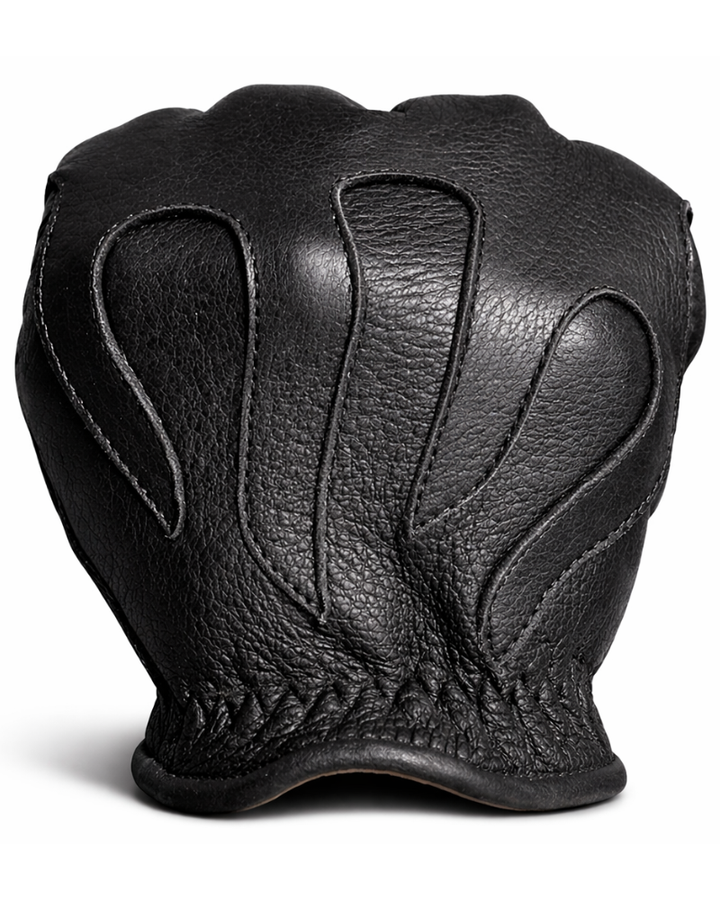
Deerskin is an exceptional glove leather — soft, thin, warm, and flexible — but it is not suitable as the primary material for a motorcycle jacket outer. Deerskin's softness and stretch make it ideal for hand protection where dexterity is the priority, but those same properties mean it provides less abrasion resistance than any of the jacket leathers discussed above at comparable thickness. You will find deerskin in gloves, including many of Legendary USA's American-made riding gloves, but not in jacket outers designed for crash protection.

Leather Comparison Table: Jacket Applications

Leather Weight/Density Break-In Time Durability Patina Price Tier
Horsehide Heaviest, densest 3–6 months Highest Outstanding — deep, personal Premium
Goatskin Lighter than cowhide, fine grain 1–2 months Very good Good — distinctive fine-grain character Mid-to-premium
Cowhide (heavy grade, 1.2mm+) Heavy, varies by tannage 1–3 months Good to very good Good — depends on finish Mid
Cowhide (fashion grade, under 1.0mm) Light, soft Minimal Low for riding Minimal Entry
Deerskin Very light, soft, stretchy Minimal Low for jacket outer Modest Gloves only — not jacket outer

For riders evaluating leather motorcycle jackets at Legendary USA, horsehide options include the BECK 666 Distressed Cafe Racer and Cockpit USA military heritage jackets. Goatskin appears in several of Legendary USA's A-2 and G-1 flight jacket offerings. Heavy cowhide is standard across the brand's everyday riding jacket lineup. All of Legendary USA's deerskin is reserved for its American-made motorcycle gloves, where the material's natural softness and grip are properly applied.

Frequently Asked Questions: Leather Types for Motorcycle Jackets

Is goatskin a good leather for a motorcycle jacket?

Yes. Goatskin is an excellent motorcycle jacket leather, particularly for flight jacket styles like the A-2 and G-1. It is lighter than cowhide, more supple from day one, and its tight fine grain provides good scratch resistance. The U.S. military originally specified goatskin for the A-2 flight jacket, which is an accurate reference point for its durability credentials. Goatskin breaks in faster than horsehide and develops a distinctive fine-grained patina over time. For riders who want a jacket that rides well immediately without the extended break-in period of horsehide, goatskin is a strong choice.

What is the most durable leather for a motorcycle jacket?

Horsehide is the most durable leather for a motorcycle jacket by fiber density and long-term wear resistance. Its tighter fiber structure means it resists abrasion at a given thickness better than cowhide or goatskin, and it holds its shape through decades of use rather than stretching or softening into deformation. The trade-off is a higher price point, a longer break-in period, and limited availability. Heavy-grade full-grain cowhide at 1.2mm or thicker is the practical runner-up — widely available, capable of lasting many years with correct care, and accessible at a mid-range price point.