



A thousand highway miles is a different test from a Sunday loop. Eight hours in, the things that separate a $60 glove from a $130 glove stop being abstract: a seam that has started to abrade, a lining that traps sweat, a palm that has gone slick, a cuff that lets wind up your sleeve every time you check a mirror. This guide is about which of those differences actually matter over distance, and which are marketing.
Is it worth spending more on quality motorcycle gloves?
Yes, but not for the reason usually given, and not by as much as most people assume.
The honest version: the jump from a $20 glove to a $65 glove is enormous, and it is where almost all of the real benefit lives. Real leather instead of coated synthetic, bonded thread instead of cotton, a palm cut in one piece instead of four. The jump from $65 to $130 is real but much smaller, and it buys refinement rather than transformation: outseam construction so seams do not press into your fingers, aramid lining, perforation placed where your hand actually sweats, touchscreen thread that lasts.
So if you are choosing where money goes, cross the first gap and think hard about the second. A $65 goatskin glove is a genuinely good glove. Anyone telling you it is dangerous compared to a $130 one is selling you the $130 one.
Are budget motorcycle gloves safe enough for a beginner rider?
A real leather glove at any price is far better than no glove, and it is worth being clear about that because the alternative to a $30 glove is often a bare hand.
What to check rather than what to spend:
- Is it actually leather? Goatskin, deerskin, cowhide. "PU leather" and "synthetic leather" abrade through fast.
- Is the palm one piece? A palm with a seam running across it puts a ridge of thread exactly where you slide.
- Is the thread bonded? Smooth and slightly glossy is bonded nylon or polyester. Matte and fuzzy is cotton, and cotton is what opens a seam.
- Does it stay on? A wrist closure matters more than anything else on this list. A glove that comes off in the first half second of a slide has protected nothing.
A budget glove that passes those four is fine to learn in. A budget glove that fails them is a costume.
Are unarmored leather motorcycle gloves still worth wearing?
Yes, and it is worth being precise about what they do and do not do, because we sell them.
Leather gloves without hard knuckle protection give you abrasion resistance and cut resistance across the whole hand. In the most common real-world get-off, a low speed slide where you put your hands out, that is the thing that decides between a scrape and weeks of debriding. What they do not give you is impact protection at the knuckles or a scaphoid slider at the heel of the palm. None of our leather gloves carry CE certification, and we are not going to imply otherwise.
The sensible reading: for cruising, commuting and touring, a well built leather glove is the right tool and always has been. For track work or aggressive riding, buy a CE certified glove with hard protection from a maker who specializes in it.
Do fingerless gloves work for long motorcycle rides?
They work well for some things on a long ride and badly for others, and the honest answer depends on the ride rather than the glove.
Where they genuinely win: heat, above roughly 85 degrees, where a full glove becomes a sweat trap. Dexterity for fuel pumps, phones and gloves-off tasks you would otherwise do fifteen times a day. And the thing riders rarely mention: a fingerless glove still covers the palm, which is the part of your hand that hits the ground.
Where they lose over distance: your fingertips take direct wind for eight hours, which is genuinely numbing below about 70 degrees and is a real fatigue source even above it. They also give you a hard sunburn line and no fingertip abrasion cover at all.
The practical answer for a long ride: carry both. Fingerless for the hot middle of the day, full gloves for early mornings, evenings and rain. Our Fingerless Deerskin Gloves are $68, which makes carrying two pairs a reasonable thing to do rather than an extravagance.
Do thicker leather gloves help reduce handlebar vibration?
A little, and less than most riders hope. This one is worth getting right because a lot of money gets spent on the wrong solution.
Leather thickness damps a small amount of high frequency buzz. What actually causes numb hands over distance is not vibration alone, it is grip pressure, and grip pressure is mostly a function of how much of your upper body weight is resting on the bars and how tightly you are holding on. A thicker glove that makes you grip harder to feel the throttle can make numbness worse, not better.
In order of what actually helps: bar-end weights, then a padded palm in the right place, then loosening your grip, then handlebar or riser geometry that takes weight off your wrists. A gel padded palm insert genuinely does something. Thick leather alone mostly just reduces feel.
If your hands go numb, try riding fifty miles consciously holding the bars with the pressure you would use to hold a full coffee cup. Most riders are shocked by the difference, and it costs nothing.
How do leather motorcycle gloves fit differently after break-in?
Leather gloves stretch across the width and barely at all in length. That single fact explains almost every fit complaint.
New, a correct glove feels snug across the back of the hand and just short at the fingertips. After roughly five to ten hours of riding, the leather relaxes around your knuckles and across the palm, the fingers seat properly, and it starts to feel like it was made for your hand. Deerskin does this fastest, in a couple of rides. Goatskin takes a little longer. Cowhide takes longest.
What will not happen: the fingers will not get meaningfully longer. If the fingertips have a quarter inch of empty leather when new, they will still be baggy in a year, and bagginess at the fingertips is what causes blisters and clumsy switch work.
The rule: buy for the length of your fingers and let the width break in.
What Actually Separates a Premium Glove
Five things, in the order they matter over distance.
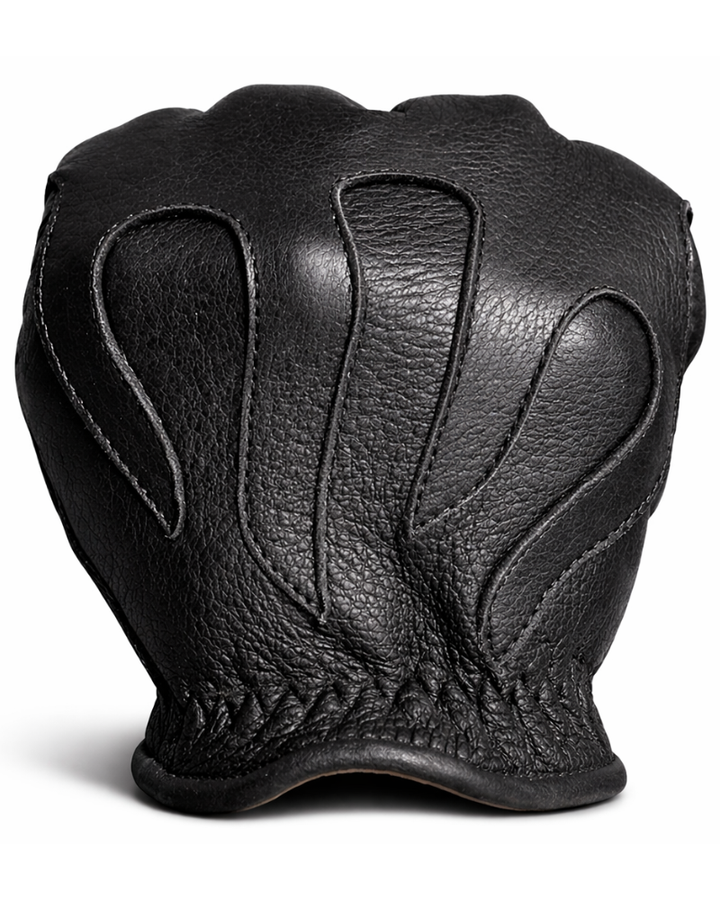
- Palm construction. One piece, no seam across the contact patch. This is the single biggest quality difference and it is visible in thirty seconds.
- Seam placement. Outseam construction puts the seam allowance on the outside of the glove so nothing presses into your fingers. On a two hour ride you will not notice. On a fourteen hour day you absolutely will.
- Thread. Bonded nylon or polyester. Cotton thread abrades against its own punch holes and opens the seam from the inside.
- Lining, or the deliberate absence of one. An unlined glove gives the most throttle feel and dries fastest. A fleece lining is for cold. An aramid lining adds cut resistance. A cheap synthetic lining is the worst of all worlds, because it holds sweat and bunches.
- The cuff and closure. A glove that can be pulled off your hand has not protected anything. Elastic at the wrist is the minimum; a strap is better.
What Premium Does Not Buy You
Being straight, because this article used to be less straight.
Our leather gloves are not certified protective equipment. They carry no CE marking, they are not tested to EN 13594, and none of them, including the aramid lined models, should be described as armored. The aramid lining in our Aramid Touchscreen Deerskin Gloves is a genuine material, and what it does is resist cutting and abrasion. It is not impact protection and it is not a certification.
What a good leather glove genuinely gives you is a layer of dense hide between your palm and the road, a glove that stays on your hand, and the ability to operate the controls precisely for eight hours without your hands cramping. That is worth real money. It is not body armor, and if a page tells you a glove will let you walk away from a crash, close the page.
The Real Cost Over Five Years
A $25 synthetic glove replaced every season is $125 over five years, and every one of those seasons ends with a glove that has gone hard and slick. A $65 goatskin glove that lasts three years is about $110 across the same period, and it is better on every single ride. A $125 deerskin glove that goes five to eight years is $16 to $25 a year.
The premium glove is not a splurge. Past the very cheapest tier it is simply the cheaper way to have good gloves, and that is the actual argument, not fear.
Top Picks, Shop Direct
Selected as a deliberate ladder rather than four versions of the same glove, because the point of this guide is where the extra money goes. Each rung adds one specific thing over the one below it, and we say what it is. All four are American deerskin or goatskin with one-piece palms.
| Product | Why it fits this question | From |
|---|---|---|
| Bad Billy Black Goatskin Gloves | The floor of good. Real goatskin, one-piece palm, bonded thread, short wrist. This is the glove that answers "is a budget glove good enough," and for most riding the answer is that this one is. Our most reviewed glove at 4.93 out of 5 across 129 reviews. | $65.00 |
| Classic Deerskin Gauntlets | What the next $140 buys: American whitetail deerskin instead of goatskin, so it is softer from day one, plus a gauntlet cuff that seals your jacket sleeve. The distance rider's answer to wind up the arm. Rated 4.88 out of 5 across 112 reviews. | $75.00 |
| Ventilated Touchscreen Deerskin Gloves | What $110 buys: perforation placed where your hand actually sweats, and conductive thread woven into the fingertips rather than a coating that wears off in a month. The one to own if summer distance is your riding. Our highest rated glove at 4.95 out of 5 across 117 reviews. | $120.00 |
| Aramid Touchscreen Deerskin Gloves | The top of the ladder: deerskin with an aramid lining that adds genuine cut and abrasion resistance, plus touchscreen fingertips. To be clear, aramid is a material, not a certification, and this glove is not CE rated. Rated 4.93 out of 5 across 102 reviews. | $125.00 |
If you are buying one pair for long rides, the Ventilated Touchscreen is the one we reach for most. If you are buying your first real pair, start at the Bad Billy and spend the difference on a jacket. Prices shown are current at time of writing. Orders over $150 ship free.
Browse the full men's American-made motorcycle glove collection or the women's motorcycle glove lineup.
Frequently Asked Questions
Is it worth spending more on quality motorcycle gloves?
The jump from a $20 synthetic glove to a $65 real leather glove is where nearly all the benefit lives: real hide, bonded thread, a one-piece palm. The jump from $65 to $130 buys refinement rather than transformation, mainly outseam construction, better ventilation placement, aramid lining and durable touchscreen thread. Cross the first gap. Think about the second based on how many hours a year you ride.
Are budget motorcycle gloves safe enough for a beginner?
A real leather glove at any price beats no glove. Check four things rather than the price: that it is genuine goatskin, deerskin or cowhide rather than PU; that the palm is one piece with no seam across the contact area; that the thread is bonded nylon or polyester rather than cotton; and that it has a wrist closure so it cannot be pulled off your hand in a slide. A budget glove that passes those is fine to learn in.
Do fingerless gloves work for long rides?
They work above roughly 85 degrees and for the fifteen small tasks a day that need bare fingers, and they still cover the palm, which is the part that hits the ground. Over distance they leave your fingertips in direct wind, which is numbing below about 70 degrees, and give no fingertip abrasion cover. The practical answer on a long trip is to carry both pairs.
Do thicker gloves reduce handlebar vibration?
Only slightly. Numb hands over distance are caused mainly by grip pressure and by upper body weight resting on the bars, not by vibration alone, and a thick glove that reduces feel can make you grip harder. Bar-end weights, a gel padded palm, and consciously loosening your grip do far more than leather thickness.
How does glove fit change after break-in?
Leather gloves stretch across the width and barely at all in length. New, a correct glove feels snug across the back of the hand and just short at the fingertips, and after five to ten hours of riding it relaxes around the knuckles and palm. The fingers will not get longer, so buy for finger length and let the width break in. Deerskin breaks in fastest, then goatskin, then cowhide.