



Aramid Lined Motorcycle Gloves: Industrial Cut Resistance Inside American Deerskin
Quick Answer: Aramid is a class of synthetic fiber known for exceptional cut and heat resistance — the same material category as Kevlar, used in ballistic vests, industrial cut-protection gloves, and aerospace components. Inside a motorcycle glove, an aramid lining adds a second layer of protection between the leather exterior and your hand that resists cutting forces during a slide or impact. Combined with American deerskin outer leather, it creates a glove that offers both the comfort of premium leather and industrial-grade cut resistance without significant bulk.
What Is Aramid Fiber?
Aramid (short for aromatic polyamide) is a class of heat-resistant, strong synthetic fiber developed in the 1960s and now used across industrial, military, and consumer safety applications. The name refers to the chemical structure — an aromatic ring bonded in a polyamide chain — which gives the fiber its exceptional mechanical properties.
The most familiar aramid fibers by brand name:
- Kevlar — developed by DuPont, para-aramid fiber, used in body armor, helmets, ropes, and protective apparel
- Twaron — Teijin's para-aramid, equivalent properties to Kevlar, common in European safety applications
- Nomex — meta-aramid, DuPont's heat and flame-resistant variant, used in firefighter gear and motorsport race suits
Kevlar is an aramid, but not all aramid is Kevlar. When a manufacturer says their glove lining is "aramid fiber," they are using the material class name, not necessarily the DuPont brand. The properties — cut resistance, heat resistance, tensile strength — are intrinsic to the aramid chemistry, not to any specific brand.
Industrial Safety Applications: Why Aramid Is Trusted
Aramid fiber earned its reputation in environments where failure is not an option. Industrial applications include:
- Cut-protection gloves rated to ANSI/ISEA 105 Level A6 and A7 (the highest cut-resistance levels)
- Body armor panels in law enforcement and military vests
- Flame-resistant coveralls for oil and gas workers
- Aerospace composite reinforcement
- Tire reinforcement (replacing steel belting in high-performance applications)
- Motorsport suits and gloves for racing
The underlying property that makes aramid valuable across all these applications is the same: the molecular structure of the fiber resists cutting, tearing, and heat with a strength-to-weight ratio that no natural fiber matches. A layer of woven aramid that weighs a few grams can stop a blade that would pass through leather alone.
How Aramid Lining Protects Hands in a Crash
In a typical low-speed motorcycle crash, the hands contact the road surface during a slide. The failure sequence without protection:
- Leather outer layer contacts pavement at speed
- Leather abrades and eventually wears through at pressure points (palm heel, fingertips, knuckle areas)
- Skin contacts pavement directly — abrasion injury, cuts from road debris, or penetration injury from sharp objects
Aramid lining interrupts step 3. Once the leather outer layer has been compromised, the aramid fabric beneath resists both the cutting forces of road debris (glass, metal, sharp stone) and the continued abrasion of the pavement surface. The fiber's tight weave provides a physical barrier that is significantly harder to penetrate than additional leather layers of equivalent weight.
The critical distinction: aramid lining is most effective against cut and penetration forces. Abrasion resistance — the glove sliding across rough pavement — is primarily the job of the leather exterior. The lining provides a second line of defense when the exterior has been compromised, not a replacement for exterior protection quality.
Aramid vs Kevlar: Are They the Same Thing?
Kevlar is a brand of aramid fiber. Saying "aramid-lined" vs "Kevlar-lined" is like saying "adhesive bandage" vs "Band-Aid" — one is the material category, one is a specific brand within that category. The cut-resistance properties are equivalent between Kevlar and other para-aramid fibers like Twaron when the fabric weight and weave are equivalent.
From a buyer's perspective: the brand name on the lining fiber matters less than the weight and construction of the lining fabric. A heavyweight woven para-aramid liner (Kevlar or otherwise) in a glove provides meaningful protection. A lightweight sprayed aramid coating in a cheap glove provides minimal protection regardless of what the label says.
When evaluating aramid-lined gloves, ask about the construction: Is the aramid woven fabric? How many layers? Does it cover the palm only or the full glove? A full-coverage woven aramid lining is substantively different from a palm-only spray treatment.
Does Aramid Lining Add Significant Bulk?
Well-constructed aramid glove linings add minimal bulk. Woven para-aramid fabric at glove-appropriate weights (typically 100-200 grams per square meter) is thin — comparable to a mid-weight jersey fabric in feel. The liner sits between the outer leather and the interior comfort lining (or the skin) and adds roughly 0.3-0.5mm to the overall panel thickness.
This is perceptible but not significant in a well-fitted glove. The key is fit: a glove that fits correctly with the lining will provide full cut protection without feeling stiff or restricting movement. A glove that is sized wrong (too small to accommodate the lining without restriction) will feel bulky and limit throttle feedback.
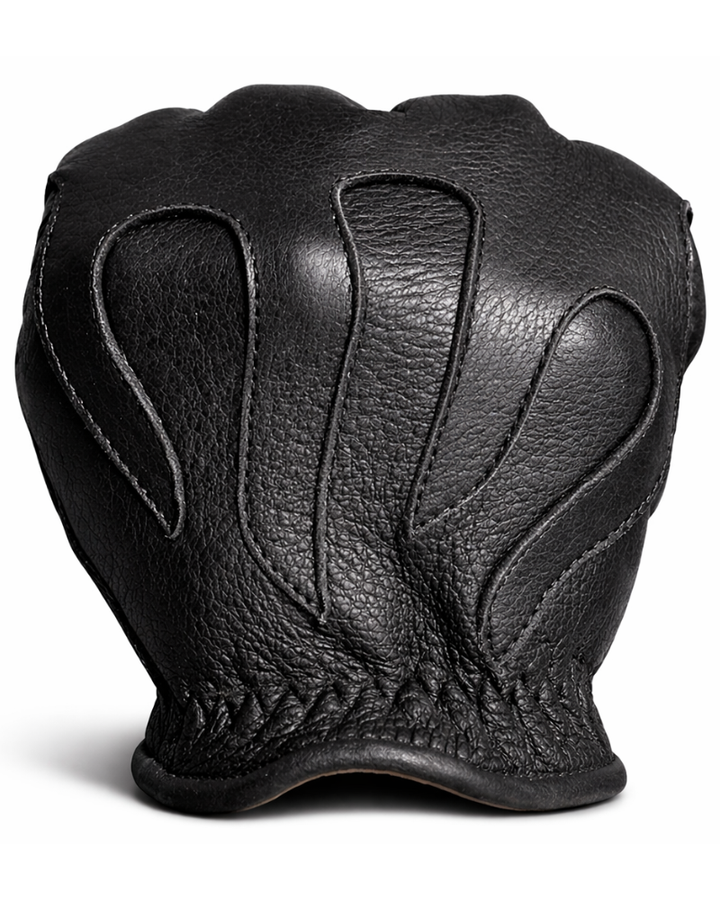
The Legendary Aramid Lined Deerskin Touchscreen Gloves are engineered with the aramid layer built into the pattern sizing — the glove is cut to accommodate the lining without requiring the rider to size up. This is a meaningful difference from aftermarket-lined gloves where a standard-cut glove has been fitted with a liner that tightens the interior.
How Aramid Lining Affects Throttle Feel
Throttle feel is the transmission of grip and resistance through the glove to your fingertips. It's how you know whether the throttle is turning smoothly, how much you've rolled it, and whether you're applying consistent force. Anything that adds material between your hand and the grip reduces throttle feel to some degree.
Aramid lining in a thin-leather glove adds less throttle-feel reduction than going to a thicker leather without lining. The reason: deerskin outer leather at 0.8mm plus thin aramid lining still produces a total panel stack thinner than a standard 1.4mm cowhide glove without any lining. The net effect on throttle feel is often neutral or even positive compared to thick unlined cowhide.
For riders who prioritize maximum throttle feel, unlined thin deerskin is the optimum. For riders who want meaningful cut protection without significant feel compromise, deerskin plus aramid is the best available combination — significantly better than cowhide plus aramid, which creates a thicker total panel that reduces feel noticeably.
Why Deerskin Plus Aramid Outperforms Cowhide Plus Aramid
This combination matters enough to explain directly. The total panel thickness in any lined glove is the outer leather plus the liner fabric plus any interior comfort layer. Minimizing total thickness while maintaining protection requires optimizing each layer.
- Cowhide (1.2mm) + aramid liner (0.4mm) = 1.6mm+ total panel — functional but thick, reduces throttle feel noticeably, heavier glove
- Deerskin (0.8mm) + aramid liner (0.4mm) = 1.2mm total panel — similar to a mid-weight unlined cowhide glove, maintains feel, cuts weight
The deerskin plus aramid combination achieves better feel, lower weight, and equivalent or superior protection to thicker cowhide configurations. It is not a compromise — it is a better engineering solution.
Abrasion Resistance vs Cut Resistance: Understanding the Difference
These are distinct failure modes that require different solutions:
Abrasion resistance: The glove surface sliding across a rough road surface. Measured in how long the material resists wearing through. Leather is the primary abrasion-resistant element. Thicker, denser leather resists abrasion longer. This is the job of the outer leather layer.
Cut resistance: A sharp object (road debris, metal edge, broken glass) making forceful contact with the glove and attempting to slice through. Leather has limited cut resistance because it can be sheared. Aramid's tightly woven, high-tensile fiber structure provides cut resistance that leather alone cannot.
A glove with excellent abrasion resistance (thick leather) but no cut resistance can still fail against a sharp object. A glove with cut-resistant lining but thin outer leather will wear through quickly under abrasion before the lining can help. The optimal design provides both: abrasion-resistant outer leather and cut-resistant inner lining working as a system.
CE Ratings and Aramid Lining
CE certification for motorcycle gloves (EN 13594) assesses impact protection, abrasion resistance, and cut resistance among other factors. Aramid lining contributes directly to the cut-resistance score within CE testing protocols.
Not all aramid-lined gloves carry CE certification, and not all CE-certified gloves use aramid lining — CE assesses the complete glove system, and there are multiple paths to meeting cut-resistance thresholds. However, a properly constructed aramid-lined glove made from quality leather will typically perform well within CE testing parameters for cut resistance even if not formally certified.
Riders who require CE certification for insurance, racing club rules, or personal standard should confirm the specific glove's certification documentation. For riders selecting gear based on informed material evaluation rather than label requirements, understanding what the lining actually does is more useful than the presence or absence of a CE tag.
When Do You Need Aramid-Lined Gloves?
Aramid lining is not necessary for every rider. Consider it if:
- You ride in urban environments with road hazard debris (construction zones, gravel, broken glass)
- You ride on roads with poor maintenance where pavement edges, gravel, and debris are common
- You commute year-round and accumulate high annual mileage, increasing statistical crash exposure
- You prioritize maximum hand protection as a personal standard
- You have had a previous hand injury or crash and want higher confidence in your gear
Riders on well-maintained roads doing recreational weekend riding may find standard deerskin sufficient. The aramid lining adds protection, not comfort or feel — its value is in crash scenarios, not in everyday riding feel. That said, because the Legendary aramid-lined gloves are designed to add the protection without meaningful thickness or feel penalty, many riders choose it simply as a "why not" upgrade.
The Legendary Uppercut Knuckle Defense Gloves take a different approach to protection by adding knuckle armor to ventilated deerskin — a choice suited to riders who prioritize impact protection from above-glove forces rather than cut resistance from below.
Aramid Glove Care: Can You Wash Them?
The outer leather determines cleaning method, not the aramid lining. Aramid fiber itself is chemically stable and machine-washable — it's used in workwear that gets washed regularly. But the deerskin outer layer cannot be machine washed without damage.
Clean aramid-lined deerskin gloves the same way you clean unlined deerskin: wipe with a damp cloth, use mild soap for deeper cleaning, dry naturally, condition with pH-neutral leather conditioner. The aramid lining requires no special treatment and does not degrade with normal care cycles.
Do not dry-clean. Dry-cleaning solvents can affect both the leather chemistry and the aramid fiber bonding in some construction methods.
Frequently Asked Questions About Aramid Lined Motorcycle Gloves
Is Kevlar the same as aramid in a motorcycle glove?
Kevlar is a brand of para-aramid fiber made by DuPont. All Kevlar is aramid, but not all aramid is Kevlar. From a protection standpoint, para-aramid fibers from different manufacturers perform comparably at equivalent fabric weight and weave density. "Aramid-lined" and "Kevlar-lined" describe the same class of protection — the brand name on the fiber does not determine protection quality.
How much cut protection does aramid lining actually provide in a crash?
Woven para-aramid fabric at typical glove liner weights can resist blades up to ANSI Cut Level A4-A6 depending on the fabric specification. In crash conditions, this translates to meaningful resistance against broken glass, metal debris, and road edge contact that would cut through leather alone. It is not impenetrable, but it extends the glove's protective window significantly against sharp-object contact.
Will I be able to feel the aramid lining when I wear the gloves?
In a well-fitted aramid-lined glove cut to accommodate the liner, you will feel the glove as slightly more substantial than an unlined equivalent. The lining itself does not have a sharp or abrasive texture — it feels similar to a smooth woven fabric. In riding use, you should not be distracted by the lining presence once the gloves are broken in and fitted to your hand.
Does aramid lining make the gloves too hot for summer riding?
Woven aramid fabric is not significantly insulating. It adds minimal heat retention compared to leather alone. Summer riding comfort in an aramid-lined glove is more dependent on the outer leather (perforated vs solid) and whether the glove is lined with an additional comfort layer. An unlined aramid/deerskin combination without heavy comfort lining is fully suitable for warm weather.
Do aramid-lined gloves protect against road rash on the palm?
Aramid lining provides cut resistance, not abrasion resistance. Abrasion resistance (road rash prevention) is primarily the job of the outer leather layer. The aramid lining becomes protective when the outer leather has been compromised — it acts as a second line of defense. For maximum abrasion protection on the palm, look for gloves with palm reinforcement panels in addition to the aramid lining.
How do I verify that the aramid lining in my gloves is genuine woven fabric and not a spray coating?
Look inside the glove — woven aramid fabric has a visible fabric texture, typically yellow or gold in color for para-aramid (Kevlar-type). A spray coating or surface treatment will appear as a film or will not be visibly distinguishable from the leather backing. Reputable manufacturers describe the lining construction explicitly in product specifications. If the listing says "aramid-lined" without describing the construction, ask before purchasing.
Can aramid-lined motorcycle gloves be repaired if the leather is damaged?
Yes. A skilled leather repair professional can patch or re-panel the outer leather while leaving the aramid lining intact. If the lining itself is damaged (cut through in a crash), the entire panel typically needs replacement. The repair feasibility depends on the damage location and the glove's construction method. Gloves with welted seam construction are generally more repairable than bonded construction.
Are aramid-lined gloves required for any specific type of riding?
No mandatory requirement exists for street riding in any US jurisdiction. Some racing sanctioning bodies require gloves with specific CE ratings that aramid lining contributes to. Track day organizations often require CE-rated gloves. For street riding, aramid-lined gloves are an informed protective choice, not a regulatory requirement.
How does aramid lining compare to impact knuckle protection in a motorcycle glove?
They protect against different injury types. Aramid lining resists cut and penetration forces from road debris during a slide. Knuckle protection (hard or soft armor) absorbs impact energy from a blow — hitting the road surface or an object with the top of the hand. Both are valuable. Some high-protection gloves include both aramid lining and knuckle armor; others choose one based on the rider's primary protection priority.
What weight of aramid fabric is used in motorcycle glove linings?
Motorcycle glove-appropriate aramid fabric typically runs 100-200 grams per square meter (GSM). Lighter weights (100-130 GSM) add minimal bulk with moderate cut resistance. Heavier weights (160-200 GSM) provide higher cut resistance at the cost of slightly more thickness. Premium gloves specify the fabric weight; budget gloves rarely do. When a manufacturer publishes the aramid fabric specification, it indicates quality transparency.
Do aramid-lined gloves wear out faster than standard leather gloves?
No. The aramid lining does not degrade faster than the leather outer layer under normal use. The leather exterior will show wear first through normal use. The aramid fiber is chemically stable, UV-resistant, and does not break down under the mechanical stresses of riding. If the leather is cared for properly, the aramid lining will remain functional for the life of the glove.
Can I get touchscreen capability in an aramid-lined motorcycle glove?
Yes. Touchscreen capability (conductive thread in the fingertips) is compatible with aramid lining — the two features are independent of each other. The conductive thread is in the outer leather fingertip panel; the aramid lining is in the palm and finger panels. The Legendary Aramid Lined Deerskin Touchscreen Gloves incorporate both features in a single glove without compromising either function.
What does "short wrist" mean in an aramid-lined motorcycle glove?
Short wrist refers to the cuff length — the glove extends to just past the wrist joint rather than up the forearm. Short-wrist gloves are suitable for riders who wear long sleeves or jacket cuffs that cover the wrist gap, and for warmer-weather riding where maximum airflow is preferred. Long-cuff or gauntlet gloves extend further up the forearm and provide coverage between glove and jacket in cooler conditions. For aramid-lined gloves, the lining typically covers the palm and finger panels regardless of cuff length.