



Why Genuine WWII Flight Jackets Matter
A real WWII flight jacket isn’t just clothing. It’s a piece of history that connects you to the pilots who flew bomber missions over Europe and the Pacific, who faced cold at 25,000 feet, who trusted their gear to keep them alive.
For serious collectors and riders, authenticity matters because it carries weight. When you wear a jacket that respects the original specifications, materials, and construction methods, you’re not wearing a costume. You’re wearing something that reflects the actual engineering of the era.
The Problem with Mass-Produced Reproduction Gear
Walk into most online retailers and you’ll find “WWII flight jackets” made overseas with shortcuts you won’t notice until you own one. Thinner leather. Wrong hardware. Stitching patterns that prioritize speed over durability. They look close enough at a glance, but they don’t age like authentic pieces.
The core issue: when manufacturing is outsourced for cost reduction, design integrity collapses. A WWII flight jacket demands premium horsehide or goatskin. Mass production typically uses split leather or bonded materials that crack within a year.
Hardware is another trap. Original jackets used solid brass or copper fittings. Cheap reproductions use pot metal that tarnishes and breaks. Zippers fail. Snaps corrode.
Our Commitment to Historical Accuracy
We’ve spent 25 years studying original WWII flight jackets, cross-referencing museum specimens, and understanding the precise specifications the military demanded. Our design process starts with research — private collections, historical contracts, exact stitch counts, hardware placement, leather treatments.
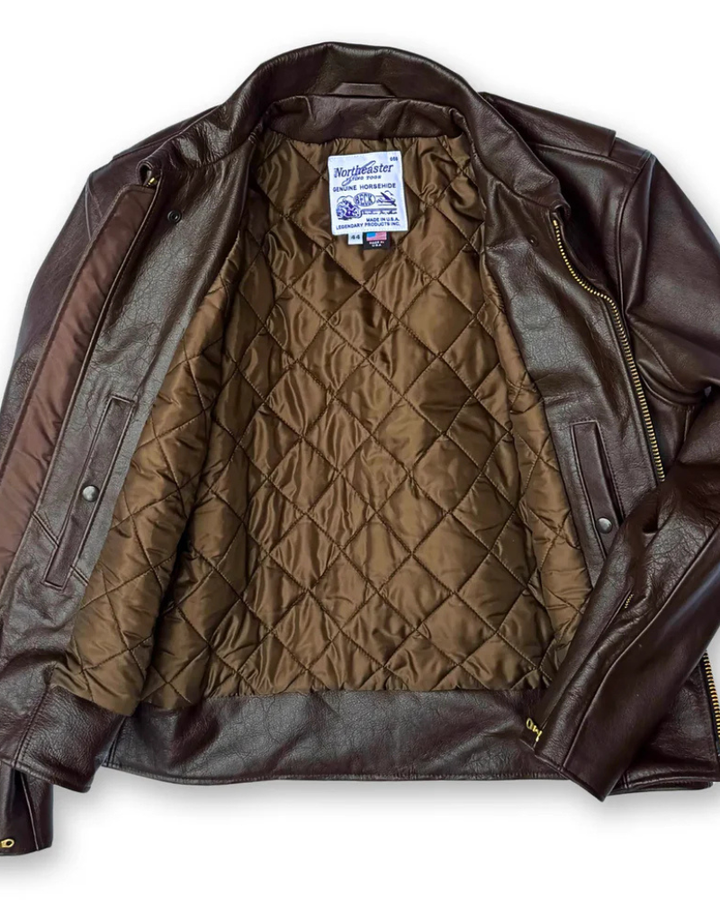
For leather, we source materials that match the performance characteristics of wartime production. Horsehide was chosen by the military because it resists wind, breaks in without cracking, and becomes more supple with age. Goatskin is the alternative for some models — more supple initially, faster break-in.
Hardware comes from domestic suppliers who specialize in period-correct brass and copper. Even thread weight and stitch patterns are deliberate reconstructions.
Small-Batch Production: Why It Matters
We don’t mass-produce flight jackets. We build them in limited runs because quality control at scale is a myth when you’re dealing with premium leather and handcrafted work.
Small-batch means every jacket gets individual attention. Our leather workers inspect each hide before cutting and adjust for grain variations. When something doesn’t meet our standard, it gets set aside. No shortcuts to hit a quota.
It also means traceability. You know where your jacket came from. You can speak with the person who made it. That matters when you need a replacement part two years down the line.
The Craftsmanship Behind Construction
Building a WWII flight jacket starts with pattern work developed from originals and refined through hundreds of hours of fitting. Pattern accuracy determines how the jacket hangs on your body and whether it functions the way it was designed to.
Leather preparation: we inspect every hide, identify the strongest sections, and plan cuts to maximize usable material while maintaining grain consistency.
Assembly follows a specific sequence. Fronts and backs are sewn first using lockstitch machines and hand-reinforced seams at stress points. Sleeves are set with particular attention to pitch and length. Collars are constructed in layers, then hand-stitched to the neckline.
A single flight jacket takes a craftsperson 15–20 hours from cutting to final inspection.
Premium Leather Selection
We specify horsehide for most jackets — tight grain structure that resists tearing and wind penetration better than other options. Develops a rich patina with age. The military chose horsehide for performance, and that performance is still relevant.
Goatskin is our alternative for some models — more supple initially, faster break-in. Thinner so it requires a higher-quality hide to achieve the same durability.
We avoid split leather and bonded materials entirely. They degrade under UV and flexing. The surface separates from the backing. Cracks appear. There’s no recovery.
Honoring Vintage Design While Meeting Modern Expectations
There’s a real tension between historical authenticity and contemporary safety. We navigate it honestly.
A genuine WWII flight jacket prioritized wind and cold protection because pilots flew in unpressurized aircraft at altitude. The design itself — tight closure, high collar, fitted sleeves — serves a protective function that’s still valid today.
Where we modernize is materials. We use modern zippers that won’t jam or corrode. We apply treatments to leather that improve water resistance without changing the appearance. We don’t add armor pockets or change silhouettes — that would undermine the historical accuracy. The jacket is designed to work with modern protective layers worn underneath if needed.
Sizing for Today’s Riders
WWII flight jackets present a sizing challenge because military sizing of the 1940s doesn’t translate directly to modern measurements. Original jackets were cut for military bodies with the expectation pilots would wear heavy thermal layers underneath. A 1940s large is usually closer to a modern medium or small.
We size our jackets to fit today’s bodies without requiring an undersized purchase. Modern large fits like a large should. But we study original proportions — sleeve length, collar depth, body length — so the jacket still looks and functions like a WWII flight jacket.
Measure your chest at the fullest point, then sleeve from center back of neck to wrist with arm slightly bent. If between sizes, order up — leather stretches slightly during break-in. Detailed sizing charts are on each product page.
25 Years of Military Apparel Expertise
We didn’t wake up one day and decide to make WWII flight jackets. We’ve been building military leather apparel for a quarter century, refining methods, building supplier relationships, and learning what actually works in the field.
Our expertise comes from being in the motorcycle and military apparel space continuously, not jumping in because the market looked profitable. That’s the difference between a company that makes flight jackets and one that understands why they matter.
Investment Value of Handcrafted American Leather
A cheap WWII reproduction might cost $150–$300 and last one to two seasons. That’s $75–$300 per year. Our jackets typically cost $600–$1,200 and last 10+ years with normal care. $60–$120 per year.
Handcrafted American leather also holds resale value. A well-maintained heritage flight jacket retains 40–60% of its original purchase price. A factory reproduction won’t resell at all.
Getting Your Authentic Flight Jacket
Browse our military and aviation jackets or specifically our A-2 leather flight jackets. For G-1 cuts: women’s G-1 flight jackets and the Legendary Hellcat G-1.
Use our sizing charts to identify your size. If between sizes or uncertain, reach out directly — actual people, not chatbots. We talk through fit, explain leather options, help you choose based on how you plan to wear the jacket. Expect 2–4 weeks for in-stock items.
Frequently Asked Questions
What’s the difference between an A-2 and a G-1?
The A-2 is the U.S. Army Air Force pattern with a leather standing collar. The G-1 is the U.S. Navy/Marine pattern with a mouton fur collar, knit cuffs and waistband, and bi-swing back.
Is horsehide really worth the premium?
For a long-term jacket, yes. Horsehide is denser, more abrasion-resistant, sheds water better than equivalent cowhide, and develops a deeper patina. The full case is in our horsehide vs. cowhide guide.
How long does a WWII reproduction flight jacket last?
10+ years with proper care for quality American-made pieces. Cheap imports often fail within 1–2 seasons.
Can I wear a WWII flight jacket on a motorcycle?
Yes. Many riders prefer A-2 and G-1 cuts on the bike. The shoulder articulation and forward-cut sleeves work well on the bars.
How should I care for an authentic horsehide flight jacket?
Standard quality leather care — condition twice a year, store on a wide hanger, avoid prolonged heat or saturation. See our leather care guide.
Article originally published April 2026. Updated May 2026 with verified collection links and FAQ.