

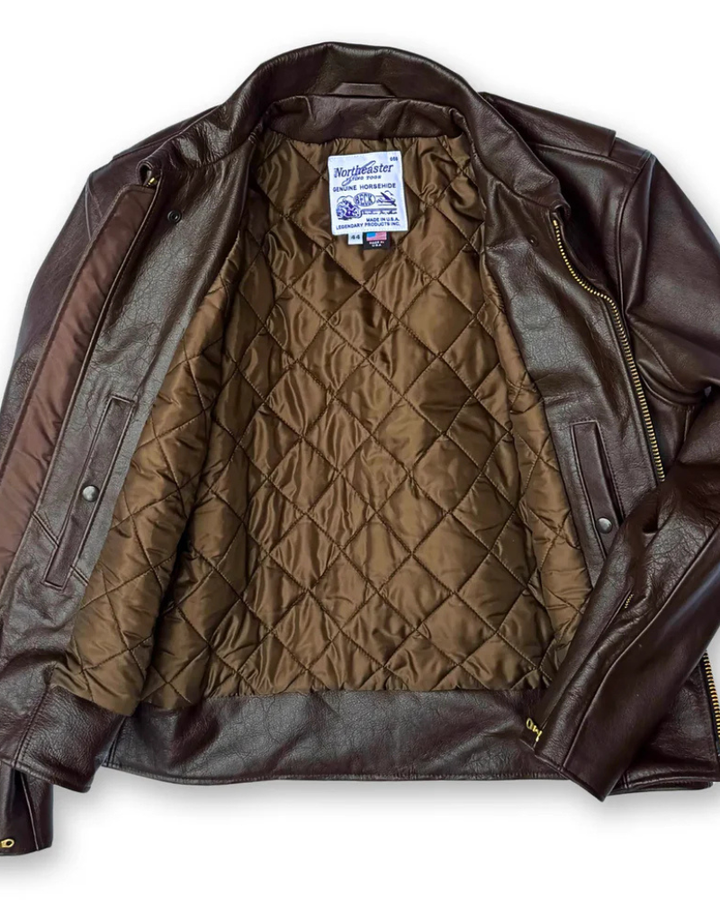
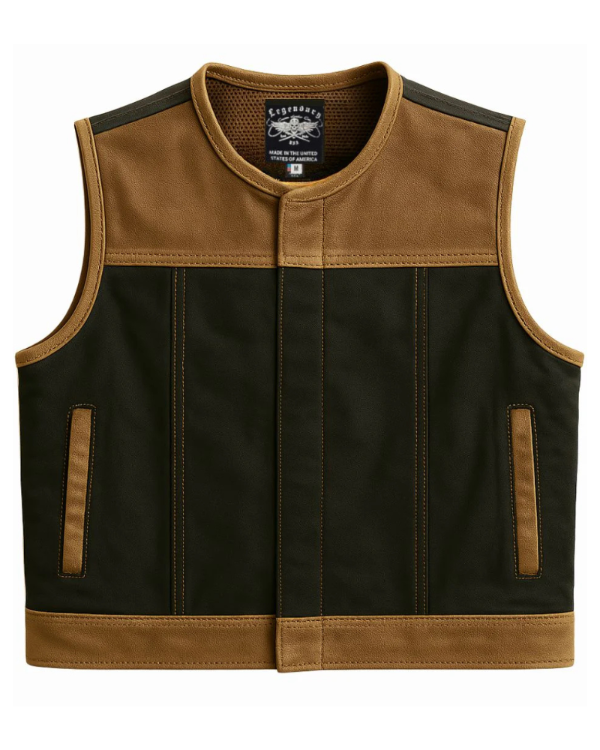
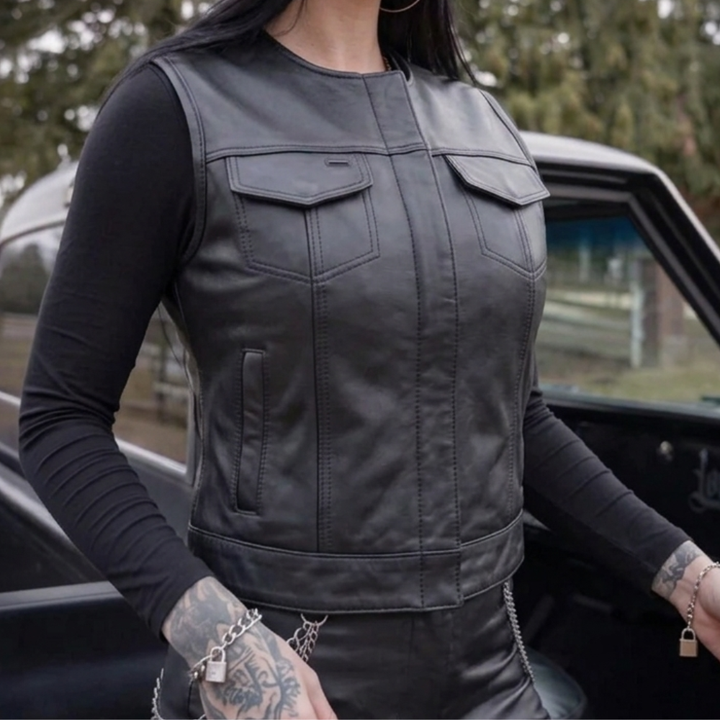


The best BECK horsehide vests and riding shirts for cold-weather layering are the pieces that block wind over the chest without adding bulk under a jacket: the BECK 566 and 882 vests for riders who layer over a flannel, the heavier 588 for riders who want the vest to be the outer layer, and the flannel-lined BECK 302 riding shirt for the rider who wants one piece to do the work of two. BECK Northeaster Flying Togs is Legendary USA's house brand, built in the United States from front quarter horsehide since 1928, and every piece in this roundup is cut from that hide. Here is how the six of them stack up once the mornings drop into the 40s.
Why horsehide earns its place in a cold-weather layer

Front quarter horsehide is the densest, most tightly grained section of the hide, and density is what matters when the wind is coming through at 65 miles an hour. It blocks air better than cowhide of the same thickness, it sheds light rain rather than drinking it, and it stands up on its own off the body until the break-in period molds it to the rider. In a vest, that means a wind barrier over the core that weighs less than a jacket and leaves the arms free for a flannel or riding shirt underneath. In a riding shirt, it means a mid-layer that blocks wind on its own and still fits under a vest or patch cut.
Horsehide is not armor, and no BECK piece carries armor or a CE rating. What it offers is abrasion resistance, wind blocking and longevity, and in cold weather the wind blocking is the part a rider feels first. Legendary USA has written about the hide itself in its history of the horsehide vest in cold-weather riding; this roundup is about picking the right cut.
BECK 566: the foundation vest
The BECK 566 Horsehide Motorcycle Vest is the starting point for the line, in black or brown. It has a one-piece back panel with no seams across the patch area, Legendary Pistola tethered gun pockets that hold position through a ride, twin chest pockets with hidden snaps and a sunglass holder, and a 1.25-inch stand-up collar that covers the neck without bulk. For cold-weather layering, the collar is the detail to notice; it closes the gap between a flannel collar and a helmet strap where wind otherwise gets in. The 566 is cut with room for a layer underneath, which makes it the vest most riders wear over a riding shirt from October onward.
BECK 882: the fitted vest for riders who layer under a jacket
The BECK 882 Fitted Horsehide Vest is the 566's tapered sibling. It is cut 1 to 2 inches narrower from chest to stomach, has no chest pockets so the front panel stays flat, and uses a piping collar instead of a stand-up one. That flat front is the reason it is the right BECK vest for cold-weather riders who wear the vest under a jacket: there is nothing to bunch under a zipper. It is intentionally stiff off the rack and molds to the rider with break-in, so size by the larger of chest or stomach and expect the first few rides to feel snug. Available in black and chestnut brown.
BECK 588: the heavyweight for riders who skip the jacket
The BECK 588 Horsehide Motorcycle Vest is cut from 1.4 to 1.6 millimeter front quarter horsehide, the heaviest leather in the BECK vest lineup, in a denim-style silhouette with side lacing and multi-panel stitching. The weight is the point. It is stiffer on the first wear and takes longer to break in than the 566 or 882, and in exchange it blocks more wind and will outlast both. For the rider whose cold-weather kit is a heavy flannel, a horsehide vest and nothing over it, the 588 is the vest that makes that kit work into the 40s. The side lacing also lets it open up over a thicker layer when the temperature drops further.
BECK 501 Trucker: the limited-edition cold-weather vest
The BECK 501 Trucker Horsehide Vest takes the 1960s denim trucker jacket proportions, pointed chest pockets and all, and cuts them in 1.3 millimeter front quarter horsehide. It has two 9-inch Cordura-lined concealed carry pockets, two zippered Cordura-lined hand pockets, two covered snap-down chest pockets and rear snap waist tighteners. The hand pockets are the cold-weather feature: a vest with zippered hand pockets gives a rider somewhere to put cold hands at a fuel stop, which most club-style vests do not. It is a limited edition in black or chestnut brown, and it is the BECK vest for a rider who wants a trucker look over a hoodie or flannel rather than a club cut.
BECK 302: the flannel-lined riding shirt
The BECK 302 Horsehide Riding Shirt is the piece in this roundup built specifically for cold weather. It is cut from 1.4 millimeter front quarter horsehide, heavier than the hide in the BECK jacket line, in a straight-hem shirt silhouette with a hidden snap front, hidden snap-down collar, covered snap cuffs and side slits so it does not bunch when seated. The lining is buffalo plaid flannel, which adds warmth without the loft of insulation. Two zippered chest pockets and two interior concealed carry pockets keep the front panel clean.
Worn alone, the 302 covers the 45 to 60 degree range that a vest over a flannel usually handles, in one piece and with the arms covered. Worn under a BECK vest or a patch cut, it reads as a shirt from a distance and blocks wind like a jacket. It is a riding shirt, not an armored riding jacket, so it has no CE armor; what it has is a heavier hide than the jackets and a lining that makes sense in October. Legendary USA's guide to choosing between a riding shirt and a motorcycle jacket covers when the shirt is the better call.
BECK 202: the short-sleeve shirt as a cold-weather mid-layer
The BECK 202 Horsehide Short Sleeve Riding Shirt sounds like a summer piece, and in summer it is one. In cold weather it has a different job: a 1.3 millimeter horsehide chest and back worn over a long-sleeve flannel or thermal, under a jacket. It gives the core a horsehide wind barrier without the sleeve bulk of a full leather shirt stacked under a jacket's sleeves, and the collarless cut sits flat under a jacket collar. It is the least obvious piece on this list and the one long-distance riders tend to discover on their own.
How to pick from the six
| Piece | Hide weight | Best cold-weather role | Layers under a jacket? |
|---|---|---|---|
| BECK 566 | Front quarter horsehide | Vest over a flannel or riding shirt | Yes, with chest pockets |
| BECK 882 | Front quarter horsehide | Fitted vest under a jacket | Yes, flat front |
| BECK 588 | 1.4 to 1.6 mm | Outer layer, no jacket | Not intended |
| BECK 501 Trucker | 1.3 mm | Trucker vest with hand pockets | Over a hoodie or flannel |
| BECK 302 | 1.4 mm, flannel lined | Lined riding shirt, alone or under a vest | Under a vest or cut |
| BECK 202 | 1.3 mm | Short-sleeve mid-layer under a jacket | Yes |
If you ride with a jacket and want the vest inside it, pick the 882. If you ride vest-out over a flannel, pick the 566, or the 588 if you want the heaviest hide and will put in the break-in. If you want one piece that replaces the flannel and the vest, pick the 302. The full lineup lives in the BECK Northeaster Flying Togs motorcycle vests and leather riding shirts collections, and the horsehide vests collection groups the vests by hide. For the jacket that goes over any of them, Legendary USA's BECK horsehide jacket buying guide for cold weather is the next read.
For how much colder moving air feels than the thermometer reads, the National Weather Service publishes a cold wind chill chart that covers the speeds a motorcycle rides at.
Frequently asked questions
- Is a horsehide vest warm enough for cold-weather riding?
- A horsehide vest is a wind barrier, not insulation, and that distinction decides how warm it is. Front quarter horsehide blocks moving air over the chest and back better than cowhide of the same thickness, so a BECK vest over a heavy flannel holds comfortable into the 40s for most riders. Below that, the vest goes under a jacket or over a lined riding shirt such as the BECK 302. The warmth comes from the layers; the horsehide keeps the wind from stripping it away.
- Which BECK vest is best for layering under a jacket?
- The BECK 882 Fitted Horsehide Vest. It is cut 1 to 2 inches narrower from chest to stomach than the 566, has no chest pockets so the front panel lies flat under a zipper, and uses a low-profile piping collar that does not fight a jacket collar. It is intentionally snug off the rack and molds to the rider with break-in. Size by the larger of your chest or stomach measurement, and size up if you fall between sizes.
- What is the difference between the BECK 566 and the BECK 588?
- Hide weight and silhouette. The BECK 566 is the foundation club-style vest in front quarter horsehide with a one-piece back, stand-up collar and chest pockets, cut with room to layer. The BECK 588 is cut from 1.4 to 1.6 millimeter horsehide, the heaviest in the BECK vest line, in a denim-style silhouette with side lacing. The 588 is stiffer at first, takes longer to break in, blocks more wind and is built to be the outer layer rather than to go under a jacket.
- Is the BECK 302 riding shirt lined for cold weather?
- Yes. The BECK 302 Horsehide Riding Shirt is lined with buffalo plaid flannel, which adds warmth without the bulk of insulation, and its 1.4 millimeter front quarter horsehide shell is heavier than the hide used in the BECK jacket line. Worn alone it covers the range a flannel and vest usually handle; worn under a vest or patch cut it blocks wind like a jacket. It is a riding shirt, not an armored riding jacket, so it has no CE armor.
- Does horsehide stiffen in cold weather?
- Front quarter horsehide is a dense hide that stands up on its own when new, and it does feel firmer on a cold morning than on a warm one until body heat and movement loosen it. That firmness is the hide blocking wind, and it eases within the first few miles. A broken-in BECK vest or riding shirt flexes freely in the cold; a new one, especially the heavier 588 or 302, takes a few rides to get there. Conditioning does not shortcut the process, and horsehide needs very little of it.
- Is BECK a Legendary USA brand?
- Yes. BECK Northeaster Flying Togs is a Legendary USA house brand. The BECK label has produced front quarter horsehide riding gear in the United States since 1928, and Legendary USA owns the trademark and builds the current BECK vests, riding shirts and jackets domestically. Every BECK piece carries a lifetime guarantee from Legendary USA. Cockpit USA, Churchill and Bohn are separate businesses that Legendary USA carries as an authorized dealer; BECK is the one that is Legendary's own.
Six BECK pieces, one hide, and a clear job for each once the mornings turn cold: the 566 and 882 as vests over or under a layer, the 588 for the rider who makes the vest the outer layer, the 501 Trucker for a different silhouette with somewhere to put cold hands, and the 302 and 202 riding shirts for the rider who wants horsehide against the core without a jacket's bulk. Legendary USA builds every one of them in the United States under the BECK Northeaster Flying Togs label, and the right one depends less on the thermometer than on what you already wear over it.