



Double Diamond Stitch Motorcycle Gloves: What This Construction Technique Actually Does
Quick Answer: Double Diamond stitching is a reinforcement technique where a second pass of thread is run through the highest-stress points of a motorcycle glove — primarily the palm crease, back panel flex lines, and finger bases. This redundant stitch pattern distributes load across two thread paths instead of one, dramatically reducing the chance of seam failure under the sustained stress of riding.
Most riders spend hours comparing leather grades and palm padding. Very few think about the thread holding their gloves together — until a seam pops on a long ride and leaves their hand exposed. The Double Diamond stitch pattern addresses this vulnerability directly, and on Legendary USA gloves, it's visible as part of the design rather than hidden inside the seam.
What Double Stitching Actually Means in Leather Glovemaking
In standard glove construction, a single row of stitches holds two leather panels together. The thread passes through both layers once per stitch, creating a single lock-stitch or chain-stitch line. This is adequate for most applications — but motorcycle gloves aren't most applications.
Double stitching means a second row of thread is run parallel to or intersecting with the first, creating two independent stitch lines at the same seam. If one line degrades — from UV exposure, abrasion against the tank, or repeated flex stress — the second line continues to hold the panels together.
The Double Diamond pattern goes a step further. Instead of two parallel lines, the second stitch pass is run at an angle that forms a diamond or X-pattern across the highest-stress zones. This geometry matters: diagonal tension distribution handles multi-directional stress better than two parallel lines, which both fail in the same axis of stress.
Where the Highest-Stress Points Are on a Motorcycle Glove
Understanding why Double Diamond stitching matters requires understanding where gloves actually wear out. The stress map of a motorcycle glove looks like this:
The Palm Crease
Every time you squeeze the throttle, brake lever, or clutch, your palm folds along the same crease line. Over thousands of miles, this repeated flexing concentrates mechanical fatigue at the stitching that crosses that crease. This is the number-one failure point in gloves without reinforced stitching.
Back Panel Flex Lines
The back of the hand flexes in the opposite direction during grip changes and when releasing the throttle. The seams running across the dorsal surface are under constant alternating tension, especially in gloves with close-fitting backs.
Finger Bases
The junction where fingers join the palm panel is a high-concentration stress point. Grip force transfers across this seam with every throttle input. In cheaper gloves, this is where index and middle finger seams commonly fail first.
Thumb Saddle
The thumb sits in a different plane than the rest of the hand, which means the seam where it joins the palm is under angular stress — not just linear pull. Double stitching here prevents the saddle seam from pulling free over time.
How a Second Thread Pass Distributes Stress Differently
When a single stitch line is under tension, all the load transfers through each needle hole in the leather. The leather itself is the weak point — not the thread. Repeated stress enlarges those needle holes microscopically, and eventually the leather tears between holes rather than the thread breaking.
A second stitch pass creates additional needle holes, but spreads the load distribution across a wider area. The key is the angle: when the second pass crosses the first at the diamond pattern angle, it creates a triangulated stress network. Each panel of the triangle resists pulling in a different direction, meaning no single direction of force can cleanly separate the seam.
This is the same engineering principle used in aircraft-grade riveting patterns and reinforced canvas — the geometry of the fastening pattern matters as much as the fastener itself.
A&E Thread in Double Diamond Applications
Thread quality is the other half of the reinforcement equation. Legendary USA gloves use A&E (American & Efird) industrial-grade thread in double diamond applications. This is the same thread category used in automotive upholstery, military gear, and industrial safety equipment — not the lightweight thread typical in fashion gloves.
A&E industrial thread offers several advantages in double diamond stitching:
- Higher tensile strength per strand — so even a single thread line holds more before breaking
- UV resistance — motorcycle gloves live in the sun; standard thread can become brittle and fade within a season
- Colorfastness — the decorative double diamond pattern stays visually crisp through extended use
- Consistent diameter — industrial thread is manufactured to tighter tolerances, which means more uniform stitch tension across the entire seam
When A&E thread is combined with a double diamond stitch pattern, the result is a seam system that's resistant to failure from three separate mechanisms: thread breakage, leather tear-out, and UV degradation.
Double Diamond Stitch as a Visual Design Element
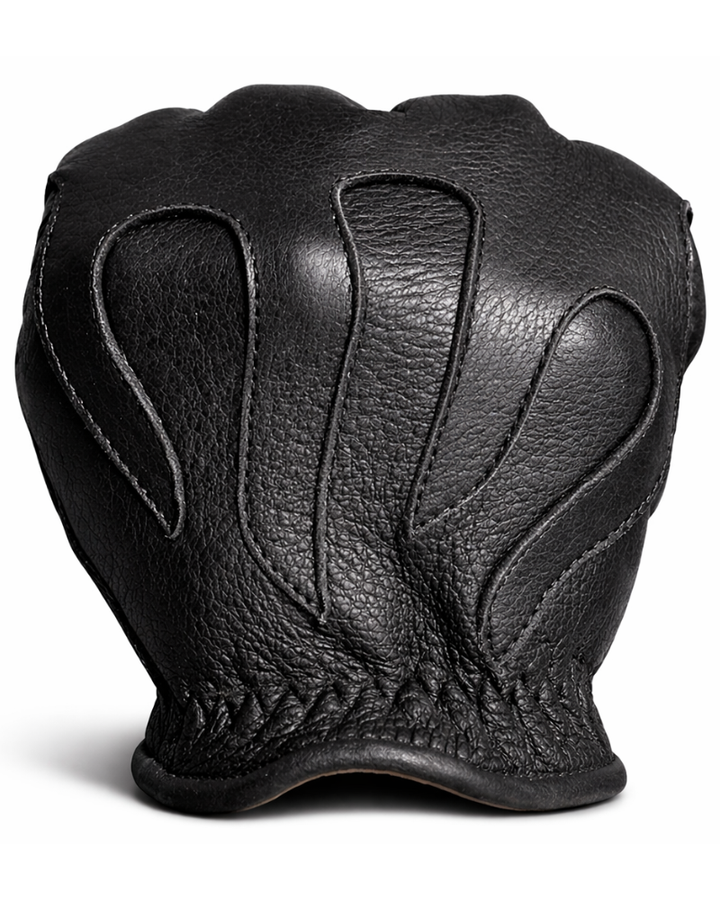
On Legendary Double Diamond Stitched Deerskin Motorcycle Gloves, the reinforcement stitching is also the decorative element. The diamond pattern is placed where it's visible — across the back of the hand — rather than buried inside the seam allowance.
This is intentional. When reinforcement stitching is hidden, there's no visual incentive to maintain thread quality or stitch density. Making it visible creates accountability in the construction process and gives the rider a way to inspect glove condition without opening seams.
The visual diamond pattern also communicates quality to other riders in a way that leather grade and palm padding can't. The stitch work is immediately recognizable as premium construction because cheap gloves simply don't invest in this kind of thread work.
Multi-Colorway Options and What They Mean
Legendary USA Double Diamond gloves are available in multiple colorways, with the diamond stitching serving as the design through-line across all variations. Color options allow the rider to match their bike, their gear, or their personal style while maintaining identical structural construction across all colorways.
What changes between colors:
- The thread color used in the diamond pattern (visible)
- The base leather dye (surface appearance)
What does NOT change:
- Thread grade (A&E industrial throughout)
- Stitch density (identical across colorways)
- Stitch pattern geometry (same double diamond layout)
- Leather grade (same deerskin stock)
This matters because some manufacturers reduce thread quality in lower-priced colorways of the same glove model. Verifying that thread and construction specs are identical across color options is a mark of consistent quality control.
How Long Does Double Diamond Stitching Last vs. Standard Stitching?
The honest answer is: it depends on riding hours and conditions, not calendar time. A glove stored in a drawer lasts indefinitely. A glove ridden 10,000 miles in the first season through rain, heat, and gravel roads is a different story.
In practical terms, riders using gloves with standard single-pass stitching commonly report seam separation at palm crease points between 18 months and 3 years of regular riding. Double diamond stitched gloves on quality leather have been documented lasting 5–8 years of regular use before any seam issues develop, provided the leather itself is conditioned.
The failure mode matters too. When a single stitch line fails, it fails completely and quickly — one thread pops and the seam opens along its full length. When one line of a double diamond fails, the second line holds the seam closed. The glove can remain functional for additional rides while the rider plans for repair or replacement.
Does Double Diamond Stitching Affect Flexibility?
This is the most common concern riders raise about reinforced stitching, and it's legitimate. More thread material crossing a seam can theoretically stiffen it.
In practice, the effect on flexibility depends on where the stitching sits. Double diamond stitching on the back panel — where the leather has room to flex between stitch lines — has negligible effect on hand movement. The leather panels flex; the stitching simply holds them together at defined points.
The potential stiffness issue arises when reinforced stitching crosses a high-flex area like the palm crease at a 90-degree angle to the flex direction. Well-designed double diamond gloves account for this by aligning the stitch pattern diagonally to the major flex axes, so the diamond geometry accommodates flex rather than blocking it.
The Legendary Haymakers Super Welted Motorcycle Gloves demonstrate how welted outseam construction combined with reinforced stitching can actually improve flexibility at the finger bases by allowing the seam to flex as a unit rather than as a rigid connection point.
Comparing Reinforced Stitching Methods
Double Pass vs. Saddle Stitch
Saddle stitching uses two needles working simultaneously, each threading from opposite sides. It produces an extremely strong single-pass stitch because each thread locks the other in place — if one thread breaks, the other remains intact. Double diamond stitching with a second pass achieves similar redundancy but at a faster production rate, making it practical for volume production without sacrificing structural integrity.
Double Pass vs. Lock Stitch
Lock stitch is the standard sewing machine stitch — an upper thread loops around a bobbin thread to form each stitch. It's fast and reliable but single-pass. Double diamond construction applies the lock stitch twice at intersecting angles, combining production efficiency with the geometric stress distribution of the diamond pattern.
Double Pass vs. Bar Tack
Bar tacks are dense concentrations of stitching at specific stress points — like the corners of pockets or the ends of belt loops. They reinforce single points rather than seam lines. Double diamond stitching reinforces the entire seam length, not just endpoints. Both have their place: bar tacks at the ends of double diamond seams create a complete reinforcement system.
When Does Stitching Failure Happen on Motorcycle Gloves?
Stitching failure on motorcycle gloves follows predictable patterns:
UV degradation — Thread exposed to direct sun for multiple seasons weakens even before mechanical stress causes visible failure. The thread becomes brittle and loses tensile strength. This is why UV-resistant industrial thread matters for gloves worn in summer riding.
Repeated flex fatigue — As described above, the palm crease is the primary failure zone. Millions of grip cycles eventually work the thread at this point.
Abrasion contact — Gloves that contact rough surfaces (tank textured grip areas, jacket cuffs, rough pavement in a crash scenario) can abrade through thread faster than through leather. Industrial-grade thread resists this better than standard thread.
Chemical exposure — Gasoline, chain lube, and cleaning products can degrade thread faster than leather. Rinsing gloves and avoiding direct chemical contact extends thread life significantly.
Custom Color Options: Choosing Your Stitch Color
When selecting a colorway on double diamond gloves, riders are effectively choosing the visual prominence of the reinforcement pattern. Contrasting thread on a dark glove makes the diamond pattern visually bold — a deliberate design statement. Tone-on-tone stitching (matching thread to leather color) creates a more subtle, understated look where the texture of the diamond reads more than the color.
Neither choice affects structural performance. The thread grade and stitch density are identical regardless of the color combination chosen.
FAQ: Double Diamond Stitching on Motorcycle Gloves
What is double diamond stitching on motorcycle gloves?
Double diamond stitching is a reinforcement technique where a second pass of thread is run through the seams of a motorcycle glove at an intersecting angle to the first, creating a diamond or X pattern. This distributes stress across two independent thread paths and improves seam strength at high-wear points like the palm crease and finger bases.
Why is double diamond stitching better than single stitching?
Single stitching creates one point of failure per seam — if the thread degrades or breaks, the seam opens. Double diamond stitching creates two independent thread paths. If one degrades, the second continues to hold the glove together, giving the rider additional time before the glove requires repair or replacement.
Does double diamond stitching make gloves stiffer?
Minimal stiffness effect when the pattern is correctly oriented. Well-designed double diamond gloves place the stitch diagonal to major flex axes so the geometry accommodates hand movement rather than restricting it.
Where does stitching typically fail on motorcycle gloves?
The palm crease is the most common failure point, followed by the finger base seams and the thumb saddle. These areas experience the most repeated flex stress from grip cycling and throttle control.
What thread is used in high-quality double diamond motorcycle gloves?
Industrial-grade thread like A&E (American & Efird) is the standard for premium gloves. It offers higher tensile strength, UV resistance, and consistent diameter compared to standard sewing thread used in fashion gloves.
How long do double diamond stitched gloves last?
With quality leather and industrial-grade thread, double diamond stitched gloves commonly last 5–8 years of regular riding before seam issues develop. Single-stitch gloves on similar leather typically show seam issues within 18 months to 3 years under the same use conditions.
Can I see double diamond stitching from outside the glove?
On Legendary USA Double Diamond gloves, yes — the pattern is placed on the back of the hand where it's visible and serves as both a structural reinforcement and a design element. Some manufacturers hide reinforcement stitching inside seam allowances, which prevents visual inspection of stitch condition.
Does the color of double diamond stitching affect performance?
No. Thread color is a surface characteristic applied during dyeing. The structural properties — tensile strength, UV resistance, diameter — are identical across color options in quality manufacturing.
Is double diamond stitching the same as saddle stitching?
They're related but different. Saddle stitching uses two needles working simultaneously from opposite sides for a single very strong stitch line. Double diamond stitching uses a second stitch pass at an intersecting angle to the first. Both achieve redundancy through different mechanical approaches.
How do I tell if my motorcycle glove stitching is wearing out?
Look for these signs: thread thinning or fraying visible along seam lines, particularly at the palm crease; slight gapping at the seam when the leather is flexed; thread color fading or becoming chalky (indicating UV degradation); or the leather panels beginning to separate at the fingertip edges.
Do all motorcycle gloves have reinforced stitching?
No. Many motorcycle gloves, especially those in lower price ranges, use single-pass lock stitch construction throughout. Reinforced stitching — whether double pass, saddle stitch, or double diamond — is a marker of premium glove construction that adds cost and production time but significantly extends service life.
Are double diamond gloves worth the premium price?
For riders logging significant miles, yes. The construction cost difference between standard and double diamond stitching in the final retail price is typically $20–$40. Given that the construction difference can double or triple glove lifespan under heavy use, the cost-per-mile math typically favors the reinforced option.
What is the best way to maintain double diamond stitched motorcycle gloves?
Condition the leather regularly to prevent cracking that could stress seam points. Avoid direct chemical contact (gasoline, solvents). Air dry after wet rides — don't use direct heat. Inspect the visible diamond stitch lines periodically for any signs of thread thinning or fraying. Address minor seam issues at a leather repair shop before they propagate.