

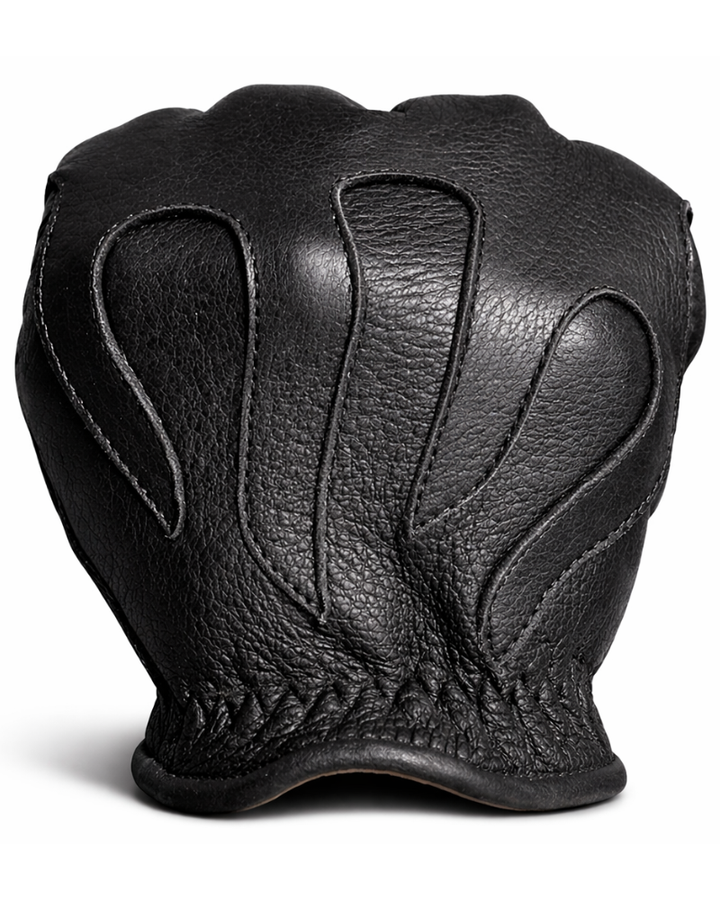


Gauntlet motorcycle gloves are the right call for shoulder-season riding because the extended cuff seals the gap between your glove and your jacket sleeve, which is exactly where cold air gets in first. Legendary USA builds its Classic Deerskin Gauntlets from American whitetail deerskin, a leather that stays soft in cold air instead of going stiff on you. If your mornings are starting at 45 degrees and your afternoons are still hitting 75, a gauntlet gives you real wind protection without the bulk of a winter glove.
This article is the explainer: how a cuff works, how insulation works, what leather is warmest, and how to build a setup. For the straight buying decision by temperature band, see our companion page, Best Gauntlet Motorcycle Gloves.
What a Gauntlet Cuff Actually Does
The gauntlet cuff does one job: it stops wind from traveling up your sleeve. At highway speed, air hitting the back of your hand looks for the shortest path inside your jacket, and on a short-wrist glove that path is the two-inch gap at your wrist. Cold air entering there does not stay at your wrist. It runs up your forearm, and within twenty minutes your hands feel cold even though the glove leather itself is doing its job.
A gauntlet closes that path by overlapping the jacket sleeve rather than tucking under it. The cuff sits on the outside, the sleeve sits inside, and the wind has nowhere to enter. That single detail is the reason a moderately warm gauntlet often outperforms a heavier short-wrist glove on a cold morning.
Gauntlets also shed rain better for the same reason. Water running down your sleeve hits the outside of the cuff and drips off instead of channeling into the glove.
Deerskin vs. Goatskin for Shoulder-Season Gauntlets
Deerskin and goatskin are both excellent riding leathers, and they behave differently in cold air.
Deerskin is the softer of the two. American whitetail deerskin has a loose fiber structure that gives it stretch and a broken-in feel almost immediately. In cold weather that matters, because a leather that stays supple lets you keep a light, controlled grip on the bars. Cold-stiffened leather forces you to squeeze harder, and squeezing harder for an hour is how you end up with hand fatigue and numb fingers. Deerskin also handles repeated wet-and-dry cycles better than most leathers, which is useful in a season full of surprise rain.
Goatskin is tighter-grained and more abrasion-tough. It has a slightly slicker hand and a firmer feel on the bar. Goatskin breaks in more slowly than deerskin but holds its shape longer over years of use. Legendary USA's Bad Billy black goatskin gloves at $75.00 are a short-wrist cut, so they are the goatskin answer for warmer shoulder-season afternoons rather than cold mornings.
The honest summary: for shoulder-season gauntlets, deerskin wins on comfort and cold-weather feel. Goatskin wins on long-term durability and grip firmness. Neither one is armor, and neither one should be confused with it. For a fuller breakdown, read our guide to goatskin motorcycle gloves.
What leather is warmest for motorcycle gloves?
This question has a slightly surprising answer: the leather itself contributes very little warmth. Almost all of a glove's insulating value comes from the lining and from how well the glove blocks wind. A quarter-millimetre of hide, whatever animal it came from, is not a thermal barrier.
What the leather does control is three things that feel like warmth:
- Windproofing. All full-grain leather blocks wind almost completely, which is the single biggest factor in how cold your hands get on a bike. This is why an unlined leather glove beats a much thicker knitted or fleece glove at highway speed: the knit lets air straight through. Any of our hides do this equally well.
- Whether it stays flexible when cold. This is where deerskin genuinely wins. Its loose fiber structure keeps it supple in cold air, while stiffer hides like cowhide firm up noticeably. That matters because a stiff glove makes you grip harder, and a hard grip restricts blood flow to your fingers, which makes your hands colder. Deerskin lets you stay relaxed, and a relaxed hand is a warmer hand.
- How it behaves wet. A leather that goes stiff and cold when damp is miserable in fall. Deerskin stays soft when wet and recovers when dried properly.
So the practical ranking for cold riding is deerskin first, goatskin second, cowhide last, but the reason is flexibility and grip rather than thermal insulation. If you want actual warmth, that comes from the lining, which is the next question.
What insulation works best inside winter motorcycle gloves?
All insulation works the same way: it traps still air. Air is the insulator; the material just holds it in place and stops it moving. That single fact explains every trade-off below.
The consequence riders run into is that more trapped air means more loft, and more loft means more bulk between your fingers and the controls. On a motorcycle there is a hard ceiling on how much insulation is useful, because past a certain thickness you cannot feel the front brake, and losing brake feel is a worse problem than cold fingers. So glove insulation is not about finding the warmest material. It is about finding the most warmth per millimetre.
Fleece is what we use, and it is the best all-round choice for riding gloves for two reasons. It gives useful warmth at a genuinely thin cross-section, and critically it keeps most of its insulating value when it gets damp. Cold riding is usually damp riding, from rain or from your own sweat, and a lining that stops working when wet is not much use. Our Fleece-Lined Deerskin Gloves at $115.00, rated 4.90 from 104 reviews, are built on this reasoning.
Synthetic loft insulations such as the branded polyester battings give more warmth per gram than fleece and also work reasonably when damp. The catch is bulk. In a glove, where you need the fingers to bend, loft costs you more dexterity than it does in a jacket.
Wool insulates well when wet and is excellent as a separate liner glove, but it compresses badly under a firm grip and it holds moisture heavily, so it is better under a leather glove than sewn inside one.
Down is the warmest material by weight and the worst possible choice for a motorcycle glove. It collapses completely when wet and stops insulating, it compresses to nothing under your grip on the bars, and your palm is exactly where it would be crushed.
A separate liner glove is the option most riders overlook and the one that gives the most flexibility. A thin liner under a correctly sized outer glove is adaptable in a way a fixed lining is not, because you can pull the liner out when the sun comes up. Our Gators Skin Glove Liners at $29.50 do this job, and they are the cheapest way to extend gloves you already own. If you go this route, buy the outer glove one size up, because a compressed liner does not insulate.
The thing that beats all of them: heated grips. They add heat rather than slowing its loss, and they add zero bulk, so they cost you nothing in feel. We do not sell them and we will still tell you they are the best cold-weather purchase a rider can make.
Are lined leather gloves warm enough for winter motorcycle riding?
It depends entirely on what you mean by winter, and this is where a lot of riders buy the wrong thing.
Down to about 45 degrees: yes, comfortably. A fleece-lined deerskin glove is more than enough, and many riders find an unlined gauntlet sufficient at the top of this range.
Between 40 and 45 degrees: yes, for rides of an hour or two. A fleece-lined glove like ours handles this well. Longer than that and you will start to feel it, particularly in the fingertips.
Between 30 and 40 degrees: not on its own. This is where a lined glove needs help, either a liner underneath, heated grips, or both. A lined leather glove alone at 35 degrees will keep your hands functional for perhaps 30 to 45 minutes at highway speed before your fingertips go.
Below 30 degrees: no. No unheated leather glove is comfortable here for a meaningful ride, and we would rather say so than sell you one and let you find out. What works below freezing is heated grips, handlebar muffs, or a mitten. Our Deerskin Insulated Mittens at $115.00, rated 4.83 from 80 reviews, are the warmest thing we make, because putting all four fingers in one shared air space is a much bigger warmth gain than any lining upgrade.
One thing that shifts every number above: wind. At 60 mph, 40 degrees ambient feels closer to 25 degrees on the back of your hand. Blocking wind at the wrist with a gauntlet cuff is worth more, in that range, than upgrading your lining.
How do I keep my hands warm when riding in winter?
Glove choice is only about half of this. Here is the whole method, in the order that actually delivers results.
1. Warm your core first. This is the one riders skip, and it matters more than any glove. When your torso gets cold, your body constricts blood flow to your extremities to protect your core temperature. Once that happens, your fingers get cold no matter what they are wearing, because there is no warm blood arriving to keep them warm. A proper base layer and a windproof jacket will do more for your hands than upgrading your gloves.
2. Block the wind at every gap. Wrist, neck, waist. A gauntlet cuff worn over the sleeve is the wrist fix, and the Classic Deerskin Gauntlets at $140.00, rated 4.88 from 112 reviews, are the cheapest big improvement available in the 45 to 65 degree range.
3. Add heat rather than only insulation. Heated grips, or heated gloves if you have the wiring. Adding heat beats slowing heat loss, and it costs you no dexterity.
4. Layer, do not just thicken. A liner under a properly sized glove adapts to the day. One very thick glove does not, and it costs you brake feel all day for warmth you need for one hour of it.
5. Keep everything dry. A damp glove is dramatically colder than a dry one at the same temperature, because water conducts heat away roughly twenty times faster than air. Rotate two pairs so each dries fully, and never dry gloves on a heater, which shrinks and hardens the leather permanently.
6. Do not grip harder than you need to. A tight grip restricts circulation in your hand. This is a real and underrated effect, and it is another reason soft deerskin outperforms stiff leather in the cold: you can hold the bars lightly.
7. Stop before you need to. Cold hands compound. A stop every 45 minutes to warm up resets it, and it is far more effective than trying to tough out a two-hour cold ride.
Top Picks, Shop Direct
Our companion page sorts cold-weather gloves by temperature band. This table does something different: it is the shoulder-season kit specifically, chosen for a day that starts at 45 degrees and ends at 75. That single day is the hardest thing a glove wardrobe has to handle, and no one glove does it well. Here are the two that split the day between them, plus the option for when wind-blocking is no longer enough and the one-glove compromise for riders who refuse to carry two pairs.
| Product | Its role in the shoulder-season kit | From |
|---|---|---|
| Classic Deerskin Gauntlets | The cold half of the day, roughly 45 to 65 degrees. The only true full gauntlet we make, and the cuff over the sleeve is what makes a 45 degree morning tolerable. Unlined, so it costs nothing in feel. Widest size run we offer at XS through 2XL, and the cheapest pick here. Rated 4.88 from 112 reviews. | $75.00 |
| ILL DOZER Outseam Gloves | The warm half, roughly 70 degrees and up. Perforated deerskin moves air on a warm afternoon, and outseam construction puts the seams outside so nothing rubs on long miles. Also XS through 2XL. Rated 4.90 from 99 reviews. | $140.00 |
| Fleece-Lined Deerskin Gloves | For when blocking wind stops being enough, roughly 40 to 60 degrees. Fleece is the right lining for fall because it keeps insulating when damp. Add this once your mornings drop below 45. Rated 4.90 from 104 reviews. Runs S through 2XL, and it runs snugger than unlined, so size up if between. | $85.00 |
| Aramid Touchscreen Deerskin Gloves | The one-glove compromise if you will not carry two pairs. The most substantial layup we build, deerskin outside with an aramid lining, an abrasion-resistant fibre, and touchscreen fingertips for stop-and-go. It is a short-wrist cut, so it will not seal wind the way a gauntlet does. Runs S through 2XL. Rated 4.93 from 102 reviews. | $125.00 |
The Gauntlets plus the Fleece-Lined pair at $160.00 together is the setup that covers most of fall in most of the country, and it clears free shipping. Browse the full range of Made in USA motorcycle gloves to compare cuts side by side. Prices shown are current at time of writing. Orders over $150 ship free.
Gauntlet vs. Short-Wrist: When Each One Wins
This is the decision most riders are actually making in September and October.
Choose a gauntlet when: you ride before 9 a.m., you spend most of your miles at highway speed, temperatures are under about 60 degrees, or rain is in the forecast. Gauntlets also pair better with a jacket that has a loose sleeve cuff, because the cuff seals what the jacket doesn't.
Choose a short-wrist glove when: temperatures are above about 70 degrees, you are riding in town with frequent stops, you take your gloves on and off constantly, or you wear a jacket with a tight elastic cuff that already seals well on its own. Short-wrist gloves breathe better and are simply faster to live with.
The trade-off is real in both directions. A gauntlet that keeps you warm at 45 degrees will feel hot and sticky at 80. A short-wrist glove that feels perfect at 80 will let wind up your sleeve at 45. This is why most riders who put on serious fall miles carry two pairs, not one.
How to Size a Gauntlet Glove
Sizing a gauntlet is the same as sizing any riding glove with one addition: the cuff has to clear your jacket sleeve.
Start with the hand. Measure around the fullest part of your palm, just below the knuckles, with your hand relaxed. That circumference in inches is your glove size. Then check the fit the way you actually use it, hands wrapped around a bar, not laid flat.
The palm should be snug with no loose leather bunching in your grip. Fingertips should just reach the ends of the fingers without jamming into them. If you can pinch a fold of leather across your palm, the glove is too big and it will slide under your hand every time you roll the throttle.
For the cuff, put the glove on over the jacket you actually ride in. The cuff should close comfortably over the sleeve without pinching. If you ride in a heavy leather jacket in the fall and a lighter one in spring, size the cuff to the heavier one. A slightly roomy cuff is fine; a cuff that will not close is useless.
Leather stretches a little with wear. A gauntlet that feels snug but not painful on day one is correct. A gauntlet that feels comfortable and roomy on day one will be loose in a month. Our full motorcycle glove fit guide walks through the measurement in more detail.
What Gauntlets Don't Do
A few things worth saying plainly, because plenty of gear writing leaves them out.
A gauntlet is not insulation. An unlined leather gauntlet blocks wind extremely well, but it has no thermal layer. Below roughly 40 degrees, wind-blocking alone stops being enough and you want an actual lined glove, which is what our fleece-lined deerskin gloves are for.
A gauntlet is not waterproof. Leather sheds rain and slows it down. In sustained rain, leather will eventually wet through. It dries fine and it will not be ruined, but do not expect a dry hand at hour two of a downpour.
A gauntlet is not hard armor. Leather offers abrasion resistance. It does not offer impact protection unless a glove is specifically built with armor, and we do not claim protection our gloves do not have. If certified impact armor is what you want, it lives elsewhere in our catalog: the Bohn Airtex armored shirt, the Bohn Kevlar flannels, the Unik armored flannels, the Knox CE knee armor set, and the armor-ready jackets.
A gauntlet is not a summer glove. Riders who buy one pair hoping to cover the whole calendar usually end up unhappy in both July and January.
For the wind chill math behind these temperature bands, the National Weather Service publishes a cold wind chill chart.
Frequently Asked Questions
- What insulation works best inside winter motorcycle gloves?
- All insulation works by trapping still air, so more warmth means more loft and more loft means more bulk between your fingers and the brake lever. In a glove the goal is the most warmth per millimetre rather than the warmest material. Fleece is the best all-round choice because it insulates at a thin cross-section and keeps working when damp, which is why our Fleece-Lined Deerskin Gloves at $85.00 use it. Synthetic loft is warmer per gram but bulkier. Wool works better as a separate liner than sewn in. Down is the worst choice for a glove, since it collapses when wet and crushes flat under your grip. A separate liner such as the Gators Skin at $25.00 is the most adaptable option, and heated grips beat all of them.
- Are lined leather gloves warm enough for winter motorcycle riding?
- It depends what you mean by winter. Down to about 45 degrees, yes comfortably. Between 40 and 45, yes for rides of an hour or two. Between 30 and 40, not on their own: a lined leather glove alone at 35 degrees keeps hands functional for perhaps 30 to 45 minutes at highway speed, so you need a liner underneath, heated grips or both. Below 30 degrees, no unheated leather glove is comfortable for a meaningful ride, and the honest answers are heated grips, bar muffs, or a mitten such as our Deerskin Insulated Mittens at $120.00. Wind shifts every number, since 40 degrees at 60 mph feels closer to 25 on the back of your hand.
- What leather is warmest for motorcycle gloves?
- The leather itself contributes very little warmth, because a thin layer of hide is not a thermal barrier. Nearly all of a glove's insulating value comes from the lining and from wind blocking. What leather does control is three things that feel like warmth: all full-grain leather blocks wind almost completely, which is the biggest single factor on a bike; deerskin stays flexible in cold air where cowhide stiffens, and a stiff glove makes you grip harder, which restricts blood flow and makes hands colder; and deerskin stays soft when damp. So the practical cold-weather ranking is deerskin, then goatskin, then cowhide, for flexibility rather than insulation.
- How do I keep my hands warm when riding a motorcycle in winter?
- Glove choice is about half of it. Warm your core first, because a cold torso makes your body constrict blood flow to your fingers and no glove can fix that. Block wind at every gap, especially the wrist, which is what a gauntlet cuff worn over the sleeve does. Add heat rather than only insulation, since heated grips cost no dexterity. Layer with a thin liner rather than buying one very thick glove. Keep everything dry, because water conducts heat away roughly twenty times faster than air. Grip lightly, since a tight grip restricts circulation. And stop every 45 minutes, because cold hands compound.
- What are gauntlet motorcycle gloves?
- Gauntlet motorcycle gloves have an extended cuff that reaches past the wrist and covers the lower forearm. The cuff is worn over the jacket sleeve so wind cannot push up the arm. Short-wrist gloves stop at or just past the wrist bone and tuck under the sleeve instead. The gauntlet cut exists specifically to close the wind gap at the wrist, which is why riders reach for gauntlets in cold and shoulder-season conditions rather than in mid-summer heat.
- Are deerskin gauntlets good for fall riding?
- Deerskin gauntlets are well suited to fall riding because deerskin stays pliable in cold air instead of stiffening the way heavier cowhide can. Legendary USA builds its Classic Deerskin Gauntlets at $75.00 from American whitetail deerskin, which gives you soft hand feel and full grip control on a 45-degree morning. Unlined deerskin gauntlets block wind well but are not insulated, so for sustained cold below roughly 40 degrees most riders move to a fleece-lined glove.
- How should gauntlet motorcycle gloves fit?
- Gauntlet gloves should fit snug across the palm with no loose leather bunching in the grip, and the fingertips should reach the end of the glove without pressing hard against it. Check the fit in the riding position with your hands wrapped around the bars, not flat on a table. The cuff should close over your jacket sleeve without cutting off circulation. Leather gloves stretch slightly with wear, so a snug new fit is correct and a loose new fit will only get looser.
- What is the difference between gauntlet and short-wrist motorcycle gloves?
- The difference is cuff length and what it does for airflow. Gauntlets extend over the jacket sleeve and block wind at the wrist, which makes them the better choice for cold mornings, highway speed, and wet weather. Short-wrist gloves stop at the wrist, go on and off faster, and stack more easily under a sleeve cuff. Short-wrist gloves also breathe better in heat. Many riders keep both and switch based on the temperature that morning.
- Do gauntlet gloves work in warm weather?
- Gauntlet gloves work in warm weather but they are not the most comfortable option once the temperature climbs past the mid-70s. The same extended cuff that blocks cold wind also traps heat around the wrist and slows airflow through the glove. On a shoulder-season day that starts at 45 and ends at 75, many riders wear gauntlets in the morning and switch to a perforated short-wrist glove for the ride home.
- How long do leather gauntlet gloves take to break in?
- Deerskin gauntlets typically break in within two to three weeks of regular riding. Deerskin is a soft, stretchy leather that molds to the hand quickly compared with cowhide, which can take a month or more of steady use. The break-in you feel is the palm and finger panels conforming to your grip. Riding in them is the fastest method. Avoid soaking or heating the leather to speed things up, since both can dry out and shrink the hide.
- Should I size up gauntlet gloves to fit a liner underneath?
- Only size up if you actually plan to wear a separate liner glove underneath. A glove sized for a liner will feel sloppy on its own, and loose leather in the palm reduces grip feel and causes hot spots on long rides. A better approach for most riders is to buy a gauntlet that fits correctly bare-handed and add a dedicated fleece-lined glove for genuinely cold days rather than trying to make one glove cover every temperature.
The Bottom Line
A gauntlet earns its place in the fall for one reason: it closes the wind gap at your wrist, and that gap is what makes cold-morning riding miserable. Buy the cuff length for the temperature you actually ride in, size the palm snug, and accept that no single glove covers 40 degrees and 85 degrees equally well. A deerskin gauntlet for the cold half of the day and a perforated short-wrist glove for the warm half is the setup that has worked for riders for decades, and it still does. For the picks sorted by temperature band, see Best Gauntlet Motorcycle Gloves.