




Keystone Thumb Construction: The Ergonomic Glove Feature Most Riders Have Never Heard Of
Quick Answer: Keystone thumb construction repositions the thumb panel so it sits at the natural angle of the hand at rest, rather than flat against the palm. This reduces the rotational stress on the thumb saddle seam during riding, lowers hand fatigue on long rides, and significantly extends the lifespan of the thumb attachment point — the most common failure zone on standard-thumb motorcycle gloves.
Most riders can name the leather grade in their gloves. Almost none can tell you how the thumb is constructed. That’s a significant oversight because the thumb saddle seam is where gloves most commonly fail, and keystone thumb construction is the engineering solution that prevents it.
What Keystone Thumb Construction Is: The Geometry Explained
Standard thumb construction in a motorcycle glove is simple: the thumb panel is cut flat and sewn directly to the palm panel, with the seam running along the inside edge of the thumb. This puts the thumb in the same plane as the palm.
The problem is that your thumb doesn’t rest in the same plane as your palm. When you hold a motorcycle grip, your thumb naturally rotates approximately 15–25 degrees outward and forward relative to the palm — a position called the “opposition angle.” Standard construction ignores this geometry and forces the seam to carry the rotational tension created by that angle every time you grip.
Keystone thumb construction addresses this directly. A “keystone” in architecture is the center stone in an arch — the piece cut with angled sides that distributes load through the arch structure rather than concentrating it at a single point. In glovemaking, keystone thumb means the thumb panel is cut with a trapezoidal shape and inserted at an angled set into the palm, pre-positioning the thumb at or near the natural opposition angle.
The result: the thumb seam is under minimal tension at rest and minimal rotational stress during grip, because the construction angle matches the biomechanics of the hand.
Standard Thumb Seam vs. Keystone Thumb: How the Angle Differs
A cross-section view makes the difference clear:
Standard thumb: The thumb panel is sewn perpendicular to the palm panel. The seam where they meet runs at 90 degrees to the palm surface. When you grip a handlebar and your thumb rotates to its natural angle, that 90-degree seam is under constant angular pull — not just linear tension.
Keystone thumb: The thumb panel is inserted at an angle matching the thumb’s natural opposition. The seam where they meet runs diagonally relative to the palm surface. When you grip and your thumb settles into its natural position, the seam angle already matches that position. The seam is under near-zero angular stress.
In practice, this means a glove with keystone thumb construction feels more natural the moment you put it on — the thumb doesn’t fight the hand’s natural position, it accommodates it. This is why riders who have used keystone thumb gloves describe them as “custom-feeling” without actually being custom made.
Why the Thumb Saddle Is One of the Most Common Glove Wear Points
The thumb saddle is the curved seam line that joins the base of the thumb panel to the palm panel. It’s called a saddle because it follows the curved saddle-shape of the web between thumb and index finger.
This seam is under more complex stress than any other point in the glove:
- Rotational stress from the thumb’s opposition movement during grip
- Linear tension from grip force pulling the palm flat while the thumb lifts
- Shear stress from glove movement relative to the grip surface
- Repeated cycling — thousands of grip/release cycles per ride multiplied across seasons
In standard thumb construction, all four of these stress types converge on the same seam point at the same angle. It’s a concentration of force that’s essentially engineered into the design.
Keystone thumb construction separates these stress types by distributing them across the angled seam geometry. Rotational stress is absorbed by the panel angle rather than the seam thread. Linear tension is still present but acts in alignment with the seam rather than against it.
How Throttle Grip Puts Stress on the Thumb Saddle Seam
The throttle side of a motorcycle grip sees the most sustained stress in any glove. The right hand is in near-constant contact with the grip during any moving ride, and the throttle twist motion adds a rotational component to that contact.
Rolling on the throttle means the wrist rotates downward while the hand maintains grip pressure. This motion doesn’t just affect the wrist — it transmits rotational force up through the palm and directly into the thumb saddle seam. The thumb, anchored at its saddle to the palm panel, resists this rotation while the palm panel rotates with the hand.
Over a long highway ride, this motion is repeated thousands of times. On a standard thumb glove, every single repetition loads the thumb saddle seam with that rotational tension. On a keystone thumb glove, the seam geometry is already set at the angle the thumb wants to be at during throttle contact, so the rotational load is minimal.
Keystone Thumb and Touchscreen Compatibility
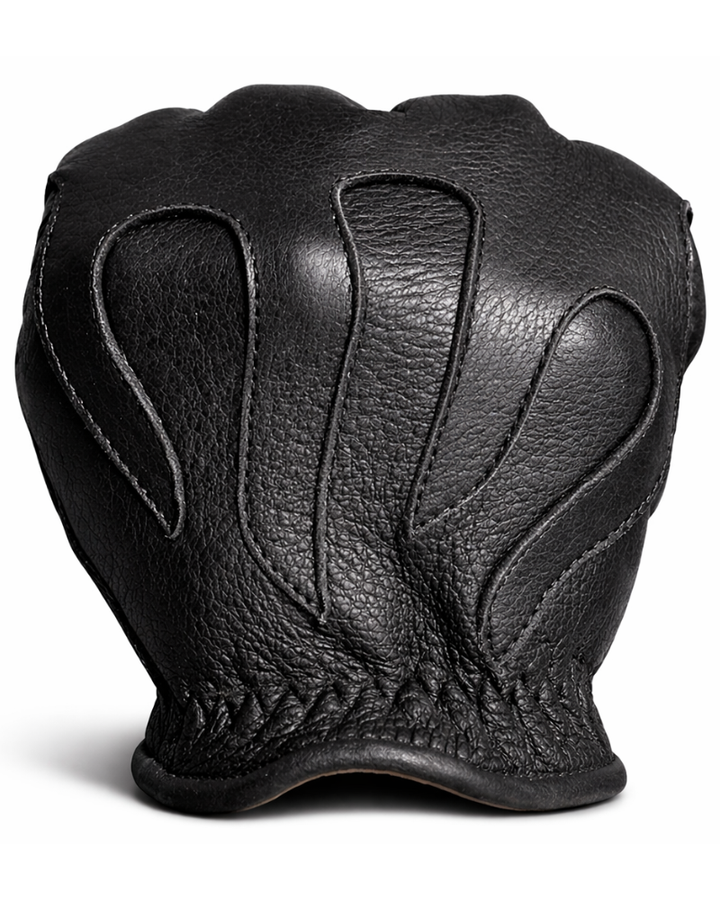
The Legendary Deerskin Short Wrist Touchscreen Gloves combine keystone thumb construction with touchscreen-capable fingertips. This combination matters because using a touchscreen while wearing gloves puts the same kind of angular stress on the thumb saddle that throttle grip does.
Tapping a navigation screen or phone with a gloved thumb involves the same opposition movement as throttle grip. In gloves without keystone thumb construction, this motion creates the same saddle seam stress during the tap. Over time — especially for riders who use GPS navigation frequently — this is a non-trivial source of wear at the thumb saddle.
Keystone thumb construction allows natural thumb opposition for touchscreen use without loading the saddle seam, making it a particularly practical feature for modern riders who integrate technology into their rides.
Does Keystone Thumb Change Sizing?
Keystone thumb construction does not change glove sizing in terms of hand circumference or finger length. These dimensions are determined by the palm panel and finger tube patterns, which are the same regardless of thumb construction method.
What keystone thumb can affect is thumb comfort at a given size. Riders who find standard-thumb gloves feel tight through the thumb web or cause the glove to torque on the hand during grip often find that keystone thumb construction resolves these issues without requiring a size change.
Conversely, riders with very long thumbs relative to their hand size should still verify thumb length when ordering, as keystone construction improves angle fit but doesn’t add length to the thumb tube itself.
Keystone Thumb in Work Gloves vs. Riding Gloves: Same Principle, Different Application
Keystone thumb construction originated in professional work gloves — welding gloves, linemen’s gloves, and heavy equipment operator gloves — where hand fatigue and seam durability under sustained grip use were the primary concerns.
Work glove applications drove the development because the failure modes were expensive and dangerous: a welder’s glove seam failure exposes the thumb to heat; a lineman’s glove seam failure risks electrical exposure. The engineering solution was keystone thumb, which moved into premium riding gloves as the benefits became recognized in the motorcycling community.
The biomechanics are identical between applications — any sustained grip on a handle or tool puts the same rotational stress on the thumb saddle — but riding gloves add the additional challenge of impact protection and leather durability against road surfaces, making keystone thumb even more valuable as part of a complete construction system.
How to Identify Keystone Thumb Construction When Buying Gloves
Keystone thumb construction isn’t always prominently labeled, and not all manufacturers use the same terminology. Here’s how to identify it:
Visual inspection: Put the glove flat on a table, back side up. Look at the thumb. On a standard thumb glove, the thumb lies flat against the palm panel, pointing straight forward. On a keystone thumb glove, the thumb will sit slightly raised and angled outward even when the glove is laid flat — because the thumb panel is pre-set at the opposition angle.
Seam angle inspection: Look at the seam where the thumb meets the palm on the inside (palm side) of the glove. Standard construction shows a clean perpendicular seam. Keystone construction shows a curved, angled seam that follows the saddle shape with a more complex geometry.
Ask the manufacturer or retailer: Specifically ask whether the thumb is flat-set or keystone-set. Quality manufacturers know their construction methods and can answer directly.
Thumb Gusset vs. Keystone Thumb: Related but Different Techniques
A thumb gusset is a separate piece of leather inserted into the thumb seam to add volume and prevent the saddle from pulling tight when the thumb is fully extended. Keystone thumb is a geometry change to the thumb panel angle itself.
These techniques address different problems:
- Thumb gusset: Adds range of motion and prevents the thumb seam from pulling on extension
- Keystone thumb: Reduces angular stress at rest and under throttle grip by pre-setting the thumb angle
Premium gloves often use both: keystone thumb for angle matching, and a gusset for extension range. The Legendary Deerskin Classic Touchscreen Gloves incorporate both principles to provide maximum thumb comfort across the full range of riding hand positions.
Long-Ride Comfort Difference with Keystone Thumb
Short rides don’t reveal the benefit of keystone thumb construction — the difference accumulates over hours. On rides under an hour, most riders can’t detect a difference between standard and keystone thumb construction.
The benefit becomes significant after 3–4 hours of continuous riding. Riders who regularly log 300–500 mile days consistently report less fatigue at the thumb base and less tendency to “shake out” the throttle hand during rest stops when wearing keystone thumb gloves.
The mechanism is cumulative: each individual grip cycle with a standard thumb creates a small rotational stress at the saddle seam. Over thousands of cycles across a long ride day, that accumulating micro-stress translates to hand fatigue that feels like general tiredness in the hand rather than a specific thumb issue. Eliminating the source of the stress at the construction level is more effective than trying to address it through breaks or hand exercises.
Why Premium Glovemakers Use Keystone Thumb vs. Standard Thumb
Standard thumb construction is faster and cheaper to produce. Cutting a trapezoidal keystone panel takes more precision than cutting a rectangular panel, and the angled insertion requires more skilled assembly than a flat-set thumb.
Premium glovemakers use keystone thumb because their market is riders who will notice and value the difference — and because construction quality is their competitive differentiator against mass-market alternatives. When a brand’s reputation is built on gloves lasting 5–10 years and feeling custom on a standard hand, every construction choice matters.
The cost premium associated with keystone thumb construction in the final retail price is modest relative to the comfort and longevity benefit. It’s one of several construction markers — alongside thread grade, palm padding material, and cuff closure design — that distinguish production-quality riding gloves from commodity alternatives.
FAQ: Keystone Thumb Construction in Motorcycle Gloves
What is keystone thumb construction in motorcycle gloves?
Keystone thumb construction is a glovemaking technique where the thumb panel is cut and inserted at a pre-set angle that matches the thumb’s natural position during grip, rather than lying flat against the palm. The angled geometry reduces rotational stress on the thumb saddle seam and improves ergonomic comfort during extended riding.
Why does keystone thumb construction matter for motorcycle riding?
Motorcycle riding involves sustained grip on handlebars and repeated throttle cycling, both of which create rotational stress at the thumb saddle seam. Keystone thumb reduces this stress by pre-matching the glove’s thumb angle to the hand’s natural riding position, reducing fatigue and extending glove lifespan.
How is keystone thumb different from standard thumb construction?
Standard thumb construction sets the thumb panel flat against the palm at a 90-degree angle. Keystone thumb sets the thumb panel at an angled, pre-opposed position matching the natural thumb angle during grip. The result is dramatically reduced rotational stress at the saddle seam.
Does keystone thumb affect glove sizing?
Keystone thumb does not change hand circumference or finger sizing. It affects only the angle and ergonomic fit at the thumb. Some riders find that keystone thumb resolves fit issues at the thumb web without requiring a size change.
Can I tell if a glove has keystone thumb construction by looking at it?
Yes. Lay the glove flat and look at the thumb. A standard thumb lies flat and forward. A keystone thumb sits slightly raised and angled outward, pre-set at the opposition angle. The seam geometry where the thumb meets the palm is also more complex on a keystone thumb glove.
Is keystone thumb construction only used on motorcycle gloves?
No. Keystone thumb originated in professional work gloves — welding gloves, linemen’s gloves, and heavy equipment operator gloves — where sustained grip and seam durability are critical. It moved into premium motorcycle gloves as the benefits became recognized in the riding community.
Does keystone thumb make a difference on short rides?
The benefit is most noticeable on long rides. Riders typically report less hand fatigue after 3–4 hours with keystone thumb gloves compared to standard construction. On short rides under an hour, most riders cannot detect a difference.
What is a thumb gusset and is it different from keystone thumb?
A thumb gusset is a separate piece of leather inserted into the thumb seam to add volume and range of motion. Keystone thumb is a geometry change to the thumb panel angle. They address different problems and are often used together in premium gloves.
Does keystone thumb construction make gloves more expensive?
Yes, modestly. Cutting and inserting a keystone thumb panel requires more precision and skilled assembly time than standard thumb construction. The retail price premium is typically $15–30 over a comparable glove with standard thumb construction.
Are keystone thumb gloves compatible with touchscreen use?
Yes. Keystone thumb construction improves touchscreen use ergonomics because the thumb’s opposition angle during touchscreen tapping is the same angle that keystone construction accommodates. The saddle seam is under minimal stress during touchscreen use, reducing long-term wear at the thumb attachment point.
Why do most motorcycle gloves not have keystone thumb construction?
Standard thumb construction is faster and less expensive to produce. Mass-market and budget gloves prioritize production speed and materials cost. Keystone thumb is a premium feature that adds construction time and requires more skilled assembly, making it economically practical only for brands positioning in the premium segment.
What other construction features should I look for alongside keystone thumb?
Thread grade (industrial vs. standard), palm reinforcement material, seam placement (outseam vs. inseam), leather grade and tannage, and wrist closure design are the other primary construction markers that distinguish premium motorcycle gloves from commodity alternatives. Keystone thumb is one of several features that together indicate a glove built for long-term riding use.