

:%20What%20Makes%20Them%20So%20Great)

Deerskin has been the American riding glove leather for a century, and most explanations of why are vague enough to be useless. This is the specific version: what deerskin actually does that cowhide and goatskin do not, where it is the wrong choice, and how to keep a pair alive for a decade.
What is the softest, most comfortable motorcycle glove material?
Deerskin, and there is a structural reason rather than a marketing one.
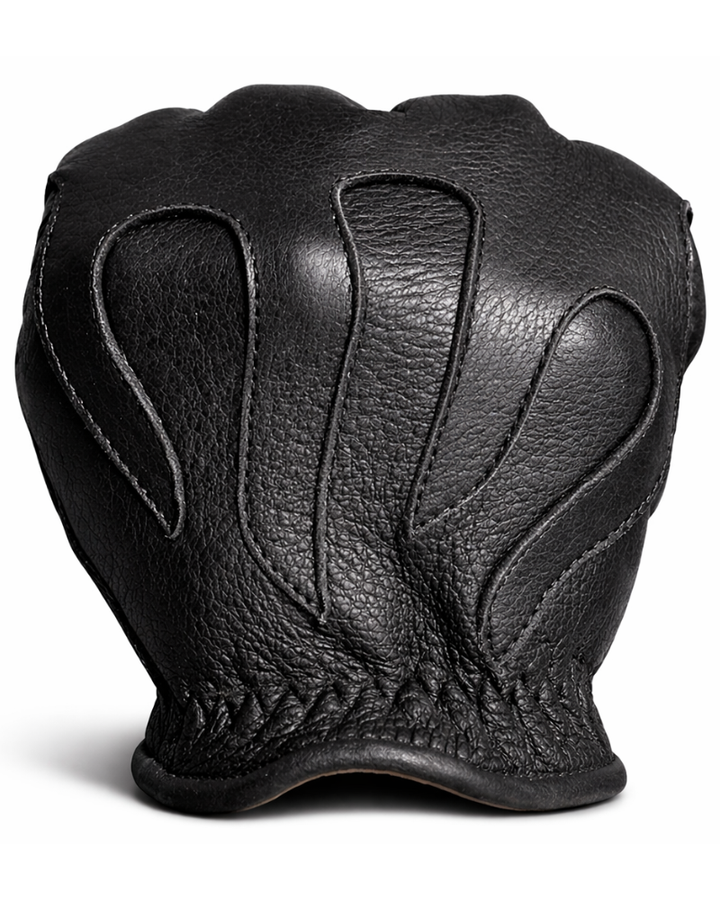
Deer are prey animals that live in brush, so their hide evolved to stretch and recover rather than to armor. The collagen fibers run in a looser, more randomized weave than cowhide, where the fibers are packed tight and parallel. That looser weave is why deerskin is soft on the first wear instead of the fiftieth, and why it stretches without a permanent bagged-out spot afterwards.
Ranked by softness out of the box, for riding gloves:
- Deerskin. Soft immediately, stretches and returns, molds to your hand within a few rides.
- Goatskin. Slightly firmer, with a natural lanolin content that keeps it supple, and a tighter grain that resists abrasion a little better than deerskin at the same thickness.
- Lambskin. The softest of all and the wrong choice for riding. It tears easily and has no business on a motorcycle.
- Cowhide. Toughest, stiffest, longest break in. The right answer for a jacket, an argumentative answer for a glove.
The practical trade: deerskin gives you the most feel at the throttle and the least break in. Goatskin gives up a little softness for a little more abrasion resistance and costs less. Both are correct answers. Lambskin is not.
Why do experienced riders prefer natural leather over synthetic for gloves?
Four reasons, and only one of them is nostalgia.
It molds and stays molded. Leather takes a set from heat and pressure, which is why a two year old glove fits your hand specifically. Synthetics do not take a set. They either fit on day one or they never do.
It fails slowly. Leather scuffs, thins, and eventually wears through, and you can see all of it coming. Coated synthetic fails suddenly: the polyurethane surface cracks along the flex lines and starts flaking off in sheets, usually in year two, and there is no warning.
It manages moisture. Leather absorbs sweat and releases it. A synthetic glove with a synthetic lining holds it against your skin, which is why cheap gloves feel clammy after an hour in the heat.
Grip improves. A leather palm develops a slightly tacky patina from skin oils and use. A synthetic palm starts grabby and polishes smooth.
The honest counterpoint: modern textile and synthetic gloves from serious manufacturers do things leather cannot, especially waterproofing and CE certified impact protection. Preferring leather is a real preference with real reasons, not an objective ranking.
What leather is warmest for motorcycle gloves?
This question has a slightly annoying answer: the leather is not what makes a glove warm. The lining and the wind sealing are.
All the common glove leathers are similar insulators at the same thickness. What actually decides warmth:
- The lining. Fleece, Thinsulate, or wool. This is most of it.
- Wind sealing. An unlined, unperforated leather glove is already a good windbreak, and wind is what steals heat at 60 mph.
- The cuff. A gauntlet that goes over your jacket sleeve stops the column of cold air that runs up your forearm. This matters more than most riders expect and more than an extra 20 grams of insulation would.
- Fit. A glove tight enough to compress the lining is colder than a slightly roomier one, because the trapped air is the insulation.
If you want warmth from a leather glove: unlined deerskin is comfortable down to roughly 50 degrees. Fleece-lined deerskin takes you into the 40s. A gauntlet cuff over a jacket sleeve adds more than the next lining upgrade would. Below about 35 degrees, no unheated leather glove is genuinely comfortable at highway speed, and heated grips or heated gloves are the honest answer rather than thicker leather.
Are lined leather gloves warm enough for winter motorcycle riding?
For 40 to 55 degrees, yes, comfortably. For 32 to 40 degrees, for shorter rides, with a gauntlet cuff, and if you accept that your fingertips will get cold on the highway. Below freezing at speed, no, and any page that says otherwise has not ridden in it. Heated grips warm your palms but not the backs of your fingers, which is where cold actually hurts. Heated gloves are the only complete answer.
Why did my leather motorcycle gloves shrink after getting wet?
They almost certainly did not shrink from the water. They shrank from how they dried.
Leather is collagen fiber. When it gets soaked and then dries fast, especially with heat, the fibers contract and bond to each other in their contracted position. The technical term is hydrothermal shrinkage, and the temperature at which it starts is much lower than people assume, well within the range of a radiator, a car heater vent, or a sunny dashboard. The glove comes out smaller, harder, and permanently so.
How to avoid it: after a wet ride, press out excess water with a towel, then dry the gloves at room temperature, away from any heat source, ideally with your hand shape maintained by loosely balled paper. When they are still slightly damp, put them on for a few minutes so they set to your hand. Then condition them, because water strips the natural oils out on its way through.
If it has already happened: you can sometimes recover part of it. Dampen the glove evenly with room temperature water, work a generous coat of conditioner in, and wear the glove until it dries on your hand. This will not undo severe shrinkage but it often recovers enough to be wearable.
Can you put leather motorcycle gloves in a washing machine?
No. This is one of the few genuinely absolute answers in leather care.
A washing machine combines everything that destroys leather: prolonged soaking, mechanical agitation that breaks the fiber structure, detergent surfactants that strip the tanning oils out, and, if it goes anywhere near a dryer, the heat that causes the shrinkage above. Gloves come out stiff, shrunken, blotchy and smaller, and it is not reversible.
What to do instead, for gloves that genuinely smell:
- Put them on and wash your gloved hands in lukewarm water with a tiny amount of leather soap or a mild unscented soap. Thirty seconds, no soaking.
- Rinse the same way, still wearing them.
- Take them off, press out water with a towel, dry at room temperature away from heat.
- Condition while very slightly damp.
For odor without dirt, a night with a little baking soda inside each glove takes most of it out, and cedar shoe trees or balled paper handle the rest.
What oil or conditioner is best for deerskin motorcycle gloves?
Deerskin is a soft, porous, garment-weight leather, and it needs a lighter hand than a boot or a jacket.
Use: a light cream or lotion conditioner made for garment leather. Lanolin based dressings work well on deerskin. Apply a thin coat with your fingers, let body heat help it in, wait twenty minutes, then buff off anything that has not absorbed.
Avoid:
- Mink oil and heavy greases. They will darken deerskin permanently and can leave the palm slick, which is genuinely the last thing you want on a throttle.
- Neatsfoot oil. Too heavy for garment weight leather. It over-softens and eventually makes the hide limp.
- Saddle soap as a routine step. It is a cleaner, it is alkaline, and repeated use dries deerskin out.
- Anything with silicone or petroleum distillates. They seal the surface so the hide can no longer breathe or absorb conditioner.
How often: once or twice a season for normal riding, and always after a soaking. Less is more. An over-conditioned glove attracts grit and loses grip.
How do you store leather motorcycle gloves over the winter?
Five minutes in autumn saves a pair of gloves.
- Clean off the season. Wipe the salt, bug residue and road film off with a barely damp cloth. Salt is hygroscopic, meaning it pulls moisture in all winter, and that is what causes mold in a stored glove.
- Condition, lightly. A thin coat, buffed off. Leather dries out more in a heated house over winter than it does in a riding season.
- Stuff them. Loosely balled acid-free paper or unprinted newsprint holds the hand shape and stops the fingers creasing flat. A hard crease held for five months becomes a permanent crack line.
- Store flat, in a breathable bag. A cotton pillowcase or a shoe bag. Never a sealed plastic bag or a plastic bin, which traps moisture and grows mildew.
- Somewhere cool, dark and dry. A closet shelf. Not an attic, not a garage, not a basement floor, and never near a furnace or a water heater.
In spring, condition once more before the first ride.
Where Deerskin Is the Wrong Choice
Worth saying since we sell a lot of it. Deerskin is soft, breathable and gives excellent feel, and those same properties make it the wrong glove for a few situations.
It is not waterproof, and it absorbs water readily, so in sustained rain a treated or membrane glove is a better tool. It is thinner than cowhide at the same feel, so for the hardest riding a heavier hide or a CE certified glove with hard protection makes more sense. And unlined deerskin below about 50 degrees is a cold glove, whatever a product page says.
Our deerskin gloves are unarmored. They carry no CE certification, they are not tested to EN 13594, and none of them, including the aramid lined models, are armored gloves. Aramid lining is a real material that resists cutting and abrasion. It is not impact protection and it is not a certification, and we will not describe it as either.
Top Picks, Shop Direct
Four American deerskin gloves chosen to cover the temperature range rather than to climb a price ladder, because with deerskin the question is almost always "what am I riding in" rather than "how much should I spend." One for heat, one for wind, one for cold, and one for the rider who wants the traditional article. Ratings and review counts are live from our own product pages.
| Product | Why it fits this question | From |
|---|---|---|
| Fingerless Deerskin Gloves | The hot weather answer, above roughly 85 degrees, and cheap enough to keep in the saddlebag alongside a full pair. Still covers the palm, which is the part that hits the ground. Rated 4.92 out of 5 across 126 reviews. | $60.00 |
| Classic Deerskin Gauntlets | American whitetail deerskin with a gauntlet cuff that seals over your jacket sleeve, which does more for cold hands than an extra layer of lining would. The pick for spring and autumn distance. Rated 4.88 out of 5 across 112 reviews. | $75.00 |
| Fleece-Lined Deerskin Gloves | The cold weather answer, comfortable into the 40s and usable in the 30s for shorter rides. Fleece is the part doing the work; the deerskin is what makes it feel like nothing on your hand. Rated 4.90 out of 5 across 104 reviews. | $85.00 |
| Churchill Classic Deerskin Gloves | The traditional article, from Churchill, a genuine dealer relationship of ours rather than a house label. Unlined for maximum throttle feel, and the one that molds to your hand fastest. Rated 4.87 out of 5 across 31 reviews. | $120.00 |
If you buy one pair, buy for the coldest riding you actually do, because a warm glove in mild weather is a minor annoyance and a cold glove in cold weather ends the ride. Prices shown are current at time of writing. Orders over $150 ship free.

Browse the full American deerskin glove lineup or the cold weather deerskin gloves.
Frequently Asked Questions
What is the softest, most comfortable motorcycle glove material?
Deerskin. Its collagen fibers run in a looser, more randomized weave than cowhide, which is why it is soft on the first wear and stretches and returns rather than bagging out. Goatskin is next, slightly firmer with a tighter grain and marginally better abrasion resistance. Lambskin is softer still and the wrong choice for riding because it tears. Cowhide is toughest and takes the longest to break in.
What leather is warmest for motorcycle gloves?
The leather is not what makes a glove warm; the lining, the wind sealing and the cuff are. All common glove leathers insulate similarly at the same thickness. Unlined deerskin is comfortable to around 50 degrees, fleece-lined deerskin takes you into the 40s, and a gauntlet cuff worn over the jacket sleeve helps more than an extra layer of insulation. Below about 35 degrees at highway speed, heated grips or heated gloves are the honest answer.
Why did my leather gloves shrink after getting wet?
They shrank from how they dried rather than from the water. When soaked leather dries fast, especially near heat, the collagen fibers contract and set in that position, and the threshold temperature is low enough that a heater vent or a sunny dashboard will do it. Dry wet gloves at room temperature away from heat, keep the hand shape with loosely balled paper, put them on while slightly damp so they set to your hand, then condition, because water strips the oils out.
Can you wash leather motorcycle gloves in a washing machine?
No. A washing machine combines soaking, agitation that breaks the fiber structure, and detergents that strip the tanning oils, and a dryer adds the heat that causes permanent shrinkage. To clean smelly gloves, wear them and wash your gloved hands briefly in lukewarm water with a little leather or mild unscented soap, rinse the same way, press out water with a towel, dry at room temperature, and condition while slightly damp.
What conditioner is best for deerskin motorcycle gloves?
A light cream or lotion conditioner made for garment leather, or a lanolin based dressing, applied thin and buffed off after twenty minutes. Avoid mink oil and heavy greases, which darken deerskin permanently and can leave the palm slick; avoid neatsfoot oil, which is too heavy for garment weight; avoid saddle soap as a routine step; and avoid anything with silicone or petroleum distillates. Once or twice a season is enough, plus after any soaking.