



Among collectors and historians of American motorcycle jackets, the model numbers that come up most often are the 666, the 732, and the 777. The BECK 333 is less frequently discussed — partly because surviving examples are rarer, and partly because it predates the period when the Beck Flying Togs model numbering became widely documented. Understanding the 333 means understanding where the company was before it hit its stride with the designs that defined an era.
The Early Beck Catalog
Beck Flying Togs was established in the 1930s in Cincinnati, Ohio, producing leather outerwear for the motorcycling market at a time when motorcycling culture and the American leather jacket were developing together. The early Beck catalog covered multiple silhouettes — not just the zip-front jacket designs that would later define the brand, but also jackets intended for the aviation and sporting markets that overlapped with motorcycling.
The 333 designation appears in pre-war Beck documentation as an early asymmetric zip style — sharing the basic DNA of what would later become the 666 but with differences in collar construction, pocket placement, and the hardware used for closure. These are not dramatic deviations from what came later, but in the context of a company establishing its visual language, the variations matter. The 333 represents a design iteration in progress rather than a finished statement.
Horsehide Construction
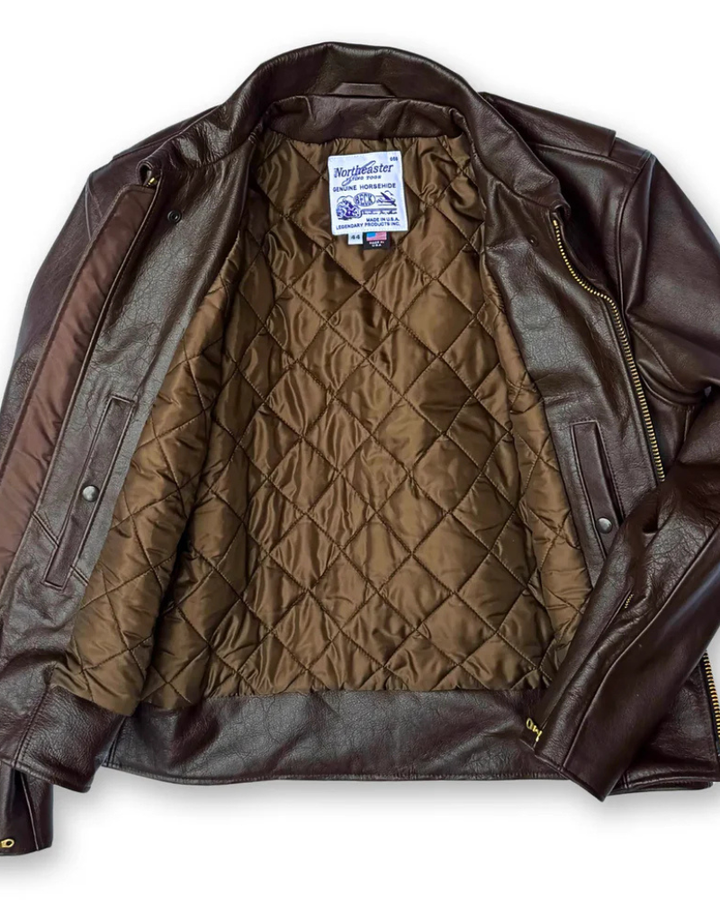
Like all serious Beck production from this period, the 333 was built in horsehide — the same material the company would use through its entire production run. Horsehide's tighter fiber structure compared to cowhide produces a jacket that resists abrasion, ages distinctively, and develops a break-in period that owners historically described as wearing-in rather than wearing-out. The jacket conforms to the wearer's body over time in a way synthetic-backed leathers don't replicate.
This material choice wasn't accidental or purely traditional. Horsehide was the correct specification for a garment that would be worn on a motorcycle at speed in all weather. Beck's choice to use it consistently across the product line established the standard that serious American motorcycle jacket construction would follow.
Why the 333 Is Rarely Discussed
The 333 exists in the shadow of the 666 for a straightforward reason: the 666 is the design that went into wide production, appeared in period photography of American motorcyclists, and was available in large enough quantities that surviving examples can be studied, bought, and compared. The 333 was produced in smaller numbers during a period when Beck's distribution was still developing, which means documented examples are harder to find and catalog.
This scarcity makes the 333 interesting to serious collectors precisely because of the research required to understand it. It's a window into Beck before Beck became Beck — before the company had locked in the design decisions that would define its legacy. For anyone studying the evolution of the American motorcycle jacket as a designed object, the 333 sits at an important junction.
The Legendary USA Connection
When Legendary USA revived the Beck Flying Togs line, the focus was on the models that defined the company's peak production period — the Beck 666, the Beck 732, and the Beck 777. These are the designs with the most documentation, the clearest pattern records, and the strongest connection to American motorcycling history. The 333 represents the company's origin story rather than its defining period.
The horsehide construction that characterized the 333 carries through to every current Beck production piece. The material specification — genuine horsehide, domestic construction, hardware that matches the original — is the thread that connects the pre-war 333 to the jackets available today. Browse the full heritage jacket collection to see where Beck's design language arrived.
The 333 is a footnote in Beck history, but it's a meaningful footnote. It represents the company figuring out what it was going to be — before the answer was obvious, before the model numbers anyone remembers were locked in, and before the horsehide asymmetric zip jacket became the defining garment of American motorcycling style.