


LEGENDARY USA
Goatskin vs Deerskin Motorcycle Gloves
Both are premium leathers. But when it comes to motorcycle gloves, the differences matter — and deerskin wins where it counts most.

Understanding the Two Materials
Both goatskin and deerskin are considered premium leathers in the global motorcycle gear market, and both are meaningfully better than commodity cowhide for glove applications. Legendary USA stocks both hides, so the comparison is not academic here: the Bad Billy Black Goatskin Gloves at $75 and the Churchill Classic Deerskin Gloves at $110 sit in the same catalog. The difference between them is subtle enough that many riders don't investigate it — and as a result, they end up with goatskin gloves when deerskin would serve them substantially better.
Goatskin is the dominant premium leather in European motorcycle gloves. It's thin, lightweight, and has a fine grain that allows good tactile feedback. For sport riding at high revs where minimum bulk and maximum feel are priorities, goatskin has genuine appeal. Its primary liability is also its primary feature: thinness. Thin leather means less material between your hand and the road in a slide — and that's a tradeoff that matters at highway speeds.
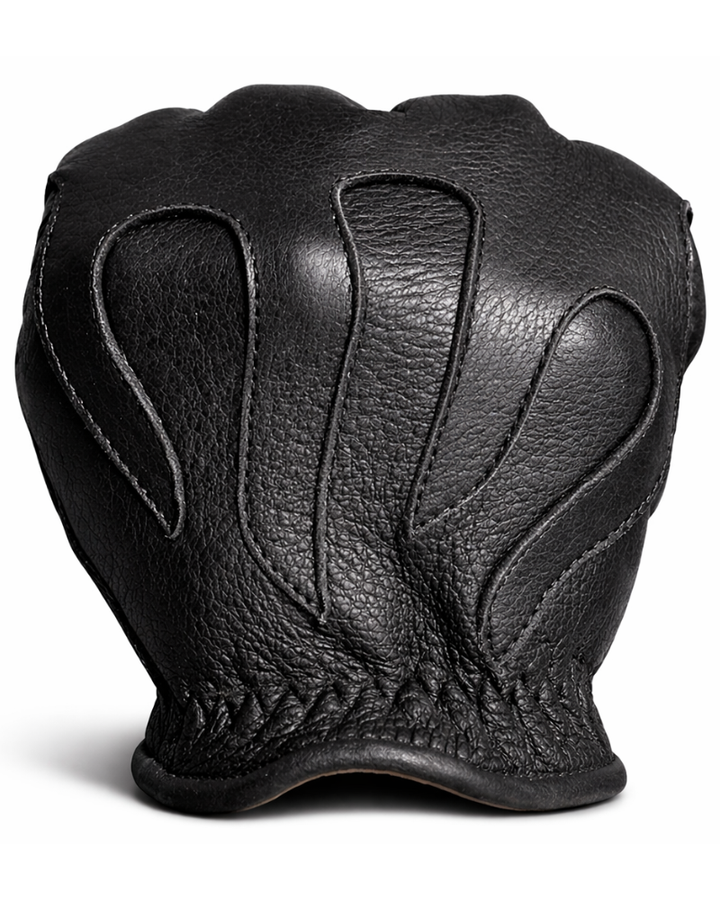
American whitetail deerskin is a different category of material. Where goatskin is thin and light by design, deerskin achieves softness and dexterity through fiber density rather than reduced thickness. The result is a leather that feels equally soft and responsive as goatskin — some riders say softer — while maintaining significantly more abrasion resistance. Deerskin also has naturally higher oil content, which means it retains its suppleness longer without frequent conditioning. For motorcycle riding specifically, where abrasion resistance and longevity are both important, American deerskin is the superior material. That is why Legendary USA builds its glove line on American whitetail deerskin, from the unlined Churchill Classic Deerskin Gloves at $110 to the Classic Deerskin Gauntlets at $140.
Full Material Comparison
| Property | American Deerskin | Goatskin |
|---|---|---|
| Softness | Exceptional — immediate from day one | Very good, thin feel |
| Abrasion Resistance | Excellent — dense fiber structure | Moderate — limited by thinness |
| Thickness | Medium — protection without bulk | Thin — less protective |
| Natural Oil Content | High — low maintenance | Lower — needs more conditioning |
| Longevity | 10–20+ years with care | 5–10 years |
| Best For | All-around riding, touring, protection | Sport/track, minimal bulk priority |
The Legendary USA Deerskin Lineup


Frequently Asked Questions
Is goatskin or deerskin better for motorcycle gloves?
For motorcycle gloves, American whitetail deerskin is the superior choice across virtually every relevant metric. Deerskin is naturally softer and more supple than goatskin while offering significantly better abrasion resistance. Goatskin is thinner and lighter, which can be appealing for warm-weather riding, but that thinness comes at the cost of abrasion resistance. Legendary USA cuts its gloves from American whitetail deerskin for that reason, and the Churchill Classic Deerskin Gloves at $110 are the straightforward place to start.
Why is goatskin popular in some motorcycle gloves if deerskin is better?
Goatskin is popular because it's more widely available and less expensive than premium American deerskin. It's also genuinely thin and lightweight, which appeals to riders who prioritize feel over protection. Many European motorcycle glove brands use goatskin as a premium material — and in the context of European leathers, goatskin is considered a step above standard cowhide. In the context of American deerskin, however, goatskin is a lesser material that trades protection for minimal weight savings. Legendary USA sells both, so riders are not stuck choosing sight unseen: the Bad Billy Black Goatskin Gloves are $75 and the Classic Short Wrist Touchscreen Deerskin Gloves are $105.
Does deerskin require more maintenance than goatskin?
Actually the opposite — American whitetail deerskin requires significantly less maintenance than most other leathers, including goatskin. Deerskin has a naturally high oil content in its fibers that helps it retain moisture and suppleness without frequent conditioning. Most deerskin glove owners condition their gloves once or twice per year and find that's entirely sufficient. Goatskin, being thinner and less dense, tends to dry out faster and requires more attentive conditioning to stay in good condition. Legendary USA works in that same American whitetail hide, in gloves such as the Fleece-Lined Deerskin Gloves at $115, which is why a deerskin pair ridden daily and conditioned once a year commonly stays in service for 10 to 20 years and beyond, where goatskin runs closer to 5 to 10.
What is American whitetail deerskin and why is it special?
American whitetail deerskin comes from white-tailed deer — a species native to North America and found nowhere else in the world in the same population density or hide characteristics. Whitetail deerskin has a uniquely fine, tight fiber structure compared to other deer species or livestock hides. This gives it a combination of softness, flexibility, abrasion resistance, and moisture resistance that no imported or farmed hide can fully replicate. Legendary USA has been sourcing and working with this specific material for decades, and cuts it into gloves like the Classic Deerskin Gauntlets at $140 and the Churchill Short Wrist Deerskin Gloves at $110.
How does the abrasion resistance of deerskin compare to goatskin?
Deerskin has substantially better abrasion resistance than goatskin at equivalent thickness. The key factor is fiber density — deerskin's fibers are tightly packed in a way that resists tearing and abrasion even at the relatively thin gauges used for motorcycle gloves. Goatskin is thinner and less dense, and while it can be stretched to cover more surface area with less material, that also means a thinner layer of leather overall. In back-to-back comparisons, deerskin holds up to abrasion noticeably better. Legendary USA builds to that difference, including the abrasion-resistant aramid-lined Aramid Touchscreen Deerskin Gloves at $120, which are not CE rated but pair the whitetail hide with a tougher inner layer.
Deerskin: The Material That Does It All.
Softer than goatskin. Tougher than goatskin. Lasts longer. Needs less maintenance. American whitetail deerskin is the answer to every compromise goatskin asks you to make.
Shop Legendary USA Gloves