

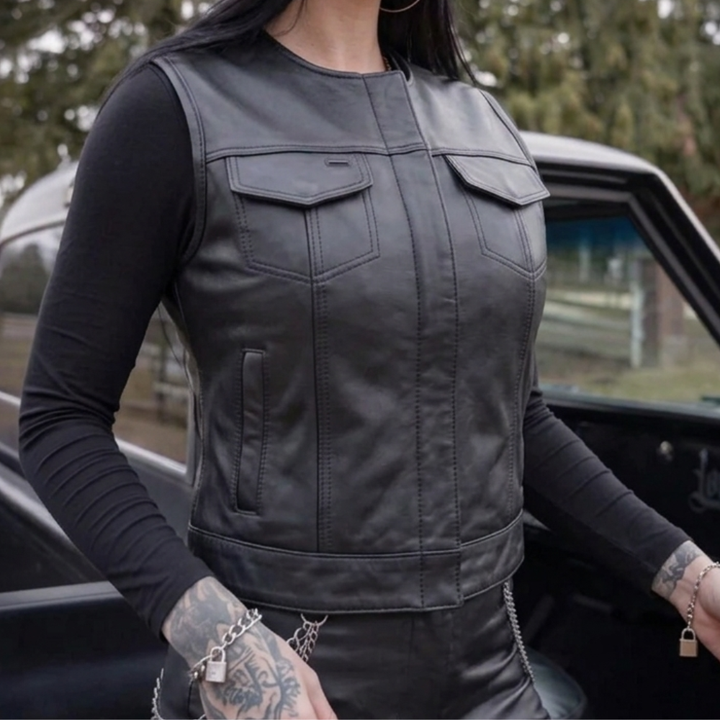


Horsehide
Motorcycle Vests
Motorcycle Jackets
American Made
BECK
Buying Guide
BECK Northeaster Flying Togs is Legendary USA's own American horsehide line. Legendary Products, Inc. owns the BECK Northeaster trademark (USPTO Reg. No. 3083433), and every garment in the line is cut from 1.3mm front quarter horsehide, the densest and most tightly grained section of the hide, and built in the USA. This guide explains what the line is, how the 732, 777, 999, 501 and 666 differ from one another, how horsehide compares with cowhide and steerhide, what break-in actually feels like, and how BECK compares with the other well-known heritage leather shops.
What Is the BECK Northeaster Flying Togs Line?

Northeaster Flying Togs is the label BECK® garments are built under, and the name is the clue to the origin. The line began in flying clothing, and the riding jackets that followed kept the same construction logic: heavy hide, reinforced seams, hardware chosen to be serviceable, and pockets positioned for someone who is sitting down and moving at speed. BECK®'s Northeaster Flying Togs label has produced horsehide riding gear in the USA since 1928.
An important point of clarity, because it is frequently misunderstood: BECK is not an outside brand that Legendary USA resells. Legendary Products, Inc. owns the BECK Northeaster trademark, filed in June 2003 and registered in April 2006 under Reg. No. 3083433. BECK is Legendary's own house line. That is why you will not find it discounted through third-party marketplaces and why sizing, custom orders and warranty questions are handled directly.
The line is broader than most people realize. It spans vests from the 588 at $365.00 through the 566 at $440.00, the 882 fitted vest at $440.00 and the 501 Trucker vest at $440.00; riding shirts including the 302 at $440.00 and the short-sleeve 202 at $475.00; and the jackets covered in detail below, from $725.00 to $845.00. Every one of them uses the same 1.3mm front quarter horsehide.
Why Front Quarter Horsehide Commands a Premium
Horsehide is less common than cowhide to begin with. Horses are working and companion animals rather than animals raised for hide, so supply is limited and the tanning process is more demanding. Front quarter horsehide narrows it further: it is cut specifically from the shoulder and neck section, the area that carries the most physical stress on the animal and develops the tightest fiber structure as a result. The difference is visible in the grain and obvious in the hand.
That density is what gives horsehide its reputation. At 1.3mm it blocks wind noticeably better than cowhide of the same thickness, it resists scuffing and surface wear better, and it holds a garment's shape for decades rather than going slack. The trade is that it starts stiff and takes real wearing time to soften.
One thing horsehide does not do is provide impact protection. BECK® jackets and vests are unarmored garments. They are sold on hide weight, construction quality, American manufacture, fit and longevity. If you want certified impact protection, buy gear built and rated for that purpose and wear it with or under your leather.
Natural scarring and grain variation are characteristics of authentic horsehide rather than defects. No two BECK® garments are identical, because no two hides are.
Horsehide vs Cowhide vs Steerhide
These three get used loosely and often interchangeably in product listings, which is why buyers end up confused. Here is the practical difference.
Cowhide is the broad category and, in practice, usually means hide from a female or young animal. It is the most widely available riding leather, it is the softest of the three from day one, and it is the cheapest to source. Good cowhide at 1.2mm and up makes a genuinely good riding jacket. Its weakness is that it stretches more over time and goes slack at the panels sooner than the other two.
Steerhide comes from mature male cattle and is the heavyweight workhorse of the leather world. It is thicker and firmer than general cowhide, with a more uniform grain, and it is what most serious American heritage jackets use when they are not using horsehide. Steerhide is stiffer than cowhide, softens over a season or two, and holds structure well. If a jacket says only "genuine leather" with no animal named, it is almost never steerhide.
Horsehide, and specifically front quarter horsehide, has the tightest fiber structure of the three. It is the stiffest new, takes the longest to break in, blocks wind best at a given thickness, and resists creasing and scuffing longest. It is also the one that develops the most distinctive individual character as it ages, because the tight grain takes and holds creases in the exact places the wearer bends.
The short version for buyers: choose cowhide if you want comfort immediately at the lowest price, steerhide if you want heavyweight structure without a long break-in, and horsehide if you intend to keep the garment for decades and are willing to earn the fit. Our horsehide vs cowhide comparison goes deeper on the first two.
BECK 732 vs 777 vs 999 vs 501 vs 666: What Actually Differs
All five are 1.3mm front quarter horsehide, made in the USA, stitched with Perma Core thread by American & Efird, with YKK zippers, bi-swing backs or vented gussets for riding range of motion, and concealed carry pistola pockets roughly 9 inches deep. The hide is the same. What separates them is silhouette, collar, hardware finish, lining and pocket layout.
BECK 732: the traditional Northeaster
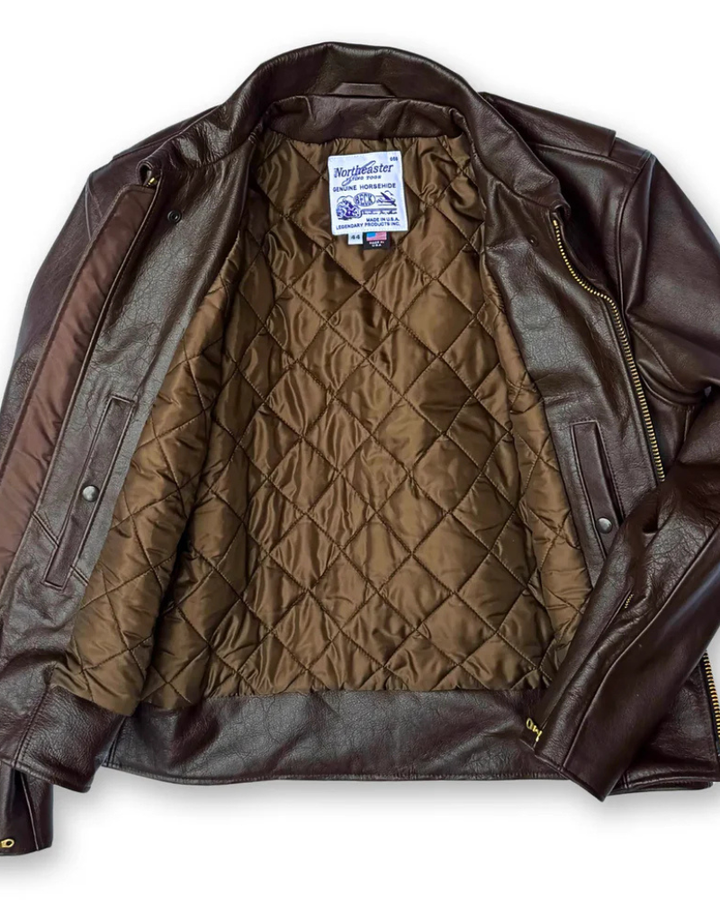
The 732 at $815.00 is the classic Northeaster silhouette and the reference point for the rest of the line. Racer snap collar, nickel-plated brass hardware, diamond-quilted polyester lining with poly-fill insulation, nylon Oxford sleeve lining, side buckle tabs that let you extend the chest for a hoodie or tighten it for a close riding fit, bi-swing back and vented underarm gussets. Also offered in chestnut brown at the same price. Choose the 732 if you want the traditional jacket with the warmest standard lining of the group.
BECK 777: the refined 732, and the most popular
The 777 at $815.00 is the same Northeaster silhouette with refined interior construction and updated hardware over the 732. Antique brass hardware instead of nickel-plated, a snap-down collar rather than the racer snap, and an angled chest pocket layout refined over decades of rider feedback. Same price as the 732, so this is a preference decision on collar style and hardware finish rather than a step up in spec. It is BECK's best-selling current horsehide jacket.
BECK 999: the top of the line
The 999 at $845.00 is the buy-once jacket. Drum-dyed black horsehide with a half-belt rather than a full-body belt, chosen deliberately with rider input for range of motion, no side laces, and shoulder epaulets without decorative hardware. Pocket layout is the most rider-specific in the line: an asymmetrical zippered chest pocket, a hidden left-front snap change pocket and two zippered hand warmer pockets positioned for use on the bike. Heavy nylon A&E reinforced thread, chrome YKK zippers, nickel-plated custom snaps, sewn-in quilted nylon lining with an interior chest pocket. Choose the 999 if you want the heaviest, longest-wearing jacket in the line and the cleanest silhouette.
BECK 501: the trucker
The 501 at $725.00 is the 1960s denim trucker silhouette translated into horsehide. Waist length, pointed chest pockets, vertical seams, covered snap front zipper and covered snap collar, exposed snap cuff tighteners and rear snap waist tighteners. The concealed carry pockets are 500 Cordura lined and the exterior hand pockets 200 Cordura lined, with Oxford nylon lining throughout rather than a quilted insulated lining. It is the least expensive way into the line, the shortest cut, and the easiest to wear off the bike. It is also the coolest in warm weather, since it has no insulated lining.
BECK 666: the distressed cafe racer
The 666 at $815.00 is the distressed version. The horsehide is aniline drum-dyed and then tumbled for 60 minutes, which works the fibers open mechanically rather than coating the surface, so it arrives with the appearance and hand of a jacket already ridden in for years. Cafe racer mandarin collar with snap closure, solid brass YKK zippers throughout, 100% cotton buffalo plaid flannel lining, zippered sleeve cuffs with wind flaps, bi-swing back and vented gussets. It carries a Lifetime Guarantee from Legendary USA. Choose the 666 if you want a short mandarin-collar cafe cut and do not want to spend three years earning the patina.
The quick decision: traditional and warmest lining, take the 732. Same jacket with different collar and hardware, take the 777. Best and heaviest, take the 999. Shortest, coolest and least expensive, take the 501. Pre-broken-in cafe cut, take the 666.
Top Picks, Shop Direct
These four cover the four reasons people actually arrive at this page: the most popular jacket, the best jacket, the most affordable way into horsehide, and the vest the line is best known for. All are 1.3mm front quarter horsehide made in the USA, all are unarmored garments chosen on hide, construction and longevity, and all show the live customer rating and review count below.
| Product | Why it fits this question | From |
|---|---|---|
| BECK® 777 Northeaster Flying Togs Horsehide Jacket | The most popular jacket in the line and the default answer to "which BECK should I buy". Refined interior over the 732, antique brass hardware, snap-down collar. Rated 4.90 out of 5 from 30 reviews. Runs 38 through 56. | $815.00 |
| BECK® 999 Genuine Horsehide Motorcycle Jacket | Top of the Northeaster line and the buy-once pick. Half-belt for riding range of motion, rider-designed pocket layout, heaviest build in the range. Rated 4.97 out of 5 from 37 reviews. Runs 36 through 56 plus a Custom size. | $845.00 |
| BECK® 501 Trucker Style Horsehide Jacket | The least expensive route into 1.3mm American horsehide, and the most wearable off the bike. Waist-length trucker cut, Cordura-lined pockets, uninsulated so it works in milder weather. Rated 4.93 out of 5 from 41 reviews. Runs 36 through 56 plus a Custom size. | $725.00 |
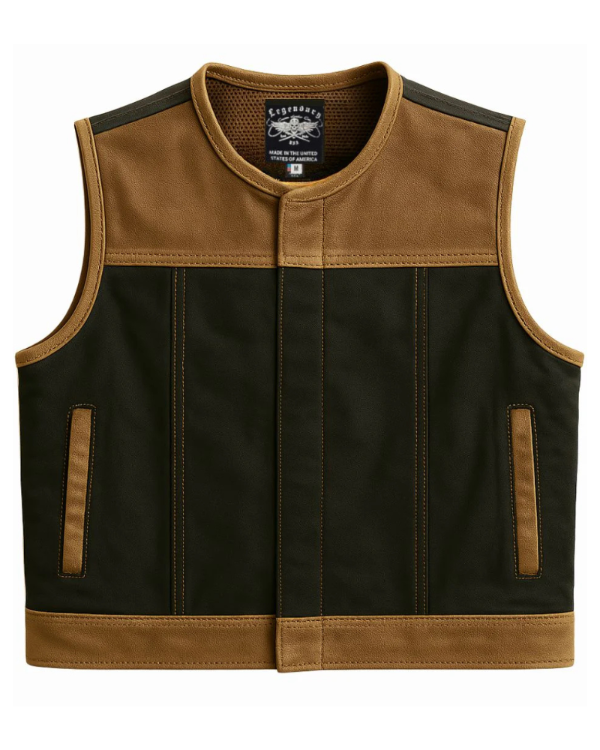
| BECK® 566 Horsehide Motorcycle Vest, Chestnut Brown | The vest the line is known for. Brown horsehide develops the richest amber and tobacco tones with wear. Highest-rated item here at 4.99 out of 5 from 71 reviews. Runs 38 through 56. | $440.00 |
If you are buying your first piece of horsehide, the 566 vest or the 501 jacket are the two lowest-risk entries. If you already know you want the jacket you will keep for twenty years, order the 999. Prices shown are current at time of writing. Orders over $150 ship free.
The full BECK Northeaster Flying Togs lineup, all models and all sizes, is available at Legendary USA.
Browse the BECK CollectionHow BECK Horsehide Breaks In
Horsehide break-in is the single thing new buyers ask about most, and the honest answer is that it takes longer than you expect and is worth it.
Weeks one to four. The jacket or vest feels stiff and board-like, particularly across the shoulders and at the front closure. It will feel like it is holding you rather than fitting you. This is normal and is not a sizing error, provided you can close it and reach the bars.
Months one to three. The hide begins to crease at the elbows, the front of the shoulders and the waist. Those creases are permanent and they are what the finished fit is made of. The garment starts to move with you rather than against you.
Months three to six. Most riders describe the garment as properly broken in somewhere in this window with regular wear. The leather has taken the shape of your specific shoulders and posture and no longer resists movement.
After that. The break-in never entirely stops; it just slows down and turns into patina. Front quarter horsehide keeps developing surface character for years.
Two things speed break-in honestly: wearing it, and conditioning it lightly once the initial finish has settled. Nothing else is worth doing. Do not soak it, do not force it, and do not heat it. A light coat of Obenauf's Heavy Duty LP Conditioner at $15.99 after the first season keeps the fibers supple while it is forming its shape. Our leather care guide covers the routine in full.
Aero Leather vs American Horsehide Makers
This comparison comes up constantly and it starts with a factual correction: Aero Leather Clothing is not an American maker. Aero is based in Galashiels, Scotland. The confusion is understandable, because Aero builds meticulous reproductions of American patterns, sells heavily into the United States, and works extensively in horsehide. But a jacket from Aero is a Scottish-made jacket built to an American pattern, not an American-made jacket.
If "made in America" is part of what you are buying, the distinction matters. The genuinely American horsehide and heavyweight leather shops include BECK® Northeaster Flying Togs, built in the USA; Langlitz Leathers of Portland, Oregon, which has made custom riding leathers since 1947; Vanson Leathers of Fall River, Massachusetts, which works primarily in heavyweight competition-weight cowhide; and Schott NYC, which has manufactured in the United States since 1913.
How BECK sits against Aero specifically: both work in genuine horsehide and both build to a standard that will outlive the buyer's interest in fashion. Aero's strength is bespoke pattern fidelity and a very wide range of vintage repro patterns, with lead times to match and international shipping and duties on top. BECK's strength is that it is an American-built horsehide garment, available in a standard 36 to 56 size run with custom sizing available, supported domestically, at $725.00 to $845.00 for jackets with no import duty. If you want an exact reproduction of a specific 1930s pattern, Aero is the specialist. If you want American-made horsehide you can order, size and service domestically, that is what BECK is for.
For a broader survey of the domestic field, including where Vanson and Schott differ from one another, see our Best American Motorcycle Gear Brands roundup.
The Concealed Carry Pocket: Practical History in Every Seam
Every BECK® jacket in the line carries two concealed pistola pockets roughly 9 inches deep, and on the 501 they are lined in 500 denier Cordura. The design logic traces to flight clothing, where internal pockets for maps, instruments and personal items had to stay closed under any physical condition. On a riding garment the function translates directly: a deep interior pocket that will not spring open in highway wind or during a hard maneuver.
It is not the most visible feature on the garment, but it is the sort of detail that separates a jacket built for use from one built for a photograph. Someone who actually rode thought about what the pocket needed to do, not just how it needed to look.
Where BECK Fits in American Riding Heritage
The American horsehide riding garment has roots that predate the interstate highway system. Early riders, many of them veterans who had worn leather flight gear during the war, carried a preference for durable functional leather into the riding world. The Northeaster Flying Togs label sits in exactly that lineage, moving from flying clothing into riding gear while keeping the same materials and the same construction logic.
For riders assembling a kit around American-made gear with documented provenance, the full BECK Northeaster Flying Togs buying guide goes deeper into each model, sizing, break-in timelines and horsehide care.
Frequently Asked Questions
What is the BECK Northeaster Flying Togs line?
Northeaster Flying Togs is the label BECK® garments are built under, and it is Legendary USA's own house line rather than an outside brand it resells. Legendary Products, Inc. owns the BECK Northeaster trademark, USPTO Reg. No. 3083433, filed June 2003 and registered April 2006. The label has produced horsehide riding gear in the USA since 1928. The line spans vests from $365.00 to $495.00, riding shirts at $475.00 and $545.00, and jackets from $725.00 to $845.00, all built from 1.3mm front quarter horsehide.
What is the difference between the BECK 732, 777, 999, 501 and 666?
All five use the same 1.3mm front quarter horsehide, Perma Core thread and YKK zippers, and all are made in the USA. The 732 at $815.00 is the traditional Northeaster with a racer snap collar, nickel-plated brass hardware and a diamond-quilted insulated lining. The 777 at $815.00 is the same silhouette with refined interior construction, antique brass hardware, a snap-down collar and an angled chest pocket layout, and it is the best seller. The 999 at $845.00 is the top of the line, with a half-belt instead of a full belt, no side laces, epaulets, a rider-designed pocket layout and the heaviest build. The 501 at $725.00 is a waist-length 1960s trucker silhouette with Cordura-lined pockets and no insulated lining, making it the coolest and least expensive. The 666 at $815.00 is aniline drum-dyed and tumbled for 60 minutes so it arrives pre-distressed, with a cafe racer mandarin collar and cotton buffalo plaid flannel lining.
Horsehide vs cowhide vs steerhide: which is better for a motorcycle jacket?
Cowhide is the most widely available and the softest from day one, but it stretches most and goes slack soonest. Steerhide, from mature male cattle, is thicker and firmer with a more uniform grain and holds structure well with a shorter break-in than horsehide. Front quarter horsehide has the tightest fiber structure of the three: stiffest when new, longest to break in, best wind blocking at a given thickness, and the most resistant to creasing and scuffing over decades. Choose cowhide for immediate comfort at the lowest price, steerhide for heavyweight structure without a long break-in, and horsehide if you intend to keep the garment for decades.
How does BECK horsehide break in?
Expect the garment to feel stiff and board-like for the first month, particularly across the shoulders and front closure. Between months one and three it creases permanently at the elbows, shoulders and waist, and those creases become the finished fit. Most riders describe it as properly broken in between three and six months of regular wear. After that the break-in turns into patina and continues slowly for years. Wearing it is what breaks it in; a light coat of conditioner after the first season keeps the fibers supple. Do not soak it, force it or heat it.
Aero Leather vs American horsehide makers: how do they compare?
Aero Leather Clothing is Scottish, based in Galashiels, not American. It builds excellent horsehide reproductions of American patterns, which is why it is often mistaken for a domestic maker. Genuinely American horsehide and heavyweight leather shops include BECK Northeaster Flying Togs, Langlitz Leathers of Portland Oregon, Vanson Leathers of Fall River Massachusetts, and Schott NYC. Aero's strength is bespoke pattern fidelity across a wide range of vintage repro patterns, with long lead times plus international shipping and duties. BECK's strength is American-made horsehide in a standard 36 to 56 size run with custom sizing, supported domestically, at $725.00 to $845.00 for jackets and no import duty.
How should I size a BECK horsehide garment?
BECK fits closer than cowhide because horsehide has less natural give. If you are between sizes, size up. A garment that feels snug on first try will soften over the break-in period to reach a proper fit, but one that starts too small will not improve, because horsehide creases and softens rather than growing. Several models including the 732, 999 and 501 offer a Custom size alongside the standard 36 to 56 run, which is the right choice for a long torso or unusually long arms. Full size charts and per-model fit notes are in the BECK buying guide at legendaryusa.com/pages/beck-northeaster-flying-togs-guide.
Can I wear a BECK vest year-round?
BECK horsehide vests are built for three-season use. The leather provides wind block and mild cold resistance, but without a liner they are not insulated garments. In cooler months most riders layer a BECK vest over a thermal base or flannel. In summer the vest breathes better than a jacket and works well on rides where a full jacket is too warm but some leather coverage is still wanted.