



The best motorcycle gloves for sweaty hands are unlined, perforated leather gloves in deerskin or goatskin. Unlined leather sits directly against your skin, absorbs moisture, and releases it as the glove dries, while perforation moves air across the back of the hand at road speed. Legendary USA builds gloves for this exact problem in American deerskin and goatskin, cut and sewn in the United States.
Sweaty hands are not a small annoyance. A wet palm inside a glove costs you grip feel, and lost grip feel is the reason riders start squeezing the bar harder than they need to. That is where hand fatigue comes from on a long August day. Choosing the right leather and the right construction fixes more than comfort.
Top Picks, Shop Direct
Three things actually help a hand that sweats: airflow through the leather, less material on the hand, and a color that reflects sun instead of soaking it up. That last one is why the White Glove Series runs cooler than black leather in direct sun. The picks below cover all three approaches.
| Product | Why it works for sweaty hands | From |
|---|---|---|
| White Fingerless Ventilated Gloves | Fingerless, ventilated and white. The most heat you can shed without giving up a real leather palm. Rated 4.85 from 40 customer reviews. | $95.00 |
| Fingerless Deerskin Gloves | The classic fingerless cut. Nothing traps sweat around the fingers because there is nothing there. Rated 4.92 from 126 customer reviews. | $60.00 |
| Holy Blanco Ventilated Gloves | Full finger coverage with ventilated panels in white leather. Touchscreen fingertips, so the gloves stay on at every stop. Rated 4.84 from 49 customer reviews. | $115.00 |
| Ventilated Touchscreen Deerskin Gloves | Ventilated full finger deerskin with touchscreen fingertips, in the classic dark colorway. Rated 4.95 from 117 customer reviews. | $120.00 |
All four are American whitetail deerskin, which breathes better than cowhide and stays soft as it dries. See the full glove collection. Prices shown are current at time of writing. Orders over $150 ship free.
Why Hands Sweat Inside Motorcycle Gloves

Hands sweat inside gloves for three reasons: trapped heat, poor airflow, and a liner that holds moisture against the skin. Palms have a high concentration of sweat glands, and a closed leather glove in direct sun becomes a small oven. At highway speed the back of the hand gets airflow, but the palm is wrapped around a grip and gets almost none.
Black leather absorbs more solar heat than tan or white leather. That is a real difference on a long ride in full sun, though it is a smaller factor than lining and perforation. If you are choosing between the Bad Billy in black goatskin and the Bad Billy in tan goatskin, the tan pair will run slightly cooler in direct sun. It will also show road grime sooner. That is the honest tradeoff.
Unlined Leather Beats Lined Leather for Sweaty Hands
An unlined glove puts the hide directly against your skin, and leather is naturally absorbent. Sweat moves into the leather and then evaporates out of it. A lined glove adds a second layer that most often holds moisture instead of moving it, and once a liner is soaked it stays soaked for the rest of the ride.
Unlined leather has costs. It shows sweat staining on the inside over time, and it will stiffen if you dry it with heat. Air-dry an unlined glove at room temperature and it stays supple. Put it on a heater vent and you will cook the oils out of the hide. Our full breakdown of lined vs unlined leather motorcycle gloves covers where each one belongs in a rotation.
Deerskin vs Goatskin for Sweaty Hands
Deerskin is the softer and more absorbent of the two. It molds to your hand quickly, feels good against a damp palm, and breaks in within two to three weeks of regular riding. Goatskin is denser, more abrasion-resistant, and holds its shape better through repeated wet-and-dry cycles, but it takes longer to soften.
For a rider whose hands sweat heavily, the practical split is this: deerskin for comfort and grip feel, goatskin for structure and longevity. Neither one is hard armor, and neither should be sold as such. If you want the long-form comparison, read deerskin vs goatskin motorcycle gloves.
Perforated vs Solid Leather
Perforated leather moves air. Solid leather blocks wind. On a ninety-degree afternoon, a perforated glove is measurably more comfortable because airflow across the back of the hand carries heat away before it becomes sweat. On a fifty-degree fall morning, the same perforation pushes cold air onto your knuckles and becomes a liability.
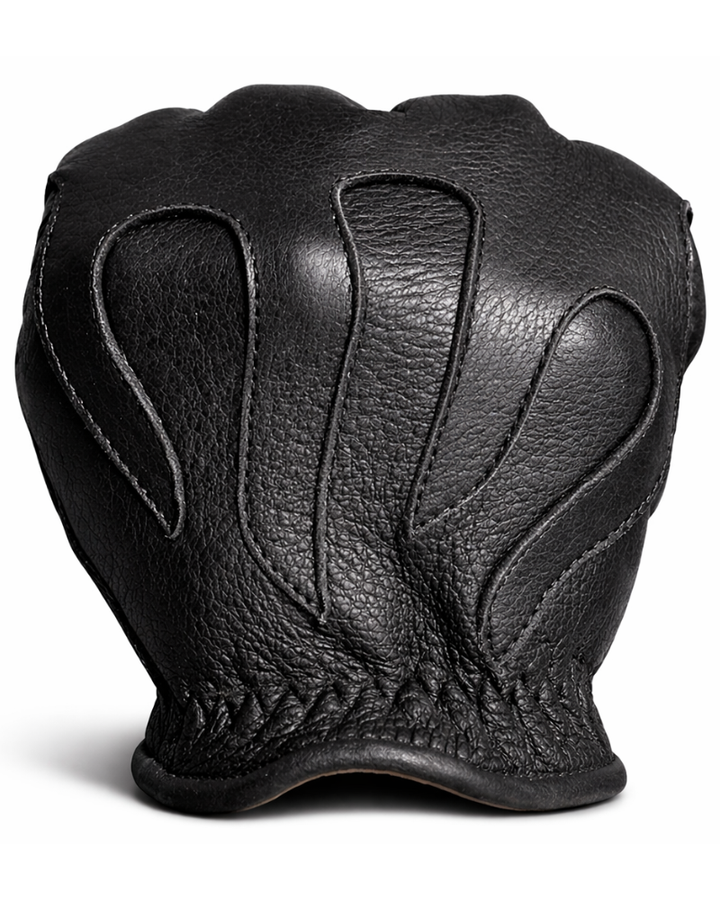
Perforation is a summer feature, not a year-round one. Riders who sweat in July and freeze in October are better off with two pairs than one compromise glove. The ILL DOZER perforated deerskin glove is built for the hot end of that split, with outseam construction that keeps seam bulk on the outside of the finger instead of pressing into it.
How to Size Gloves When Your Hands Sweat
Size snug. A loose glove slides on a wet hand, and sliding leather is what raises hot spots and blisters over a long day. There should be no bunched leather in the palm and no empty space at the fingertips. Leather stretches with wear, so a glove that feels slightly firm when new usually settles into a correct fit within two to three weeks.
Check the fit in the riding position, not standing at a counter. Close your hand around an imaginary grip. If the back of the glove pulls tight across the knuckles or the palm gathers into a ridge, the size or the cut is wrong. Our motorcycle glove sizing guide walks through the measurement.
Legendary USA Gloves Worth Considering
These are the pairs from the Made in USA motorcycle gloves collection that fit this problem best.
ILL DOZER Perforated Deerskin
Perforated American deerskin with outseam construction. Best for hot-weather riders who want maximum airflow and the softest break-in. Not the pair for cool mornings.
Ventilated Touchscreen Deerskin
The ventilated deerskin glove adds touchscreen capability for riders who navigate from a phone at gas stops. Same warm-weather limits as any ventilated glove.
Bad Billy Goatskin
Unlined goatskin, short wrist. Best for the rider who wants a glove that stays structured across several hard summers. Break-in takes longer than deerskin.
Fingerless Deerskin
The fingerless deerskin glove removes the sweat problem in the fingers entirely. It also removes finger coverage, and exposed skin takes full sun. Short rides and town use.
Common Mistakes Riders Make
Buying a size up to get more airflow. It does not work, and it introduces movement inside the glove. Drying gloves with heat, which stiffens the hide permanently. Leaving damp gloves in a saddlebag overnight, which is how leather sours. Running one pair year-round, which forces a compromise in both directions.
The fix for most of these is a rotation. Two pairs, alternated, each getting a full day to dry, will both feel better and last longer than one pair worn every day.
Frequently Asked Questions
- What are the best motorcycle gloves for sweaty hands?
- Unlined, perforated leather gloves in deerskin or goatskin are the best choice for sweaty hands. Unlined leather sits directly against your skin, absorbs moisture, and releases it as the glove dries between rides. Perforation lets airflow move across the back of the hand at road speed, which carries heat away before it turns into sweat. Legendary USA builds the ILL DOZER in perforated American deerskin and the Bad Billy in unlined goatskin, and both are built on this principle.
- Do unlined leather gloves really help with sweaty hands?
- Yes. A liner adds a second layer between your hand and the leather, and most liners hold moisture instead of moving it out. Unlined leather lets the hide itself absorb sweat and then dry. The tradeoff is that unlined gloves show sweat marks on the inside over time and can stiffen if you dry them with heat. Air-dry them at room temperature and they stay soft.
- Is deerskin or goatskin better for sweaty hands?
- Deerskin is softer and more absorbent, so it feels better against a damp hand and molds to your grip faster. Goatskin is denser and more abrasion-resistant, and it holds its shape better through repeated wet-and-dry cycles. If comfort and immediate break-in matter most, choose deerskin. If you want a glove that stays structured over several hard summers, choose goatskin. Both are used unlined at Legendary USA.
- Should I size up if my hands sweat?
- No. Size for a snug fit with no bunched leather in the palm. A loose glove slides on a sweaty hand, and sliding leather is what causes hot spots and blisters. Leather gloves stretch during break-in, so a glove that is slightly firm on day one usually fits correctly within two to three weeks of regular riding. A glove sized large will only get larger.
- Are fingerless gloves a good option for sweaty hands?
- Fingerless gloves solve the sweat problem in the fingers because the fingers are open to the air. They do not protect your fingers, and the exposed skin takes full sun on a long day. They work well for short summer rides and around-town use. For a full day of highway miles, a perforated full-finger glove usually beats fingerless because it manages heat without leaving skin exposed.
- How do I keep sweaty leather gloves from smelling?
- Pull the gloves off finger by finger instead of yanking them from the cuff, open the cuff wide, and let them air-dry at room temperature away from sun and heat vents. Never leave damp gloves in a saddlebag or a closed helmet. Rotating two pairs so each gets a full day to dry is the single most effective habit for keeping leather gloves from turning sour.
- Do perforated gloves work in cool weather?
- Not well. Perforation is a heat-management feature, and the same holes that move air on a ninety-degree afternoon will push cold air straight onto your hands at fifty degrees. Riders who deal with sweat in summer and cold in fall are better served by two pairs than by one compromise glove. Keep a perforated pair for heat and an unperforated or lined pair for the cool end of the season.
The Bottom Line
If your hands sweat, buy unlined leather, buy perforated for summer, size it snug, and give it a full day to dry between rides. Deerskin gets you comfort and fast break-in. Goatskin gets you structure and a longer service life. Neither is a miracle, and both work better in a two-pair rotation than alone. That is the whole answer, and it has not changed in the twenty-five years Legendary USA has been selling American-made riding gloves.