



Cockpit USA Flight Jackets: A Deep Dive for Serious Collectors
Cockpit USA doesn't make flight jackets that look like military originals. They make flight jackets built to the same contract specifications the US military used. That distinction — spec-authentic vs. visually authentic — is the entire point for collectors who know the difference and the riders who want gear built to a real standard. Here's the detailed breakdown of every Cockpit USA model, what makes it specification-correct, and how to choose.
How Cockpit USA Operates Differently
Most flight jacket manufacturers use WWII originals as visual references. They study the silhouette, the pocket placement, the collar style, and reproduce the appearance. What they don't reproduce is the specification: the exact material call-outs, the hardware specifications, the stitching density requirements, the lining construction standards.
Cockpit USA holds the original US military contract documents for the G-1, B-3, and A-2 and builds to those documents. When the G-1 specification calls for lambskin, Cockpit USA uses lambskin — not an alternative that photographs similarly. When the B-3 specification calls for sheepskin at a particular shearling density, that's what goes into the jacket. This is why military museums use Cockpit USA jackets in their displays and why film productions requiring period accuracy specify them for principal cast.
Legendary USA is an authorized Cockpit USA dealer. The full collection is at legendaryusa.com/collections/cockpit-usa.
The A-2: The Specification Standard
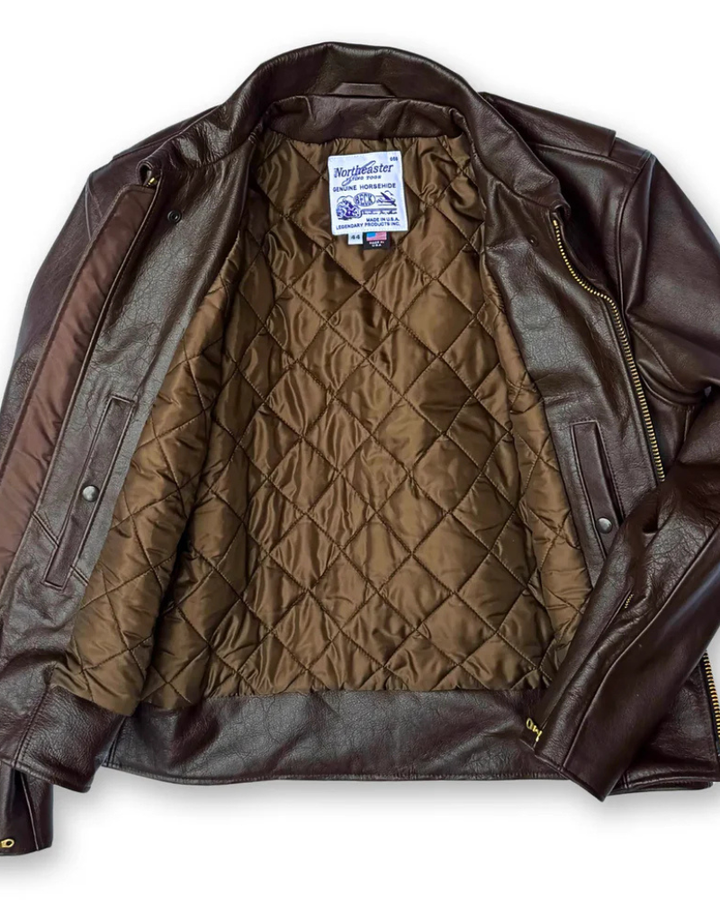
The A-2 is the jacket that defined what a flight jacket looks like. Issued from 1931 through WWII, it established the template — fitted horsehide body, shirt collar, knit cuffs and hem, snap front, internal chest pocket, two lower flap pockets — that every flight jacket since has referenced. Cockpit USA's A-2 is built to that original specification: horsehide leather, correct collar construction, period-accurate hardware.
For collectors, the key differentiators of a specification-correct A-2 are: the collar shape (true shirt collar, not flight officer collar), the snap gauge and finish, the knit composition and color, the internal pocket construction, and the label format. Cockpit USA addresses all of these because they're working from the original documents, not from photographs of surviving originals.
The full Cockpit USA A-2 and related models are available through the Cockpit USA collection at Legendary USA.
The G-1: Navy and Marine Corps Specification
The Cockpit USA G-1 is built to the US Navy and Marine Corps flight jacket specification. The Navy spec differs from the Army spec in material and silhouette: lambskin rather than horsehide, a slightly different knit collar treatment, and a fit profile that reflects Naval aviation's different operational requirements.
The antique lambskin finish on the Cockpit USA G-1 replicates the appearance of broken-in original G-1s — the slight distress to the surface that accumulates on a leather jacket worn in service. This is not artificial aging for aesthetic effect; it's the Cockpit USA interpretation of what a G-1 looks like after it's been properly worn in, built in at the manufacturing stage.
For collectors: the G-1 is the correct choice for Navy and Marine Corps aviation history focus. For riders: the G-1 is the most rider-friendly Cockpit USA model — lambskin is lighter than horsehide, the fitted silhouette stays in place at speed, and the shorter cut doesn't bind when seated.
The B-3: Army Air Corps Cold Weather Specification
The Cockpit USA B-3 is built to the Army Air Corps specification for high-altitude cold weather protection. The B-3 entered service in the late 1930s and was worn by bomber crews on missions where unpressurized aircraft at 25,000 feet created survival-level cold exposure. The sheepskin construction — suede exterior, dense shearling interior, large fur-lined collar — was the correct answer to that thermal problem.
Cockpit USA's B-3 uses sheepskin of the density and construction specified in the original contract. The jacket is substantial — it's supposed to be. This is not a jacket that was designed for freedom of movement; it was designed to keep bomber crew members alive in conditions that would otherwise be incapacitating. For collectors focused on Army Air Corps history, or for riders who need serious cold-weather outer layer capability, the B-3 is correct.
The Modified Raider: Modern Application of Military Standards
The Modified Raider applies Cockpit USA's construction standards to a G-2 based design — the leather jacket issued to Naval aviators in the jet era. The G-2 updated the G-1 design for jet-age operations, and the Modified Raider adapts it further for everyday wear and riding use. For riders who want Cockpit USA's material quality in a longer, more coverage-forward silhouette, the Modified Raider provides it.
Frequently Asked Questions
What makes Cockpit USA different from other flight jacket brands?
Cockpit USA holds the original US military contract specifications for the G-1, B-3, and A-2 and builds to those documents exactly. This means correct materials — lambskin for G-1, sheepskin for B-3, horsehide for A-2 — correct hardware specifications, correct stitching standards, and correct construction details at every level. Other brands use WWII originals as visual references and reproduce the appearance. Cockpit USA reproduces the specification. Military museums, film productions requiring period accuracy, and serious collectors distinguish between these two approaches.
Which Cockpit USA model is closest to the original WWII specification?
All three — G-1, B-3, and A-2 — are built to their respective original WWII specifications. The A-2 is the Army Air Corps spec, the G-1 is the Navy/Marine Corps spec, and the B-3 is the Army Air Corps cold-weather spec. "Closest to original" depends on which branch and mission type you're focused on. For the most iconic American military leather jacket, the A-2 is the reference standard. For Navy aviation history, the G-1 is correct.
How do I size for a Cockpit USA jacket?
Cockpit USA jackets are cut to military specification, which runs trim. Measure your chest at its widest point and use the Cockpit USA size chart as your primary reference. For the G-1, size to your chest measurement; if between sizes, size up. For the B-3, size up at least one size from your chest measurement — the shearling interior takes significant space and the spec is designed for layering underneath. For the Modified Raider, true to chest measurement with modest room for a light mid-layer.
Are Cockpit USA jackets practical for motorcycle riding?
Yes, with some model-specific notes. The G-1 is the most rider-practical — lightweight lambskin, fitted silhouette, natural range of motion. The Modified Raider provides good riding coverage with a longer cut. The B-3 works for cold-weather slow riding but is bulky for spirited highway miles. None of the jackets include armor pockets, as they're built to military spec rather than motorcycle-safety spec. Riders who choose flight jackets for riding accept that trade-off in exchange for specification-authentic construction.
Building a Cockpit USA Collection
For collectors building across all three WWII military specifications: the A-2 establishes the Army Air Corps standard, the G-1 establishes the Naval aviation standard, and the B-3 establishes the cold-weather operational standard. Together they represent the full range of American WWII flight leather.
For riders who want one jacket: the G-1 for its rider-practical combination of light weight, fitted silhouette, and naval aviation provenance. Browse the full Cockpit USA lineup at Legendary USA and read the Cockpit USA brand history for context on how these jackets came to be made the way they are.