

How Military Flight Jackets Are Made: Leather, Sheepskin and Nylon
Military flight jackets are made by cutting leather, sheepskin or flight-satin nylon to a government pattern, then sewing it with reinforced seams, a mobility-friendly back and rugged hardware. The pattern comes first; the material and the stitching decide how the jacket wears. The details below come from how Cockpit USA describes its own American-made flight jackets, so you know what to look for before you buy.
Step One: The Pattern and the Specification
Every flight jacket begins as a pattern drawn to a military specification: the A-2 for Army Air Forces, the G-1 for the Navy, the B-3 for bomber crews, and the CWU series for modern aircrew. The pattern sets body length, pocket placement, collar type and lining. A faithful reproduction keeps those elements even when the maker updates small details, such as adding side-entry handwarmer pockets to a B-3 for modern use.
Step Two: Choosing the Material
Material drives everything else. Horsehide is dense and stiff, goatskin is tough and pebbled, lambskin is light and supple, and sheepskin is the shearling that gives the B-3 its warmth. Cockpit USA's B-3 uses thick, supple sheepskin with a nappa-finished exterior. Its G-1 Antique Lambskin is 100% antique-finished lambskin, which the maker describes as lighter and more supple than goatskin.
Hides vary. Cockpit USA notes that each B-3 varies slightly in sheepskin grain and character, and the Pearl Harbor reproduction uses hand-selected antiqued pelts with unique shading on every jacket. Expect natural variation. It is a feature of real hide, not a defect.
Step Three: Cutting and Sewing the Panels
Panels are cut from the hide, matched for grain and sewn together. Strength comes from the seam. The Cockpit USA B-3 uses leather-welted seams for strength and durability. The reproduction B-3 adds horsehide-reinforced outer sleeves for abrasion resistance and a single horsehide map pocket, copying jackets issued in the early 1940s.
Step Four: Building in Mobility
Aircrew needed to reach controls and swing their arms. The solution is the bi-swing back, a pleated back panel that lets the shoulders move without pulling the hem up. Cockpit USA uses bi-swing backs on its G-1, Modified Raider, tanker and CWU-style jackets. Underarm grommets or gussets with vent holes add airflow on lined jackets, which is a real help when a lined jacket warms up.
Step Five: Linings, Collars and Insulation
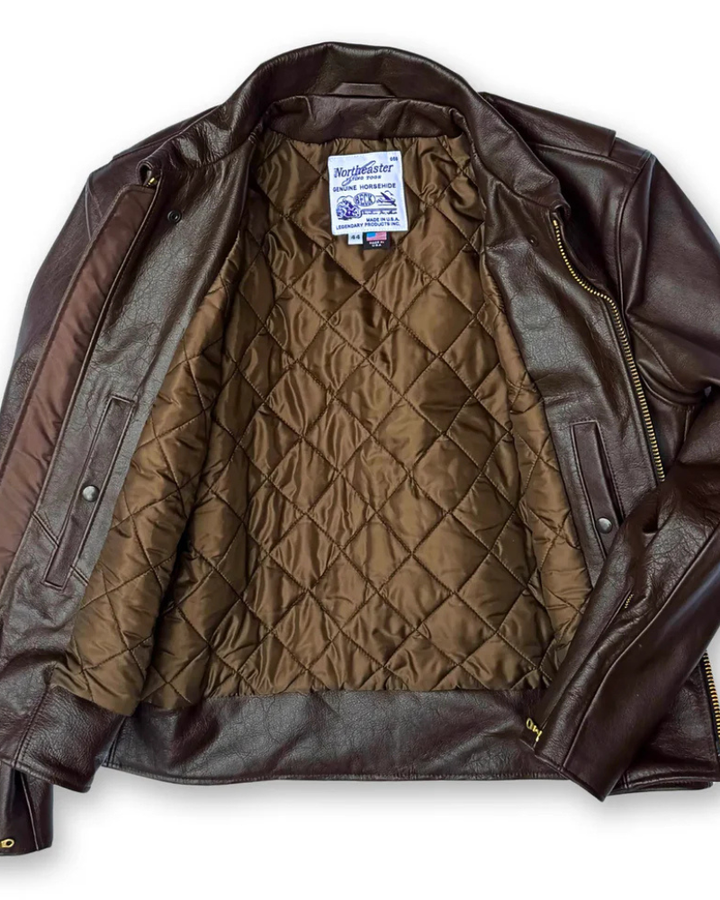
Linings change a jacket's season. The G-1 Antique Lambskin carries a polyfiber quilted lining with an embroidered and silk-screened pilot's escape map and a removable mouton shearling collar. The tanker jacket uses an olive wool-blend blanket lining. The CWU-55/P uses quilted poly-fill insulation under a flight-satin nylon shell that is not fire retardant. The B-3 needs no lining at all because the shearling is the insulation.
Step Six: Hardware and Finishing
Zippers, buckles and straps are where cheap jackets fail first. The B-3 uses a heavy-duty front zipper with an interior wind flap and a double-buckle throat latch. The Pearl Harbor reproduction uses heavy latigo leather belting straps and square antique-brass buckles engraved with the Cockpit logo. Knit cuffs and waistbands seal in warmth on the G-1 and CWU styles.
Leather vs Sheepskin vs Nylon: How Construction Changes the Jacket
Leather jackets such as the A-2 and G-1 are built around a single hide layer and rely on lining or layering for warmth. Sheepskin jackets are built with the wool on the inside, so the jacket is heavy but needs no extra insulation. Nylon jackets are lighter and cheaper, shed rain better and wear out faster at the shoulders and elbows when abraded. None of the three is armored riding gear, so match construction to how you ride.
What to Check Before You Buy a Flight Jacket
- Look at the seams and welting for even, tight stitching.
- Check the zipper pull and the throat latch hardware for weight and finish.
- Read the lining description so you know the season it fits.
- Confirm the country of origin on the product page.
- Try it in your riding position and reach for the bars.
Conclusion
A flight jacket is only as good as its pattern, hide, seams and hardware, and that is where a Made in USA build shows. Compare how these details differ across the G-1 leather flight jackets, then read the guide to identifying an authentic A-2 jacket to see the same construction details applied to the A-2.
Frequently Asked Questions
- How are military flight jackets made?
- Military flight jackets are cut from leather, sheepskin or flight-satin nylon using a pattern drawn to a military specification. Panels are sewn with reinforced seams, fitted with a mobility back such as the bi-swing, then finished with a lining, knit trim and heavy hardware like zippers, buckles and straps.
- What is a bi-swing back on a flight jacket?
- A bi-swing back is a pleated back panel that lets the shoulders move forward without pulling the jacket hem upward. It was designed so aircrew could reach controls freely. Cockpit USA uses it on its G-1, Modified Raider, tanker and CWU-style jackets for the same freedom of movement.
- What material is a B-3 bomber jacket made from?
- A B-3 bomber jacket is made from thick sheepskin with the shearling wool on the inside and a leather-finished exterior. The Cockpit USA B-3 uses supple sheepskin with a nappa-finished outside. The shearling provides the insulation, so the jacket needs no separate lining.
- Why does every sheepskin jacket look slightly different?
- Sheepskin is a natural material, so grain, shading and wool character vary from pelt to pelt. Cockpit USA notes that each B-3 varies slightly, and its Pearl Harbor reproduction uses hand-selected antiqued pelts that make every jacket unique. That variation is normal for real hide.
- Are military flight jackets safe for motorcycle riding?
- Flight jackets are popular for casual riding, but they are not sold as impact-rated or abrasion-rated riding armor, and no CE rating is claimed. Heavier leather resists abrasion better than nylon, yet riders who want certified protection should choose gear built for that purpose.
- What is the CWU-55/P flight jacket made of?
- The Cockpit USA CWU-55/P style uses a military-spec flight-satin nylon shell that is not fire retardant, with quilted poly-fill insulation inside. It adds a bi-swing back, rib-knit cuffs and waistband, and a sleeve utility pocket. It is a lighter, lower-cost alternative to leather and sheepskin.