

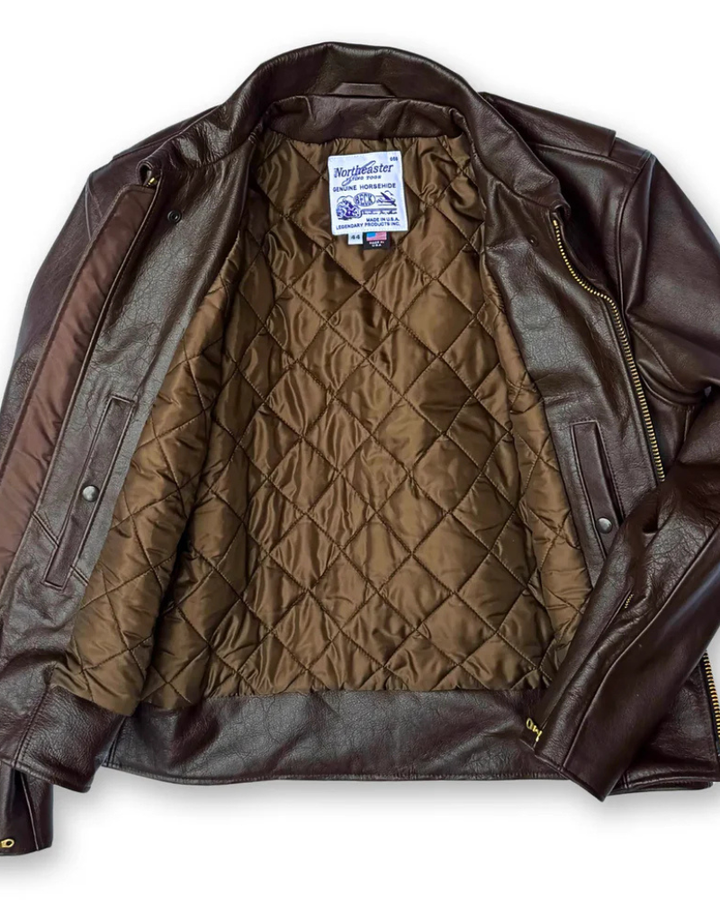


The D-pocket design — a curved, diagonally-angled chest pocket flap that closes more securely in a riding position than a horizontal pocket — is one of the most practical innovations in American motorcycle jacket history. The question of who made it first is also one of the more contested in vintage leather jacket collecting circles.
Here's what the evidence actually shows, and why the question matters for understanding BECK's place in American motorcycle jacket history.
What the D-Pocket Is and Why It Matters
A standard horizontal chest pocket on a leather jacket works fine when you're standing upright. When you're leaning forward in a riding position, gravity and the angle of your torso work against the pocket flap — it tends to gap open, and anything stored inside is at risk of falling out at speed. The D-pocket resolves this by angling the pocket opening to close naturally in a riding position.
It's a functional design improvement, not a decorative one. And because it's genuinely useful rather than just visually distinctive, multiple manufacturers arrived at similar solutions around the same era.
The Dating Problem
Establishing precise production dates for pre-war and early post-war American motorcycle jacket makers is difficult. Company records from this era are incomplete. Catalog dating is imprecise — the same catalog image was often used across multiple production years. Dating vintage jackets by construction details, hardware manufacturers' codes, and label typography is the method that serious collectors use, and it involves significant uncertainty ranges.
What's known with reasonable confidence: BECK was producing the 666 D-pocket cafe racer design by the late 1940s. Buco's J-24 and J-100 designs with D-pocket elements were appearing in the same general era. The exact sequence is disputed among collectors because the documentary evidence for both brands has gaps.
What BECK Collectors Say
Among the community of American vintage motorcycle jacket collectors, BECK's 666 design is generally credited as one of the earliest production D-pocket designs at commercial scale — and some collectors argue it predates the Buco designs that are often cited as the D-pocket standard. The argument rests on dated catalogs, surviving jacket hardware from known manufacturers, and the observation that BECK's production volume in the 1940s was substantial enough that the design would have been in wide circulation early.
The counterargument is that Buco's documentation is somewhat better preserved, making its timeline easier to verify. Absence of evidence for BECK's earlier production isn't evidence of absence.
Why It Matters Less Than the Jackets Themselves
The historical question of who made it first is genuinely interesting to collectors and researchers. But for riders, the more relevant question is: what does the D-pocket design do, why is it still the right design for a motorcycle jacket, and what does that tell you about the builders who used it?
BECK's use of the D-pocket is evidence that the brand was building jackets based on what riders actually needed, not what was easiest to manufacture or most visually distinctive. That philosophy is what distinguishes the best American motorcycle jacket heritage from the brands that were producing fashion products that happened to be worn on motorcycles.
The revival BECK 666 Distressed Horsehide Cafe Racer maintains the D-pocket design from the original because the original design worked. Read the full history of the BECK 666 jacket for the complete design lineage, and the BECK model comparison for how the 666 fits in the current revival lineup.