

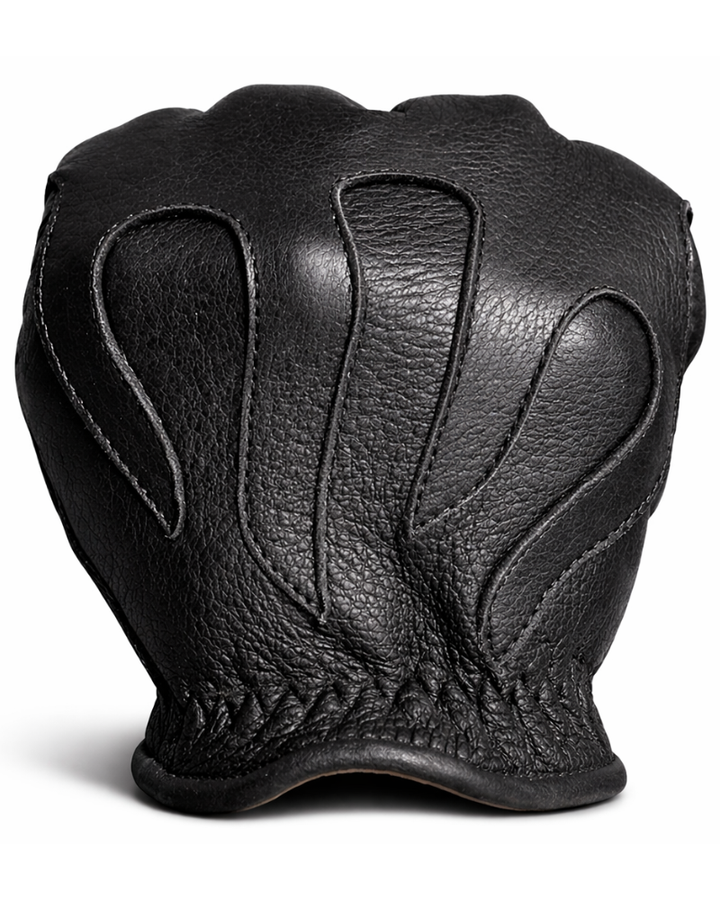


The best motorcycle gloves for commuting are full-grain leather gloves built for daily wear: goatskin if you want maximum durability, deerskin if you want comfort and grip feel, with touchscreen fingers if you navigate by phone. Legendary USA hand-cuts its commuter-friendly gloves from American deerskin and goatskin, so the leather molds to your hand instead of wearing out against it. This guide covers what daily miles actually demand from a glove, and above all how to get the fit right, because fit is what a commuter feels five days a week.
Looking for the short version? Our companion page, Best Motorcycle Gloves for Daily Commuting, is the straight shortlist with picks and prices. This article is the long-form explainer: materials, features, and the full sizing method.
What Makes a Commuting Glove Different
A commuting glove works harder than a weekend glove. It goes on and comes off ten times a week, soaks up sweat in August, catches rain in October, and grips the same bars every single day. That constant cycle is what kills cheap gloves: stitching loosens, linings pill, and thin leather goes slick at the palm.
Daily riders should look for four things: full-grain leather that stands up to repetition, outseam or well-finished seams that do not rub during long stop-and-go stretches, a snug fit that will not bunch on the grips, and features that match the ride itself, like ventilation for warm climates or a touchscreen index finger for navigation. Fashion matters less than repetition. If a glove annoys you on day one, it will infuriate you by day thirty.
Deerskin vs Goatskin for Daily Miles
This is the core commuter decision, and the tradeoff is honest on both sides.
Goatskin is the durability pick. Goatskin carries natural lanolin, which keeps the leather supple and resists drying, cracking, and abrasion under constant use. The Bad Billy black goatskin short-wrist gloves at $75.00 are built exactly for this kind of duty, and the tan Bad Billy version at $75.00 offers the same glove in a lighter color that absorbs less heat in the sun, though light leather shows dirt faster.
Deerskin is the comfort pick. It is softer out of the box, breaks in within 2 to 3 weeks of regular riding, and delivers better bar feel, which matters in traffic where you are constantly working the clutch and front brake. The tradeoff: deerskin is not as abrasion-resistant as goatskin and wears faster under hard daily use.
For a full comparison, read our deerskin vs goatskin breakdown.
Features That Earn Their Keep on a Commute
Touchscreen fingers. Navigation, gas pumps, parking garages, phone calls at a stop. The deerskin aramid-lined touchscreen gloves at $120.00 put a conductive thumb and index finger on a full-grain deerskin glove with an aramid lining, an abrasion-resistant fibre, so you never have to pull a glove off at a red light.
Ventilation. If your commute runs through summer, moving air is the difference between a glove you wear and a glove you leave home. The deerskin ventilated short-wrist gloves at $110.00 keep airflow moving across your hands in stop-and-go heat. Ventilated and perforated gloves are warm-weather tools, not winter gloves.
Fleece lining for cold months. Cold mornings are the commuter's tax. The fleece-lined deerskin short-wrist gloves at $115.00 handle fall and early-winter commutes. Fleece-lined gloves run snugger than unlined gloves, so check sizing.
Short-wrist cuffs. Most commuters ride in jackets or long sleeves, and a short-wrist glove goes on and off faster and stows in a pocket. Gauntlets seal out wind better on the highway but are slower to deal with ten times a day.
How do you measure your hand for motorcycle gloves?
Two measurements, one tape measure, two minutes. Do it on your dominant hand, because it is usually slightly larger, and size to that hand.
- Palm circumference. Open your hand flat and wrap a soft tape measure around the widest part of your palm, just below the knuckles, excluding the thumb. Pull it snug but do not compress the flesh. Read the measurement in inches. That number is your glove size in the American system: an 8.5 inch palm is roughly a size 8.5, which lands in most brands as a Medium.
- Hand length. Measure from the crease at the base of your palm to the tip of your middle finger. This is the number most riders skip, and it is the one that decides whether the fingertips fit. If your hand length is more than about half an inch longer than the typical length for your palm width, you have long fingers relative to your palm and you need to read the section below.
Then convert. As a general guide for our range: 7 to 7.5 inches is Small, 8 to 8.5 is Medium, 9 to 9.5 is Large, 10 to 10.5 is XL, 11 and up is 2XL. Some of our gloves run XS as well, which covers roughly 6 to 6.5 inches.
One critical rule: check the fit with your hand in a riding grip, wrapped around a bar or a broom handle, not laid flat on a table. A glove that fits a flat hand can bind badly the moment you close your fist, and that is exactly what your hand does for the entire commute. Our full motorcycle glove sizing guide walks through the measurement with more detail.
Are motorcycle glove sizes the same across brands?
No, and this is the single most common reason a glove order goes wrong. There is no enforced sizing standard for motorcycle gloves. A Large from a European sportbike brand, a Large from a Japanese textile brand and a Large from an American leather house can differ by a full size in palm width and by more than that in finger length.
Three specific things vary between makers:
- The base system. Some brands size by numeric palm circumference (8, 9, 10), some by letter (S, M, L), and the mapping between them is not consistent. European brands frequently run a half size to a full size smaller than American brands at the same letter.
- Finger length for a given palm width. Race-oriented brands cut for a pre-curved, shorter finger. Traditional American cruiser gloves cut a straighter, longer finger. Same palm size, noticeably different glove.
- How the hide behaves. A deerskin Large will end up larger after break-in than a cowhide Large, because deerskin stretches considerably more. Two gloves that measure identically in the box will not measure identically in a month.
The practical rule: never order by the letter size you wore in another brand. Measure your palm and use that number against the specific brand's own chart every time. If you are between sizes in deerskin, take the smaller one, because deerskin stretches. If you are between sizes in goatskin, take the larger one, because goatskin stretches much less.
What motorcycle gloves fit wide hands?
Wide hands are a palm-versus-finger mismatch: your palm circumference puts you in an XL, but XL fingers are then too long and you get empty leather at the fingertips that bunches under the levers.
Three things actually help, in order of how much difference they make:
Choose deerskin over goatskin or cowhide. American whitetail deerskin has a loose, open fiber structure, which is why it stretches so readily across the palm while the finger length stays put. For a wide hand this is exactly the right behaviour: buy for your finger length and let the deerskin give you the palm width over the first two or three weeks. Goatskin is tighter-grained and will not accommodate a wide palm the same way.
Choose an outseam glove. On an outseam glove the seam allowances are stitched to the outside of the glove rather than folded inside, which returns real interior volume across the knuckles and between the fingers. The ILL DOZER outseam deerskin gloves at $135.00 are built this way, and they are the pair we point wide-handed riders at first. They run XS through 2XL. The ILLEST DOZER white outseam version at $135.00 is the same construction in white.
Choose a short-wrist cut over a gauntlet. A gauntlet cuff has to clear the widest part of your hand to go on at all. On a wide hand that often means sizing the whole glove up just to get it past the knuckles. A short-wrist glove has an open cuff and does not force that compromise.
What are the best motorcycle gloves for people with long fingers?
Long fingers are the opposite mismatch: your palm is a Medium but your fingers want a Large, so a correctly sized glove jams your fingertips into the ends and a correctly fingered glove swims on your palm. Jammed fingertips are not a cosmetic problem. They go numb on a long ride and they cost you feel on the levers.
What works:
Size up on the palm and let deerskin do the rest. Take the size that gives your fingers room, then rely on deerskin stretch and break-in to bring the palm in around your hand. This works in deerskin specifically and it does not work in cowhide, which will simply stay loose.
Look for a straight-cut, traditional finger. Our classic American patterns are cut with a longer, straighter finger than race-derived gloves, which are pre-curved and deliberately short. The Classic Short Wrist Touchscreen Deerskin Gloves at $105.00 and the Churchill Short Wrist Deerskin Gloves at $110.00 both use the traditional longer cut.
Consider an outseam glove again. Outseam construction adds usable length as well as width, because the seam bulk is not eating into the inside of the fingertip. The ILL DOZER is the pick here too.
What to avoid: fleece-lined gloves, if your fingers are long. The lining takes up length as well as width and it is the fastest way to end up with pressure on the fingertips. If you need a cold-weather glove and you have long fingers, size up rather than buying your normal size lined.
Should motorcycle gloves fit tight or loose when new?
Snug, verging on slightly tight, and never loose. A new leather glove should feel close through the palm and fingers with no loose leather bunching anywhere. You should be able to close your hand into a full riding grip without the glove fighting you, but you should be aware that you are wearing it.
The reason is simple and one-directional: leather stretches, it does not shrink back. A glove that is comfortably roomy in the shop is a glove that slides around your palm in a month. Loose leather in the palm folds into ridges under your grip, and those ridges become hot spots and blisters on a long ride. It also costs you control, because a glove that rotates on your hand puts your fingers somewhere slightly different from where you left them every time you reach for the brake.
What is genuinely too tight, as opposed to correctly snug: your fingertips press hard into the ends of the fingers when you make a fist, the glove restricts your knuckles from closing fully, or you feel any pinching or tingling within a few minutes of wearing it. Those do not break in. Everything else does.
Should you size up in leather motorcycle gloves?
Usually no. Deerskin and goatskin both give with wear, and sizing up front-loads a fit problem you cannot undo. There are three exceptions worth knowing:
- You genuinely have long fingers relative to your palm, as covered above. Size up and let the palm come in.
- You plan to wear a liner glove underneath in winter. Size up for the liner, and accept that the glove will feel sloppy without it. A better answer for most riders is to buy a correctly fitting glove and add a properly insulated pair for cold days.
- You are buying fleece-lined. Our fleece-lined deerskin gloves run noticeably snugger than the unlined version because the lining takes up interior volume. If you are between sizes here, take the larger one.
How snug should new motorcycle gloves feel on the hand?
A useful test: put the glove on, wrap your hand around a handlebar or a broom handle, and try to pinch a fold of leather across the middle of your palm with your other hand. If you can grab a fold, the glove is too big. If the leather is drum-tight against your palm with nothing to pinch, that is correct. If you cannot close your hand around the bar without effort, it is too small.
How do leather motorcycle gloves fit differently after break-in?
Break-in is real and it is mostly width, not length. Over two to three weeks of regular riding, a deerskin glove will gain meaningful room across the palm and across the knuckles, because that is where the leather flexes most. Finger length changes very little. This is why the sizing advice above weights finger length so heavily: it is the dimension you cannot fix later.
The glove also changes shape, not just size. The panels take a set in the curled position your hand actually holds, so a broken-in glove is slightly pre-curved and easier to close. The palm develops a soft patina where it contacts the grip. Deerskin does this within a few weeks. Goatskin takes longer, perhaps six to eight weeks of steady use, but holds the resulting shape better over years.
Ride in them to break them in. Flex them at your desk between rides. Do not soak them in water and do not put them near a heater, both of which dry the hide out and can shrink it permanently. Our guide to breaking in leather motorcycle gloves covers the process step by step.
Top Picks, Shop Direct
The companion page ranks commuter gloves by riding conditions. This table does something different: it picks for fit. Each of these four is here because it solves a specific sizing problem a commuter runs into, from hard-to-fit hands to the size change that comes with a lining. If you have measured your palm and your hand length using the method above, this table tells you which pair to start with.
| Product | Which fit problem it solves | From |
|---|---|---|
| ILL DOZER Outseam Gloves | Wide hands and long fingers. Outseam construction puts the seam allowances on the outside, which returns real interior room across the knuckles and in the fingertips. It also carries the widest size run we offer, XS through 2XL. Rated 4.90 from 99 reviews. | $140.00 |
| Classic Short Wrist Touchscreen Deerskin Gloves | The standard-hand baseline, and the safest pair to buy snug. Traditional straight-cut finger rather than a short race curve, and deerskin that will give you palm width over two to three weeks. Rated 4.90 from 106 reviews. | $120.00 |
| Bad Billy Black Goatskin Gloves | For riders who do not want their gloves to change shape. Goatskin stretches far less than deerskin, so what you buy is roughly what you keep. If you are between sizes here, take the larger one. Our highest rated glove at 4.93 from 129 reviews. | $65.00 |
| Fleece-Lined Deerskin Gloves | The cold-morning pair, and the one where sizing genuinely changes. The fleece takes up interior volume in both width and length, so this runs a half size snug compared with the unlined deerskin. Size up if you are between sizes or have long fingers. Rated 4.90 from 104 reviews. | $85.00 |
Every pair above is cut and sewn in the USA from American hide. If you are still unsure between two sizes after measuring, the deerskin gloves reward taking the smaller one and the goatskin rewards taking the larger. Prices shown are current at time of writing. Orders over $150 ship free.
The Two-Glove Commuter Rotation
The most practical commuter setup is not one glove, it is two. A ventilated or standard deerskin glove for the warm half of the year and a fleece-lined glove for the cold half. Rotating pairs also lets each glove dry out fully between wears, which extends the life of both. Sweat left in leather every day is what ages a glove fastest. Browse the full lineup of Made in USA motorcycle gloves to build your rotation.
A Note on What Leather Gloves Do
Full-grain deerskin and goatskin give you genuine abrasion resistance, and that is the honest reason to wear leather on a commute instead of textile or mesh. They are not impact protection and we do not describe them that way. If you want certified impact armor, that is a different part of our catalog: the Bohn Airtex armored shirt, the Unik armored flannels, and the armor-ready jackets that take CE inserts.
Frequently Asked Questions
- How do you measure your hand for motorcycle gloves?
- Take two measurements on your dominant hand. First, palm circumference: wrap a soft tape around the widest part of your palm just below the knuckles, excluding the thumb, pulled snug. That figure in inches is your glove size. Second, hand length: measure from the crease at the base of the palm to the tip of the middle finger, which tells you whether the fingers will fit. As a rough guide, 7 to 7.5 inches is Small, 8 to 8.5 Medium, 9 to 9.5 Large, 10 to 10.5 XL, 11 and up 2XL. Always check the fit with your hand closed in a riding grip, not laid flat.
- Are motorcycle glove sizes the same across brands?
- No. There is no enforced sizing standard for motorcycle gloves, and a Large from one maker can differ by a full size from a Large at another. Three things vary: the base system, since numeric and letter sizing do not map consistently and European brands often run smaller; finger length for a given palm width, since race-cut gloves use a short pre-curved finger while traditional American gloves use a longer straight one; and how the hide behaves, since deerskin stretches far more than goatskin or cowhide. Always measure your palm and use the specific brand's own chart rather than ordering by the letter you wore elsewhere.
- What motorcycle gloves fit wide hands?
- Look for deerskin, outseam construction, and a short-wrist cut. Deerskin has an open fiber structure that stretches readily across the palm while finger length stays put, which is exactly what a wide hand needs. Outseam gloves stitch the seam allowances to the outside, returning real interior volume across the knuckles. The Legendary ILL DOZER outseam deerskin gloves at $140.00 combine both and run XS through 2XL, rated 4.90 from 99 reviews. Avoid gauntlets, whose cuff must clear the widest part of the hand and often forces you to size the whole glove up.
- What are the best motorcycle gloves for people with long fingers?
- Size up on the palm and let deerskin stretch back in around your hand, which works in deerskin but not in cowhide. Choose a traditional straight-cut finger rather than a race-derived pre-curved one: the Legendary Classic Short Wrist Touchscreen Deerskin Gloves and the Churchill Short Wrist Deerskin Gloves, both $120.00, use the longer cut. Outseam gloves like the ILL DOZER add usable fingertip length because seam bulk is not eating into the inside. Avoid fleece-lined gloves in your normal size, since the lining takes up length as well as width.
- Should motorcycle gloves fit tight or loose when new?
- Snug, verging on slightly tight, and never loose. Leather stretches and does not shrink back, so a glove that feels roomy in the shop will slide on your palm within a month, and loose leather folds into ridges that become hot spots on a long ride. Correctly snug means close through the palm and fingers with no leather to pinch, while still allowing a full riding grip. Genuinely too tight means fingertips pressing hard into the ends, knuckles unable to close, or pinching within a few minutes. Those do not break in.
- Should you size up in leather motorcycle gloves?
- Usually no, because deerskin and goatskin both give with wear and sizing up creates a fit problem you cannot undo. Three exceptions: if you have long fingers relative to your palm, size up and let the palm come in; if you plan to wear a liner glove underneath in winter, size up for the liner; and if you are buying fleece-lined gloves, which run snugger than unlined because the lining takes interior volume, take the larger size when between two.
- How do leather motorcycle gloves fit differently after break-in?
- Break-in is mostly width, not length. Over two to three weeks of regular riding a deerskin glove gains real room across the palm and knuckles where the leather flexes, while finger length barely changes. That is why finger length matters most when sizing, since it is the dimension you cannot fix later. The glove also takes a set in the curled position your hand holds, so it becomes slightly pre-curved and easier to close. Goatskin takes six to eight weeks but holds its shape better afterwards.
- What are the best motorcycle gloves for commuting?
- The best commuting gloves are leather gloves you can wear every day without thinking about them: durable enough for daily miles, comfortable enough for an hour in traffic, and practical enough to check your phone at a stop. For most commuters that means a short-wrist goatskin glove like the Legendary Bad Billy at $65.00 for durability, or a deerskin touchscreen glove at $120.00 if you use navigation. Buy for your actual commute, not for a ride you take twice a year.
- Are deerskin or goatskin gloves better for daily riding?
- Goatskin is the more durable choice for daily use. Its natural lanolin content helps it resist drying and abrasion, so it holds up to constant wear, weather, and handlebar friction. Deerskin is softer, breaks in faster, and gives better grip feel, but it wears faster under hard daily use. Commuters who prioritize longevity lean goatskin; commuters who prioritize comfort and feel lean deerskin.
- Can I wear the same motorcycle gloves year-round for commuting?
- In most of the country, no single glove covers July heat and January cold well. A practical commuter setup is two pairs: a ventilated or perforated deerskin glove for warm months and a fleece-lined deerskin glove for cold mornings. Running one glove year-round means sweating it out in summer, which breaks leather down faster, and riding underprotected from cold in winter.
The Bottom Line
Commuting is the hardest job a motorcycle glove does, because it never gets a week off. Measure your palm and your hand length before you order, buy snug rather than comfortable, pick goatskin if durability is the priority and deerskin if comfort and feel win, add touchscreen fingers if your ride includes stops and navigation, and run a two-glove rotation so each pair dries out between shifts. Every glove Legendary USA makes is cut and sewn in the USA from full-grain American leather, built for the rider who is on the bike tomorrow morning either way. For the shortlist with current prices, see Best Motorcycle Gloves for Daily Commuting.